
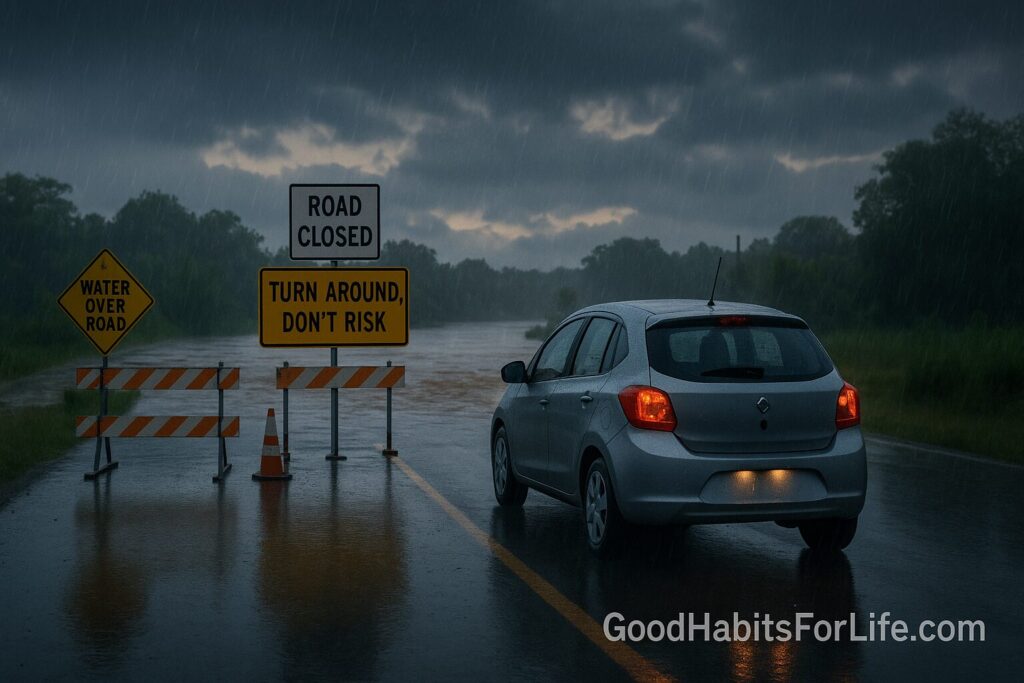
Flash Flood Awareness: Turn Around, Dont Risk
Flash Flood Awareness: Turn Around, Don’t Risk
Table of Contents
🧭 What & Why: Flash Flood Risk in Plain Language
Flash floods are sudden, dangerous surges of water caused by intense rain, dam/levee failures, or rapid runoff over saturated or hard surfaces. Streets, underpasses, low-water crossings, and river fords can fill in minutes—often before you realize it’s happening.
Why drivers are at high risk
-
Depth deception: Murky water hides road edges, sinkholes, and missing pavement.
-
Current + buoyancy: As little as ~15 cm (≈6 in) of fast water can knock you off your feet; around ~30 cm (≈12 in) can move small cars; deeper water can sweep away SUVs. These are approximate thresholds—the safest choice is don’t enter.
-
Vehicle failure: Water can stall engines, disable brakes, and trap doors/windows.
-
Night hazards: Headlights flatten reflections; you can’t judge depth or current.
Non-negotiable rule: If water covers the road—or barricades are present—Turn Around, Don’t Risk.
✅ Quick Start: Do-This-Today Checklist
-
Enable alerts on your phone. Turn on government severe-weather alerts and flood warnings.
-
Add a fast pre-drive check: Open a radar/precip app; glance at river/stream gauges if you live near waterways.
-
Know your 2 safe detours for each regular route—especially if they include underpasses, dips, or low-water crossings.
-
Pack a minimal flood kit in the glove box: seat-belt cutter/glass-breaker, small torch, whistle, microfiber cloth, power bank.
-
Practice the STOP test before risky segments: Stop, Think, Observe (water, debris, barricades), Plan (alternate route).
-
Night driving rule: If you can’t see the road surface end-to-end across water, do not proceed.
-
Park higher. At home/work, choose parking on higher ground away from drains/culverts.
🛠️ 30-60-90 Habit Plan for Safer Driving
Days 1–30 (Foundations)
-
Map your area: Mark low spots (underpasses, causeways, river fords, coastal roads).
-
Save your Top-3 Weather Sources (national meteorological service, radar app, local river gauge page).
-
Turn on wireless emergency alerts.
-
Build a one-page detour sheet for your common routes (print + phone note).
-
Run a 15-minute family drill: What everyone does if a route is flooded.
Days 31–60 (Systems)
-
Add calendar reminders before seasonal heavy-rain periods to revise detours.
-
Create a Shared Location rule with family during amber/red rain warnings.
-
Stock car flood kit and set a quarterly check reminder.
-
Learn window exit: practice finding the glass-breaker and belt cutter (engine off, parked).
Days 61–90 (Mastery & Review)
-
Spot-audit one new area weekly (commute, school run, sports). Note hazards.
-
Add two alternate parking options on higher ground.
-
Review STOP-TADD: STOP test + Turn Around, Don’t Risk as your standing policy.
-
Close the loop: Review one near-miss or news story as a teachable moment.
🧠 Techniques & Frameworks that Prevent Bad Calls
1) STOP Test (5–20 seconds)
-
S – Stop: Pull up safely. Don’t crowd the water line.
-
T – Think: Your priority is not getting stuck or swept.
-
O – Observe: Barricades? Other cars turning? Debris, fast flow, manhole covers displaced, powerlines, oil sheen?
-
P – Plan: Turn around, pick pre-planned detour, text ETA update.
2) The 3R Risk Lens
-
Rain: Intensity now + upstream rain in last 1–3 hours.
-
Runoff: Urban (concrete) or saturated soils = faster rises.
-
Roadway: Dips/underpasses, creek crossings, bridges near blockages.
3) Depth-Speed Red Flags (rules of thumb—never test with your car)
-
Any flowing water across the road = no go.
-
Standing water you can’t gauge = no go.
-
Water touching hubcaps or higher = extreme danger.
4) Low-Water Crossing Protocol
-
If signs say ROAD CLOSED or HIGH WATER → Comply.
-
No pedestrians around flooded crossings; currents can undercut asphalt.
5) Wet-Season Route Strategy
-
Maintain A-B-C routes for school/work. Avoid underpasses after cloudbursts.
-
Prefer roads with good drainage and higher elevation.
👥 Audience Variations: Tips by Driver Type
Students & New Drivers
-
Keep a laminated STOP-TADD card on the visor.
-
Practice calling a parent/guardian to report a closed road and calmly choose a detour.
Parents with Kids
-
Pre-load comfort items (water, snack, small blanket) in case of longer detours.
-
Talk through the rule so kids know not to pressure you to “just go through.”
Professionals & Delivery Drivers
-
Company policy should mandate detour autonomy: no delivery is worth a flooded dip.
-
Dispatch script: “High water on [road]; I’m rerouting via [detour]; ETA +12 min.”
Seniors
-
Prefer daylight travel around storms; coordinate rides after warnings.
-
Keep phone emergency contact and medical info up to date.
Tourists/Road-trippers
-
Ask locals about seasonal fords and monsoon cloudbursts.
-
Don’t rely on sat-nav alone; verify with radar and local advisories.
⚠️ Mistakes & Myths to Avoid
-
“It’s only a few centimetres.” Depth + current + unseen road damage = trap.
-
Following a tall vehicle through. Their clearance/weight ≠ your safety.
-
Driving around barricades. Barricades mark known hazards—violating them is illegal in many places.
-
Assuming the same route is safe every storm. Drainage changes with debris and soil saturation.
-
Stopping on bridges in fast-rising water. If water threatens the deck or approaches, leave promptly for high ground.
🗣️ Real-Life Examples & Scripts
Phone update to family/manager
“Heavy rain here and the underpass is flooded. I’m taking Route C via Ridge Road. New ETA 18 minutes.”
Passenger briefing
“We never drive through water. I’m turning around and taking the higher route.”
Witnessing a risky attempt
“That road’s closed for flooding—please turn around. It rises fast.”
If water suddenly rises around your parked car
-
Unbuckle; if doors jam, break side window (not windshield).
-
Exit uphill side; move to higher ground immediately.
-
Call emergency services once safe.
🧰 Tools, Apps & Resources
-
National weather service app/site: Official warnings; set push alerts.
-
Radar app: See storm cells and now-casting.
-
River/stream gauges: Track local levels before/after storms.
-
Navigation with hazard reports: Community-flagged closures help—but verify visually.
-
Wireless Emergency Alerts / Cell Broadcast: Free, location-based severe alerts.
Pros: authoritative, fast, location-aware. Cons: may be patchy in remote zones; keep multiple sources.
📌 Key Takeaways
-
If water covers the road—or a barricade is up—turn around.
-
Build A-B-C routes and check weather before you drive.
-
Use the STOP test and stick to the Turn Around, Don’t Risk rule.
-
Keep a minimal flood kit and practice emergency egress.
-
Share your plan with family/teammates to remove the pressure to “push through.”
❓FAQs
1) How shallow is “too shallow” to drive?
Any water across the road is too shallow to risk—depth and current are deceptive. If you can’t confirm a dry, intact surface, turn around.
2) What if other cars are making it through?
They may be heavier, higher, or just lucky. Conditions change minute to minute. Your safest choice is to not enter.
3) Is it safer to drive fast through water?
No. Speed creates a bow wave that can flood your engine and push you off line. Don’t enter at all.
4) What should I do if I stall in water?
Abandon the vehicle if water is rising or moving; get to higher ground. Call emergency services once safe.
5) Are electric cars more dangerous in floods?
EVs are designed with sealed high-voltage systems, but floodwater still disables vehicles and creates hazards. The rule doesn’t change: don’t drive into water.
6) How do I prepare for flash-flood season?
Enable alerts, map detours, avoid low-lying routes, and store a small flood kit. Rehearse decisions with family.
7) Does 4×4 or high clearance make it safe?
No. Strong current can lift and move heavy vehicles; unseen washouts can drop any axle.
8) Is it okay to walk through a flooded street?
Avoid it. Even ankle-deep moving water can knock you down and hide hazards like open manholes or debris.
9) Can I rely on navigation apps to reroute?
Use them as one input, but always follow official closures and your own observation. If unsure, choose higher ground.
📚 References
-
National Weather Service — Flood Safety & Turn Around, Don’t Drown®: https://www.weather.gov/safety/flood-turn-around-dont-drown
-
National Weather Service — Flood Safety Overview: https://www.weather.gov/safety/flood
-
Ready.gov — Floods: https://www.ready.gov/floods
-
CDC — Floods (Health & Safety): https://www.cdc.gov/disasters/floods/index.html
-
USGS Water Science School — Floods & Flash Floods: https://www.usgs.gov/special-topics/water-science-school/science/floods-and-flash-floods
-
FEMA — Flood Hazard & Preparedness: https://www.fema.gov/emergency-managers/risk-management/floods
-
FCC — Wireless Emergency Alerts (WEA): https://www.fcc.gov/wireless-emergency-alerts
-
Google Flood Hub (riverine flood forecasting in many regions): https://floodhub.google/
-
Met Office (UK) — Flood Safety Advice: https://www.metoffice.gov.uk/weather/warnings-and-advice/seasonal-advice/flooding
-
AAA — Wet-Weather & Flood Driving Tips: https://exchange.aaa.com/safety/driving-advice/wet-weather-driving-tips/