
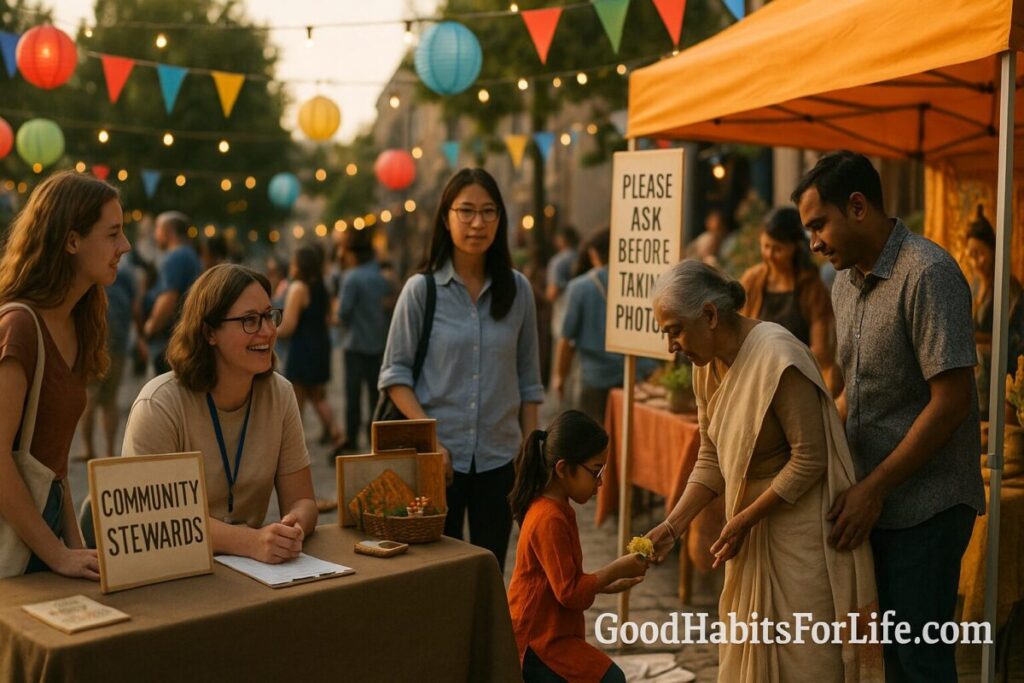
Festivals & Traditions: Join with Respect
Festivals & Traditions: Join with Respect
Table of Contents
🧭 What & Why
Festivals and traditions are “living heritage.” They include practices, expressions, rituals, skills, and cultural spaces that communities recognize as part of who they are. Joining respectfully means recognizing that communities—not visitors—define what is appropriate. ich.unesco.org+1
Community leadership is the compass. Ethical participation centers the people who create and carry the tradition; they should have the widest possible role in guiding, managing, and inviting participation. When you’re unsure, ask a local steward or organizer. ich.unesco.org
Appreciation vs. appropriation. Appreciation supports cultural expression and artisans; appropriation uses sacred symbols or regalia out of context, often without permission. For example, dressing up as a “Native American” for fun or fashion is inappropriate. National Museum of the American Indianlearninglab.si.edu
Consent is non-negotiable. Many traditions—especially Indigenous ones—emphasize free, prior, and informed consent for activities that affect the community (including documentation). Apply the same mindset to personal interactions and photography. ich.unesco.orgOHCHR
Religious and cultural literacy helps you belong. Learning what a practice means, how it changes over time, and how it varies internally (not all members do the same thing) helps you avoid stereotypes and engage with humility. rpl.hds.harvard.edu
✅ Quick Start (Do This Today)
-
Pick one event you can attend in the next month (local cultural festival, temple open day, community parade).
-
Read the basics (15 minutes):
-
Meaning and history of the festival.
-
Expected dress, entry rules, food customs, and times for quiet/sacred moments.
-
Who to contact for visitor guidance (cultural center, temple office, organizers).
-
-
Ask 3 respectful questions in advance (email/DM/desk):
-
“Is this event open to visitors?”
-
“Are there parts for observers only vs. participants?”
-
“Any dress, food, or photo rules I should know?”
-
-
Plan your role: Observer, helper (volunteer), or participant (if explicitly invited).
-
Pack a “respect kit”: modest clothing layer, scarf, small gift/donation, water, tissues, and a notebook.
-
On the day: Arrive early, watch first, follow the lead of hosts, and ask permission before photos—especially of people and sacred objects.
-
After: Thank your hosts, share verified info (credit the community), and donate/buy from local artisans.
🗺️ Habit Plan: 30–60–90 Days to Confident, Respectful Participation
Days 1–30 (Foundations)
-
Weekly micro-learn: 30 minutes on the festival’s history and meaning (library site, cultural center page).
-
Dress rehearsal: Assemble modest, context-appropriate clothing and remove potentially disrespectful items (e.g., shoes/headwear where required).
-
Photo policy checklist: Decide in advance: “Ask first,” “no children close-ups without guardian consent,” “no photos during sacred rites,” and “share with credit.” NSPCC Learning
-
Reach out: Message organizers to confirm visitor guidelines.
Days 31–60 (Practice & Feedback)
-
Attend 1–2 events (even small ones).
-
Volunteer 1 shift if appropriate—support set-up/cleanup or handouts.
-
Debrief: What did you learn? Note moments you almost made a misstep and how locals guided you.
-
Deepen literacy: Explore how the tradition varies by region/family; avoid “one story” assumptions. rpl.hds.harvard.edu
Days 61–90 (Confidence & Contribution)
-
Request a mentor/guide (if offered) for a deeper ceremony or role.
-
Give back: Donate to the cultural association, buy from artisans, or contribute skills (design, photography within consent, translation).
-
Share responsibly: Post photos only where consent is clear; caption with context and credits. If children appear, confirm written guardian consent. NSPCC Learning
🛠️ Techniques & Frameworks
1) Intercultural competence (Deardorff’s model).
Build attitudes (respect, openness), knowledge (self/other awareness), and skills (listening, observing) to communicate appropriately and effectively across cultures; treat competence as ongoing practice, not a checkbox. NAFSA
2) Consent layers for participation & images.
-
Context consent: Is this part of the festival open to outsiders?
-
Relational consent: Does the specific person/group invite you?
-
Image consent: Ask before photographing; get guardian consent for minors; avoid sacred/private moments. UNC Global AffairsNSPCC Learning
3) Appreciation in action.
Buy or rent appropriate clothing from local artisans (when encouraged), learn pronunciation of key terms, attribute songs/dances properly, and avoid sacred regalia unless explicitly invited to wear it. National Museum of the American Indian
4) “Observe → Ask → Act” loop.
-
Observe: Watch the flow, where shoes are removed, who leads, when people bow/offer.
-
Ask: Quietly confirm with a host, “May I…?”
-
Act: Participate as guided; step back if unsure.
5) Religious literacy triad.
Remember: traditions are internally diverse, change over time, and are embedded in everyday life—don’t reduce them to a single stereotype or “spectacle.” rpl.hds.harvard.edu
👥 Audience Variations
-
Students/Teens: Go with a school club or community liaison; prepare two genuine questions for hosts.
-
Parents with Kids: Brief kids on quiet times and “ask-before-touching.” Keep cameras away during blessings; never post children’s faces without guardian consent. NSPCC Learning
-
Professionals/Teams: If attending as a company, coordinate with the community to avoid “brand takeover.” Consider sponsorships that fund cultural education rather than logo placement.
-
Seniors: Ask about seating, shade, and quieter vantage points; hosts can often accommodate elders warmly.
⚠️ Mistakes & Myths to Avoid
-
Myth: “It’s public, so anything goes.” Many public events include sacred elements; follow host rules and signage.
-
Mistake: Treating regalia as costume. Some garments and symbols are reserved; do not wear them without explicit invitation. National Museum of the American Indian
-
Mistake: Photographing children or sacred rites without consent. When in doubt, don’t shoot. Get guardian permission for minors and respect no-photo zones. NSPCC Learning
-
Myth: “All members do it the same way.” Traditions are internally diverse; avoid sweeping claims. rpl.hds.harvard.edu
-
Mistake: Posting decontextualized clips. Add captions, context, and credits; ask if sharing is appropriate.
💬 Real-Life Examples & Scripts
At a temple/ceremony entrance
-
“Hi, I’m visiting. Is there a place for observers? Anything I should know before I enter?”
-
“Would it be respectful to sit/stand here?”
Before taking a photo
-
“May I take a photo of this moment?”
-
“Would you like me to share it with you? I’ll credit your group.”
-
With children present: “Is a parent/guardian here who can confirm permission?” NSPCC Learning
On dress and symbols
-
“Is this scarf appropriate for today, or should I choose something else?”
-
“I’ve seen this pattern in sacred contexts—should visitors refrain from wearing it?” National Museum of the American Indian
Online sharing
-
“I attended X Festival hosted by Y Community. Posting with permission; more info here [community site]. Thank you for welcoming visitors.”
🧰 Tools, Apps & Resources
-
Organizer pages & cultural centers: Primary source for visitor rules and schedules.
-
UNESCO Intangible Cultural Heritage portal: Learn how living heritage is defined and safeguarded. (Background reading) ich.unesco.org
-
Harvard Religion & Public Life (Religious Literacy): Short primers on diversity within traditions. rpl.hds.harvard.edu
-
Consent/Photo policies: Check local guidance (schools, community orgs) for child-image rules; model your approach on them. NSPCC Learning
-
Language tools: Google Translate (download offline), pronunciation guides from community websites.
📌 Key Takeaways
-
Communities define the boundaries—follow their lead. ich.unesco.org
-
Learn the meaning, not just the schedule; literacy reduces missteps. rpl.hds.harvard.edu
-
Consent applies to presence, roles, and images (especially minors). NSPCC Learning
-
Appreciation supports people and context; appropriation removes them. National Museum of the American Indian
-
Respect is a habit: prepare, observe, ask, act, and reflect.
❓ FAQs
1) How do I know if a festival is open to outsiders?
Check the organizer’s page, cultural center, or local government listings. If unclear, message a host and ask if visitors may observe or participate in specific parts.
2) What should I wear?
Default to modest, clean clothing that covers shoulders and knees unless told otherwise; bring a scarf or layer for head/shoulder covering where required.
3) Can I take photos or video?
Ask first. Avoid photography during sacred rites, and never post identifiable photos of children without guardian consent. Some festivals mark no-photo zones—respect them. NSPCC Learning
4) What’s the difference between appreciation and appropriation?
Appreciation supports and learns with a community; appropriation uses sacred symbols/regalia out of context or for personal gain. When unsure, ask a host or refrain. National Museum of the American Indian
5) Is it okay to join dances or rituals?
Only if explicitly invited and you understand what participation signifies. Observing is often the respectful default.
6) How do I credit culture-bearers when sharing online?
Tag the organizing group, name the tradition (with correct spelling), and include a line such as “shared with permission” when applicable.
7) I made a mistake—now what?
Apologize briefly, correct it (e.g., delete a photo), and ask how to proceed. Most hosts value sincere learning.
8) Can companies bring teams to festivals?
Yes—coordinate with organizers to avoid disruption; consider sponsoring educational materials or logistics rather than branding the event.
📚 References
-
UNESCO. Text of the Convention for the Safeguarding of the Intangible Cultural Heritage. ich.unesco.org
-
UNESCO. What is Intangible Cultural Heritage? ich.unesco.org
-
UNESCO. Involvement of communities, groups and individuals. ich.unesco.org
-
UNESCO. Ethical principles for safeguarding intangible cultural heritage (background note). ich.unesco.org
-
OHCHR/United Nations. Consultation and Free, Prior and Informed Consent (FPIC). OHCHR
-
Harvard Religion & Public Life. What is Religious Literacy? rpl.hds.harvard.edu
-
Deardorff DK (NAFSA). Intercultural Competence Framework/Model (overview/PDF). NAFSA
-
Smithsonian NMAI (Native Knowledge 360°). Cultures and Clothing (why “dressing up” is not appropriate). National Museum of the American Indian
-
NSPCC. Photographing and filming children: consent and safeguarding guidance. NSPCC Learning
-
UNC Global Affairs. Ethical global photo guidelines (consent before taking photos). UNC Global Affairs