
Family Friendship Rituals: High/Low/Thanks
Family Friendship Rituals: High/Low/Thanks
Table of Contents
🧭 What & Why
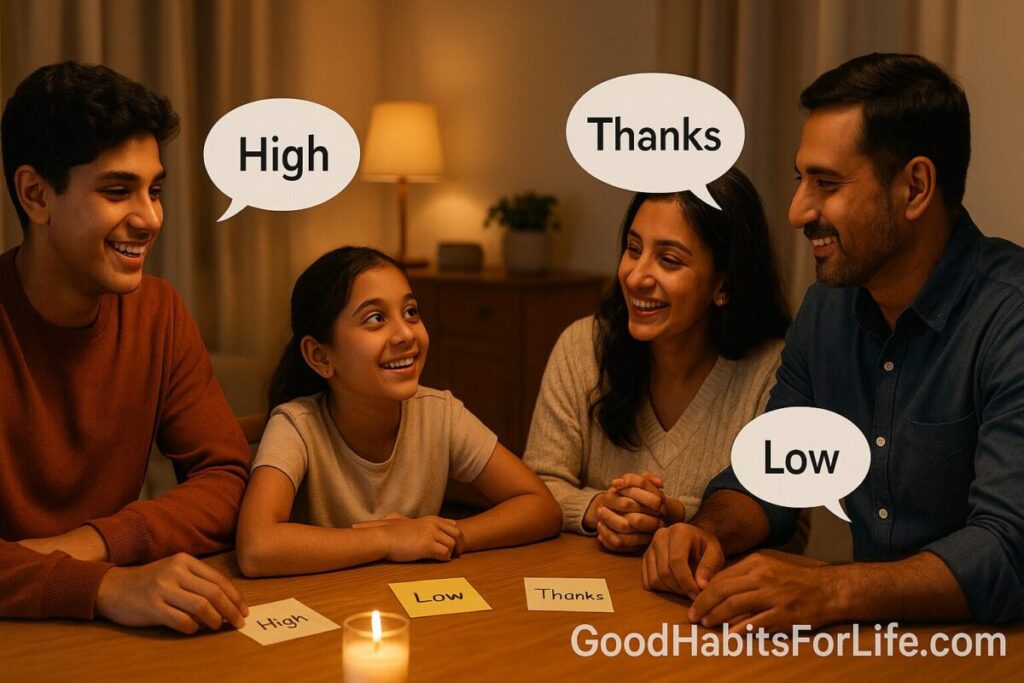
What it is. “High/Low/Thanks” is a short, structured daily check-in where each person shares:
-
a High (best moment),
-
a Low (hard moment), and
-
a Thanks (gratitude or appreciation).
It’s a low-pressure ritual that fits at dinner, a living-room circle, or bedtime.
Why it works. Decades of research link family routines and rituals with stability, stronger relationships, and child adjustment—especially during stress or transitions. Regular shared routines act as “organizers” of family life. APA+1
Consistent family meals and conversation are associated with better mental health and lower risks of depression, disordered eating, and substance use in youth—likely via connection, monitoring, and shared problem-solving. HealthyChildren.orgPubMed Central
Feeling connected to family is a protective factor for adolescent well-being and lower suicide risk; small, repeatable rituals build that connectedness. PubMed Central
Adding a gratitude moment (“Thanks”) fosters positive emotion and relationship quality for both parents and kids. Greater Good
✅ Quick Start (Do This Tonight)
-
Set a 10-minute window. Dinner, sofa, or bedside—phones away.
-
Prompt: “Let’s share High, Low, and Thanks from today.”
-
Rules: One person speaks at a time; others listen without fixing.
-
Close with appreciation: “Thanks for sharing—love hearing your days.”
-
Optional: Note one sentence per person in a shared journal.
If time is tight: do “One-Word High/Low/Thanks” and pick one person to elaborate.
🛠️ 7-Day Starter Plan
-
Day 1–2: Keep it simple—parents model first.
-
Day 3: Add a feelings wheel print-out to expand vocabulary.
-
Day 4: Introduce a talking object (whoever holds it speaks).
-
Day 5: Add “Rose/Thorn/Bud” variation (High/Low/Something you’re looking forward to).
-
Day 6: Try location swap—cushions on the floor or a balcony for novelty.
-
Day 7: Celebrate consistency with a family mini-treat (board game, hot cocoa).
🧠 30-60-90 Habit Roadmap
30 Days (Lock the Routine):
-
Choose a fixed anchor (after dinner, 8:15 pm).
-
Track streaks on a wall calendar; aim for 5 nights/week.
-
Keep it to 10 minutes max to avoid fatigue.
60 Days (Deepen Skills):
-
Add active listening (reflect what you heard, name feelings).
-
Invite one specific ask: “Would you like empathy or ideas?”
-
Rotate a conversation card once a week for variety.
90 Days (Make It Identity):
-
Let kids co-host; create a family ritual card with your rules.
-
Add a monthly photo or journal recap highlighting “Top 3 Thanks.”
-
Protect the ritual during busy seasons with a 2-minute micro-version.
(Active listening and supportive communication are repeatedly linked to better relationship perceptions and outcomes, though methods matter—practice reflective, non-judgmental responses.) PubMed CentralTaylor & Francis Online
🧩 Techniques & Frameworks
-
High/Low/Thanks Core Script
-
High: “A moment that felt good today was…”
-
Low: “A hard moment was… I felt…”
-
Thanks: “I’m grateful for…”
-
-
Active Listening (R-E-N): Reflect (“So you felt…?”), Empathize (“That sounds tough/awesome”), Name a feeling (“frustrated, nervous, proud”). PubMed Central
-
The 80/20 Rule: 80% listening, 20% follow-ups. Ask open questions: “What made that part the highlight?”
-
Turn-Taking Tools: a timer (60–90s each) and a talking object for fairness.
-
Feelings Wheel: keeps shares beyond “good/bad,” building emotional granularity.
-
Conversation Cards: use family-friendly prompts to keep it fresh. pz.harvard.edu
-
Gratitude Booster: rotate “Thanks to someone at this table” to strengthen bonds. Greater Good
-
Ritual Stability: anchor to meals or bedtime—predictability increases follow-through and emotional security. APA
👨👩👧👦 Audience Variations
-
Toddlers/Young Kids: use pictures/emojis for High/Low; keep to 30–60 seconds each.
-
School-Age Kids: add “Bud” (something you’re excited about); celebrate small wins.
-
Teens: allow “pass” without pressure; offer privacy after group chat if they want to go 1:1. Connection itself is protective in adolescence. PubMed Central
-
Neurodivergent Kids: offer written options, alternative communication (typing, drawing), and clear turn order.
-
Single-Parent or Shift-Work Families: use asynchronous voice notes or a shared journal when schedules don’t overlap.
-
Multigenerational Homes: invite grandparents once a week to share stories for identity-building.
-
Busy Professionals: stack the ritual onto a standing evening alarm; even 3 minutes counts.
⚠️ Mistakes & Myths to Avoid
-
Myth: “If we can’t do it daily, it isn’t worth it.”
Reality: Even 3–5 times/week yields benefits; consistency beats perfection. PubMed Central -
Mistake: Turning Lows into lectures.
Fix: Ask, “Do you want empathy or ideas?” before advising. -
Mistake: Letting one person dominate.
Fix: Use timers and rotate who starts. -
Myth: “Teens won’t share.”
Reality: They share more with trusted, attentive adults; connection predicts better mental health outcomes. PubMed Central -
Mistake: Skipping gratitude.
Fix: Keep a visible “Thanks” jar; read three notes on weekends. Greater Good
🗣️ Real-Life Examples & Scripts
-
Starter: “Let’s try High/Low/Thanks for 10 minutes after dinner this week.”
-
Modeling a Low (Parent): “Low—my meeting ran long and I felt stressed. I took three deep breaths before driving home.”
-
Empathy Response: “Sounds like that quiz felt overwhelming. I’m glad you told us.”
-
Asking Before Fixing: “Do you want ideas or just a listening ear?”
-
Gratitude Cue: “Thanks—today I’m grateful for the team effort on dishes.”
-
When Someone Passes: “Pass noted—thanks for being here with us.”
🧰 Tools, Apps & Resources
-
Conversation Cards (printable, ages 3–99) — easy variety; keep on the table. pz.harvard.edu
-
The Family Dinner Project — recipes + conversation ideas; great hub for making the ritual stick. The Family Dinner Project
-
Shared Notes App/Journal — captures one-liners; review at month-end.
-
Kitchen Timer/Phone Timer — ensures equal airtime.
-
Feelings Wheel (print) — expands emotion vocabulary, helpful for kids and adults alike.
-
Gratitude Jar — visual reinforcement; read weekly.
Pros: low cost, flexible, scalable. Cons: requires device-free time and a consistent anchor.
📌 Key Takeaways
-
Short daily rituals like High/Low/Thanks create strong family bonds. APA
-
Mealtime conversation correlates with better youth mental health and functioning. HealthyChildren.orgPubMed Central
-
Gratitude and active listening make shares deeper and relationships warmer. Greater GoodPubMed Central
-
Start tonight, protect 10 minutes, and iterate with cards, timers, and a feelings wheel.
❓ FAQs
1) What’s the best time for High/Low/Thanks?
Whenever you can be device-free—dinner or bedtime work well. Consistency matters more than clock time. APA
2) My teen won’t talk. Any tips?
Allow passes, start with your own vulnerable share, and honor privacy. Connection and feeling heard—not interrogation—drive engagement. PubMed Central
3) Is there science behind gratitude with kids?
Yes—gratitude practices are associated with better parent well-being and closer parent-child relationships, and broader research links gratitude with positive affect. Greater Good
4) Do family meals really help mental health?
Studies associate frequent family meals with better mental health and lower risk behaviors in youth; conversation quality matters. HealthyChildren.orgPubMed Central
5) How do we handle sensitive Lows?
Use active listening and ask if advice is wanted. If safety concerns arise, follow local mental-health supports. PubMed Central
6) What if schedules clash?
Use asynchronous voice notes or a shared journal, then do a weekend “catch-up circle.” The key is regular, reliable connection. APA
7) How short can it be and still work?
Even a 2–3 minute micro-ritual maintains continuity during busy weeks—aim for frequent, bite-size connection. APA
8) Should parents correct or teach during Lows?
Save coaching for later unless help is requested. The ritual’s goal is connection first; problem-solving can follow. PubMed Central
📚 References
-
American Academy of Pediatrics (HealthyChildren.org). Family Meals: Eat Together, Thrive Together (May 14, 2024). HealthyChildren.org
-
American Psychological Association. Family routines and rituals may improve the health and well-being of children (press release). APA
-
Fiese, B. H., et al. A Review of 50 Years of Research on Naturally Occurring Family Routines and Rituals. APA
-
Utter, J., et al. Dinnertime regularity and associations with nutritional, social and emotional wellbeing among adolescents. Int J Behav Nutr Phys Act (2018). PubMed Central
-
WHO. Adolescent mental health: Fact sheet (Sept 1, 2025). World Health Organization
-
Pastor, Y., et al. School, family, and peer connectedness as protective factors for adolescent depression and suicide risk. Frontiers in Psychology (2025). PubMed Central
-
Greater Good Science Center. If You Practice Gratitude, Your Children Can Benefit, Too (Nov 15, 2023). Greater Good
-
Croft, R. L., et al. The influence of active listening on parents’ perceptions of their child’s physician. (2022). PubMed Central
-
Harvard Project Zero / The Family Dinner Project. Conversation Cards (resource). pz.harvard.edu
-
The Family Dinner Project (site hub for recipes & conversation). The Family Dinner Project
Disclaimer: This article is for general education and is not a substitute for professional mental-health advice.