
Family Fitness Night: Games that Count: AI workflows (2025)
Family Fitness Night: Games that Count (AI 2025)
Table of Contents
🧭 What It Is & Why It Works
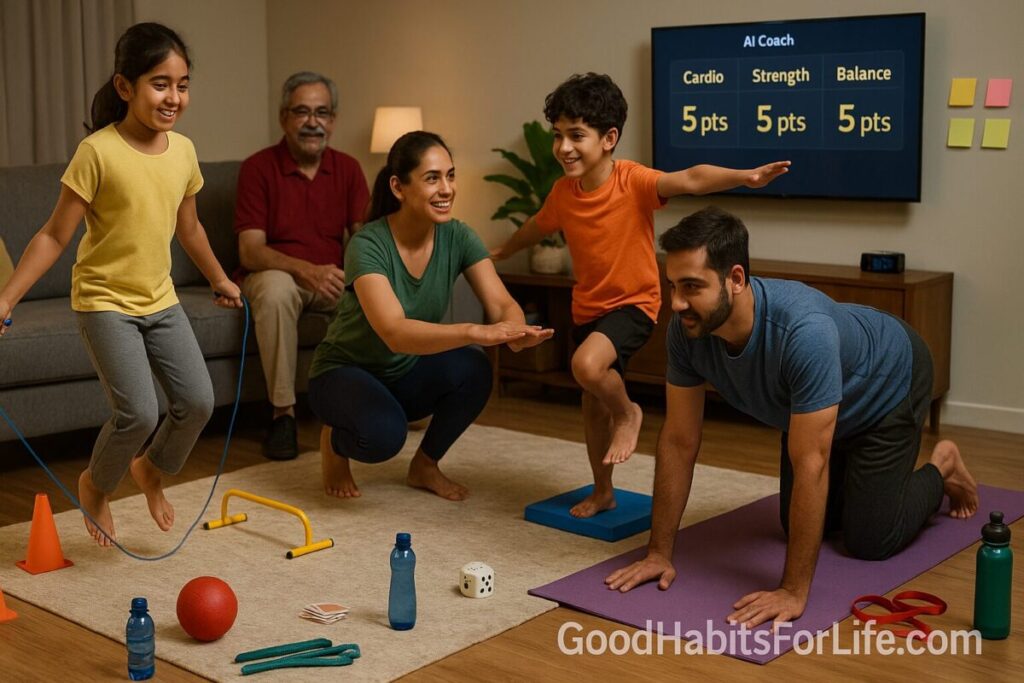
Family Fitness Night is a recurring, 45–60-minute, everyone-joins session built from short, rotating games that cover four pillars: cardio, strength, balance, and mobility. You’ll log meaningful minutes toward public-health recommendations while building connection and fun.
Evidence-backed benefits
-
Meets guidelines: Adults benefit from ≥150 min/week moderate-intensity activity and muscle-strengthening twice weekly; children/adolescents need ≥60 min/day with vigorous and bone-loading activities several days a week.
-
Gamification drives adherence: Points, challenges, and feedback loops increase motivation and physical activity in adults and kids.
-
Short bouts count: Accumulating moderate-to-vigorous minutes in brief segments still improves cardiometabolic health.
-
Family & social support are strong predictors of exercise adherence, especially for children and teens.
Behavior design in one line: Make it easy + fun + scheduled + tracked.
✅ Quick Start: Tonight’s 60-Minute Plan
Equipment: water, timer, yoga mats, 2 light dumbbells or resistance bands, a ball, and a safe space.
-
Warm-up (8 min) — March in place → arm circles → hip hinges → light shadow-boxing.
-
Game 1: Cardio Relay (12 min) — Teams (or individuals) alternate 30 s work / 30 s rest: fast walking laps, stair steps, or jump-rope (low-impact option: step jacks).
-
Game 2: Strength Circuit (12 min) — 3 rounds x 40 s on / 20 s off: squats/sit-to-stands, push-ups against a wall/table, band rows, glute bridges.
-
Game 3: Balance & Brain (10 min) — “Statue Tag”: freeze on one leg; rotate to heel-to-toe walks; add simple memory tasks for kids (name 3 fruits while balancing).
-
Game 4: Stretch & Breathe (8 min) — Calf, hamstring, hip flexor, chest; 4-7-8 breathing to finish.
-
Score & Streak (5 min) — Everyone logs minutes and rates effort using RPE 0–10. Add a sticker or point if RPE was ≥5 for at least 20 minutes.
Intensity guide: Aim for moderate—you can talk but not sing. For kids, make it playful and vigorous in bursts.
🛠️ The Game Library (Cardio • Strength • Balance • Stretch)
Pick one from each pillar, 8–12 minutes per game.
Cardio (MVPA)
-
Dice Dash: Roll 1–6 to pick movements (e.g., 1=high knees, 2=fast walk laps).
-
Obstacle Loops: Pillows, chairs, cones; repeat laps.
-
Dance Battles: Follow-the-leader or Just Dance-style routines.
-
Treasure Hunt Walk: Hide tokens; brisk walk to collect.
-
Shadow Boxing Combos: 1-2-3-4 pattern with footwork.
Strength
-
Deck of Reps: Red = lower body, Black = upper; numbers = reps (cap face cards at 12).
-
Partner Push/Pull: Band rows facing each other; synchronized squats.
-
Animal Moves: Bear crawl, crab walk, frog hops (low-impact variations welcome).
-
Household Lifts: Loaded backpack deadlifts; carry & stack books.
-
Core Ladder: 20-15-10-5 of dead bug, side plank (each), bird-dog, hollow hold.
Balance/Agility
-
Line Leaps: Chalk line or tape; forward/back/side hops (step if needed).
-
Single-Leg Arcade: Toss ball while balancing; add head turns.
-
Agility T’s: Shuffle forward, side, back; call directions randomly.
Mobility/Stretch
-
Flow Four: Cat-cow → world’s greatest stretch → hip flexor lunge → child’s pose.
-
Partner Assisted: Strap/band hamstrings, gentle pec doorway stretch.
-
Breathe & Box: 4-in / 4-hold / 4-out / 4-hold for 2–3 minutes.
🤖 AI Workflows That Save Time
Make the night turn-key with these quick, reusable workflows.
-
5-Minute Lineup Generator (Chat Prompt)
Prompt:
“Create a 60-minute Family Fitness Night plan for [ages/fitness levels] with 4 mini-games (cardio, strength, balance, stretch). Use household items, RPE targets, and low-impact options. Format as timed blocks with coaching cues.” -
Auto-Scaling & Accessibility
Add: “Provide regressions for knee pain and progressions for athletic teens. Include standing and chair options.” -
Scorecard Builder (Spreadsheet + AI)
-
Columns: Date, Game1–4 minutes, Total MVPA minutes, RPE (0–10), Wins, Notes.
-
Ask AI to generate conditional-format rules (e.g., turn cell green when Total ≥ 30).
-
Create a weekly dashboard (sum minutes, streak counter).
-
Theme & Playlist Generator
Prompt for “8 upbeat, clean tracks for 10-12-yr-olds + adults” or “Bollywood cardio mix 120–135 BPM,” then paste into your music app. -
Age-Split Cards
Have AI produce printable game cards: one side instructions, other side progressions. Keep a stack in a shoebox. -
Workplace Edition
Prompt: “Adapt for a 30-minute workplace wellness break for 8 colleagues in business attire; include no-sweat options and desk-friendly moves.”
📅 30-60-90 Day Roadmap
Goal: Hit guidelines consistently, build identity: “We are an active family.”
Weeks 1–4 (30 Days): Foundation
-
Anchor: Same day/time every week (e.g., Friday 7:30 pm).
-
Cue: Put mats out after dinner; playlist starts automatically.
-
Measure: Track total MVPA minutes and RPE.
-
Win Rule: If everyone participates ≥45 minutes → choose next week’s theme.
Weeks 5–8 (60 Days): Progression
-
Intensity: Add intermittent vigorous bursts (20–30 s) for older kids/adults.
-
Strength: Add one load (bands or light dumbbells) and one unilateral move.
-
Social: Invite a neighbor family or run virtual games with relatives.
Weeks 9–13 (90 Days): Personalization
-
Focus tracks: Cardio-endurance, strength-starter, or balance/mobility.
-
Mini-goals: 1-km family jog/walk; 60-second plank; 10 perfect chair-stands.
-
Celebration: Badge board + healthy picnic/outing.
Checkpoint cadence: quick 5-minute retro after each night—what to keep/change next time.
👥 Audience Variations
Parents with young kids (3–8): 5-minute stations, animal moves, story-quest themes.
Pre-teens/teens: Competitive rounds, music voting, skill challenges (push-up ladder).
Professionals & workplace groups: 25–30 min, no-sweat options (isometrics, brisk hallway walks), posture resets.
Seniors: Chair variants, slower transitions, balance first (tandem stance, heel raises), RPE 3–5.
Mixed abilities: Use color cones for difficulty (green = easy, yellow = mod, red = hard). Everyone chooses their cone.
⚠️ Mistakes & Myths to Avoid
-
Myth: Only long workouts count. Reality: Accumulated short bouts improve health.
-
Mistake: Skipping warm-ups and cool-downs.
-
Mistake: Over-competing with kids—keep ratios cooperative.
-
Myth: Strength training is unsafe for kids. Reality: Properly supervised body-weight/band work is beneficial and safe.
-
Mistake: No plan B. Always prep one low-impact indoor option.
💬 Real-Life Scripts & Prompts
Family invite (WhatsApp):
“Friday 7:30–8:30 pm = Family Fitness Night. Theme: ‘Space Quest.’ Bring water and a smile. We’ll earn 4 badges and hit our weekly movement goal. Who’s in?”
Workplace nudge (Slack):
“👟 12:30–1:00 Wellness Break—No-sweat desk circuit + brisk hallway walk. Log your minutes; coffee after!”
If-Then cue:
“If it’s raining, then we run ‘Living-Room Olympics’ (dance, band circuit, balance game, stretch).”
Micro-reward:
“Complete three Fridays in a row → choose next theme + movie night pick.”
🧰 Tools, Apps & Resources
-
Timers & Scorecards: Google Sheets/Excel; phone interval timer apps.
-
Music: Any app with BPM playlists; pick 120–140 BPM for moderate cardio.
-
Gamified Movement:
-
Nintendo Switch – Just Dance / Ring Fit Adventure (fun, scalable; needs console).
-
Pokémon GO / geocaching (outdoor walking; requires smartphones).
-
Zwift / Rouvy (indoor cycling/running; requires sensors; great community).
-
-
Trackers (optional): Fitbit, Apple Health, Google Fit (minutes, HR trends).
-
Household gear: resistance bands, light dumbbells, jump rope, yoga mats.
Pros/Cons snapshot
-
Consoles/games: High fun & adherence; con = hardware cost.
-
Wearables: Clear metrics & streaks; con = not essential, watch for accuracy limits.
-
Sheets/printables: Free, customizable; con = manual data entry.
🔑 Key Takeaways
-
Schedule one consistent Family Fitness Night to turn intention into action.
-
Rotate 4 pillars (cardio/strength/balance/stretch) so the routine is complete and never boring.
-
Use AI workflows to plan, adapt, and track in minutes—not hours.
-
Measure minutes + RPE and celebrate streaks to lock in habits.
-
Personalize for age, ability, and space; safety and joy first.
❓ FAQs
1) Do short games really “count” toward fitness?
Yes. Minutes of moderate-to-vigorous activity add up across the week and improve health.
2) How do we know it’s “moderate”?
Use the talk test: you can talk but not sing. Or aim for RPE 5–6/10.
3) Is strength work safe for kids?
With proper technique and supervision, body-weight/band resistance is safe and recommended for youth several days per week.
4) What if someone has joint pain?
Use chair/low-impact options (step jacks, wall push-ups), keep RPE lower, and stop with sharp pain. Seek professional advice for persistent issues.
5) We have very little space. Ideas?
Station circuits, shadow boxing, balance games, yoga flows, and hallway brisk walks work in small spaces.
6) Can we do this at work?
Yes—adapt to 25–30 minutes with low-sweat moves, standing isometrics, brisk walks, and stretch/breathe finishers.
7) How do we stay motivated for months?
Theme nights, rotating roles (DJ, coach, scorekeeper), small rewards, and inviting friends/family keep engagement high.
8) Do we need wearables?
No. A timer, a sheet, and honest RPE ratings are enough. Wearables can help if you like data.
9) How do we include grandparents?
Prioritize balance, chair strength, and range-of-motion games; keep transitions slow and encourage frequent water breaks.
10) What’s a good first goal?
Log 30 minutes of MVPA during the session for adults and make it fun for kids—consistency beats intensity at the start.
📚 References
-
World Health Organization. WHO Guidelines on Physical Activity and Sedentary Behaviour (2020, updates and briefs). https://www.who.int/publications/i/item/9789240015128
-
U.S. CDC. How Much Physical Activity Do Adults Need? & For Children & Adolescents. https://www.cdc.gov/physicalactivity/basics/adults/ and https://www.cdc.gov/physicalactivity/basics/children/
-
American College of Sports Medicine. ACSM’s Guidelines for Exercise Testing and Prescription (11th ed.). https://www.acsm.org/
-
American Academy of Pediatrics. Physical Activity for Children and Adolescents (Policy/Clinical resources, 2023–2024). https://www.aap.org/
-
Johnson D, et al. Gamification for health and wellbeing: A systematic review of the literature. Internet Interventions. 2016;6:89–106. https://doi.org/10.1016/j.invent.2016.10.002
-
Looyestyn J, et al. Does gamification increase engagement with online programs? JMIR Serious Games. 2017;5(2):e12. https://doi.org/10.2196/games.6931
-
Staiano AE & Calvert SL. Exergames for physical education and health promotion in youth. Child Dev Perspect. 2011;5(2):93–98. https://doi.org/10.1111/j.1750-8606.2011.00162.x
-
Howie EK, et al. Brief bouts of physical activity and health. Sports Med. 2020;50:217–228. https://doi.org/10.1007/s40279-019-01189-w
-
Donnelly JE, et al. Physical Activity, Fitness, Cognitive Function, and Academic Achievement in Children. Med Sci Sports Exerc. 2016;48(6):1197–1222. https://doi.org/10.1249/MSS.0000000000000901
-
Piercy KL, et al. Physical Activity Guidelines for Americans, 2nd Edition. U.S. Department of Health and Human Services, 2018 (evidence base). https://health.gov/paguidelines/second-edition/
Disclaimer
This article offers general fitness information and is not a substitute for individualized medical advice; consult a qualified professional for specific conditions.