
Exam Week Triage: What to Cut, What to Keep: AI workflows (2025)
Exam Week Triage 2025: Cut, Keep + AI Workflows
Table of Contents
🧭 What “Exam Week Triage” Means — and Why It Works
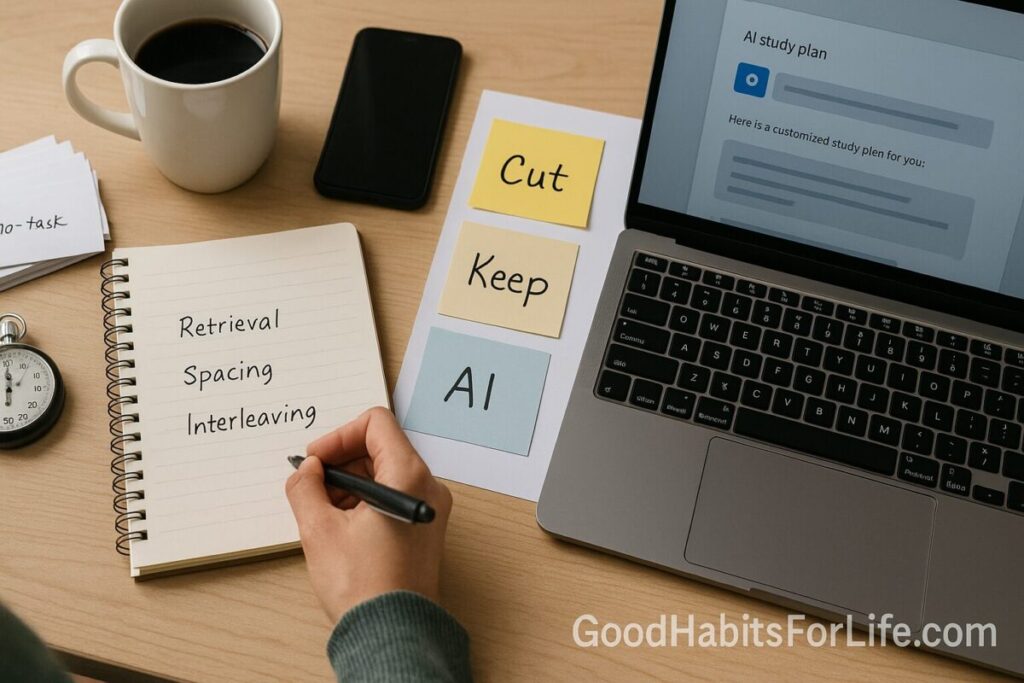
Triage = ruthlessly prioritizing the limited time and energy you have by (1) doubling down on high-yield, high-weight topics you don’t yet know, (2) keeping habits that move scores fast (retrieval + spacing + interleaving), and (3) cutting or limiting everything else.
Why it works (evidence-first):
-
Practice testing and distributed (spaced) practice are top-utility learning techniques across large reviews; rereading/highlighting are low-utility for performance gains. SAGE Journals+1
-
Spacing your reviews over time yields much better long-term retention than massed, last-minute sessions. PubMed
-
Sleep actively supports memory encoding and consolidation; protecting sleep during exam week is score-positive. CDC+1
-
Task-switching/multitasking taxes working memory and wastes precious minutes—mono-task. APA
The Triage Matrix (Weight × Mastery)
| Low Mastery | High Mastery | |
|---|---|---|
| High Exam Weight | KEEP: Daily retrieval sets, spaced reps, past papers | LIMIT: 10–20 min recon to prevent slippage |
| Low Exam Weight | LIMIT: Only core definitions/problem types | CUT: Archive for post-exam review |
🛠️ Quick Start: 60-Minute Triage Setup
Goal: Build a one-week, evidence-based plan with AI assist—without crossing academic integrity lines.
-
Map the Exam (10 min)
-
List exam topics + % weight from syllabus/past papers.
-
Rate current mastery (0–3).
-
-
Pick Targets (10 min)
-
Prioritize High Weight × Low Mastery topics (top 3–5).
-
-
Timebox (10 min)
-
Block 2–4 daily study windows (50–80 min each), + 10-min movement breaks.
-
-
Build Retrieval Sets (15 min, with AI assist ethically)
-
Prompt an AI tutor to quiz you (not write answers) and to generate flashcards from your own notes.
-
Example prompt below in “Scripts”.
-
-
Space It (5 min)
-
Schedule reviews: T+1d, T+3d, T+6d for each target. PubMed
-
-
Sleep & Guardrails (10 min)
-
Fix bedtime alarms; adults 7+ h, teens 8–10 h. CDC
-
📅 7-Day Exam-Week Plan
Daily non-negotiables: mono-task blocks, retrieval first, spaced reviews, 5–10 min walk between blocks, lights-out schedule.
Day 1 — Audit & Setup
-
Build the matrix, choose 3–5 targets, create first retrieval deck, schedule spaced reviews.
Day 2 — Retrieval + Past Paper
-
2 blocks on Target 1 (quiz → check → fix gaps), 1 block on Target 2.
-
1 past-paper section, open-book for feedback.
Day 3 — Interleave & Explain
-
Mix Targets 1–3 in one session; teach back to a rubber duck/peer; record 2-minute voice explainer. Nature
Day 4 — Simulation + Recovery
-
Full timed section under exam rules.
-
Evening: lighter spaced review only; prioritize sleep.
Day 5 — Patch Day
-
Mine errors from Day 4; create “fix cards”. 30-minute AI Q&A to close conceptual gaps (no graded tasks).
Day 6 — Second Simulation + Micro-exercise
-
Timed mixed-topic set + 10-minute brisk walk before and after (alertness/memory boost). PMC
Day 7 — Taper & Confidence
-
Short (30–45 min) active recall on weakest items only; 20-minute calming walk; early lights-out. CDC
🧠 Techniques & AI Workflows That Actually Work
✅ Retrieval Practice (default)
-
Do: free recall, short-answer, past-paper questions, teach-back.
-
AI workflow: “Socratic quizzer’’—feed your own notes/outlines; ask the AI to quiz you, refuse direct answers, and only reveal hints, then the worked solution after your attempt.
-
Why: Retrieval strengthens memory and transfer more than restudy. SAGE Journals+1
⏱️ Spaced Repetition
-
Do: schedule reviews at increasing gaps (e.g., 1d → 3d → 6d).
-
AI workflow: have AI convert bullet-note sections into Q/A flashcards and tag due dates (export to Anki/RemNote/Notion).
-
Why: Spacing beats massed practice for long-term retention; optimal gaps scale with test delay. PubMed+1
🔀 Interleaving
-
Do: mix similar problem types (e.g., derivative rules, then related rates) in one set.
-
AI workflow: ask the AI to shuffle and label problems by concept, then generate a mixed set with varied difficulty.
-
Why: Interleaving often outperforms blocking for discriminating between confusable concepts. Nature
💤 Sleep + Planned Breaks
-
Do: fixed bedtime, phone out of room, pre-sleep routine; 5–10 min movement breaks every 50–80 min.
-
Why: Sleep supports consolidation; pre-set breaks improve mood/efficiency vs ad-hoc breaks. walkerlab.berkeley.edu+1
-
Targets: Adults 7+ h; teens 8–10 h. CDC
🚫 Multitasking
-
Do: one tab/task; notifications off; “batch check” messages between blocks.
-
Why: Task switching adds time costs and reduces accuracy. APA
🤖 AI, Integrity & “Allowed Use”
-
Use AI for: quizzing, scheduling, flashcard generation from your notes, outlining study plans, explaining steps in practice problems.
-
Avoid AI for: graded answers, take-home solutions unless explicitly permitted.
-
Policies vary — check your syllabus. Many universities now provide explicit AI policy templates and guidance for instructors. Academic Senate+1
-
Note on AI detection: leading centers advise against relying on AI detectors for academic integrity decisions. Teaching at Pitt
-
Global guardrails: UNESCO’s guidance urges human-centered, transparent AI use in education—align your habits accordingly. UNESCO
👥 Audience Variations
High School (Teens)
-
Aim for 8–10 h sleep; set a device curfew and use a physical alarm clock. CDC
-
Smaller blocks (40–50 min) with 5–10 min movement breaks.
Undergrad
-
Use interleaved problem sets in STEM; create “error banks” from past papers. Nature
-
For essay courses: retrieval = outline from memory → compare to readings.
Working Learners / Parents
-
Two anchor blocks (early AM + late PM), one micro-block at lunch.
-
Batch AI flashcard creation on commute/down-time.
⚠️ Mistakes & Myths to Avoid
-
Myth: “Rereading = learning.” → Reality: low-utility versus practice testing/spacing. SAGE Journals
-
Myth: “All-nighters help.” → Reality: sleep loss impairs memory and performance. CDC
-
Myth: “Multitasking saves time.” → Reality: switching costs stack up. APA
-
Mistake: Using AI to produce graded work—risk of policy violations; use it as a study coach, not a ghostwriter. cmu.edu
💬 Real-Life Examples & Copy-Paste Scripts
1) “Socratic Quizzer” Prompt (use with your notes):
“You are my exam-prep tutor. From the notes pasted below, create 10 short-answer questions (mix easy/medium/hard). Ask one at a time. Do not reveal answers until I attempt. If I’m wrong, give a hint first, then the worked answer. Track weak areas and revisit them at the end. Notes: [paste your notes].”
2) “Flashcard Factory” Prompt:
“Turn the following class notes into Q/A flashcards suitable for Anki. Use concise wording, one fact per card, include cloze deletions for formulas, and tag by chapter/topic. Notes: [paste].”
3) “Interleaver” Prompt (STEM):
“Generate 12 practice problems interleaving these concepts: [list]. Label each by concept and difficulty. Provide full solutions only after I ask.”
4) “Timebox & Space” Prompt:
“Given these exam topics, weights, and my availability, build a 7-day schedule with 3 daily blocks (50–80 min), including spaced reviews on T+1, T+3, T+6, and built-in 10-min movement breaks. Topics/weights: [paste]. Availability: [times].”
5) Polite Integrity Check (email/message):
“Hi Prof. [Name], for exam prep I plan to use an AI tutor to generate practice questions from my own notes and to schedule reviews—not to produce assignment answers. Is that acceptable under our course policy?”
🧰 Tools, Apps & Resources
-
Flashcards: Anki, RemNote, Quizlet (export/import support).
-
Note systems: Obsidian/Logseq (plugins for spaced repetition).
-
Timers: Focus To-Do, Forest, OS clock timer.
-
Past papers & rubrics: course LMS, department archives.
-
AI tutors: Use your institution-approved tools and “study” modes; follow syllabus policy. Academic Senate
Pros/Cons snapshot
-
Flashcards (pro: fast retrieval reps; con: easy to drift into trivia).
-
Note graphs (pro: concept linking; con: setup time).
-
Timers (pro: reduce drift; con: can fragment deep work—adjust intervals to 50–80 min if needed). PubMed
📌 Key Takeaways
-
Prioritize High Weight × Low Mastery topics.
-
Make retrieval + spacing + interleaving your default loop. SAGE Journals+2PubMed+2
-
Sleep and planned breaks are performance tools, not luxuries. CDC+1
-
Use AI as a coach (questions, schedules, clarifications), not a cheat—follow your course policy. cmu.edu
❓ FAQs
1) Is it too late to start spacing during exam week?
No—start now and set shorter gaps (e.g., 1d → 3d → 6d). Even modest spacing beats massing. PubMed
2) How long should my focus blocks be?
Use 50–80 min with 5–10 min movement breaks; pre-scheduled breaks improve mood/efficiency vs ad-hoc pauses. PubMed
3) Does interleaving help for essays, or only STEM?
It helps when you must discriminate similar ideas (theories, lenses, case types). Mix prompts and practice outlines. Nature
4) What if my professor bans AI?
Then don’t use it for that course. Many universities now publish explicit AI policy statements—check the syllabus or ask. cmu.edu
5) Is rereading ever useful?
As a primer before retrieval or to locate gaps—yes. As a main tactic for performance—low utility versus testing/spacing. SAGE Journals
6) How much should I sleep before the exam?
Adults: target 7–9 h; teens: 8–10 h. Bank consistency the week before; avoid all-nighters. CDC
7) Does light exercise really help?
Short bouts (e.g., brisk walks) can aid alertness and memory—use between study blocks. PMC
📚 References
-
Dunlosky, J., et al. (2013). Improving Students’ Learning with Effective Learning Techniques. Psychological Science in the Public Interest. (Overview of 10 techniques; practice testing & spaced practice rated high.) SAGE Journals
-
Donoghue, G. M., et al. (2021). A Meta-Analysis of Ten Learning Techniques. Frontiers in Education. (Distributed practice & practice testing show strongest effects.) Frontiers
-
Cepeda, N. J., et al. (2008). Spacing Effects in Learning. Psychological Science. (Optimal gaps scale with test delay.) SAGE Journals
-
Walker, M. P., & Stickgold, R. (2006). Sleep, Memory, and Plasticity. Annual Review of Psychology. (Sleep-dependent consolidation.) walkerlab.berkeley.edu
-
CDC (2024). About Sleep. (Recommended sleep durations by age.) CDC
-
APA (n.d.). Multitasking: Switching costs. (Time/accuracy costs of task switching.) APA
-
Biwer, F., et al. (2023). Comparing ‘Pomodoro’ Breaks and Self-Regulated Breaks. (Pre-set breaks show mood/efficiency benefits.) PubMed
-
Samani, J., et al. (2021). Interleaved practice enhances memory and problem solving. npj Science of Learning. (Interleaving benefits.) Nature
-
Loprinzi, P. D., et al. (2021). Acute and Chronic Exercise Effects on Human Memory. (Exercise & memory.) PMC
-
UC San Diego Academic Integrity Office (2025). Artificial Intelligence in Education. (AI use guidance.) Academic Integrity
-
University of Pittsburgh (2025). Generative AI: Encouraging Academic Integrity. (Advises against AI detectors.) Teaching at Pitt
-
UC Berkeley Academic Senate (2025). GenAI Guidance for Instructors (Sample Syllabus Statements). (Course-level AI policies.) Academic Senate
-
UNESCO (2023, updated 2025). Guidance for Generative AI in Education and Research. (Global guardrails.) UNESCO