
EV Basics for New Drivers: Range, Regen, Routine: Dopamine Detox (2025)
EV Basics for New Drivers: Range, Regen & Dopamine Detox
Table of Contents
🧭 What This Guide Covers & Why
Electric vehicles (EVs) feel familiar yet different. Three skills erase most beginner stress: (1) planning range realistically, (2) using regenerative braking for smoother, more efficient driving, and (3) keeping your attention clean with a dopamine detox routine that cuts digital distractions. Master these and you’ll drive safer, arrive calmer, and keep your battery and brakes healthier for the long run.
⚡ Range 101: How to Stop Worrying About Kilometres
What affects range most?
-
Speed: Aerodynamic drag rises quickly with speed. Cruising slightly slower (e.g., 95 vs 105 km/h; 59 vs 65 mph) often saves meaningful range.
-
Temperature: Cold lowers battery performance; very hot weather increases cooling loads.
-
HVAC use: Cabin heat is energy-intensive. Seat/steering wheel heaters are usually more efficient.
-
Elevation & wind: Climbing hills and headwinds increase consumption; descents and tailwinds help.
-
Tyres & load: Under-inflation and excess cargo hurt efficiency.
Practical rules for new drivers
-
Keep a buffer: Plan trips with 20–30% SoC margin at arrival.
-
Charge smart: For daily use, many EVs are happiest around 20–80% SoC. On road trips, arrive ~15–25%, charge to what you need plus buffer, and go.
-
Pre-condition: If your car supports it, finish charging close to departure and warm/cool the cabin while plugged in. In cold, battery pre-conditioning also speeds fast-charging.
-
Watch the live efficiency: Use your car’s consumption meter (kWh/100 km or Wh/km) and adapt speed/HVAC.
-
Plan alternatives: Save a backup charger and a safe stopping point along your route.
🔁 Regenerative Braking: Turning Motion Back into Energy
What it is: Your motor reverses function during deceleration, converting motion into electricity that recharges the battery.
How to use it well
-
Start in moderate regen. Practice one-pedal driving on a quiet road or empty car park. Learn where your car will fully stop and when you still need the brake pedal.
-
Look far ahead. Lift off early before turns and lights; smooth, early deceleration maximises regen.
-
Know the limits. On very cold batteries or at high SoC, regen is reduced. Wet/icy roads may also limit regen for traction.
-
Blend with friction brakes. For emergency stops, press the pedal firmly—ABS and brake blending will handle the rest.
🛠️ Quick Start: Your First Day & Week
Day 1 (30–45 minutes)
-
Set charge limit (e.g., 80% for daily use).
-
Add apps: A Better Routeplanner (ABRP), PlugShare, your charging network(s), and your vehicle app.
-
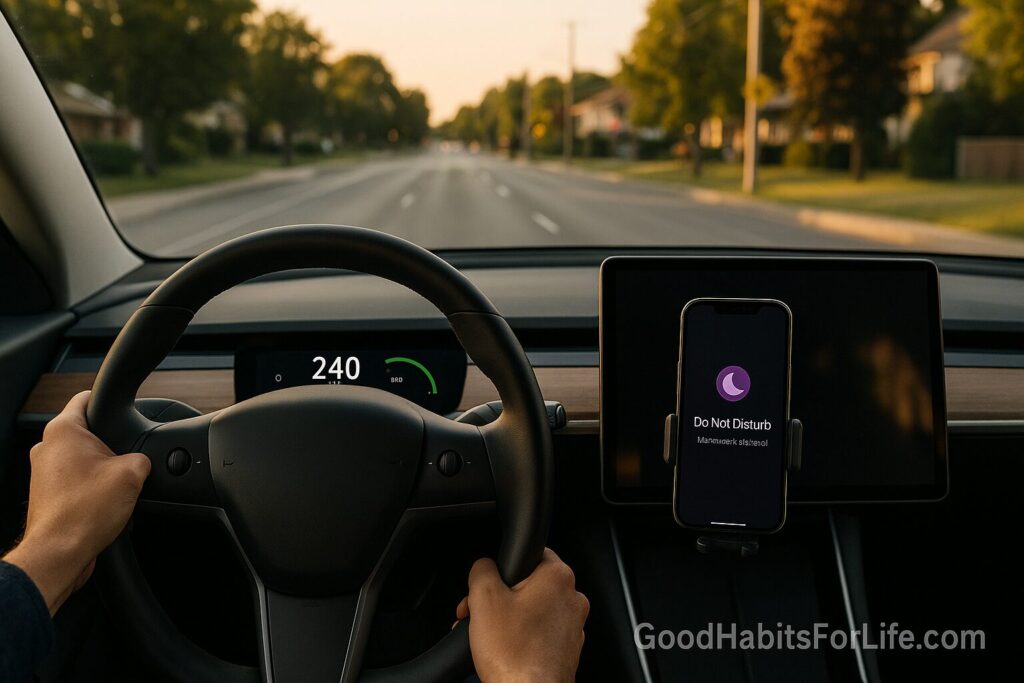
Turn on DND-While-Driving on your phone; pair Bluetooth once, then stow the phone out of reach.
-
Practice regen: Three laps in a safe area—accelerate gently to 30–40 km/h (19–25 mph), lift early, stop smoothly.
-
Create a “home routine”: Preferred departure times, climate pre-conditioning, and a weekly tyre pressure reminder.
First week
-
Commute rehearsal: Drive your usual route once with an extra 10 minutes to watch efficiency.
-
Fast-charge drill: Do a short top-up at a nearby DC fast charger so it’s familiar before you need it.
-
Review settings: Try different regen levels and driver-assist settings until they feel natural.
📅 7-Day Starter Habit Plan
Goal: Confident, distraction-free EV driving with stable efficiency.
-
Day 1 – Setup: Charge limit, apps, DND-While-Driving, regen practice.
-
Day 2 – Efficiency baseline: Normal commute; record kWh/100 km and average speed.
-
Day 3 – Smoothness drill: Keep acceleration under ⅓ pedal, lift early; note if efficiency improves.
-
Day 4 – HVAC optimisation: Pre-condition while plugged in; use seat heat more than cabin heat.
-
Day 5 – Trip plan test: Map a weekend route with ABRP/Google Maps EV; save a backup charger.
-
Day 6 – Fast-charge practice: Arrive to DC fast at ~20–30% SoC, charge to planned SoC, log time.
-
Day 7 – Review & lock routine: Set a weekly reminder (tyres, cables, charging schedule). Keep what worked.
🧠 Dopamine Detox Behind the Wheel (Distraction-Free Driving)
Why it matters: Notifications, endless playlist-skipping, and app-hopping spike novelty seeking and steal attention. A “dopamine detox” in the driver’s seat means intentionally simplifying your digital environment so your brain can focus on the road.
Build your in-car detox
-
One-tap focus: Enable Do Not Disturb While Driving (iOS/Android). Allow calls from favourites only.
-
Phone out of reach: Glovebox or bag; use steering-wheel controls for audio.
-
Set it before you roll: Destination entered, playlist selected, climate set—then drive.
-
Minimal UI: Prefer map+speed view; avoid multi-app switching.
-
Micro-break rule: If you must change apps or text, pull over safely first.
-
Passenger protocol: One “media captain” handles calls/music; driver stays heads-up.
❄️ Weather, Terrain & Driving Style
-
Cold: Pre-condition; keep SoC a bit higher; park indoors when possible; clear snow/ice from aero surfaces.
-
Heat: Shade parking, ventilate first, then cool; consider scheduled charging in cooler nighttime hours.
-
Hills: Expect higher use uphill and regen downhill—don’t count on full recovery.
-
Speed discipline: Try cruise control or driver-assist to hold a steady 90–100 km/h (56–62 mph) where legal.
-
Tyres: Check pressures monthly and before trips. Low rolling-resistance tyres can help efficiency.
🗺️ Trip & Charging Strategy (Home, City, Highway)
Home & workplace
-
Top up regularly, keeping daily SoC ~50–80%.
-
Time charging to finish near your departure (better thermal conditions).
-
If you have variable electricity rates, schedule for off-peak.
City
-
Short hops favour regen; smooth driving matters more than top speed.
-
Prefer reliable Level 2 chargers near errands; plug in while you do tasks.
Highway & road trips
-
Plan hops between 20–80% SoC for faster DC charging sessions.
-
Save Plan B chargers every 50–80 km (31–50 mi).
-
Know your connector type and network options; carry a tested payment method and any needed adapters.
-
Arrive with a buffer, especially in extreme weather or at night.
👥 Audience Variations
Students: Campus chargers can be busy—bookmark off-campus options; use a shared charging calendar in your dorm.
Parents: Pre-load kid playlists/audiobooks; teach “media captain” rules; keep an emergency charging cable and snacks.
Professionals: Add charger stops near meetings; automate mileage + charging logs; keep a clean cable kit.
Seniors/Teens: Larger fonts on the nav screen; voice commands for calls/music; extra practice with regen modulation.
⚠️ Mistakes & Myths to Avoid
-
Myth: “You must always charge to 100%.” → Not for daily use; partial cycles are usually fine.
-
Mistake: Ignoring tyre pressure—easy range killer.
-
Myth: “Regen replaces brakes completely.” → You still need friction brakes for hard/low-speed stops.
-
Mistake: Setting destination after moving—do it before you go.
-
Myth: “HVAC use doesn’t matter.” → It does; pre-condition and use targeted heating/cooling.
🗣️ Real-Life Scripts & Checklists
Pre-Drive 30-Second Script
-
“Maps set, playlist picked, DND on.”
-
“SoC ___% → target arrival buffer 20–30%.”
-
“Backup charger saved.”
-
“Phone stowed, eyes up.”
Parking-Lot Regen Drill (5 minutes)
-
Accelerate to 30–40 km/h (19–25 mph) → lift early → stop line.
-
Aim for smooth decel with minimal brake pedal. Repeat x3.
Fast-Charge Etiquette
-
Park centred; move when charge is sufficient; avoid occupying fast stalls to 100%; coil cable neatly.
Weekly Mini-Audit (5 minutes)
-
Tyres, cable condition, charge schedule, consuming apps (HVAC overuse?), average kWh/100 km trend.
🧰 Tools, Apps & Resources
| Tool | Best For | Pros | Considerations |
|---|---|---|---|
| A Better Routeplanner (ABRP) | Detailed trip energy planning | Vehicle-specific models; weather/elevation | Requires setup; subscription features for advanced users |
| PlugShare | Finding chargers & reliability | User check-ins/photos | Verify recent check-ins |
| Google Maps / Apple Maps (EV-routing where available) | Simple routing + traffic | Integrates with phone and car | Feature availability varies by region/model |
| ChargePoint / Other Network Apps | Starting/Paying at stations | Price/session history | Coverage varies |
| Vehicle App (OEM) | Pre-conditioning, charge limits, schedules | Direct control of your car | Feature set differs by model |
| Tire-pressure monitoring & log apps | Consistent efficiency | Alerts & history | Needs habit to check |
🔑 Key Takeaways
-
Keep a 20–30% SoC buffer and plan 20–80% hops on trips.
-
Practice moderate regen and smooth lifts; know regen limits in cold/high SoC.
-
Run a dopamine-detox routine: DND on, set-and-forget media, phone out of reach.
-
Pre-condition while plugged in; mind speed, tyres, and HVAC.
-
Save a backup charger and rehearse a fast-charge before you need it.
❓ FAQs
1) How much range should I plan to keep in reserve?
Aim for 20–30% at arrival, more in extreme weather or unfamiliar areas.
2) Is it bad to charge to 100%?
Occasionally for trips it’s fine; for daily use, many drivers keep lower limits (e.g., 80%) to balance convenience and battery care.
3) Does one-pedal driving wear brakes less?
Yes—regen handles much of everyday deceleration, reducing friction-brake use. You’ll still need the brake pedal for firm stops.
4) What speed is most efficient on highways?
Legally safe speeds slightly below the limit often improve efficiency; even a 5–10 km/h (3–6 mph) reduction can help.
5) How does cold weather change charging?
Batteries accept charge more slowly when cold. Pre-conditioning the battery (often automatic when navigating to a fast charger) helps.
6) Should I carry adapters?
Carry any adapter your vehicle supports and you may need on your route. Confirm compatibility in your manual/app.
7) Are public chargers safe to use in rain?
Yes—equipment is designed for outdoor use. Follow normal safety: handle connectors by insulated grips and avoid damaged equipment.
8) How do I know if a charger is reliable?
Check recent check-ins and photos in PlugShare or your network app, and keep a nearby backup.
9) Will frequent fast charging damage my battery?
Moderate, occasional fast charging is expected. For battery longevity, prefer slower (Level 2) charging for daily needs.
10) What’s the best way to learn regen quickly?
Practice short lift-offs and smooth stops in a safe, empty area, testing different regen levels.
📚 References
-
U.S. Department of Energy, Alternative Fuels Data Center — Electric Vehicles & Charging Basics: https://afdc.energy.gov/
-
U.S. EPA, Fuel Economy — Driving More Efficiently (applies to EV efficiency strategies): https://www.fueleconomy.gov/
-
National Highway Traffic Safety Administration — Distracted Driving Overview & Tips: https://www.nhtsa.gov/risky-driving/distracted-driving
-
International Energy Agency — Global EV Outlook (latest edition): https://www.iea.org/reports/global-ev-outlook-2024
-
National Renewable Energy Laboratory — Impacts of Temperature on EV Efficiency/Range (technical resources): https://www.nrel.gov/transportation/
-
Transport Canada — Winter Driving & EV Tips: https://tc.canada.ca/en/road-transportation/driving-safely/winter-driving
-
AAA — Cold Weather and EV Range (report & guidance): https://newsroom.aaa.com/
-
World Health Organization — Managing Distraction & Road Safety: https://www.who.int/roadsafety