
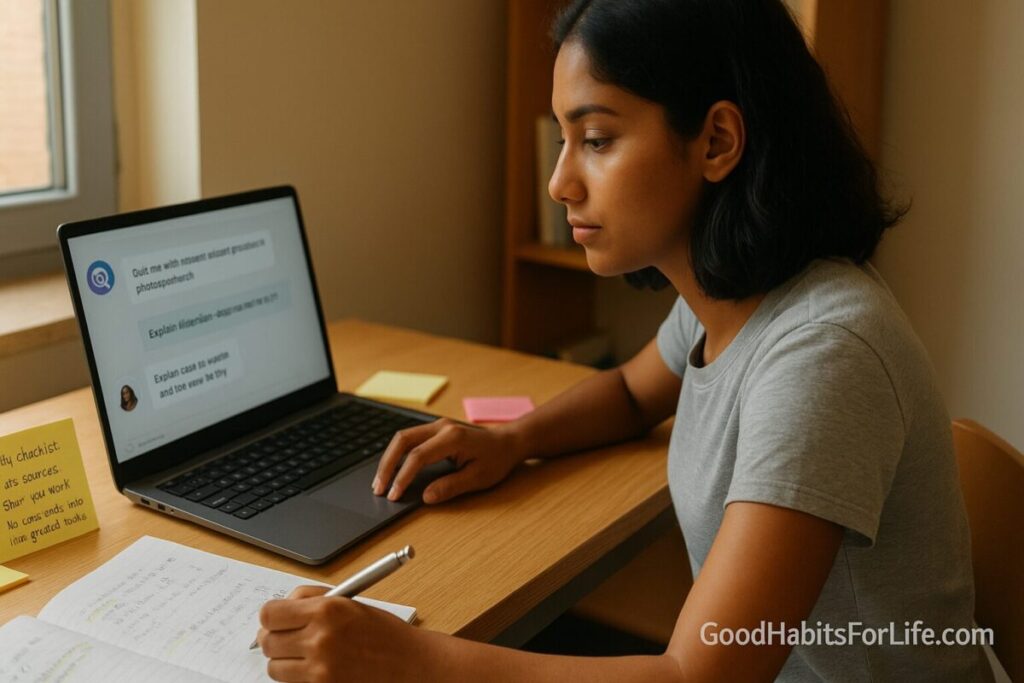
Ethical AI for Studying: Prompt Patterns that Teach (Not Cheat)
Ethical AI for Studying: Prompt Patterns that Teach (Not Cheat)
Table of Contents
🧭 What this guide covers & why it matters
Generative AI can be a powerful learning partner—if you use it to practice retrieval, structure explanations, and check understanding—not to generate entire answers for graded work. Global guidance (UNESCO, OECD) and risk frameworks (NIST) emphasize human-centered, transparent, and trustworthy use that supports learning outcomes and respects integrity. UNESCO+2OECD AI+2
You’ll get: copy-ready prompt patterns, an integrity checklist, and a 30-60-90 plan to build durable knowledge.
✅ The ethics frame: learn with AI, don’t outsource learning
Principles to steer by
-
Human agency & integrity first. Use AI to support your reasoning and skill practice, not to submit AI-written work as your own. UNESCO’s GenAI guidance calls for human-centered, equitable, and responsible use in education. UNESCO
-
Transparency. If your instructor or policy requires, disclose AI assistance and cite it (APA guidance provides clear formats). apastyle.apa.org
-
Trustworthy practice. Aim for accuracy, privacy, and bias awareness—NIST’s AI RMF is a practical lens for risks/mitigations. NIST Publications
-
Values of academic integrity. Honesty, trust, fairness, respect, responsibility, courage—use AI in ways that honor these. Academic Integrity
-
Policy fit. Local policies vary; OECD AI Principles endorse accountable, transparent AI—adapt to your institution’s rules. OECD AI
Integrity checklist (copy to your notes)
-
I used AI for practice (explanations, quizzes, planning), not to generate graded answers.
-
I preserved citations and verified facts with primary sources.
-
I disclosed/cited AI as required (see FAQ). apastyle.apa.org
-
I kept personal/third-party data out of prompts; I summarized sensitive content. NIST Publications
🧠 How AI helps you learn (cognitive science essentials)
Retrieval practice (testing yourself) significantly boosts long-term retention vs. re-reading. Design prompts that force recall before seeing the answer. psychnet.wustl.edu
Spacing/distributed practice (study → wait → restudy) strengthens memory over days/weeks; scheduling prompts over time beats cramming. laplab.ucsd.edu+1
Self-explanation & elaboration (explain in your own words, connect ideas) deepen understanding and transfer. Prompt your AI to interrogate your reasoning. Westsächsische Hochschule Zwickau+1
🛠️ Prompt patterns that teach (not cheat)
Use these with your own notes first. Start with you answering, then ask AI to probe, correct, and extend.
1) Tutor Mode (Socratic)
Goal: Build understanding through guided questions.
Prompt:
“You are my Socratic tutor for [topic]. Start by asking 3 diagnostic questions (one easy, one medium, one application). Don’t give answers. After I respond,:
identify gaps concisely
ask a follow-up that targets my weakest point
only reveal an explanation after I attempt an answer.”
Why it works: Encourages active retrieval and elaboration. psychnet.wustl.edu+1
2) Active-Recall Quizzer
Goal: Test yourself before reading.
Prompt:
“Generate 10 short-answer questions on [topic] by sub-concept (S1…S5). Hide answers until I type ‘reveal Sx’. Track my score and flag weak areas.”
Why it works: Retrieval + feedback. psychnet.wustl.edu
3) Feynman + Analogy Builder
Goal: Explain simply, then map to a new context.
Prompt:
“I’ll explain [concept] in <150 words. Grade it for clarity and missing pieces. Then produce:
a 12-year-old level explanation,
one tight analogy from everyday life,
one counter-example to prevent overgeneralizing.”
Why it works: Self-explanation improves structure and transfer. SpringerLink
4) Error-Spotting Coach (Worked Examples)
Goal: Diagnose misconceptions.
Prompt:
“Here’s my solution to [problem] (steps 1-n). Identify the first incorrect step only. Ask me to fix it. Don’t show the full solution unless I fail twice.”
Why it works: Pinpoints faults; supports deliberate practice.
5) Synthesis Grid (Compare Sources)
Goal: Integrate multiple readings.
Prompt:
“Given these 3 sources (I’ll paste citations), build a 3×4 table: claims, evidence, limitations, ‘what’s still unclear’. Ask me to fill the ‘my judgment’ column first; then propose where to verify with primary literature.”
Why it works: Organizes evidence and uncertainty; fosters source-checking (aligns with integrity frameworks). NIST Publications+1
6) Exam Wrapper & Reflection
Goal: Metacognition and plan.
Prompt:
“Interview me about a recent quiz. Ask: what went well/poorly, error types (recall/understanding/application), time use, and plan 3 habit tweaks. Produce a one-page study plan using spacing over 4 weeks.”
Why it works: Turns feedback into spaced actions. laplab.ucsd.edu
7) Code/Math Tracer (Step-Check Only)
Goal: Understand each transformation.
Prompt:
“Walk through my code/proof line-by-line. For each line: state intent, preconditions, postconditions. Ask me to predict the next line before revealing.”
Why it works: Forces prediction (a form of retrieval).
8) Language Shadowing Coach
Goal: Pronunciation + recall.
Prompt:
“Create a 10-line mini-dialogue using today’s vocab. I’ll record myself and summarize from memory. Grade for meaning accuracy; recommend 3 spaced reviews.”
Why it works: Combines retrieval with spacing. laplab.ucsd.edu
🚀 Quick start: do this today (15–30 min)
-
Pick one topic you’re studying.
-
Run Active-Recall Quizzer for 10 questions; answer before revealing. psychnet.wustl.edu
-
Use Tutor Mode on your weakest sub-topic.
-
Write a Feynman explanation (≤150 words); refine with an analogy. SpringerLink
-
Schedule 3 spaced reviews over the next 10 days (Day 2, Day 6, Day 10). PubMed
📅 30-60-90 learning roadmap
Days 1–30 (Foundation)
-
Two 25-min sessions/day: quiz → explain → correct.
-
Build a Synthesis Grid for each major chapter.
-
Space reviews at 2, 6, 14, 30 days. PubMed
Days 31–60 (Application)
-
Add Error-Spotting Coach on past papers.
-
Weekly reflection (Exam Wrapper) to adjust focus.
-
Start mixed-topic interleaving once/week. Westsächsische Hochschule Zwickau
Days 61–90 (Mastery & Transfer)
-
Teach a friend (or your AI) a mini-lesson.
-
Build a 1-page “concept map + formulas + traps.”
-
Final spaced reviews; practice under time limits. laplab.ucsd.edu
🧩 Audience variations
-
Students (secondary/uni): Use Quizzer + Exam Wrapper each week; cite AI use if policy requires (APA guidance). apastyle.apa.org
-
Professionals: Focus on Synthesis Grid for reports; keep a privacy-first workflow (no confidential data). NIST Publications
-
Seniors/returning learners: Start with micro-sessions (15 min) and heavy spacing; emphasize Feynman + analogies. laplab.ucsd.edu
-
Teens/parents: Co-create a family “AI study rules” sheet: when it’s okay (practice), when it’s not (graded answers).
⚠️ Mistakes & myths to avoid
-
Myth: “AI explanations = learning.”
Fix: Learning requires you to retrieve and apply. Use prompts that make you answer first. psychnet.wustl.edu -
Mistake: Pasting full assignment questions verbatim.
Fix: Paraphrase context; protect assessment integrity and privacy. NIST Publications -
Myth: “Detectors can prove cheating.”
Reality: Detection signals can be noisy; vendors report higher false positives at low percentages—bring process evidence (drafts/notes) instead. guides.turnitin.com+1 -
Mistake: Not citing AI when required.
Fix: Follow your style guide (e.g., APA). apastyle.apa.org
💬 Real-life scripts & templates (copy-paste)
Study planner:
“I have 4 weeks to learn [topic]. Build a calendar with: daily 25-min active-recall blocks, spaced reviews (Day 2/6/14/30), and 2 weekly mixed-topic sessions. Ask me for my weak areas first.”
Paper reading helper:
“Here’s an abstract. Ask me to state the research question, method, and key result in my own words, then compare my summary to the paper and point out gaps.”
Math step-checker:
“Review my proof. Only reveal the first faulty inference. Ask one question to nudge me. If I fail twice, show a minimal hint.”
Language:
“Create a 10-item picture-word drill. Hide answers; reveal only when I type ‘show 1’, ‘show 2’… Add 3 analogy sentences using today’s verbs.”
Cite & check:
“For these claims I wrote, propose primary sources (preferably peer-reviewed or official). Label each source as ‘confirm’, ‘nuance’, or ‘contradict’.”
🧰 Tools, apps & resources
-
Anki / RemNote: Spaced-repetition flashcards; schedule reviews automatically (great for vocab, formulas). PubMed
-
Zotero / Mendeley: Collect sources and generate references; store PDFs for quick retrieval.
-
Obsidian / Notion: Keep a learning log; paste your prompts, drafts, feedback.
-
Institutional style guides (APA, etc.). Follow citation rules for AI usage. apastyle.apa.org
-
Your library’s databases: Prefer peer-reviewed and official bodies (WHO, OECD, NIST, universities).
📚 Key takeaways
-
Use AI as a thinking gym—design prompts that make you recall, explain, compare, and correct. psychnet.wustl.edu
-
Schedule spaced reviews; tiny sessions over time beat cramming. laplab.ucsd.edu
-
Stay ethical and transparent: respect policies, cite AI when needed, and protect privacy. UNESCO+2apastyle.apa.org+2
-
Keep evidence of process (notes, drafts) in case of detector noise or questions about authorship. guides.turnitin.com
❓ FAQs
1) Is using AI to quiz me considered cheating?
Generally no—if it’s for practice and you’re not submitting AI-generated text as your own. Follow your course policy and cite AI if you used it in assessed work. UNESCO+1
2) How do I cite AI (APA)?
APA recommends citing the model as a source when you quote or rely on it; include version/date and URL. Check your instructor’s rules. apastyle.apa.org
3) Are AI detectors reliable “proof”?
They’re indicators, not verdicts; false positives are more common at low percentages. Keep drafts and notes to document your process. guides.turnitin.com+1
4) What about privacy?
Don’t paste personal data, confidential content, or full exam items; summarize and anonymize. Use tools aligned with risk frameworks like NIST’s AI RMF. NIST Publications
5) What’s the single best prompt to start with?
The Active-Recall Quizzer—answer first, reveal later. Pair it with spaced reviews for durable learning. psychnet.wustl.edu+1
6) Can AI help me write, ethically?
Yes—for planning, outlining, and revision suggestions—if you remain the author, verify facts, and cite AI use as required. UNESCO+1
7) How often should I schedule reviews?
A practical pattern: review after ~2 days, 1 week, 2 weeks, 1 month—then monthly. Adjust by difficulty and exam date. PubMed
References
-
UNESCO (2023). Guidance for Generative AI in Education & Research (web page & report). https://www.unesco.org/ UNESCO
-
NIST (2023). AI Risk Management Framework 1.0 (NIST AI 100-1). https://nvlpubs.nist.gov/ NIST Publications
-
NIST (2024). Generative AI Profile (NIST AI 600-1). https://nvlpubs.nist.gov/ NIST Publications
-
OECD (2019, updated 2024). OECD AI Principles. https://oecd.ai/ OECD AI+1
-
APA Style (2023). How to cite ChatGPT. https://apastyle.apa.org/blog/how-to-cite-chatgpt apastyle.apa.org
-
Roediger, H. L., & Karpicke, J. D. (2006). The Power of Testing Memory. Psych. Science. https://psychnet.wustl.edu/ psychnet.wustl.edu
-
Cepeda, N. J., et al. (2008). Spacing Effects in Learning. Perspectives on Psychological Science. https://laplab.ucsd.edu/ laplab.ucsd.edu
-
Dunlosky, J., et al. (2013). Improving Students’ Learning With Effective Learning Techniques. PSPI. https://journals.sagepub.com/ SAGE Journals
-
International Center for Academic Integrity. Fundamental Values of Academic Integrity. https://www.academicintegrity.org/ Academic Integrity
-
Turnitin (2023–2025). AI detection guidance & false positives. https://guides.turnitin.com/ guides.turnitin.com
-
K-12 Dive (2023). Turnitin notes higher false positives <20%. https://www.k12dive.com/ k12dive.com