
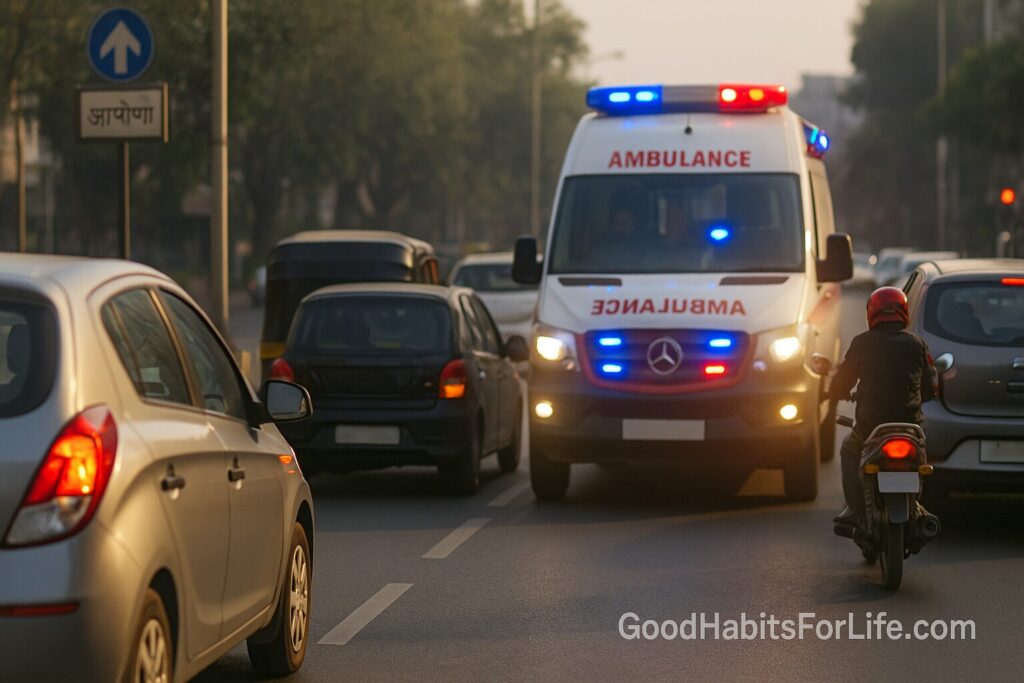
Emergency Vehicles: Yielding the Right Way
Emergency Vehicles: Yielding the Right Way
Table of Contents
🧭 What “Yielding to Emergency Vehicles” Means & Why It Matters
Yielding means you promptly make way for an approaching emergency vehicle using sirens and flashing lights—typically by signalling, moving toward the near curb/edge, and stopping until it passes and it’s safe to re-enter traffic. If the emergency vehicle is stationary on the roadside with lights activated, “Move Over” rules generally require changing lanes away from it or slowing down significantly if a lane change isn’t safe.
Why it matters
-
Lives & minutes: Ambulances, fire, and police responses are time-critical. Small delays compound across traffic.
-
Safety: Predictable yielding reduces sudden lane changes and rear-end collisions.
-
Legal & insurance: Failure to yield can mean fines, points, increased premiums, and liability if a crash occurs.
Orientation rule of thumb
Keep-right countries (e.g., US, Canada, most of Europe): move right and stop.
Keep-left countries (e.g., India, UK, Australia, New Zealand): move left and stop.
Always check your jurisdiction’s road code.
✅ Quick-Start: Do This Today
-
Spot the cues early: faint siren, blue/red lights, vehicles ahead slowing or edging over.
-
Signal your intent. Smoothly move to the near edge (right or left per your country).
-
Stop fully parallel to the lane; keep wheels straight; stay behind crosswalks and out of intersections.
-
Stay put until the last emergency vehicle passes (often more than one).
-
Re-enter by mirror-check + shoulder check; indicate; accelerate smoothly.
-
For stopped responders: If safe, change one full lane away. If you can’t, slow considerably and pass with wide clearance.
🧠 7-Day Habit Plan to Make Yielding Automatic
Goal: Build a reflex so you react calmly and correctly without overthinking.
-
Day 1 – Mirror habit: Every 8–10 seconds, quick eyes: mirror, speed, far ahead. Do this on every drive.
-
Day 2 – Edge positioning: Practice keeping a safe lateral cushion from the lane edge so you have space to yield.
-
Day 3 – Signal discipline: Drill “Signal → Mirror → Shoulder check → Move → Stop” in an empty lot with cones or markers.
-
Day 4 – Intersection logic: In a quiet area, rehearse approaches to signals and stop lines. Practice not entering an intersection when you hear/see an emergency vehicle; if already inside, clear it, then pull over.
-
Day 5 – Highway routine: Practice smooth lane changes: anticipate gaps; avoid last-second braking. Rehearse “change lanes away” and, if not possible, “slow down significantly.”
-
Day 6 – Roundabouts & narrow streets: Rehearse continuing to the next exit before pulling over; practice tucking into lay-bys or bays without blocking.
-
Day 7 – Full simulation: With a co-driver playing a siren sound at random (phone volume low), run the entire routine on quiet streets.
Weekly checkpoint: You can consistently execute the five Quick-Start steps in <10 seconds without panic.
🛠️ Techniques & Frameworks (Urban, Rural, Highway, Roundabout)
🏙️ Urban streets
-
Before you move: Check mirrors and blind spots; pedestrians and cyclists may also be reacting.
-
Lanes packed? Edge toward the curb line within your lane to enlarge the corridor; tiny movements coordinated across cars create a usable path.
-
Don’t mount footpaths (sidewalks) unless directed by an officer and it’s legal/safe.
🛣️ Highways & multi-lane roads
-
Approaching from behind: Signal, change lanes away early. If traffic blocks you, slow significantly and create a gap for others to merge.
-
Crests/curves: Avoid stopping immediately after blind crests. Move over, then stop where you’re visible.
🔁 Roundabouts & intersections
-
Intersections: If you can stop before the line, do. If you’re already in the junction, clear it and then pull over.
-
Roundabouts: Do not stop inside. Continue to the next exit and pull over there.
🅿️ Narrow roads & one-way streets
-
One-way: Pull to the near curb/edge. On multi-lane one-ways, move toward the edge of your lane; vehicles on both sides should create a central corridor.
-
Narrow two-way: Find a turnout, driveway apron, or lay-by. Keep enough angle so your vehicle is predictable and parallel to the roadway.
🧯 For stationary scenes (“Move Over”)
-
Lane change away: If safe, move one full lane away from the responders.
-
If you can’t change lanes: Slow markedly and pass with a wide berth; avoid rubbernecking.
📏 Following distance
-
Never tail an emergency vehicle. Many jurisdictions explicitly prohibit following within a long buffer (often hundreds of feet/metres). Create generous space and choose another route if tempted to “draft” behind them.
👥 Audience Variations
Students & new drivers
-
Rehearse the 5-step routine weekly. Keep a laminated “Yield steps” card on the sun visor.
Professionals (commuters, ride-hail, delivery)
-
Plan routes with fewer pinch points. Keep in-vehicle noise reasonable so you can catch faint sirens.
Seniors
-
Reduce cabin noise; consider hearing-assist settings. Keep windows clean and mirrors correctly adjusted.
Teens
-
No sudden swerves for “hero moves.” Smoothness beats speed; your job is to be predictable.
⚠️ Mistakes & Myths to Avoid
-
Myth: “Speeding up to get out of the way is helpful.”
Reality: Brief acceleration to merge is fine; sustained speeding creates new hazards. -
Mistake: Stopping in the middle of an intersection or roundabout.
-
Mistake: Slamming brakes without signalling; you may be rear-ended.
-
Myth: “I can follow the ambulance to skip traffic.”
Reality: Often illegal and dangerous; give them a large buffer. -
Mistake: Blocking bus lanes, bicycle lanes, or driveways when alternatives exist.
-
Myth: “Hazard lights make it clearer while I’m moving.”
Reality: Use turn indicators to show your direction; hazards are for stationary warnings unless local law says otherwise.
🗺️ Real-Life Scenarios & Scripts
1) Emergency vehicle behind you on a busy city street
-
Action: Signal; edge toward your legal curb side; stop parallel; keep crosswalks clear.
-
Script (to passengers): “I’m yielding—moving to the [left/right] and stopping. Seat belts on.”
2) You’re first at a red light, siren approaching cross-traffic
-
Action: Stay behind the line; do not enter to “wave them through.” Let the emergency driver manage the junction.
-
After it clears, proceed on green as normal.
3) In a roundabout
-
Action: Keep circulating to the next exit. Pull over safely after exiting.
4) Multilane highway with stopped fire truck ahead (lights on)
-
Action: Check mirrors; signal; change one full lane away. If blocked, reduce speed significantly and pass with wide clearance.
-
Script (to self): “Away lane if safe; otherwise slow way down.”
5) Nighttime, rain, limited visibility
-
Action: Increase following distance to the vehicle ahead, reduce speed earlier, and make lane changes sooner to avoid last-second moves.
6) They stop just ahead to assist at a crash
-
Action: Do not pull up behind them closely. Pass slowly when waved through; keep lanes clear for additional responders.
🧰 Tools, Apps & Resources
-
Navigation apps (Google Maps, Apple Maps, Waze): Sometimes surface incident alerts that help you anticipate yielding moments. Pros: early warning; Cons: alerts can lag; don’t touch your phone while driving.
-
Dashcams: Useful for post-incident clarity; Cons: never let mounting or fiddling obstruct your view or attention.
-
Driver training refreshers: Local defensive-driving courses reinforce calm, legal reactions.
📌 Key Takeaways
-
Signal early, move toward your legal road edge, stop, and wait until all responders pass.
-
Don’t block intersections or roundabouts; clear first, then pull over.
-
“Move Over” for stopped responders: change lanes away or slow significantly if you can’t.
-
Never tailgate emergency vehicles; keep a large buffer.
-
Laws vary—know your local rules and practice the routine weekly.
❓ FAQs
1) Do I always move to the right (or left)?
Move toward your near curb/edge according to your country’s driving side. Keep-right countries typically move right; keep-left countries move left.
2) Should I stop in the intersection to yield?
No. If you’re before the stop line, stay put. If you’re already in the intersection, clear it first, then pull over.
3) What if there are multiple emergency vehicles?
Stay pulled over until you’re sure the last vehicle has passed—there may be a convoy.
4) Do I use hazard lights while yielding?
Generally, no. Use turn indicators to show your direction and come to a controlled stop. Use hazards only if stopped in an unusual spot or as local law directs.
5) How close can I follow an emergency vehicle?
Don’t. Many jurisdictions prohibit following closely behind emergency vehicles; keep a very large gap and choose another route.
6) What if traffic is gridlocked and I can’t change lanes for a stopped responder?
Slow substantially, keep a wide lateral buffer, and pass cautiously; avoid rubbernecking.
7) Can I enter a bus lane or cross a solid line to yield?
Only if local law allows and it’s safe. The priority is to create space without creating a new hazard.
8) Are “Move Over” laws everywhere?
They exist widely (and in all US states) but specifics vary. Always learn your local rules.
9) How do cyclists or scooter riders yield?
Slow, pull to the curb, and stop safely without blocking pedestrian crossings. Avoid sudden swerves.
10) What if the emergency vehicle is coming from the opposite direction?
If its path will cross yours (e.g., at an intersection), pull over and stop. If separated by a physical median and it’s staying on the far side, you may continue cautiously unless local law says otherwise.
📚 References
-
UK Highway Code, Rule 219: Emergency vehicles — guidance on creating a path safely. https://www.gov.uk/guidance/the-highway-code/road-users-requiring-extra-care-204-to-225#rule-219
-
Ontario (Canada) Official Driver’s Handbook — Emergency vehicles. https://www.ontario.ca/document/official-mto-drivers-handbook/emergency-vehicles
-
AAA — “Move Over” laws overview & safety guidance. https://exchange.aaa.com/safety/roadway-safety/move-over/
-
National Safety Council — Move Over, Slow Down. https://www.nsc.org/road/safety-topics/move-over
-
Texas Transportation Code §545.157 (Move Over for certain vehicles) and §545.407 (following fire apparatus). https://statutes.capitol.texas.gov/Docs/TN/htm/TN.545.htm#545.157 ; https://statutes.capitol.texas.gov/Docs/TN/htm/TN.545.htm#545.407
-
California Vehicle Code §21806 — Duty to yield to authorized emergency vehicles. https://leginfo.legislature.ca.gov/faces/codes_displaySection.xhtml?lawCode=VEH§ionNum=21806.
-
Queensland Government (Australia) — Pull over for emergency vehicles. https://www.qld.gov.au/transport/safety/rules/other/pull-over-for-emergency-vehicles
⚖️ Disclaimer
This article provides general road-safety information; it is not legal advice—always follow the law and official instructions where you drive.