
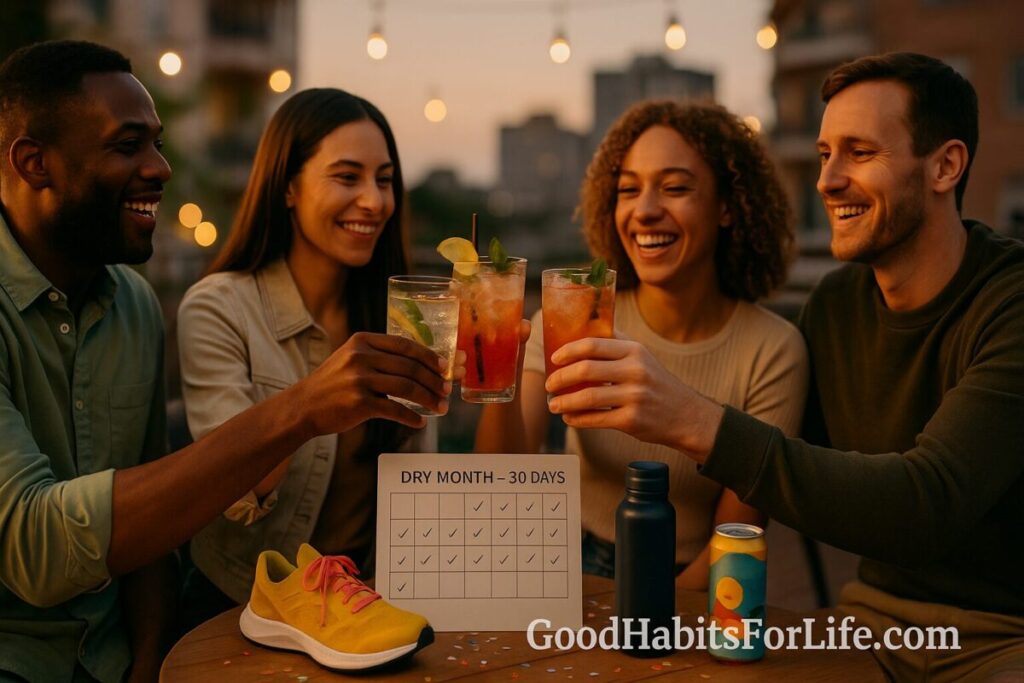
Dry Months in 2025: Plan, Socialize, Celebrate
Dry Months 2025: Plan, Socialize, Celebrate
Table of Contents
🧭 What Are “Dry Months” & Why Try One?
A dry month is a 30-day period without alcohol (e.g., Dry January, Sober October). People use it to reset routines, check their relationship with drinking, and test how life feels alcohol-free. Commonly reported benefits include better sleep, clearer focus, lower resting heart rate, calorie savings/weight changes, and money and time reclaimed. Public-health guidance also supports limiting alcohol for reduced risks of injuries, high blood pressure, liver disease, and certain cancers. Dry months provide a safe, time-boxed experiment to experience those benefits and to practice social strategies in real life.
Success drivers:
-
A fixed start/finish with visible progress tracking
-
If-then planning for triggers (e.g., “If Friday invite → suggest café first”)
-
Identity cues (“I’m the early-morning runner this month”)
-
Support (buddy, community, or app)
-
Environment design (NA options on hand; remove cues)
✅ Quick Start: Do This Today
-
Pick your month (or start next Monday): add to calendar; invite a friend.
-
State your “because…” (sleep, training block, budget, clarity). Write it on your phone lock screen.
-
Prep the environment: remove alcohol from easy reach; stock alcohol-free (AF) beer/wine, seltzers, shrubs, mocktail ingredients.
-
Choose your tracker: paper calendar ✅ marks, a streaks app, or a habit spreadsheet.
-
Set two if-then plans:
-
“If offered a drink → ‘I’m doing a dry month—sparkling water for me, please.’”
-
“If stress spikes at 7 pm → go for a 10-min walk + herbal tea.”
-
-
Tell your circle: short text—“Dry month in March. I’m in for dinners/coffee/morning walks.”
-
Pick your reward: day-15 treat (e.g., massage) + day-30 experience (e.g., day hike).
🛠️ 30-60-90 Roadmap (Prep, Dry Month, Aftercare)
Phase 1: 10-Day Prep (T-10 to T-1)
-
Audit triggers: time/place/people/emotions (Fri 7–9 pm, cooking, after big meetings).
-
Design swaps: AF lagers, zero-proof spirits, spicy ginger beer, kombucha; evening rituals (reading nook, bath, puzzle).
-
Schedule friction: don’t keep alcohol at home; pre-pay morning classes; plan early coffees/weekend hikes.
-
Baseline metrics: sleep hours/quality, steps, mood (1–10), resting HR if you track, spend vs. save.
Phase 2: 30-Day Dry Month (T0–T30)
-
Daily: mark your streak; drink water; 20-minute walk; lights-out target time.
-
Weekly checkpoint (Day 7/14/21/28): note changes in sleep, mood, cravings, energy, bloating, productivity, and money.
-
Social rule: two lines then pivot (“I’m off alcohol this month—going for the AF IPA. How’s your week?”).
-
High-risk plan: write 3 if-then statements for your biggest triggers; keep them in Notes.
Phase 3: 30-Day Aftercare (T31–T60)
-
Decide your path:
-
Continue AF (extend streak); or
-
Re-introduce with limits: e.g., max 7 standard drinks/week (men) and ≤4 on any day; ≤5/week (women) and ≤3 on any day—then adjust lower based on your health, meds, and country guidance.
-
-
Guard rails: alcohol-free weekdays; “first drink = water + food”; 2-drink ceiling with a hard stop; plan your ride home.
-
Track outcomes vs. your baseline (sleep, mood, money).
Phase 4: 90-Day Rhythm (T61–T90)
-
Choose a cadence: 1 dry week/month, or another dry month (e.g., Sober October).
-
Identity cement: add a “why” that isn’t about alcohol—training for 10K, deep-work mornings, calmer parenting block.
Tip: If cravings feel unmanageable or alcohol has caused harm, seek professional support now rather than white-knuckling it. (See resources below.)
🧠 Techniques & Frameworks That Work
-
If-Then Planning (Implementation Intentions): “If situation X, then I will do Y” turns vague goals into automatic scripts.
-
Coping Planning: plan for obstacles and the coping response (e.g., “If wedding toast → AF bubbly I brought”).
-
COM-B Model: change Capability (learn AF drinks, refusal skills), Opportunity (remove cues; schedule morning workouts), Motivation (visualize wins).
-
Identity-Based Habits: call yourself what you’re practicing (“I’m an AF month person”); wear/wield cues (sports bottle, early alarm).
-
Temptation Bundling: pair cravings window with a reward that’s incompatible with alcohol (night bike ride, sauna, crafting).
-
Urge Surfing: notice→name→ride the urge like a wave for 10 minutes; it always peaks and falls.
-
Self-Monitoring: daily tick marks; share a screenshot with a buddy every 3–4 days.
-
Pre-Commitment: RSVP “AF” on event threads; bring AF options; be the driver.
🥂 Social Life: Scripts, Menus & Boundaries
House setup: make your own AF menu—lime & bitters, grapefruit spritz, spicy ginger/lemon shrub, AF lager, AF sparkling rosé. Keep fancy glassware to maintain ritual.
Two core scripts
-
Offer: “I’m on a dry month—sparkling water/lime for me. Looks great though!”
-
Pressure: “I’m good tonight—doing a 30-day reset. Tell me about your trip!”
Menu tricks
-
Order first (AF) to set tone.
-
Ask bars for NA lists; most can do seedlip + citrus + tonic or a zero-proof sour.
-
Rotate venues: cafés, dessert bars, mini-golf, morning hikes, board-game nights.
Boundary lines
-
“I’m driving early.”
-
“Training block—alcohol messes with sleep.”
-
“Happy to hang until ten.”
👥 Audience Variations
Students: free AF mixers for flatmates, join morning sport clubs, budget tracker to show savings.
Parents: pair evening craving with 10-minute tidy + audiobook; batch mocktail syrups for quick pours.
Professionals: block deep-work mornings; set meeting recaps to 9 am to incentivize early nights.
Seniors: check medication interactions; emphasize sleep, balance, and hydration; choose warm AF drinks for evening ritual.
Teens (with guardian support): frame as performance (study, sports); practice refusal skills for peer situations; stick to AF parties.
⚠️ Mistakes & Myths to Avoid
-
“Cold turkey needs willpower only.” Plans beat willpower.
-
Swapping alcohol for high-sugar drinks all month. Choose low-sugar AF options most nights.
-
Skipping sleep and nutrition basics. Cravings spike when tired or under-fed.
-
Letting one lapse end the month. Treat it as a data point; restart at the next decision.
-
Assuming AF beer/wine are calorie-free. Still energy-dense—scan labels.
🗣️ Real-Life Examples & Copy-Paste Scripts
At a wedding:
-
“I’ll toast with the AF bubbly I brought—could you keep it on ice? Thanks!”
Friday team drinks: -
“I’m doing Sober October—beer-flavored water for me 😄. Who’s in for the quiz after?”
Family dinner host text: -
“I’m AF this month—bringing a ginger-lime shrub and extra for everyone.”
At home, 7 pm urge: -
“Timer for 10 minutes → balcony air + sparkling water → start cooking playlist.”
🧰 Tools, Apps & Resources
-
Try Dry (Alcohol Change UK): Month challenge, badges, community. Pro: purpose-built; Con: UK-centric.
-
I Am Sober / Reframe / Sunnyside: streaks, education, coaching. Pro: daily structure; Con: paid tiers.
-
Streaks / Habitify / TickTick: generic habit tracking. Pro: flexible; Con: not alcohol-specific.
-
Zero-proof brands: seek local AF lagers, hop waters, botanical spirits; compare sugar per 100 ml and price per serving.
-
Wearables: track sleep, resting HR, HRV; note improvements vs. baseline.
📌 Key Takeaways
-
Choose a specific month and write your why.
-
Engineer your environment and pre-commit socially.
-
Use if-then plans, urge surfing, and daily tracking.
-
Celebrate non-scale wins weekly; pick a day-30 reward.
-
At day 30, decide to continue AF or re-introduce with limits—and keep the habits you liked.
❓ FAQs
1) Does one dry month make a real difference?
Yes. Many people notice better sleep, morning energy, and lower resting heart rate within 2–4 weeks. It’s also a chance to practice social strategies and reassess long-term habits.
2) What if I slip once?
Treat it like missing one workout: log what led to it, recommit at the next decision, and continue your plan.
3) Are alcohol-free drinks “safe”?
AF beer/wine are useful substitutes, but still watch sugar and calories. If the taste triggers urges, switch to seltzers, teas, or hop waters.
4) How much is a “standard drink”?
Typically ~10–14 g ethanol depending on country. Examples: 330 ml beer (~5%), 150 ml wine (~12%), 45 ml spirits (~40%). Check your local definitions.
5) Can I do a dry month while training?
Absolutely—many athletes report better recovery and sleep. Hydrate, eat enough protein, and prioritize bedtime.
6) Is moderation after a dry month realistic?
It can be. Set specific limits, keep AF options at home, and continue self-monitoring for another 30 days.
7) What if friends push me to drink?
Use the two-line script, then pivot the topic. Plan allied friends or be the driver.
8) I’m on medication—is a dry month necessary?
Some medications interact with alcohol. A dry month is the safest default; if you plan to drink later, discuss limits with your clinician.
9) Which month should I choose?
Pick the one with the fewest high-risk events, or join big community months (January/October) for extra support.
10) How do I track progress?
Use any streak app or paper calendar. Measure sleep, mood (1–10), steps, and money saved weekly.
📚 References
-
World Health Organization. Alcohol — key facts and health effects. https://www.who.int/news-room/fact-sheets/detail/alcohol
-
U.S. CDC. Alcohol and Public Health — guidelines, risks, and resources. https://www.cdc.gov/alcohol/
-
National Institute on Alcohol Abuse and Alcoholism (NIAAA). Rethinking Drinking — risk levels and strategies. https://www.rethinkingdrinking.niaaa.nih.gov/
-
Alcohol Change UK. Dry January research and support. https://alcoholchange.org.uk/get-involved/campaigns/dry-january
-
Harvard Health Publishing. The benefits of cutting back on alcohol. https://www.health.harvard.edu/blog/benefits-of-cutting-back-on-alcohol
-
NHS. Alcohol units and drinking guidelines. https://www.nhs.uk/live-well/alcohol-advice/
-
American Heart Association. Alcohol and heart health — what the science says. https://www.heart.org/
-
Cancer Research UK. Alcohol and cancer risk. https://www.cancerresearchuk.org/about-cancer/causes-of-cancer/alcohol-and-cancer
-
Cochrane Library. Digital interventions for alcohol reduction (systematic reviews). https://www.cochranelibrary.com/
-
American Psychological Association. Willpower/implementation intentions and behavior change resources. https://www.apa.org/
⚖️ Disclaimer
This guide is educational and not a substitute for professional medical advice; speak with a qualified clinician about alcohol use, medications, or withdrawal concerns.