
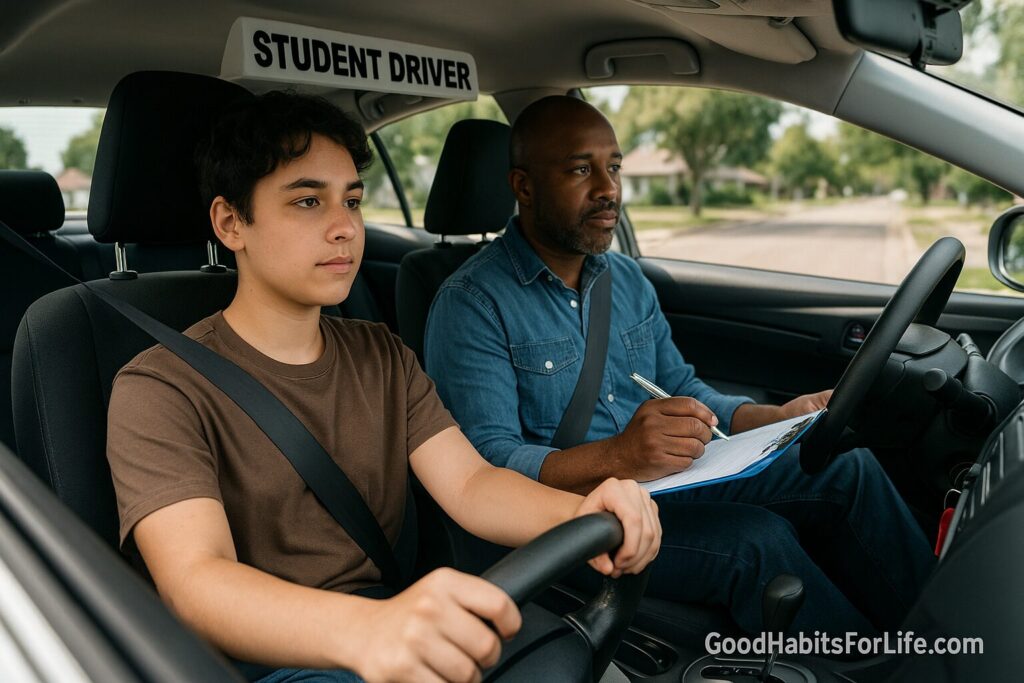
Driving School vs ParentTaught: Pros & Pitfalls
Driving School vs ParentTaught: Pros & Pitfalls
Table of Contents
🧭 What You’re Deciding (and Why It Matters)
Learning to drive safely isn’t just about passing a test—it’s about building habits that prevent crashes, especially in the first months of solo driving. Graduated Driver Licensing (GDL) systems and structured training help reduce risks for novices by phasing exposure to complex situations and encouraging supervised practice. Evidence from safety agencies consistently shows that strong GDL rules and high-quality training are linked to fewer teen crashes and injuries. (See references.)
Your decision:
-
Driving School = Certified instructors, structured curriculum, dual controls, often recognized for insurance discounts.
-
Parent-Taught = Lower cost and flexible schedule; quality depends on the parent coach, local laws, and discipline in logging hours.
Best overall approach: a hybrid—take pro lessons for fundamentals and risk management, then extend skills with lots of coached home practice.
✅ Quick Comparison: Driving School vs Parent-Taught
| Factor | Driving School | Parent-Taught |
|---|---|---|
| Legality & Recognition | Widely recognized; meets formal curriculum standards; accepted for insurance discounts in many regions. | Allowed only in some jurisdictions (e.g., select U.S. states); may require registration packets, logs, or online coursework. |
| Safety Equipment | Instructor cars often have dual pedals/mirrors, giving added safety during early lessons. | Family car—no dual controls; risk management relies on careful route selection and coaching. |
| Instructor Expertise | Trained in pedagogy, hazard perception, and local test standards. | Varies by parent; requires learning a curriculum and modern techniques to avoid passing on bad habits. |
| Structure & Curriculum | Sequenced modules with measurable outcomes; mock tests; feedback reports. | You must build structure yourself (logs, checklists, route progression, debriefs). |
| Scheduling | Fixed slots; can accelerate progress quickly. | Highly flexible; easier to fit around school/work but requires consistency. |
| Cost | Higher upfront cost; potential insurance savings later. | Lower cost; may need to buy cones, logbook app, and fuel/time. |
| Test Readiness | Instructors track weaknesses aligned to examiner rubrics; mock tests. | Depends on parent’s familiarity with test criteria and objective assessments. |
| Insurance Perks | Often available with approved certificates. | May or may not qualify; check your insurer beforehand. |
Bottom line: If your area allows parent-taught and budget is tight, you can succeed with a disciplined plan. Otherwise, a short course + home practice is the safest and most time-efficient route.
🛠️ Quick Start: Choose Your Path in 30 Minutes
-
Check the law: Look up your region’s DMV/transport authority for rules on driver education, GDL phases, and whether parent-taught is permitted.
-
Call your insurer (5 min): Ask what discounts require (approved school certificate? minimum hours?).
-
Pick a plan:
-
Hybrid (recommended): Book 6–10 professional lessons covering basics, complex scenarios, and test prep, plus 40–80 hours of supervised home practice.
-
Driving school only: Enroll in a full beginner course; still add home practice to reach total supervised hours.
-
Parent-taught only: Download a curriculum, choose a logbook app, and schedule 3–5 practice sessions/week.
-
-
Prepare the car: Adjust seating, mirrors (use the wide-angle “BGE” method), tire pressure, clean windshield, and create a practice kit (cones, high-visibility vest, checklists).
-
Set metrics: Track hours, new maneuvers mastered, errors per drive, and stress level (1–5) after each session.
📚 Techniques & Frameworks That Improve Safety
-
GDL Mindset: Limit exposure early—daylight, low-traffic neighborhoods first; add night, rain, and high-speed roads later.
-
BGE Mirror Setting: Reduces blind spots by angling side mirrors outward so adjacent lanes are visible sooner.
-
IPDE / OODA: Identify-Predict-Decide-Execute (or Observe-Orient-Decide-Act) loops for continuous scanning.
-
SMOG for lane changes: Signal–Mirror–Over-shoulder–Go when safe.
-
3-second rule (≥4 s in rain/dark): Following distance to avoid rear-end collisions.
-
Commentary Driving: Encourage the student to speak aloud hazards and decisions—builds hazard perception.
-
Deliberate Practice Rounds: Each 15-minute block targets a single skill (e.g., smooth braking, gap selection).
-
After-Action Review: What went well, what surprised you, what to try next time—log in your app.
📅 30-60-90 Habit Plan for New Drivers
Goal: Build from basic control to confident, low-risk solo driving.
First 30 Days — Foundations
-
Hours: 15–25 h supervised.
-
Routes: Empty lots → quiet neighborhoods → simple arterials at ≤50 km/h (≤30 mph).
-
Focus: Seating/mirror setup, smooth starts/stops, turning lines, scanning, right-of-way basics, parking, backing.
-
Drills: Figure-8 cone work; 10 gentle stops to a mark; mirror checks every 8–10 seconds; SMOG lane changes on empty roads.
-
Checkpoint: No stalls, no curb strikes, consistent signaling, calm composure.
Days 31–60 — Traffic Skills
-
Hours: +20–30 h supervised (cumulative 35–55 h).
-
Routes: Busier arterials, multilane roads, roundabouts, hills; first highway merges in light traffic.
-
Focus: Gap selection, speed control, lane discipline, on-ramps/off-ramps, night driving, wet roads.
-
Drills: Commentary driving 10 minutes per session; entering/exiting roundabouts; multi-point turn practice.
-
Checkpoint: Maintains 3–4 s following gap; merges without instructor intervention; smooth speed adaptation.
Days 61–90 — Advanced & Test Readiness
-
Hours: +20–30 h (cumulative 55–85 h or your region’s requirement).
-
Routes: Complex downtown, tight parking, school zones, highway at peak (brief), rural two-lane.
-
Focus: Hazard anticipation (pedestrians, cyclists), complex intersections, emergency maneuvers, mock tests.
-
Drills: Emergency stop from 40 km/h (25 mph) on empty straight; evasive swerve within lane; parallel parking to a standard.
-
Checkpoint: Passes two mock tests; consistent smoothness; error rate trending to near-zero.
👥 Audience Variations
-
Teens/Students: Prioritize GDL compliance, curfews, and passenger limits; use a parent-teen agreement with consequences and rewards.
-
Adult Beginners: Fewer scheduling limits; consider an intensive weekend with an instructor to break initial anxiety.
-
Nervous Drivers: Shorter sessions (20–30 min), practice lots first, add breathing resets; choose an instructor experienced with anxiety.
-
Parents as Coaches: Take a one-hour “coaching lesson” yourself with a pro to learn cues, routes, and test criteria.
⚠️ Mistakes & Myths to Avoid
-
Myth: “If you can pass the test, you’re safe.”
Reality: Crash risk remains highest in the first months post-licensing—keep practicing progressively. -
Myth: “Parent habits are good enough.”
Reality: Many experienced drivers carry shortcuts; update to modern techniques (mirror setup, scanning, GDL rules). -
Mistake: Jumping to highways or night driving too early.
-
Mistake: Practicing only in perfect weather—add controlled exposure to rain/night once basics are solid.
-
Mistake: Skipping debriefs—without feedback, errors become habits.
-
Mistake: Not checking legal requirements before starting a parent-taught path.
💬 Real-Life Examples & Coaching Scripts
Example 1 — First Merge
-
Coach: “Mirror, signal, check over shoulder. We’re aiming for a 3–4 s gap. I’ll call out if the gap closes. Ready—maintain speed, gentle steer, now ease in.”
-
Student: “Merging after mirror and shoulder check; keeping 3 seconds.”
Example 2 — Hard Braking Practice
-
Coach: “At the cone, apply firm, steady brake—no swerve. We’ll stop in a straight line and evaluate ABS feel.”
-
Debrief: “How early did you look? Did the wheel stay straight? What would you change?”
Parent-Teen Driving Agreement Snippets
-
“No phones, food, or extra passengers during first 30 solo days.”
-
“Car is available if weekly practice ≥3 sessions and zero intentional rule violations.”
-
“Curfew hours follow GDL; any breach = one-week suspension.”
🧰 Tools, Apps & Resources
-
Logbook Apps: RoadReady, Simply Auto, or your DMV’s official log; track hours, conditions, and routes.
-
Cones & Markers: Cheap discs for parking and figure-8 drills.
-
Checklists: Pre-drive (seat, mirrors, belt, fuel, tire pressure), post-drive (debrief, log entries).
-
Official Sources: Your regional DMV/transport authority (licensing steps, approved courses, parent-taught packets).
-
Insurance: Ask about “new driver” or “driver education” discounts and what proof they accept.
🔑 Key Takeaways
-
Structure beats guesswork: Whether school or parent-taught, follow a written curriculum and logbook.
-
Hybrid is efficient: A few pro lessons accelerate learning; home practice cements habits.
-
Safety first: Start simple, add complexity gradually, and debrief every session.
-
Check local rules & insurer: Legal acceptance and discounts differ by region.
-
Use the 30-60-90 plan: Build skills in phases and validate with mock tests.
❓FAQs
1) Is parent-taught driver education legal everywhere?
No. Some regions don’t allow it, while others require specific registration, coursework, and supervised-hours logs. Check your DMV/transport authority.
2) Which is cheaper—driving school or parent-taught?
Parent-taught is usually cheaper upfront, but driving school may bring insurance discounts that offset costs. Confirm with your insurer.
3) Do I still need home practice if I attend a driving school?
Yes. Most safety groups recommend extensive supervised practice across varied conditions, even with professional lessons.
4) How many hours should a new driver log?
Follow your region’s requirement (often 40–80 hours, with a subset at night). More quality practice generally leads to safer outcomes.
5) Can I mix both options?
Absolutely. Many families take 6–10 professional lessons and rely on parent supervision for most hours.
6) What about adults—do they need a school?
Not necessarily. Adults can learn with a patient coach and a structured plan; one or two professional sessions help address blind spots.
7) Will a school certificate guarantee an insurance discount?
Not always. Some insurers require approved providers; others offer no discount. Always check before enrolling.
8) Are instructor cars safer?
They often include dual brake pedals and extra mirrors, which can reduce risk during early mistakes.
9) How do I know I’m test-ready?
Pass two mock tests with different supervisors, meet hour requirements, and demonstrate consistent hazard scanning and smooth control.
10) What should I practice after I get my license?
Keep a weekly “advanced exposure” session: night rain, highways, rural roads—always within your comfort zone and with clear objectives.
📚 References
-
Centers for Disease Control and Prevention (CDC). Teen Drivers: Get the Facts.
-
National Highway Traffic Safety Administration (NHTSA). Teen Driving & GDL.
-
Insurance Institute for Highway Safety (IIHS). Graduated Licensing.
-
AAA Foundation for Traffic Safety. Teen Driver Risk and Behavior Reports.
-
National Safety Council. Defensive Driving & Driver Safety.
-
Texas Department of Public Safety. Parent Taught Driver Education Program Guide (example of a region that permits parent-taught).
-
Simons-Morton BG et al. “Parent Involvement in Novice Teen Driving” (NIH/PMC overview of Checkpoints Program). PubMed Central.
-
World Health Organization. Road traffic injuries: key facts.
⚖️ Disclaimer
Licensing laws and insurance policies vary by region; this article is for general guidance only—check your local DMV/transport authority and your insurer for current requirements.