
Divorce & Money: Untangle with a Plan: No-Spend Challenge (2025)
Divorce & Money: No-Spend Challenge (2025)
Table of Contents
🧭 What Is a “No-Spend Divorce” Plan & Why It Works
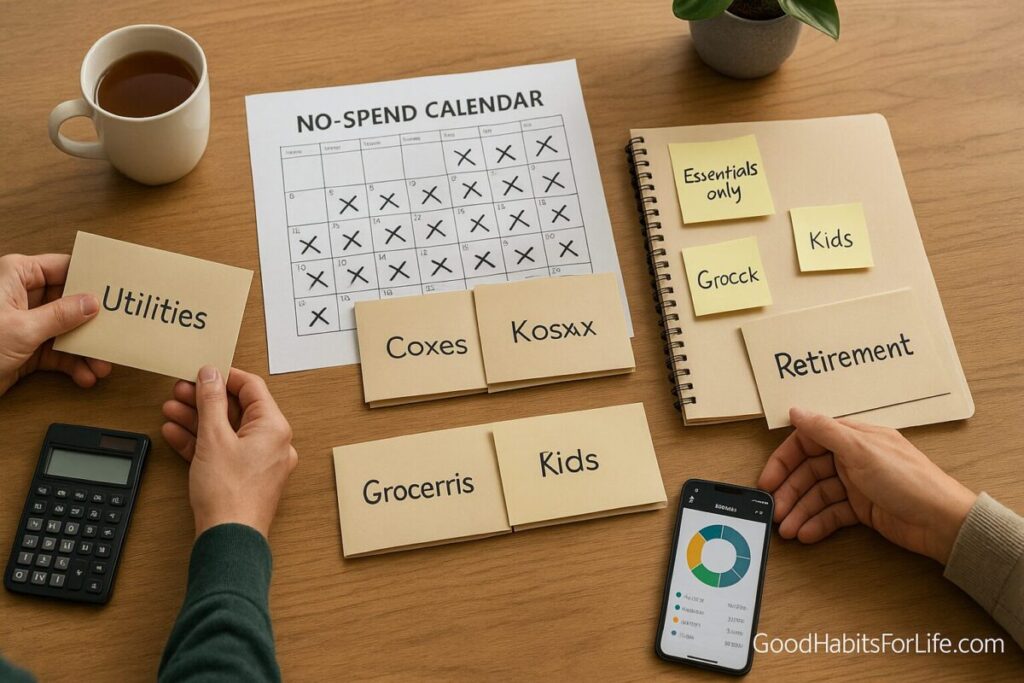
A no-spend challenge is a temporary spending freeze where you purchase only essentials (housing, utilities, groceries, transport, medicines, children’s needs) for a defined period (usually 30–90 days). It creates breathing room to pay mandatory costs, reduce debt, build a small emergency buffer, and make clear financial decisions under stress. Cooperative extension guidance explicitly recommends a “no-spend month” to jump-start savings—exactly the kind of reset most people need during a separation. financialliteracy.extension.uconn.edu
Divorce also raises financial stress, which can cloud judgment. Recent APA data shows the economy/money remains a top stressor for adults, making simple, rule-based actions (like no-spend rules) especially helpful. American Psychological Association
Finally, divorce affects long-term finances (e.g., pension/retirement splits). Knowing that a Qualified Domestic Relations Order (QDRO) may be required to divide retirement benefits helps you plan contributions and avoid costly mistakes while you’re tightening spending. DOL+1
✅ Quick Start: Your First 48 Hours
-
Map today’s money. List monthly income, all bills, debt minimums, and irregular expenses. Use a zero-based budget so every unit of currency has a job (including savings). OSU ExtensionConsumer Financial Protection Bureau
-
Define “essentials only.” Essentials for no-spend = housing, utilities, basic food, healthcare, transport, kids’ needs; everything else is paused. financialliteracy.extension.uconn.edu
-
Freeze non-essentials. Put subscriptions on hold, remove cards from shopping sites, and set daily cash to zero unless pre-approved.
-
Protect your financial identity. Create/secure individual accounts where appropriate, change passwords, enable alerts, and monitor credit. (If home/mortgage issues exist, note that servicers must meet communication standards—know your rights.) Consumer Financial Protection Bureau+1
-
Collect documents. Tax returns, pay stubs, bank/credit statements, loan docs, insurance, and retirement plan summaries. The CFPB’s organizing checklist is a practical aid. Consumer Financial Protection Bureau
-
Sketch a debt tactic. Choose avalanche (highest APR first) for math efficiency or snowball (smallest balance first) for fast wins. Consumer Financial Protection BureauConsumer Financial Protection Bureau
🛠️ 30-60-90 Day No-Spend Roadmap
Days 1–30: Stabilize
-
Budget lock-in: Commit to essentials-only. Review spend every 3–4 days.
-
Automate must-pays: Rent/mortgage, utilities, insurance, debt minimums on autopay; set weekly “cash envelopes” (digital or physical) for groceries/transport. Consumer Financial Protection Bureau
-
Emergency buffer: Aim for a starter buffer (e.g., ₹20,000–₹40,000 or US$250–$500) by redirecting all non-essential spend.
-
Retirement & benefits snapshot: Request retirement plan summaries; note whether a QDRO might be necessary later. DOL
-
Weekly ritual: 20-minute money check-in (see script below).
Days 31–60: Optimize
-
Trim fixed costs: Negotiate internet/phone, cancel add-ons, review insurance deductibles, and check for duplicate subscriptions.
-
Debt acceleration: Apply freed-up cash to chosen method (avalanche or snowball). Track principal drop weekly. Consumer Financial Protection Bureau
-
Housing decisions: If applicable, understand servicer obligations and options before refinancing or assuming a mortgage during/after divorce. Consumer Financial Protection Bureau
-
Tax awareness: If you’re in a jurisdiction where alimony/maintenance has tax implications (e.g., U.S. post-2018 rules), factor that into cash flow and withholdings. Go USA+1
Days 61–90: Rebuild
-
Lift the freeze selectively: Add back 1–2 high-value categories (e.g., kids’ activities) while keeping total spend flat by trading off elsewhere.
-
Future funds: Automate transfers to a 3–6-month emergency fund and retirement once the decree/QDRO path is clear. DOL
-
Long-view tune-up: Update beneficiaries, insurance, and estate basics; review pension/retirement splits before any rollovers. DOL
🧠 Techniques & Frameworks That Make It Stick
-
Zero-based budgeting (ZBB): Assign every currency unit a job—spend, save, or debt. Divorce budgets change fast; ZBB adapts quickly. OSU Extension
-
Pre-commitment rules: Create bright-line rules (e.g., “no delivery, no clothing, no impulse buys”) to cut decision fatigue.
-
Micro-reviews: 10-minute daily glance; 20-minute weekly check-in; 60-minute month-end reset.
-
Debt snowball/avalanche: Behavioral momentum vs. interest efficiency—either beats doing nothing. Consumer Financial Protection Bureau
-
Stress management pairing: Money stress is common during divorce; pair budget reviews with short, calming routines (walks, breathing). American Psychological Association
-
Know the macro context: Divorce rates and patterns vary across countries; the key is your personal cash resilience. Use national statistics as context, not destiny. OECD
👥 Audience Variations
Students: Use campus financial counseling (often free). Budget around term-time irregular income and textbooks; keep the challenge to 30 days but aggressive. University of Maryland Extension
Parents: Prioritize stability for children’s essentials (food, school, health). Maintain predictable routines despite spending cuts.
Professionals: Audit payroll deductions, benefits, and retirement contributions; ensure withholdings match your new tax situation.
Seniors: Review pension options, survivor benefits, and healthcare coverage; consider how QDROs or local equivalents impact retirement income. DOL
Teens in the home: Explain the family “no-spend” as a temporary team project; involve them in meal planning and free activities.
⚠️ Mistakes & Myths to Avoid
-
“No-spend means deprivation.” It’s a temporary reset—not forever—and you can plan low-cost joys (library, parks, home movie nights).
-
Ignoring legal financial ties. Joint accounts, shared credit lines, and beneficiary designations need proactive handling.
-
Over-optimistic timelines. Court dates, property sales, or pension splits (via QDRO) can take months—plan cash accordingly. DOL
-
Stopping debt minimums. Always pay on time to protect your credit while you reduce extras.
-
Going it alone. Use free, impartial guidance where available (e.g., MoneyHelper in the UK) and reputable nonprofit counseling. MaPS
🗣️ Real-Life Examples & Copy-Paste Scripts
Weekly Money Check-In (20 minutes)
-
“What must be paid before next Friday?” (List due dates & amounts.)
-
“What can wait one week without fees or harm?”
-
“What’s our tiny win?” (₹1,000/$15 off the grocery bill, one subscription canceled.)
-
“What’s our risk?” (Unexpected car bill?) “What’s our buffer plan?”
Text to Pause a Subscription
“Hi [Service], I’m pausing my membership for 60 days due to a major life event. Please confirm the suspension and the next bill date.”
Email to HR/Plan Admin about Retirement Split
“Hello, I’m in a divorce proceeding. Could you send the Summary Plan Description and your QDRO procedures so my counsel can review? Thank you.” DOL
Mortgage Servicer Call Prompt
“I’m recently divorced/separated and need to confirm who is listed on the loan and title, payment status, and any available options. Please note this call as a request for information under servicing rules and provide your written response.” Consumer Financial Protection Bureau
🧰 Tools, Apps & Resources (quick pros/cons)
-
Budgeting apps: YNAB, Monarch, Goodbudget, EveryDollar (robust categorization; some paid).
-
Spreadsheets: Google Sheets/Excel (free, flexible; manual upkeep).
-
Bank alerts: Instant spend notifications (great for no-spend visibility).
-
Government/Nonprofit guidance:
-
MoneyHelper (UK)—divorce & separation money guides and calculators (impartial, free). MaPS+1
-
CFPB (US)—budgeting, debt payoff methods, servicer rules, complaint portal. Consumer Financial Protection Bureau+2Consumer Financial Protection Bureau+2
-
DOL/EBSA (US)—QDRO booklets and FAQs for dividing retirement benefits. DOL+1
-
📚 Key Takeaways
-
A time-boxed no-spend challenge stabilizes cash during divorce so you can meet essentials, protect credit, and plan long-term moves. financialliteracy.extension.uconn.edu
-
Pair zero-based budgeting with weekly reviews to stay adaptive under stress. OSU Extension
-
Choose one debt method and automate everything else. Consumer Financial Protection Bureau
-
Understand legal/administrative items (mortgage servicing rights, retirement orders) early to avoid costly surprises. Consumer Financial Protection BureauDOL
❓ FAQs
1) How strict should “no-spend” be during divorce?
Strict on non-essentials; flexible on true needs (medicine, kids’ items). Use a written “allowed list” to avoid decision fatigue. financialliteracy.extension.uconn.edu
2) How long should I run it?
Most start with 30 days, then extend to 60–90 if it’s working and you still need cash stability. Track weekly stress and savings to decide. financialliteracy.extension.uconn.edu
3) What if my income is irregular?
Budget around minimum guaranteed income; build a larger mini-buffer before accelerating debt. Cooperative extensions emphasize tailored budgets for variable income. Penn State Extension
4) Which debts do I prioritize?
Use avalanche to minimize interest paid or snowball for motivation; both are validated approaches by consumer finance authorities. Consumer Financial Protection BureauConsumer Financial Protection Bureau
5) How do pensions/retirement accounts get split?
Many plans require a QDRO or local equivalent; request your plan’s procedures early to avoid delays. DOL
6) What about my mortgage after separation?
Know your servicer’s obligations and request written confirmation of status/options before you agree to changes. Consumer Financial Protection Bureau
7) Where can I get neutral guidance?
In the UK, MoneyHelper offers free, impartial divorce & money resources; in the U.S., CFPB provides budgeting tools, debt strategies, and complaint support. MaPSConsumer Financial Protection Bureau
8) Are divorce rates rising or falling?
OECD data show divorces stabilized or declined in many countries around 2020; individual circumstances vary, so focus on your household plan. OECD
References
-
Consumer Financial Protection Bureau (CFPB). “Budgeting: How to create a budget and stick with it.” Consumer Financial Protection Bureau
-
CFPB. “How to reduce your debt” + Reducing Debt Worksheet (avalanche/snowball). Consumer Financial Protection BureauConsumer Financial Protection Bureau
-
U.S. Dept. of Labor, EBSA. “QDROs: The Division of Retirement Benefits Through Qualified Domestic Relations Orders” + FAQs. DOL+1
-
MoneyHelper (UK). “Divorce and separation: money guidance & tools.” MaPS+1
-
IRS Newsroom. “Tax considerations for people who are separating or divorcing” (U.S. alimony/tax effects). Go USA+1
-
American Psychological Association. Stress in America 2024 (money as a top stressor). American Psychological Association
-
OECD. Society at a Glance 2024—Marriage and Divorce chapter. OECD
-
Oklahoma State University Extension. “Re-adjusting Finances After Divorce” (zero-based budgeting, setup costs). OSU Extension
-
UConn Extension, Financial Education. “16 Tips to Save Money for an Emergency Fund” (no-spend month tip). financialliteracy.extension.uconn.edu
-
CFPB Regulation X §1024.38 (servicer policies and procedures). Consumer Financial Protection Bureau
Disclaimer: This article is educational and not financial, tax, or legal advice; consult a qualified professional for your situation.