
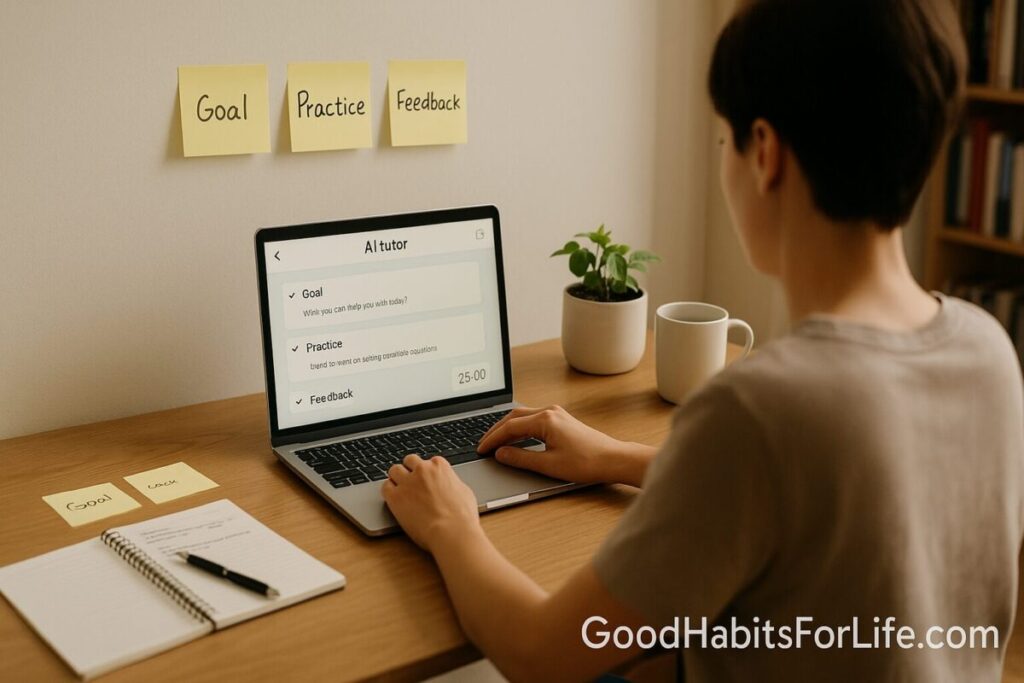
Design an AI Tutor Session: Goals Practice Feedback
Design an AI Tutor Session: Goals Practice Feedback
Table of Contents
🧭 What & Why
What is an AI tutor session?
A structured, short learning block where you and an AI tutor collaborate to reach a clear learning goal through micro-teaching, deliberate practice, feedback, and spaced follow-ups.
Why this structure works
-
Tutoring can dramatically accelerate learning; Bloom’s classic “2-sigma” result showed one-to-one tutoring outperforms conventional classes by ~2 SDs—our design borrows those mechanics (clear goals, feedback, mastery checks). Massachusetts Institute of Technology
-
Modern intelligent tutoring systems (ITS) show substantial gains vs. business-as-usual instruction (median ~0.66 SD)—a strong signal to combine structured practice + immediate feedback. SAGE Journals+1
-
Retrieval practice (testing yourself) and spacing are two of the highest-utility study techniques; they beat rereading and cramming for long-term retention. augmentingcognition.com+3SAGE Journals+3psychnet.wustl.edu+3
-
Feedback is most effective when it’s specific, timely, goal-referenced, and helps the learner act (feed up, feed back, feed forward). conselhopedagogico.tecnico.ulisboa.pt+1
✅ Quick Start (10-Step Blueprint)
Session length: 25–45 minutes.
Materials: your notes or source text, 3–6 practice items, a rubric (below), timer.
-
Set one goal (2 min).
“By the end, I can solve quadratic equations by completing the square.” -
Baseline check (3 min).
2–3 quick items without hints to see current level (record accuracy/time). -
Mini-lesson via worked example (5–7 min).
Walk through one model solution step-by-step; call out common errors. (Worked examples reduce cognitive load for novices.) browningmedportfolio.weebly.com -
Guided practice (5–7 min).
One problem with fading prompts: AI reveals the next hint only when you ask. -
Independent retrieval (8–10 min).
3–5 items from memory (no notes). Vary numbers/context. psychnet.wustl.edu -
Immediate feedback (5 min).
Ask the AI to show where and why an error occurred and the next step you should try—avoid dumping full solutions. conselhopedagogico.tecnico.ulisboa.pt -
Reflect (2–3 min).
“What tripped me up? What will I do differently next time?” -
Interleave (2–3 min).
Mix 1–2 adjacent skills (e.g., factoring vs. completing the square) to prevent illusion of mastery. -
Plan spaced reviews (1 min).
Schedule quick follow-ups at +1 day, +3 days, +1 week (calendar reminders). laplab.ucsd.edu+1 -
Log progress (1 min).
Score today’s rubric; note time-to-solve and accuracy.
🛠️ 7-Day Starter Plan
Goal example: “Explain photosynthesis and correctly answer AP-style questions.”
| Day | Focus | What you’ll do | Outcome |
|---|---|---|---|
| 1 | Baseline + Worked Example | 3 baseline Qs → 1 worked example → 3 retrieval Qs | Misconceptions listed |
| 2 | Retrieval Burst | 6 retrieval Qs (2 easy, 2 medium, 2 hard) + feedback | Accuracy ≥60% |
| 3 | Interleave | Mix photosynthesis with cellular respiration (3+3) | Discern differences |
| 4 | Teach-Back | 3-min explanation to AI → AI challenges gaps | Coherent summary |
| 5 | Problem Variants | New contexts (graphs/data) + error analysis | Transfer improves |
| 6 | Cumulative Review | 8 mixed items from Days 1–5 | Retention check |
| 7 | Mini-assessment | 12 Qs timed; reflection + next week’s spacing plan | Ready for next unit |
(Repeat the cycle for your next topic; keep daily touchpoints short to leverage spacing.) laplab.ucsd.edu
🧠 Techniques & Frameworks That Work
-
Goal setting with criteria
Use a specific, challenging goal and define success metrics (e.g., “80%+ on mixed practice in 12 minutes”). Stanford Medicine -
Worked examples → problem solving
Start with a model solution, then fade steps so you assume more of the process—classic novice-to-expert progression. browningmedportfolio.weebly.com -
Retrieval practice (don’t just reread)
Close the notes; produce answers from memory; check; repeat with spacing. SAGE Journals+1 -
Spacing & interleaving
Short, repeated sessions over days beats one long cram; mix near-neighbor skills to improve discrimination. laplab.ucsd.edu+1 -
High-impact feedback
Make it: timely, task-focused, actionable, and forward-looking (“Next time, first isolate variable X, then…”). conselhopedagogico.tecnico.ulisboa.pt+1 -
Explicit instruction principles
Check for understanding in small steps; provide guided practice before independent work. American Federation of Teachers -
Guardrails for AI use
Keep a human-in-the-loop mindset; prioritize transparency, safety, and equity when deploying AI for learning. U.S. Department of Education
👥 Audience Variations
-
Students (secondary/uni): shorter blocks (25–35 min); emphasize retrieval quizzes and interleaving; keep a visible progress chart.
-
Professionals: anchor sessions to a work output (slide, memo, code snippet); practice with real datasets/tickets; add “teach-back to a peer” at the end.
-
Parents supporting teens: co-create the weekly spacing schedule; review the rubric together; ask your teen for a 2-minute “explain it to me” at dinner.
-
Seniors/lifelong learners: go slower on new concepts, heavier on worked examples and frequent, gentle retrieval with clear feedback.
⚠️ Mistakes & Myths to Avoid
-
Myth: “If I understand the notes while reading, I’ve learned it.”
Reality: Familiarity ≠ retrieval; you must recall without looking. SAGE Journals -
Mistake: Solving many problems with the solution visible.
Fix: Hide steps; ask AI for hints only after your attempt. -
Mistake: All feedback at the end.
Fix: Micro-feedback during practice beats delayed dumps. conselhopedagogico.tecnico.ulisboa.pt -
Myth: “Cramming works if I do enough hours.”
Reality: Spaced practice outperforms massed practice for long-term memory. laplab.ucsd.edu -
Mistake: No success criteria.
Fix: Define accuracy and time targets up front. Stanford Medicine
🗣️ Real-Life Scripts (Copy-Paste)
A. Kickoff & Goal
“You are my AI tutor. Goal: Solve quadratic equations by completing the square. Assess my baseline with 3 items (easy→medium). Don’t give answers—just say Correct/Incorrect and log error types.”
B. Worked Example (One-Time Micro-Lesson)
“Show one worked example with numbered steps. After each step, ask me to predict the next step before revealing it. Highlight common mistakes.”
C. Guided → Independent Practice
“Give 1 guided problem with hint-on-request only, then 4 independent problems. Mix coefficients and signs. After each, ask: 1) Where did I hesitate? 2) What rule applies?”
D. Feedback Format
“When I err, respond with: 1) What I did right, 2) Where the error occurred, 3) The next step I should attempt (not the whole solution), 4) One similar micro-problem.”
E. Interleaving
“Interleave 2 factoring problems with 2 completing-the-square problems; ask me to name which method fits before solving.”
F. Spacing Plan
“Create a 7-day micro-review plan: 6 items total per day, difficulty staircase, cumulative mix, with a 2-minute explain-aloud prompt.”
G. Reflection & Next Steps
“Prompt me to write a 3-sentence reflection: what improved, what still fails, what I’ll change next time.”
🧰 Tools, Apps & Resources (quick view)
-
General-purpose AI tutors (LLM chatbots): flexible, fast feedback; needs careful prompts and verification.
-
Intelligent Tutoring Systems (e.g., algebra/coding platforms): tight alignment to curricula; built-in mastery tracking; narrower scope but strong guidance. SAGE Journals
-
Practice & SRS apps: easy spacing calendars; great for definitions/steps; combine with problem-solving practice for transfer. laplab.ucsd.edu
-
Rubrics & checklists: keep a one-page scoring guide for accuracy, speed, and explanation quality (0–2 scale each).
Sample 6-point rubric (score 0–2 each):
-
Accuracy (correct answer)
-
Process (clear steps, justified)
-
Fluency (within target time)
📚 Key Takeaways
-
Anchor every AI tutor session to one measurable goal and a baseline check.
-
Move quickly from worked example → guided → independent retrieval. browningmedportfolio.weebly.com
-
Use timely, specific, actionable feedback; avoid full-solution dumps. conselhopedagogico.tecnico.ulisboa.pt
-
Space and interleave practice over days; track with a simple rubric. laplab.ucsd.edu
-
Keep human judgement in the loop for safety, equity, and transfer to real tasks. U.S. Department of Education
❓ FAQs
1) How long should an AI tutor session be?
25–45 minutes works well for one skill cluster; shorter sessions favor spacing.
2) Should I let the AI show full solutions?
Only after your attempt and targeted hints; prioritize next-step feedback to build independence. conselhopedagogico.tecnico.ulisboa.pt
3) How often should I review?
Hit quick reviews at +1 day, +3 days, +1 week; keep each review brief (6–10 items). laplab.ucsd.edu
4) What if the AI gives a wrong or vague explanation?
Ask for sources or alternative derivations; cross-check with textbooks/primary sources; keep a human mentor or peer for sanity checks. U.S. Department of Education
5) Is rereading ever useful?
Use rereading only to prepare for retrieval practice (build initial map), not as the main strategy. SAGE Journals
6) How do I measure progress?
Track accuracy, time-to-solve, and explanation quality on your rubric; expect gradual improvement across spaced sessions.
7) Should I interleave or block practice?
Start blocked (new skill), then interleave closely related skills to boost transfer and discrimination.
8) What about motivation?
Set specific, challenging goals and note progress visibly; this boosts persistence. Stanford Medicine
References
-
Bloom, B. S. (1984). The 2 Sigma Problem: The Search for Methods of Group Instruction as Effective as One-to-One Tutoring. Educational Researcher. (PDF). Massachusetts Institute of Technology
-
Kulik, J. A., & Fletcher, J. D. (2016). Effectiveness of Intelligent Tutoring Systems: A Meta-Analytic Review. Review of Educational Research. (Abstract/PDF). SAGE Journals+1
-
Dunlosky, J. et al. (2013). Improving Students’ Learning With Effective Learning Techniques. Psychological Science in the Public Interest. (PDF). SAGE Journals
-
Roediger, H. L., & Karpicke, J. D. (2006). The Power of Testing Memory. Perspectives on Psychological Science. (PDF). psychnet.wustl.edu
-
Cepeda, N. J., et al. (2008). Spacing Effects in Learning. Psychological Science. (PDF). laplab.ucsd.edu
-
Cepeda, N. J., et al. (2006). Distributed Practice in Verbal Recall Tasks: A Meta-Analysis. (PDF). augmentingcognition.com
-
Hattie, J., & Timperley, H. (2007). The Power of Feedback. Review of Educational Research. (PDF/Abstract). conselhopedagogico.tecnico.ulisboa.pt+1
-
Shute, V. J. (2008). Focus on Formative Feedback. Review of Educational Research. (PDF/DOI). myweb.fsu.edu+1
-
Rosenshine, B. (2012). Principles of Instruction. American Educator. (PDF/Page). American Federation of Teachers+1
-
Sweller, J. (2006). The worked example effect and human cognition. (PDF). browningmedportfolio.weebly.com
-
U.S. Department of Education, Office of Educational Technology (2023). Artificial Intelligence and the Future of Teaching and Learning. (PDF). U.S. Department of Education