
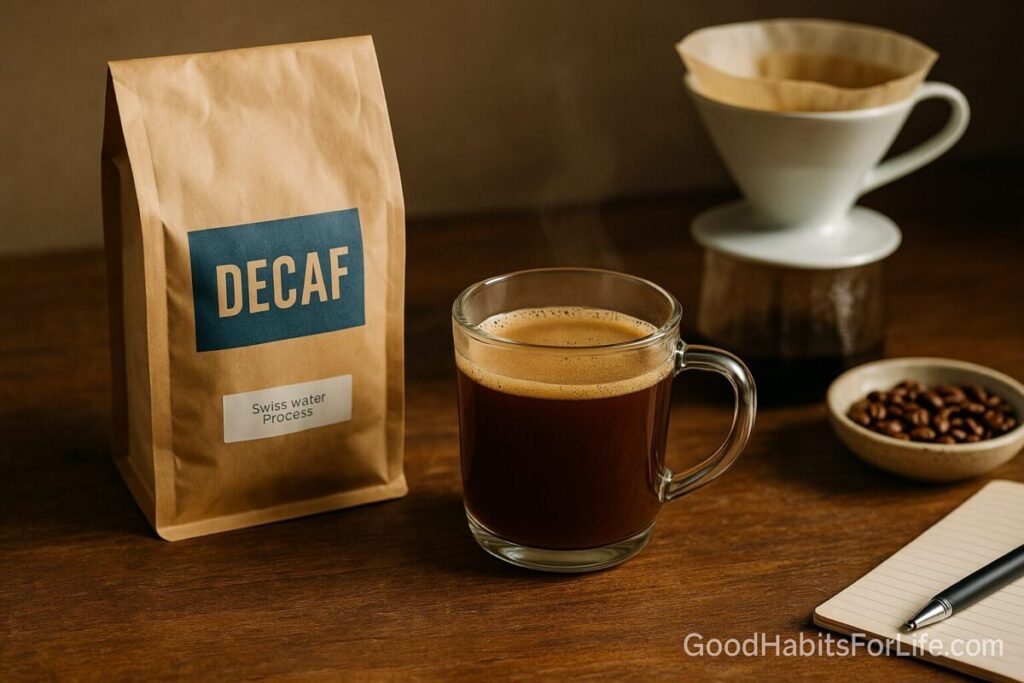
Decaf in 2025: How Its Made & What Tastes Good
Decaf Coffee 2025: How It’s Made & What Tastes Good
Table of Contents
🧭 What Is Decaf & Why Choose It
Decaf coffee is coffee with most—but not all—caffeine removed before roasting. Typical cups contain ~2–15 mg of caffeine (vs 70–140 mg in regular), with flavor increasingly close to standard coffee thanks to better processing and roasting.
Why people pick decaf
-
Sleep & anxiety: Lower stimulation later in the day.
-
Pregnancy & sensitivity: Easier to stay within recommended daily limits.
-
Health management: Reduce reflux or palpitations triggered by caffeine while keeping polyphenols and coffee flavor.
-
Habit shaping: Keep the comforting ritual without the jitters.
🧪 How Decaf Is Made (2025 Methods)
Decaffeination happens to green (unroasted) beans. The goal: remove ≥97% of caffeine while preserving aromatics.
1) Water Processes (Swiss Water®, Mountain Water)
-
Beans are soaked in hot water; caffeine diffuses out.
-
A green coffee extract rich in coffee solubles but free of caffeine is used so only caffeine leaves the bean (osmosis).
-
Caffeine is captured by carbon filters, then beans are dried.
-
Taste: Often clean and sweet; great for chocolaty profiles.
2) Supercritical CO₂ (Carbon Dioxide)
-
Beans are moistened; CO₂ at high pressure acts like a selective solvent for caffeine.
-
CO₂ is depressurized to release caffeine and recycled.
-
Taste: Maintains origin character; common in Europe and for espresso blends.
3) Ethyl Acetate (EA) — “Sugarcane Process”
-
EA is a compound found in fruit and sugarcane. Beans are steamed; EA selectively bonds with caffeine and is washed out.
-
Taste: Fruity, caramel notes; popular from Colombia (often labeled “sugarcane decaf.”)
4) Methylene Chloride (MC) — Direct or Indirect
-
Regulated food-grade solvent dissolves caffeine; beans are then steamed/washed to remove residues.
-
Taste: Often preserves heavier body and classic “coffee” notes; common in large-scale decaf.
-
Regulation: Strict residue limits (see safety section).
Roasting after decaf: Decaf beans are structurally different (more brittle, less bound caffeine), so roasters often use gentler, longer profiles to avoid scorching and to boost sweetness.
✅ Is Decaf Safe? (Residues, Regulations & Caffeine)
-
Residues: Regulatory agencies set very low limits for any processing solvents. For example, methylene chloride residues in decaf coffee are capped at 10 ppm in the finished product, and typical brewed coffee is far below that.
-
Caffeine totals: Adults can generally consume up to ~400 mg/day from all sources; pregnant individuals are advised to stay around ≤200 mg/day. Decaf helps you enjoy flavor while staying under these limits.
-
CO₂ & water methods: Leave no solvent residue.
-
EA (sugarcane): Any remaining EA evaporates during roasting; EA is widely used in foods.
Bottom line: When produced within regulations, all common methods are considered safe. Taste and sustainability should guide your choice more than fear of the process.
😋 What Tastes Good: Beans, Roast & Brew Tips
Beans
-
Single-origin decafs (especially Colombia, Ethiopia, Mexico) shine in 2025 thanks to improved water/EA processes.
-
Look for labels: Swiss Water®, Mountain Water, CO₂, Sugarcane EA.
-
Choose fresh-roasted (roast date ≤4 weeks) and whole-bean.
Roast
-
Medium to medium-dark often tastes best in decaf—more caramelization compensates for aromatics lost during processing.
-
Espresso? Try medium-dark for syrupy shots.
Grind & Brew
-
Grind slightly finer than regular coffee; decaf extracts slower.
-
Water: 92–96 °C (197–205 °F).
-
Ratio: Start at 1:15–1:16 (e.g., 20 g coffee → 300–320 g water).
-
Bloom longer (30–45 s) to degas properly.
-
Methods:
-
Pour-over (V60/Kalita) = clarity, sweetness.
-
French press = body; steep 4–5 min.
-
Espresso = 1:2 to 1:2.5 yield in 25–35 s; raise temp 1–2 °C vs regular.
-
Milk drinks: Decaf pairs beautifully with milk; sugarcane EA decafs often taste like caramelized sugar or milk chocolate.
🛠️ Quick Start: Buy & Brew Checklist
-
Pick a process: Water or CO₂ for ultra-clean; sugarcane EA for caramel/fruity; MC if you prefer classic body.
-
Select roast: Medium/medium-dark; check roast date.
-
Grinder: Burr grinder; dial a touch finer than your regular setting.
-
Dose & ratio: 18–20 g (espresso) or 20–25 g (filter) per cup; start at 1:15–1:16.
-
Water temp: 92–96 °C.
-
Taste & adjust: If sour/weak → finer grind, longer brew. If bitter → coarser grind, lower temp.
-
Log it: Note process, origin, grind, time, taste.
📅 7-Day Switch Plan
Goal: Replace late-day caffeine while keeping the ritual.
-
Day 1–2: Swap your last cup for decaf. Track sleep and mood.
-
Day 3–4: Make your afternoon cup half-caf (50/50 regular + decaf).
-
Day 5: Move to full decaf after 14:00.
-
Day 6: Experiment with two processes (e.g., sugarcane EA vs Swiss Water) and note flavor differences.
-
Day 7: Decide your steady state (e.g., regular morning, decaf PM). Set a reminder: no caffeine 6–8 hours before bedtime.
🧠 Techniques & Frameworks (Flavor & Habit)
-
R.A.T.E. Tuning (Ratio-Agitation-Time-Extraction): Adjust one variable at a time; taste again.
-
“Brewer’s Triangle”: Grind, water temp, and dose—optimize two, nudge the third.
-
2-Cup A/B Test: Brew two small cups with one change (process or grind) to learn your palate fast.
-
Habit Stack: “After lunch, I grind decaf and start a 3-minute pour-over.”
-
Cue-Craving-Response-Reward: Keep the same mug and brewing ritual; swap the beans.
🧑🤝🧑 Audience Variations
-
Students/Teens: Use decaf for evening study to avoid sleep loss before exams. Keep total caffeine conservative.
-
Professionals: Make post-meeting decaf your norm to reduce afternoon crashes.
-
Parents (newborn stage): Decaf keeps the ritual during fragmented sleep; consider half-caf AM, decaf PM.
-
Seniors: If sensitive to palpitations or reflux, trial decaf after midday; monitor how you feel.
-
Athletes: Keep pre-workout caffeine if it helps performance; switch recovery/late day to decaf.
⚠️ Mistakes & Myths to Avoid
-
Myth: “Decaf is chemical-soaked.” → All methods used in food are regulated; residues are strictly limited or absent.
-
Myth: “Decaf has zero caffeine.” → It has a small amount; factor it into daily totals.
-
Mistake: Using old pre-ground decaf. → Fresh whole-bean matters even more for decaf.
-
Mistake: Brewing decaf like regular. → Grind finer, brew slightly hotter, and extend bloom.
-
Myth: “Decaf is bad for health.” → Evidence suggests coffee’s polyphenols remain; for many, decaf is a net positive if caffeine is problematic.
🗣️ Real-Life Examples & Scripts
-
At a café: “Could I get a decaf pour-over? Do you have Swiss Water or sugarcane EA decaf today?”
-
At work: “Let’s brew a fresh decaf for the 4 pm meeting—helps sleep before tomorrow’s presentation.”
-
With a roaster: “I’m looking for a medium roast decaf, preferably CO₂ or sugarcane EA. Any single-origin options?”
-
Half-caf at home: Mix 1:1 regular and decaf of the same roast level for balance.
🧰 Tools, Apps & Resources
-
Burr grinder: Consistent extraction (manual or electric).
-
Kettle with thermometer: Hit 92–96 °C reliably.
-
Scale & timer: Precise ratios; repeatable results.
-
Apps: Any timer/notes app to log grind, ratio, and taste; consider a coffee logging app if you prefer.
-
Labels to look for: Swiss Water®, Mountain Water, CO₂ Process, Sugarcane EA, MC (Indirect/Direct).
Buying cues: Roast date, process on bag, origin notes (chocolate/nutty for comfort; berry/citrus if you like brighter cups).
🧾 Key Takeaways
-
Decaf in 2025 is better-tasting than ever thanks to refined water, CO₂, and sugarcane EA methods.
-
It’s regulated and safe when produced within strict limits.
-
For flavor: choose fresh-roasted single-origin, brew hotter and finer, and consider medium/medium-dark roasts.
-
Use the 7-Day Switch Plan to cut caffeine without losing the ritual.
-
Read labels and choose the process that matches your taste and values.
❓ FAQs
Does decaf have caffeine?
Yes—usually ~2–15 mg per 240 ml cup, depending on bean, process, and brew strength.
Which decaf process tastes best?
Subjective. Many prefer Swiss/Mountain Water for clean sweetness, sugarcane EA for caramel/fruit, and CO₂ for preserving origin character.
Is methylene chloride decaf safe?
Food-grade MC decaf must meet strict limits (e.g., ≤10 ppm). Brewed coffee typically contains far less; regulators consider it safe at these levels.
Is decaf okay in pregnancy?
Yes—decaf helps stay near ≤200 mg/day total caffeine commonly advised during pregnancy. Always consult your clinician.
Does decaf still have antioxidants?
Yes; decaffeination removes caffeine but retains many beneficial polyphenols present in coffee.
Will decaf help sleep?
Switching your late-day cups to decaf generally reduces caffeine-related sleep disruption, especially if you avoid caffeine 6–8 h before bed.
Is “naturally decaffeinated” better?
“Sugarcane EA” often uses EA derived from sugarcane—some market it as “natural.” Safety and taste depend more on process control and roast quality than the label alone.
How can I make decaf espresso taste rich?
Use medium-dark roast, a slightly finer grind, higher brew temp, and a longer pre-infusion. Aim for 1:2–1:2.5 ratio in 25–35 s.
What about decaf tea?
Similar idea—residual caffeine remains. Consider naturally low-caffeine herbs (e.g., rooibos) for true zero-caffeine options.
📚 References
-
U.S. FDA. Spilling the Beans: How Much Caffeine is Too Much? https://www.fda.gov/food/food-additives-petitions/spilling-beans-how-much-caffeine-too-much
-
EFSA Panel on Nutrition. Scientific Opinion on the safety of caffeine. EFSA Journal, 2015. https://efsa.onlinelibrary.wiley.com/doi/10.2903/j.efsa.2015.4102
-
U.S. eCFR. Methylene Chloride—21 CFR §173.255 (Use in decaffeination). https://www.ecfr.gov/current/title-21/chapter-I/subchapter-B/part-173/section-173.255
-
National Coffee Association. How is Coffee Decaffeinated? https://www.ncausa.org/About-Coffee/What-is-Decaf
-
Specialty Coffee Association. Decaffeination: Methods & Considerations. https://sca.coffee
-
UC Davis Coffee Center. Coffee Science Resources (Decaffeination overview). https://coffeecenter.ucdavis.edu
-
Swiss Water Decaffeinated Coffee Inc. How Swiss Water® Process Works. https://www.swisswater.com
-
Royal Society of Chemistry. Supercritical CO₂ decaffeination explained. https://edu.rsc.org/resources
-
ACOG. Moderate Caffeine Consumption During Pregnancy. https://www.acog.org/womens-health
-
Harvard T.H. Chan School of Public Health. Coffee and Health. https://www.hsph.harvard.edu/nutritionsource/food-features/coffee
-
American Academy of Sleep Medicine. Caffeine and Sleep. https://sleepeducation.org/healthy-sleep/healthy-sleep-habits/caffeine-and-sleep
-
Lachance et al. Caffeine Content of Brewed Coffees & Decaf Variability. (Review). https://pubmed.ncbi.nlm.nih.gov
⚖️ Disclaimer
This article is for general information only and is not a substitute for personalized medical advice; consult your healthcare professional about caffeine intake for your situation.