
Dating Without Alcohol: Fun Plans & Safe Scripts
Dating Without Alcohol: Fun Plans & Safe Scripts
Table of Contents
🧭 What “Dating Without Alcohol” Means & Why It Works
Definition. Dating without alcohol is choosing connection-first activities and communication—no wine “for courage,” no bar-centric default. You can still meet in social venues; you simply skip alcohol.
Why it works (evidence-aligned):
-
Alcohol reduces inhibition and judgment; lower intake is linked with safer choices and fewer injuries. Public health bodies (e.g., CDC, WHO) note wide-ranging harms at higher intakes and that less is safer.
-
Sober/low-risk dating improves recall, consent clarity, sleep quality, and mental focus—foundations for healthy relationships.
-
If alcohol has been problematic, staying alcohol-free supports goals from NIAAA/NIH guidance (e.g., “Rethinking Drinking”) and helps notice compatibility without chemical gloss.
Signals this might suit you: you want to feel fully present; you or your date are sober-curious; you’re training, saving money, or managing health; or you simply prefer mornings and daylight.
✅ Quick Start: Do This Today
-
Set the expectation early. In chat/app bio or first messages: “I prefer activity dates over drinks—game for coffee, a gallery, or a park walk?”
-
Pick a time-boxed plan (60–90 min). Example: “Saturday 11:00—bookstore browse + tea.”
-
Choose a venue with options. Café with good non-alcoholic menu, museum, mini-golf, board-game café, community class.
-
Safety stack: meet in public, share location with a friend, arrange your own transport, keep your phone charged.
-
Bring a backup plan + line. “If the café is packed, the botanical garden is 5 minutes away.”
-
Use a simple script to decline alcohol (see scripts below).
🗺️ 30-60-90 Day Alcohol-Free Dating Roadmap
Days 1–30: Try & Tinker
-
Schedule 3–4 activity dates (walk + coffee, gallery, street food tour).
-
Write and practice your no-alcohol script.
-
Build a venue list (5–10 places) with strong NA menus or no alcohol focus.
-
Post-date reflection (5 minutes): Did I feel present? What to adjust?
Days 31–60: Normalize & Deepen
-
Add skill-based dates: pottery, language exchange, cooking class, climbing intro, volunteer shift.
-
Introduce daylight dates (markets, cycling trail, book festival).
-
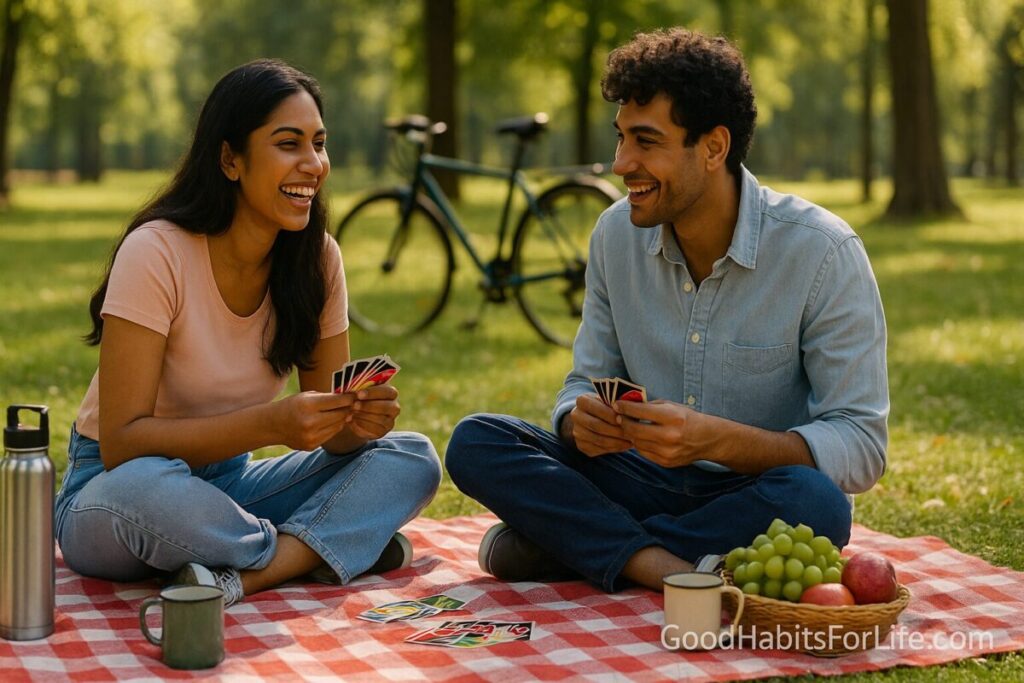
Try micro-adventures: sunrise walk, picnic with card prompts, geocaching.
-
Practice consent check-ins (“How are you feeling about pace?”).
Days 61–90: Expand & Sustain
-
Host home-base sober hang: mocktail tasting + puzzle night (clear boundaries, set end time).
-
Plan a half-day mini-trip: nature trail + lunch; museum district + sketching.
-
Reassess boundaries and compatibility; decide your default (e.g., “I don’t drink on dates”).
-
Keep a running list of wins and favorite formats.
🛠️ Techniques & Frameworks that Help
-
WOOP (Wish-Outcome-Obstacle-Plan): “Wish: make dating fun without drinks. Obstacle: social pressure. Plan: if someone suggests alcohol, then I use my script and offer two alternatives.”
-
Implementation intentions: Pre-decide actions: “If the venue is bar-centric, I suggest relocating.”
-
Anxiety tools (APA-aligned): slow breathing (inhale 4, exhale 6), grounding (5-4-3-2-1 senses), brief exposure (gradual practice with low-stakes socials).
-
Habit stacking: Pair date planning with weekly review—every Sunday, book one non-alcohol date.
-
Consent & communication: Use clear, affirmative language; check in about boundaries and timing.
🎒 Date Ideas (by vibe & budget)
| Vibe | Free / Low Cost | Moderate |
|---|---|---|
| Active | Park walk + photo challenge; public yoga; outdoor fitness trail | Climbing intro; kayaking; dance class |
| Creative | Library zine-making; sketch in a gallery; street-photography loop | Pottery wheel class; cooking workshop |
| Curious | Museum free day; historical walking tour app; campus lecture | Science center; escape room |
| Cozy | Farmers’ market + fruit tasting; board-game café (NA drinks) | Mocktail bar flight; indie cinema matinee |
| Nature | Sunrise hike + thermos tea; bird-watch mini-list | Botanical garden; bike rental |
Pro tip: Choose activities with built-in conversation cues (exhibits, prompts, shared tasks) to reduce first-date awkwardness.
🛡️ Safety Essentials
-
Meet in public, well-lit places; tell a friend where you’re going and when you’ll check in.
-
Arrange your own transport both ways; avoid being dependent on your date.
-
Keep drinks in sight; accept only sealed cans/bottles or watch prep.
-
Have exit lines and a code word with a friend.
-
Trust your gut; leave if something feels off—no justification needed.
👥 Audience Variations
-
Students: campus museum nights, peer-run events, language tables, study-date + snacks.
-
Professionals: lunch-and-walk near the office; gallery late nights; themed mocktail spots.
-
Parents (co-parenting schedules): time-boxed coffee + park bench, weekend daytime activities with clear wrap-up times.
-
Seniors: morning garden strolls, community choirs, heritage tours, matinee theater.
-
Teens/Young adults (where appropriate and legal): guardian-approved, public spaces, club meetings, zero-proof cafés.
⚠️ Mistakes & Myths to Avoid
-
Myth: “Dates need alcohol to be fun.”
Reality: Novelty and shared focus create more memorable connection. -
Mistake: Waiting until you’re seated to say you don’t drink.
Fix: Set expectations in chat or when proposing the plan. -
Myth: “Saying no is rude.”
Reality: Clear boundaries are respectful and attractive. -
Mistake: Choosing loud, bar-heavy venues.
Fix: Prioritize activity or daylight venues with varied menus.
💬 Real-Life Scripts (copy/paste)
Set the tone (apps/bio):
“Into coffee walks, museums, and markets. I don’t drink on dates—up for a gallery + tea?”
Suggest a plan:
“Free Saturday morning? Bookstore browse for 30 mins then chai across the street.”
Decline alcohol gracefully:
“Thanks, I don’t drink, but I’d love a sparkling water or tea.”
or “I’m alcohol-free—are you cool with a mocktail place or a gallery instead?”
Redirect from a bar:
“Bars aren’t my thing. How about the botanical garden or the board-game café?”
Set a boundary if pressed:
“I’m firm on not drinking. If that’s a dealbreaker, no worries—wishing you the best.”
Consent & check-in:
“I’m having a nice time. How are you feeling about pace and timing?”
Exit line (if needed):
“I’ve got to head out now, but thank you for meeting—take care.”
🧰 Tools & Resources
-
Venue finders: Google Maps lists for “mocktail” or “zero-proof”; museum free-day calendars.
-
Planning apps: Notion/Sheets for a date-idea library; calendar reminders.
-
Safety: Built-in phone location sharing; rideshare apps; personal check-in timers.
-
Learning: Short classes (community centers, adult ed), Meetup-style interest groups.
Pros & Cons (quick):
-
Activity dates: +Conversation starters, +memorable; −requires planning.
-
Daylight slots: +Safety, +energy; −less “romantic” lighting (fix with cozy venues).
-
Home hang (later stage): +Comfort, +budget; −requires strong boundaries.
📌 Key Takeaways
-
Lead with clear plans and early expectations.
-
Pick activity-based or daylight dates with non-alcoholic options.
-
Prepare scripts and a safety stack—clarity beats awkwardness.
-
Use the 30-60-90 roadmap to make sober dating normal, not novel.
-
Connection > cocktails. Presence is the point.
❓ FAQs
Is dating without alcohol awkward?
It may feel unfamiliar at first, but activity-based plans provide natural conversation and reduce first-date nerves.
Can I mention sobriety on my profile?
Yes. A simple line (“I don’t drink; into coffee walks and galleries”) sets expectations and attracts aligned matches.
What if my date orders alcohol?
You can still enjoy the date. If it conflicts with your boundary, redirect (“Next time, how about the climbing gym?”) or end early.
How do I handle social anxiety without a drink?
Use pre-planned coping (breathing 4-6, grounding, short exposures). Choose calmer venues and earlier times.
Are mocktails always alcohol-free?
Confirm with staff. Some include bitters (trace alcohol). Ask for zero-proof options or sealed alternatives.
Is it safer to date without alcohol?
Lower alcohol use reduces impairment and can support clearer consent and decision-making; still follow safety best practices.
What if someone pressures me to drink?
Repeat your boundary once; if pressure continues, leave. Your comfort matters.
How can I keep dates feeling “special”?
Add novelty: rotating neighborhoods, seasonal events, themed picnics, or skill classes.
Does skipping alcohol save money?
Usually yes—NA options and activity dates often cost less than cocktails.
How do I talk about recovery (if relevant)?
Share only what you’re comfortable with. A simple “I’m alcohol-free for health reasons” is enough; details are optional.
📚 References
-
Centers for Disease Control and Prevention (CDC). Alcohol and Public Health. https://www.cdc.gov/alcohol/
-
World Health Organization (WHO). Alcohol. https://www.who.int/health-topics/alcohol
-
National Institute on Alcohol Abuse and Alcoholism (NIAAA/NIH). Rethinking Drinking. https://www.rethinkingdrinking.niaaa.nih.gov/
-
Harvard T.H. Chan School of Public Health. Alcohol: Balancing Risks and Benefits. https://www.hsph.harvard.edu/nutritionsource/alcohol/
-
American Psychological Association (APA). Anxiety management & evidence-based strategies. https://www.apa.org/topics/anxiety
-
NHS (UK). Alcohol support & guidance. https://www.nhs.uk/live-well/alcohol-advice/
-
Mayo Clinic. Alcohol use: If you drink, keep it moderate. https://www.mayoclinic.org/healthy-lifestyle/nutrition-and-healthy-eating/in-depth/alcohol/art-20044551
-
SAMHSA. National Helpline (US). https://www.samhsa.gov/find-help/national-helpline
-
RAINN. Consent basics. https://www.rainn.org/articles/what-is-consent
Disclaimer: This article is for information only and is not a substitute for professional medical, mental-health, or legal advice. If alcohol use is harming you or others, seek qualified help.