
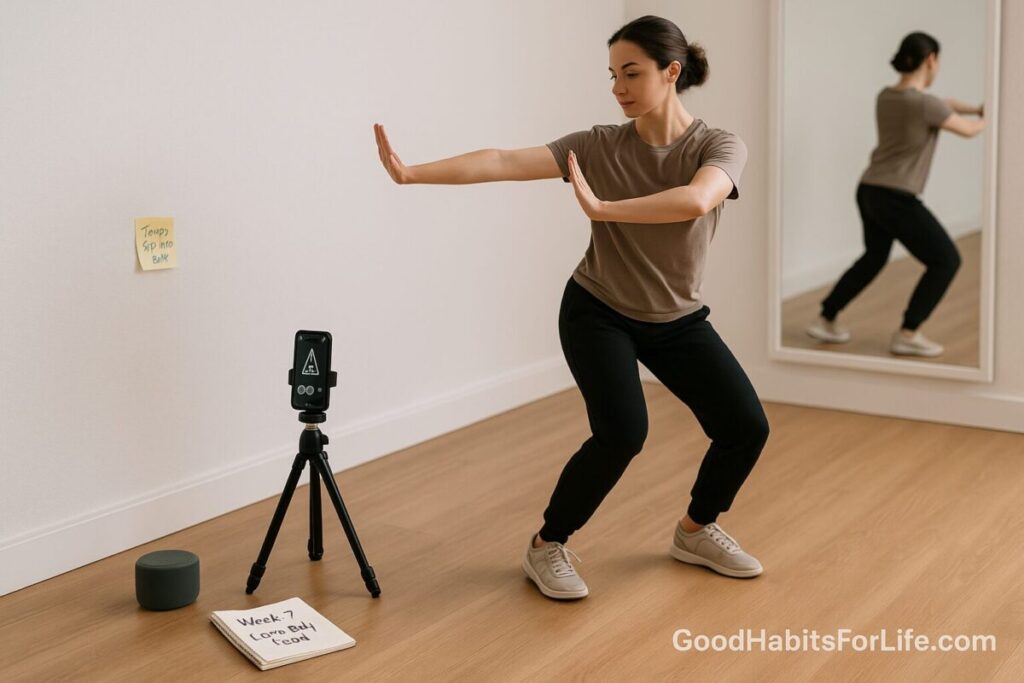
Dance Micro-Progressions: One Move a Week
Dance Micro-Progressions: One Move a Week
Table of Contents
🧭 What & Why
Micro-progressions mean shrinking your dance goals to the smallest meaningful unit—one move per week—and practicing it in short, focused bursts. Instead of trying to learn long routines all at once, you refine a single move across tempos, directions, and contexts, then stack it with other moves.
Why it works
-
Spaced (distributed) practice—short sessions across days—beats cramming for long-term learning and performance. PMC+1
-
Practice variability & interleaving—changing speeds, facings, entries/exits, and mixing moves—improves retention and transfer to real dancing. PMC+1
-
Rhythmic cues—metronomes and musical loops—aid timing via auditory-motor entrainment. MDPI
-
Warm-ups reduce injury risk and prep body & mind for high-quality reps. IADMS
✅ Quick Start (Do This Today)
-
Choose one move (e.g., shoulder roll, heel-toe swivel, body wave, basic spin). Name it.
-
Define success in 2 metrics:
-
Tempo you can execute cleanly (beats per minute).
-
Smoothness score (1–5) or a single take without stutter.
-
-
5-minute warm-up: easy pulse-raise, joint circles, gentle dynamic mobility. IADMS
-
12-minute practice block:
-
3′ slow isolation (half-time).
-
3′ tempo builds: 60 → 70 → 80 BPM.
-
3′ variable reps: different facings/arms/levels.
-
3′ one-take test on video; rate smoothness.
-
-
Log it: BPM reached, smoothness score, 1 note to fix tomorrow.
-
Cool down (2–3 min) and stop while fresh—fatigue tanks form and learning quality. IADMS
🛠️ 30-60-90 Habit Plan (One Move a Week)
Days 1–7 (Week 1: Move A)
-
Mon–Thu: 12–18 min blocks (as above).
-
Fri: Interleave Move A with a basic step (A-basic-A-basic).
-
Sat: “Context” day—use A in a 20–30 s freestyle.
-
Sun: Light review + film a clean 10 s clip.
-
Checkpoint: Hold form at +10–15 BPM vs. Monday and score ≥4/5 smoothness.
Days 8–14 (Week 2: Move B)
-
Repeat the structure for Move B.
-
Interleave A & B every session (A-B-A-B), which boosts retention even if practice feels messier. Frontiers
-
Checkpoint: B at goal BPM; A remains ≥ last week’s BPM with equal or better smoothness.
Days 15–21 (Week 3: Move C)
-
Add variable practice: switch facings (front/left/right/back), add travel (in-place → across floor), and level changes. PMC
-
Checkpoint: C at goal BPM in 3 contexts (in-place, traveling, with arm change).
Days 22–30 (Weeks 4–5: Moves D–E)
-
Keep the weekly cadence.
-
Combo build: stitch A-B-C in 8 counts; next week add D-E to form a 16-count phrase.
Days 31–60
-
Stack & rotate: Each week = new move + two old moves (e.g., F + review C & A).
-
Transfer test (weekly): One-take, no-stop 30 s freestyle including the new move at social-dance or class tempo.
Days 61–90
-
Performance cycle:
-
Week 9: Technique cleanup (slow tempo).
-
Week 10: Musicality (accent, swing, groove).
-
Week 11: Dynamics (level, speed, direction).
-
Week 12: Showcase video of 32 counts using 8 mastered moves.
-
🧠 Techniques & Frameworks (Science-Aligned)
-
Distributed practice: 10–20 min daily beats a single long weekly session for durable skill. PMC
-
Variable practice: Change one parameter per set—tempo, facing, entry/exit, level, or arm styling—to build adaptable schemas. PMC
-
Contextual interference: Alternate different moves (A-B-A-B…) to strengthen retention/transfer, even if short-term accuracy dips. Frontiers
-
Rhythmic entrainment: Use click tracks or looped grooves; syncing to external beats improves timing and coordination. MDPI
-
Warm-up essentials: pulse-raise → joint mobilization → light dynamic lengthening; 5–8 minutes is enough for micro-sessions. IADMS
-
Load & fatigue: Keep micro-sessions crisp; stop when form degrades to prevent “bad reps.” Schedule tougher conditioning after skill work. IADMS
-
General activity baseline: Meet weekly movement guidelines for health and recovery capacity. PMC
👥 Audience Variations
-
Students/Teens: 10–12 min after homework; track BPM and smoothness; use phone timer + metronome app.
-
Professionals (office): Lunchtime micro-block + evening review; focus on posture resets and ankle/calf mobility.
-
Parents: 8-minute “commercial-break” practice; dance with kids using simple counts to keep reps fun.
-
Seniors: Prioritize balance (weight shifts, step-touch) and moderate tempos; add chair support as needed; keep warm-up slightly longer.
-
Performers: Increase variability (lighting, flooring, footwear) and transfer tests (mirror/no mirror, audience/no audience).
⚠️ Mistakes & Myths to Avoid
-
Myth: “Long sessions are better.” → Truth: Spacing wins for memory and motor learning. PMC
-
Myth: “Always practice at full speed.” → Truth: Start slow; build tempo only when form is consistent.
-
Mistake: Grinding through fatigue. → Stop early; schedule conditioning after high-skill work. IADMS
-
Mistake: Never changing context. → Vary tempo, facings, and entries to generalize skills. PMC
-
Myth: “Interleaving is confusing, so it’s bad.” → Feeling messy in practice often signals better retention later. Frontiers
💬 Real-Life Examples & Scripts
12-Minute Block (copy-paste):
-
00:00–02:00 Warm-up pulse + joints
-
02:00–05:00 Move at 60 BPM (half-time)
-
05:00–08:00 Move at 70–80 BPM (tempo ladder)
-
08:00–10:00 Variable reps (change facing/arms)
-
10:00–12:00 One-take video + smoothness score
Interleaving Script:
“Three rounds: A@70 → B@70 → A@80 → B@80. Finish with 20 s freestyle using both.”
Weekly Review Prompt:
“Can I cleanly hit +10 BPM vs. Monday and keep ≥4/5 smoothness? If not, slow down and fix one detail.”
Combo Build:
“A(2)-B(2)-C(2)-groove(2) → repeat x2 → add D(2)-E(2) next week.”
🧰 Tools, Apps & Resources
-
Metronome / rhythm: Any metronome app; DAW-style loopers if you like grooves.
-
Video feedback: Phone camera + slow-mo; mark best take weekly.
-
Practice timer: Interval timer (work:rest 3:1).
-
Tracking: Spreadsheet or habit app; log BPM, smoothness (1–5), notes.
-
Floor & footwear: Smooth, non-slip surface; supportive shoes for impact styles.
-
Warm-up cues: 4 parts—pulse, joints, dynamic lengthening, light skill preview. IADMS
📚 Key Takeaways
-
Focus on one move per week; keep sessions short and high-quality.
-
Use spaced, variable, and interleaved practice to retain and transfer skills. PMC+2PMC+2
-
Rhythm tools improve timing; measure progress with BPM and smoothness. MDPI
-
Warm up and avoid fatigue spikes to protect technique and reduce risk. IADMS
-
Stack moves into phrases by Day 30, polish by Day 60, and showcase by Day 90.
❓ FAQs
1) How long should each micro-session be?
10–20 minutes is ideal for distributed practice; consistency matters more than session length. PMC
2) Do I need to practice daily?
Aim for 5–6 days/week. Spacing reps across days outperforms one long weekly session. PMC
3) Is a metronome necessary?
Not required, but beat cues improve timing and coordination; try 60–80 BPM ladders. MDPI
4) Should I practice only at full speed?
No. Start below target tempo and climb gradually; quality before speed.
5) How do I avoid injury with frequent practice?
Warm up 5–8 minutes and stop when form degrades; schedule conditioning after skill work. IADMS+1
6) What if interleaving feels messy?
That’s normal; interleaving often reduces short-term accuracy but boosts retention/transfer. Frontiers
7) Can this help social dancing or choreography?
Yes—variable practice (tempos, facings, entries) builds adaptability for real-world dancing. PMC
8) How does general fitness fit in?
Meeting weekly physical-activity guidelines supports recovery and capacity for quality practice. PMC
📚 References
-
International Association for Dance Medicine & Science (IADMS). The Importance of a Good Warm-Up. PDF. https://iadms.org/media/5788/iadms-resource-paper-the-importance-of-a-good-warm-up.pdf IADMS
-
Mawson RD. The Distributed Practice Effect on Classroom Learning. (2025) https://pmc.ncbi.nlm.nih.gov/articles/PMC12189222/ PMC
-
Czyż SH, et al. High contextual interference improves retention in motor skills. (2024) https://pmc.ncbi.nlm.nih.gov/articles/PMC11237090/ PMC
-
Frontiers Review: The effect of contextual interference on transfer in motor skill learning. (2024) https://www.frontiersin.org/articles/10.3389/fpsyg.2024.1377122/full Frontiers
-
Caballero C, et al. Applying different levels of practice variability for motor learning. (2024) https://pmc.ncbi.nlm.nih.gov/articles/PMC11212619/ PMC
-
Wang Y-N, et al. Effects of movement training based on rhythmic auditory stimulation. (2024) https://pmc.ncbi.nlm.nih.gov/articles/PMC11057238/ PMC
-
Pranjić M, et al. Neural mechanisms of auditory–motor entrainment and synchronization. (2024) https://www.mdpi.com/2076-3425/14/11/1063 MDPI
-
WHO. Guidelines on Physical Activity and Sedentary Behaviour. (2020) https://pmc.ncbi.nlm.nih.gov/articles/PMC7719906/ PMC
-
IADMS. Dance Physical Fitness Resource Paper. (2025) https://iadms.org/media/rwthabxe/iadms-resource-paper-dance-fitness.pdf IADMS
-
IADMS Blog. Are You Warm Enough to Start Dancing? (2017) https://iadms.org/education-resources/blog/2017/april/are-you-warm-enough-to-start-dancing/ IADMS
-
Schorn JM, et al. Contextual interference in motor sequence learning. (2020) https://cognitivesciencesociety.org/cogsci20/papers/0469/0469.pdf Cognitive Science Society
-
Kaipa R, et al. Constant, Variable, Random, and Blocked Practice—What Works? (2017) https://www.nzbri.org/resources/publications/404/Kaipa_%C2%A0Journal-of-Motor-Learning-and-Development_2017.pdf nzbri.org
⚖️ Disclaimer
This article shares general skill-building guidance; it is not a substitute for personalized medical, fitness, or rehabilitation advice.