
CutDowntoQuit: How to Taper with a Timeline: AI workflows (2025)
Cut Down to Quit: Timeline + AI Workflows (2025)
Table of Contents
🧭 What & Why
What is “cut down to quit”?
A structured reduction in cigarettes/day (CPD) over a set timeline—usually 2–6 weeks—ending in a firm Quit Day when you stop smoking completely. It’s evidence-supported, especially when combined with nicotine replacement therapy (NRT) or prescription meds and behavioral support (Quitlines, counseling, text programs) WHO, NICE NG209, USPSTF.
Why taper instead of going “cold turkey”?
A landmark trial found abrupt quitting can slightly outperform gradual reduction for some people; however, both methods work, and reduction + NRT notably improves quit rates versus reduction alone. The best method is the one you can stick with—with adequate medication and support JAMA 2016, Cochrane Review.
Health payoff starts fast:
Within 20 minutes heart rate drops; 24–48 hours carbon monoxide clears; 2–12 weeks circulation and lung function improve; 1 year coronary heart disease risk halves CDC, NHS.
✅ Quick Start (Do This Today)
-
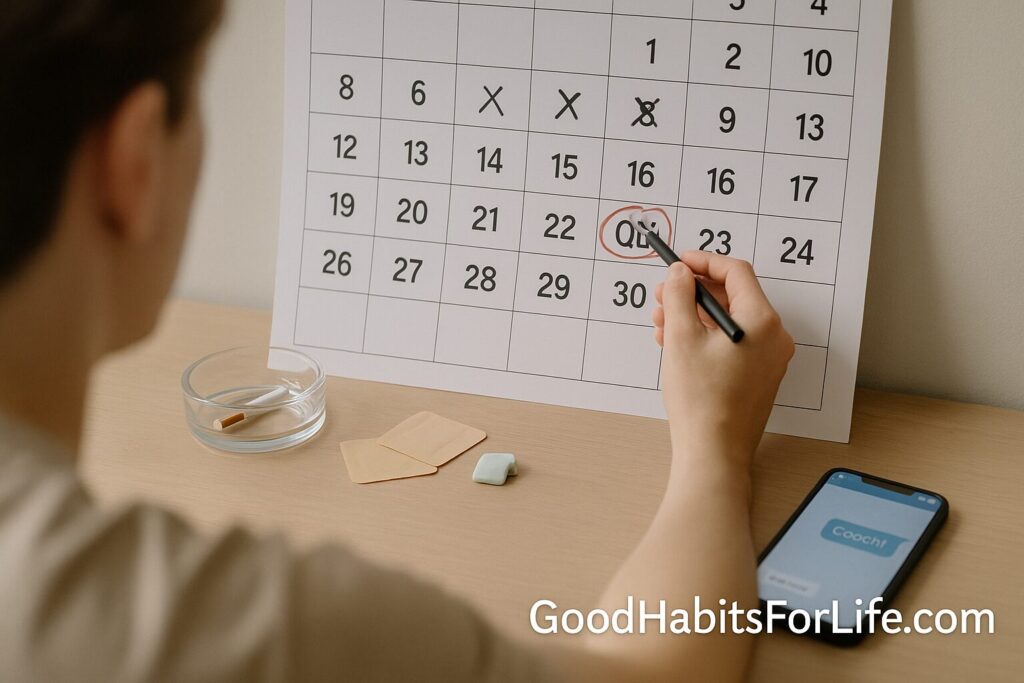
Pick a Quit Day 3–4 weeks from now (Sunday nights work well).
-
Baseline check: Write your average CPD and time-to-first-cigarette (TTFC). If TTFC ≤30 min, dependence is higher—plan on robust NRT support.
-
Start supports:
-
Quitline: Call your country’s quitline (e.g., India/State helplines, US: 1-800-QUIT-NOW).
-
Text coaching: Sign up for SMS programs (e.g., SmokefreeTXT/NCI) or your local equivalent.
-
-
Choose medication:
-
NRT options: patch + (gum/lozenge) for cravings. Typical starting patch dose for >10 CPD is 21 mg; ≤10 CPD may start 14 mg—follow product label and clinician advice.
-
Varenicline or bupropion: Ask your clinician; typically started 1–2 weeks pre-quit [NICE, USPSTF].
-
-
AI setup in 15 minutes:
-
Ask an AI assistant: “List my smoking triggers from my notes; draft 5 ten-second coping lines for each.”
-
Generate a calendar with daily goals and reminders (morning plan, evening review).
-
Create a reward list and urge-surfing script; save to your phone.
-
-
Remove cues: Lighters, ashtrays; clean car/clothes; set smoke-free rules at home and with friends.
-
Tell two supporters your Quit Day and plan; schedule check-ins.
🗓️ 30-Day CutDown-to-Quit Timeline
Goal: Reduce CPD by ~25% each week → Zero on Day 28–30 (Quit Day). Keep NRT/meds throughout and at least 8–12 weeks beyond Quit Day.
Week 1 (Days 1–7): Reduce to 75% of baseline
-
If baseline is 20 CPD → target 15/day.
-
Rules: No smoking before a set time (e.g., after coffee), extend intervals, and skip “trigger cigarettes” (after meals, driving).
-
NRT: Start patch in morning; use 2–4 mg gum/lozenge when urges spike.
-
Track: CPD, strongest trigger, craving (0–10).
Week 2 (Days 8–14): Reduce to 50%
-
20 CPD → 10/day.
-
Restructure routines: Walk after meals, change routes, swap coffee for tea/water in the morning.
-
Practice urge-surfing (90-second wave riding), 4-7-8 breathing, and delay-distract-decide.
Week 3 (Days 15–21): Reduce to 25%
-
20 CPD → 5/day.
-
Micro-rules: No two cigarettes within 2 hours; never smoke indoors/vehicles; smoke only while standing outside with a glass of water.
-
Quit rehearsal: One full practice day smoke-free using NRT fast-acting form.
Week 4 (Days 22–28/30): Quit Week
-
Days 22–26: 2/day → 1/day (if needed).
-
Quit Day (28–30): 0/day. Remove remaining packs. Increase fast-acting NRT for breakthrough urges.
-
Post-Quit (Weeks 5–12): Stay on patch per label; taper patch only after 6–8 weeks of stability. Keep fast-acting NRT handy.
Adjustments:
-
If you miss a daily target, do not reset the whole plan. Repeat the current day’s target tomorrow and continue.
🧠 Techniques & Frameworks That Work
The 5Ds (quick cravings toolkit)
-
Delay 10 minutes (set a timer).
-
Deep breathe (4-7-8 once, box breathing x3).
-
Drink water.
-
Do something else (2-minute task).
-
Discuss (text a supporter or your AI “coach”).
Identify & rewire triggers
-
Situations: coffee, commute, breaks, alcohol.
-
Emotions: stress, boredom, celebration.
-
People/places: smoking friends, balcony, office entrance.
-
For each trigger, pair an incompatible action (walk, mint, gum, call).
Medication pairing (evidence-aligned)
-
Patch provides steady nicotine; gum/lozenge/inhaler/spray cover spikes.
-
Combining forms improves success vs single form [NICE, Cochrane].
-
Varenicline reduces satisfaction from cigarettes; bupropion helps with withdrawal; both require a prescription and medical review.
Behavioral supports
-
Quitlines/text coaching and brief counseling raise quit rates, especially when layered with meds [USPSTF].
-
Digital CBT and contingency management (small rewards) reinforce progress.
Relapse planning
-
Treat slips as data: what was the trigger, what will you change?
-
Re-commit within 24 hours; use extra NRT dose and a coping script.
👥 Audience Variations
Students/Teens: Focus on social triggers and study routines. Replace breaks with 5-minute mobility or short walk with a friend; use app-based streaks and low-cost rewards.
Professionals: Combat desk and commute cues. Keep NRT in laptop bag; schedule “air breaks” (no phone) instead of smoke breaks; add calendar nudges before meetings.
Parents/Caregivers: Prioritize home smoke-free rules and car. Use children-related motivations and visible trackers on the fridge; ask family to be “no-offer” allies.
Seniors: Discuss medication interactions with clinician; pair taper with gentle activity after meals to replace habitual cigarettes; use larger font reminders and simple paper trackers.
⚠️ Mistakes & Myths to Avoid
-
Myth: “If I slip, I’m back to square one.” Truth: A slip is a cue to adjust—not a failure.
-
Myth: “Tapering never works.” With NRT/meds + counseling, tapering is effective and acceptable for many.
-
Mistake: Random reductions with no Quit Day. Set a date and work backward.
-
Mistake: Using NRT too little. Under-dosing leads to white-knuckling; follow labels and talk to a clinician.
-
Mistake: Keeping cues (ashtrays, “emergency” pack). Remove them early.
-
Mistake: Skipping morning plans and evening reviews.
💬 Real-Life Examples & Scripts
Coping lines (copy-paste):
-
“Urges peak and pass in 90 seconds. I ride the wave.”
-
“Not today. I protect my quit for the next 10 minutes.”
-
“I only smoke outdoors; I’ll walk for 3 minutes first.”
-
“Coffee → stretch + mint. Car → playlist + water.”
Boundary texts:
-
“I’m tapering to quit this month—please don’t offer me a cigarette.”
-
“If I text 🚩, please call me and ask what I need instead.”
If you slip:
-
“I learned my balcony is a trap after dinner. Tomorrow I’ll do dishes + gum right away.”
Reward menu (small, frequent):
-
₹100 / $3 treat jar per day goal met; weekly movie night; new playlist; car detail at Week 4.
🧰 Tools, Apps & AI Workflows
Evidence-based supports
-
Quitlines/Text Coaching: Free counseling, NRT vouchers in many regions.
-
Apps with CBT & tracking: Look for relapse plans, craving logs, NRT guidance, and coach messaging.
-
Smartwatch timers & step counters: Pair urges with 90-second “wave rides.”
AI workflows (simple + practical)
-
Trigger Mapper: Paste a week of notes; ask AI to tag triggers (time/place/emotion) and suggest 2 replacement actions per trigger. Export as a checklist.
-
Calendar Builder: Prompt: “Create a 30-day taper schedule from 20 CPD → 0, include daily targets, 2 reminders, and reward prompts.” Paste into Google Calendar.
-
Craving Coach:
-
Prompt: “Role-play a craving for after-dinner smoking; ask me 3 questions, then give a 45-second script and one 2-minute activity.”
-
-
Slip Analyzer: After any slip, paste what happened and ask: “What was the trigger? What one change protects me next time?”
-
Supporter Messages: Generate 5 short check-in texts for your ally to send on key days (Day 1, 7, 14, Quit Day, Day 35).
-
Reward Brainstormer: Have AI list 10 free/cheap rewards aligned with your interests (music, food, sports).
-
Data Dashboard: Keep a tiny spreadsheet (CPD, cravings 0–10, NRT used, mood); weekly, ask AI to summarize trends and adjust targets.
Pros/Cons (quick):
-
AI & apps: 24/7, personalized, private; but not a substitute for medical care.
-
Meds (NRT/varenicline/bupropion): Strong evidence; but need adherence and medical guidance.
-
Social support: Boosts success; but requires asking and boundary setting.
📌 Key Takeaways
-
Tapering is valid—especially with NRT/meds and counseling.
-
A 30-day plan (-25% each week) with a firm Quit Day keeps momentum.
-
AI can lighten the planning load: triggers, scripts, schedules, rewards, and reflection.
-
Treat slips as feedback, not failure. Keep supports for 8–12 weeks post-quit.
-
Every smoke-free day improves health and finances—compound those wins.
❓ FAQs
1) Is cutting down as effective as quitting abruptly?
Abrupt quitting sometimes shows higher short-term abstinence, but both work. With NRT/meds + support, tapering can be highly effective—choose the plan you’ll follow.
2) When should I start NRT if I’m tapering?
You can start patch on your planned Quit Day or use NRT during reduction to manage withdrawal; follow label/clinician guidance.
3) Can I smoke on the patch while tapering?
Many programs allow combining patch with occasional cigarettes during a reduction phase—but the goal is to reach zero. Read product instructions and consult a clinician.
4) How long should I stay on NRT?
Typically 8–12 weeks, tapering doses per label. Some benefit from longer use—discuss with a clinician.
5) What if I live with smokers?
Make home/car smoke-free, set boundaries (“no offers”), and schedule alternative shared activities (tea walk, after-dinner stretch).
6) How do I handle weight gain fears?
Plan snack swaps (fruit, yoghurt, nuts), water before meals, and 10-minute walks after triggers. Health benefits of quitting outweigh modest weight changes.
7) Are e-cigarettes a good taper tool?
Regulatory guidance varies. Some adults use regulated vaping products short-term to transition off cigarettes; discuss risks and local guidance with a clinician.
8) What if I relapse fully?
Re-set within a week: pick a new Quit Day, review triggers, increase support/medication, and try again. Most successful quitters have previous attempts.
📚 References
-
World Health Organization. Tobacco (health effects & quitting). https://www.who.int/news-room/fact-sheets/detail/tobacco
-
Centers for Disease Control and Prevention. Benefits of Quitting Smoking. https://www.cdc.gov/tobacco/quit_smoking/how_to_quit/benefits/index.htm
-
National Health Service (UK). Stop Smoking Advice. https://www.nhs.uk/live-well/quit-smoking/10-self-help-tips-to-stop-smoking/
-
JAMA. Lindson-Hawley N, et al. Abrupt vs Gradual Smoking Cessation. 2016. https://jamanetwork.com/journals/jama/fullarticle/2492881
-
Cochrane Tobacco Addiction Group. Interventions for reducing smoking for people who are not ready to stop (reduction approaches). https://www.cochranelibrary.com/cdsr/doi/10.1002/14651858.CD013183.pub2/full
-
NICE Guideline NG209 (2021). Tobacco: prevention and cessation. https://www.nice.org.uk/guidance/ng209
-
USPSTF (2021). Tobacco Smoking Cessation in Adults, Including Pregnant Persons. https://www.uspreventiveservicestaskforce.org/
-
National Cancer Institute (Smokefree). SmokefreeTXT & digital tools. https://smokefree.gov/tools-tips/text-programs
-
Cochrane Review (2019, updated). Combination vs single-form NRT. https://www.cochranelibrary.com/cdsr/doi/10.1002/14651858.CD008063.pub6/full
-
CDC. How to Use Quitline Services. https://www.cdc.gov/tobacco/quit_smoking/cessation/quitlines/index.htm
Disclaimer: This article is for general education and does not replace personalized medical advice—consult your clinician, especially before using medications.