
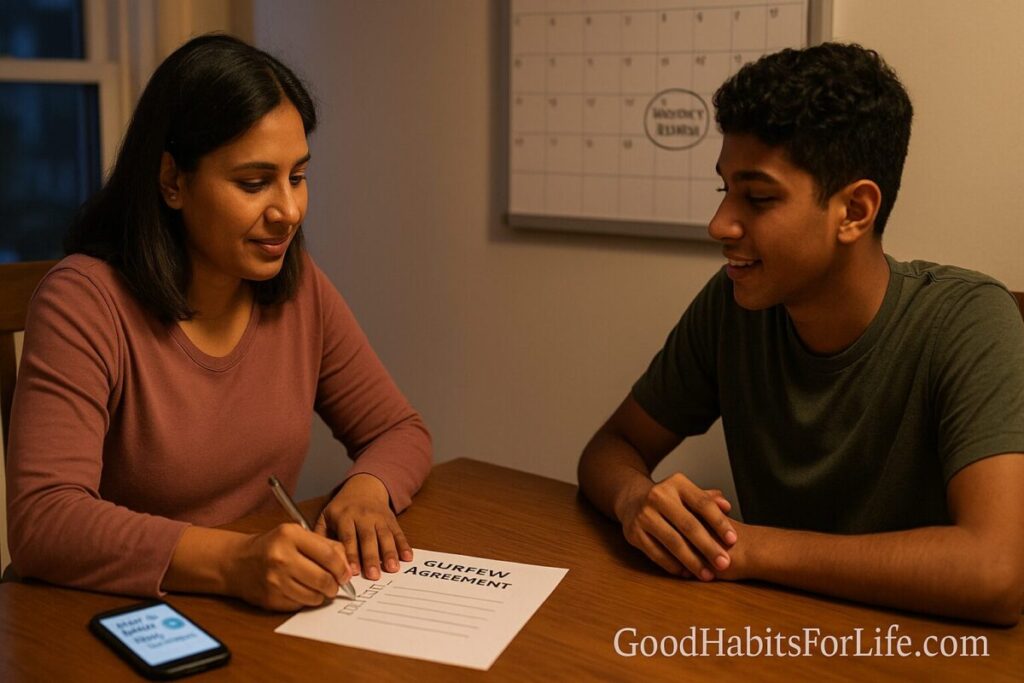
Curfews & CheckIns: Write It Down, Review Monthly
Teen Curfew & Check-Ins: Write It Down, Review Monthly
Table of Contents
🧭 What & Why
What: A written, shared curfew with simple check-in rules (time, place, plan, and contact method) plus a monthly review to adjust as teens grow.
Why it works
-
Clarity reduces conflict. Teens do better with specific expectations and predictable follow-through.
-
Parental monitoring (knowing who/where/when) is protective against risky behaviors, including alcohol and drug use.
-
Regular reviews shift curfews from power struggles to problem-solving: “What’s working? What needs a tweak?”
-
Alcohol awareness: Clear no-alcohol rules, safe-ride plans, and check-ins reduce harm and make it easier for teens to ask for help.
🚀 Quick Start (Do This Today)
-
Pick one channel for check-ins (e.g., WhatsApp/Signal text).
-
Write the basics (1 page):
-
Night(s) covered, home-by time, grace period (e.g., 10 minutes), and who they’re with.
-
Check-in times (e.g., arriving, mid-evening, leaving, if plans change).
-
Alcohol rule: no alcohol; call for a safe ride anytime—no punishment for calling.
-
Consequences for late/no check-in; rewards for a perfect month.
-
-
Add safety scripts (ready-to-send texts + call phrases).
-
Set a monthly review date (first Sunday, 15 minutes).
-
Sign it together (parent/guardian + teen) and post it where everyone sees it.
-
Track the month: on-time %, missed check-ins, any alcohol-risk situations and how they were handled.
🛠️ Curfew & Check-In Agreement Template
Copy/paste into Notes/Docs and customize.
Teen Name: ____ | Parent/Guardian: ____ | Month: ____
1) Curfew Times
| Day | Home By | Grace | Notes |
|---|---|---|---|
| Sun–Thu | 21:30–22:00 (9:30–10 pm) for 14–15; 22:30–23:00 for 16–17 | 10 min | School nights; adjust for exams |
| Fri–Sat | 22:30–23:30 for 14–15; 23:30–24:00 for 16–17 | 10 min | Later with reliable history & safe ride |
Adjust for local laws, transport options, events, and maturity.
2) Check-Ins
-
Arrival: “Here w/ [friend], at [place].”
-
Mid-evening: “All good. Leaving at [time].”
-
Leaving: “Leaving now; ETA [time].”
-
Plan change: “Plan changed: now at [new place] w/ [who]. New ETA [time].”
3) Alcohol & Safety
-
No alcohol/drugs.
-
Safe-ride policy: Call/text “SAFE” anytime for a no-questions-asked pickup that night; we’ll debrief calmly next day.
4) Consequences (predictable, brief)
-
Late ≤10 min: lose 30 minutes from next weekend curfew.
-
Late >10 min or missed check-in: earlier curfew next week and an extra check-in.
-
Pattern (2+ times in a month): pause social outings for one weekend and reset the plan.
5) Rewards (reliability earns freedom)
-
Perfect month: +15–30 minutes next month, one extra outing, or later movie/game night.
6) Monthly Review (date/time): ______
Signatures: Teen ______ | Parent/Guardian ______
📅 30-60-90 Day Habit Plan
Days 1–30 (Start & Stabilize)
-
Use the written agreement.
-
Track on-time %, missed check-ins, and any safety incidents.
-
Teach and rehearse the scripts; do one “practice pickup.”
-
Review at Day 30; adjust 15 minutes earlier/later based on data.
Days 31–60 (Build Reliability)
-
Add one “late-return scenario drill” (rain, ride canceled).
-
If 90%+ on-time and zero missed check-ins, extend weekend curfew by 15 minutes.
-
Debrief any alcohol-risk moments using calm, open questions.
Days 61–90 (Autonomy with Accountability)
-
Shift to two check-ins on low-risk nights (arrival + leaving).
-
Introduce a self-report: teen logs ETA estimates vs actual.
-
If reliability holds, reduce grace penalties; keep monthly review.
🧠 Techniques & Frameworks that Work
-
Collaborative rules (not top-down): Teens are more likely to follow rules they helped create.
-
SMART limits: Specific, Measurable (times, check-ins), Achievable (transport), Relevant (safety), Time-bound (monthly resets).
-
Behavioral data > feelings: Decide adjustments on on-time percentage, missed check-ins, and problem-free nights.
-
Pre-commitment: Sign the agreement; it turns intentions into follow-through.
-
If-Then plans: “If plans change, then I text the new location and ETA before moving.”
-
Positive reinforcement: Reliability earns later times or fewer check-ins.
-
Alcohol-specific planning: Safe-ride policy, buddy system, and refusal lines reduce harm and make help-seeking easier.
👥 Audience Variations
-
Younger teens (13–15): Earlier times, more structured check-ins, parent-verified rides.
-
Older teens (16–17): Later times tied to reliability; integrate driver rules (no passengers, weather limits, nighttime driving restrictions where applicable).
-
Single-parent or two-household families: Mirror the same written plan in both homes; agree one check-in channel.
-
Rural areas (longer travel): Larger grace window; earlier “leaving” check-in to account for distance.
-
Events (prom, concerts, festivals): Use an event-specific addendum: venues, chaperones, meeting points, curfew exception with pre-approved ride.
-
Neurodivergent teens: Visual schedules, alarms, and fewer, clearer rules; practice check-ins with prompts.
⚠️ Mistakes & Myths to Avoid
-
Myth: “Curfews don’t work.”
Reality: Vague curfews don’t. Clear, written rules with check-ins and fair consequences do better. -
Mistake: Using GPS tracking as a substitute for trust.
Fix: Use location sharing sparingly and transparently; still require active check-ins. -
Mistake: Only punishing late returns.
Fix: Reward reliability to reinforce the habit. -
Mistake: Never adjusting.
Fix: Monthly reviews prevent resentment and keep safety aligned with maturity. -
Mistake: Ignoring alcohol-risk moments.
Fix: Debrief calmly the next day; refine the safe-ride plan and refusal scripts.
🗣️ Real-Life Examples & Scripts
1) Before heading out
-
Teen → Parent: “With Maya/Jay at Nisha’s, 18:30–22:30. I’ll text when I arrive and when I leave. If plans change, I’ll text new place + ETA.”
-
Parent → Teen: “Thanks. If you need a ride, text SAFE anytime. Have fun, be smart.”
2) If running late
-
Teen: “Running 10–15 late; leaving now, ETA 22:45.”
-
Parent: “Got it. See you at 22:45. Drive/walk safely.”
3) Safe-ride text
-
Teen: “SAFE. At 5th & Oak. Please pick me up.”
-
Parent: “On my way. We’ll talk tomorrow. Proud you called.”
4) Plan change
-
Teen: “Plan changed: going to Anaya’s. With Maya/Jay. Leaving at 22:10. New ETA 22:35.”
-
Parent: “Thanks for the update.”
5) Monthly review opener
-
Parent: “You were on time 11/12 nights; one missed check-in. What made it easy on good nights? What should we tweak for the busy days?”
🧰 Tools, Apps & Resources (quick pros/cons)
-
Shared family chat (WhatsApp/Signal/iMessage):
Pros: Simple, universal, easy media/location share. Cons: Muted notifications; agree on tone and timing. -
Shared calendar (Google Calendar/Outlook):
Pros: Plan visibility; reminders. Cons: Needs upkeep. -
Location sharing (iOS Find My / Google Maps):
Pros: Backup safety layer. Cons: Privacy concerns—use with consent and clear rules. -
Driving safety (built-in Focus/Do Not Disturb While Driving):
Pros: Reduces distractions. Cons: Teens may forget to enable—automate if possible. -
Simple habit tracker (Notion, Google Sheets):
Pros: Visibility of on-time %. Cons: Manual entry.
📌 Key Takeaways
-
Put curfew and check-ins in writing; keep it one page and specific.
-
Pair curfew with alcohol-free rules and a no-blame safe-ride option.
-
One channel for check-ins; use short scripts.
-
Review monthly; reward reliability with more freedom.
-
Use data, not drama: on-time %, missed check-ins, and what helped or hindered.
❓ FAQs
1) What’s a reasonable curfew for a 15-year-old?
Start around 21:30–22:00 on school nights and 22:30–23:00 on weekends, then adjust for maturity, transport, and local norms/laws.
2) Should I use GPS tracking?
Use as a backup safety tool, not a substitute for communication. Be transparent, ask consent, and still require active check-ins.
3) How strict should consequences be?
Predictable and brief is best (e.g., earlier curfew next week). Pair with rewards for reliability.
4) What if my teen is at a party with alcohol?
Re-state the no-alcohol rule and safe-ride policy. If they call for help, prioritize safety first; debrief next day and adjust the plan.
5) How do I handle repeated late returns?
Tighten next week (earlier time, extra check-in), troubleshoot barriers (ride issues, time blindness), and rehearse scripts.
6) Can teens help set the curfew?
Yes—co-creating rules increases buy-in and responsibility. Use the monthly review to revisit.
7) How does school workload or sports affect curfew?
Busy seasons may need earlier times on weekdays and clearer study blocks; revisit during the monthly review.
8) What about licensed teen drivers?
Add driving-specific rules: no passengers at first, weather limits, and comply with any local nighttime driving restrictions.
9) Is a “no questions asked” ride policy too lenient?
It’s a safety net, not a free pass. Promise calm pickup now and a respectful debrief tomorrow.
10) How do we include two households?
Mirror the same plan across homes, share the calendar/chat, and keep one check-in channel.
📚 References
-
Centers for Disease Control and Prevention (CDC). Underage Drinking: Facts. https://www.cdc.gov/alcohol/fact-sheets/underage-drinking.htm
-
National Institute on Alcohol Abuse and Alcoholism (NIAAA). Make a Difference: Talk to Your Child About Alcohol. https://www.niaaa.nih.gov
-
Substance Abuse and Mental Health Services Administration (SAMHSA). “Talk. They Hear You.” https://www.samhsa.gov/talk-they-hear-you
-
National Institute on Drug Abuse (NIDA). Family Checkup: Positive Parenting Prevents Drug Abuse. https://nida.nih.gov/prevention/family-checkup
-
American Academy of Pediatrics (HealthyChildren.org). Help Your Teen Make Safe Choices. https://www.healthychildren.org
-
World Health Organization (WHO). Adolescent Alcohol Use—Fact Sheets. https://www.who.int
-
U.S. National Highway Traffic Safety Administration (NHTSA). Teen Driving & Nighttime Restrictions. https://www.nhtsa.gov/road-safety/teen-driving
⚖️ Disclaimer
This article provides general information about parenting, teen safety, and alcohol awareness and is not medical or legal advice.