
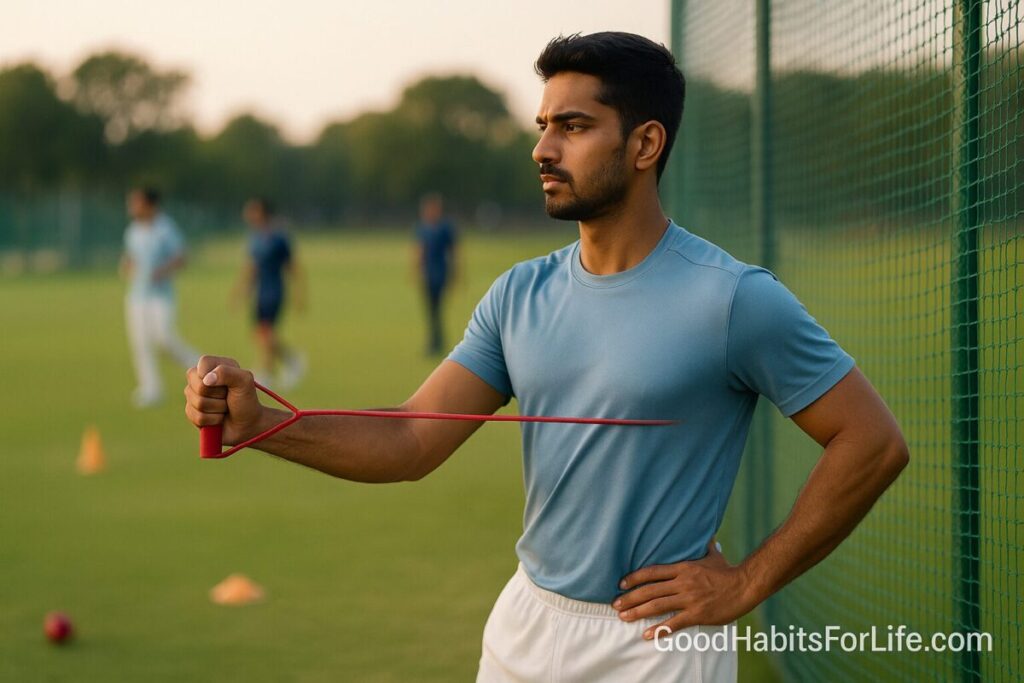
Cricket Shoulder & Elbow Care: Zone 2 + NEAT (2025)
Cricket Shoulder & Elbow Care: Zone 2 + NEAT (2025)
Table of Contents
🧭 What This Is & Why It Works
Cricket shoulders and elbows take repetitive load—bowling, throws from the deep, direct hits from fielding drills, even wicketkeeping throws. The most durable athletes combine (1) aerobic base work (so tissues recover faster between efforts), (2) NEAT—non-exercise movement all day—to keep blood flow high and stiffness low, and (3) targeted prehab for the scapula, rotator cuff, and forearm tendons. NEAT is the energy you spend on everything that isn’t sleep, eating, or sports exercise; higher NEAT supports healthier body composition and recovery. Physiology Journals
Health bodies recommend ~150–300 min/week of moderate activity (or 75–150 min vigorous) plus 2+ days of strength. This is an excellent umbrella for cricket conditioning, within which Zone 2 and NEAT fit perfectly. CDCACSM
What about Zone 2 specifically? Zone 2 generally sits around the first ventilatory threshold (VT1)—a pace where you can speak in full sentences. It is a low-strain way to expand mitochondrial capacity and aerobic efficiency; however, evidence cautions against treating Zone 2 as uniquely “magic”—a mix of intensities is still best for overall cardiometabolic gains. PMCPubMed
Workload matters. Sudden spikes in bowling volume increase overuse injury risk, especially for juniors. Adult and high-level players also benefit from planned loads and recovery windows. PubMedPlay Cricket
✅ Quick Start (Do This Today)
-
Set your Zone 2. Use the talk test: pace where you can chat comfortably. If you track HR, aim roughly near VT1 (often ~60–70% HRR for many athletes, but individualize). Do 30–45 min, 3×/week—bike, jog, brisk walk, row, or swim. PMC
-
Turn up NEAT. Hit 8–10k steps/day or insert 5-minute movement snacks every hour: stairs, walk-and-talk calls, band pull-aparts, desk push-ups. Physiology Journals
-
10–15-minute Prehab Circuit (3–5×/week):
-
Warm-up smarter: 8–12 minutes: pulse raise → mobility (T-spine, posterior shoulder) → activation (band ERs, scapular push-ups) → progressive throws/bowling run-ups. Upper-body warm-ups improve performance and may reduce injury risk. PubMed
-
Plan bowling loads: Track balls/session, RPE (1–10), and rest at least 24–48 h after your heaviest day. For juniors, follow age-appropriate ball caps and avoid sharp spikes. Play Cricket
-
Pain rules: Mild, warming “stiffness” that settles within 24 h is okay. Sharp pain, night pain, or weakness → stop, regress, and consult a clinician.
🛠️ 30-60-90 Day Habit Plan (Roadmap)
Days 1–30 — Foundation
-
Zone 2: 3×/week × 30–40 min (bike/treadmill/row/field laps).
-
NEAT: Baseline step count + 2k/day (e.g., 6k → 8k).
-
Strength (2×/week):
-
A: Goblet squat, hip hinge, split squat, plank, farmer’s carry.
-
B: Push-up or incline press, row, landmine press, Pallof press.
-
-
Prehab: 10–15 min after warm-up or as a separate micro-session (scapular + cuff + eccentrics).
-
Workload: Log balls/session and RPE; avoid >20–30% weekly spikes.
-
Checkpoints: Pain 0–3/10 only; shoulder flex/ext equalizing; grip strength steady.
Days 31–60 — Build
-
Zone 2: 3–4×/week × 35–50 min; add one tempo (VT1–VT2) set of 10–20 min every 7–10 days. PMC
-
NEAT: 8–10k steps; add 5-min mobility walks after meals.
-
Strength (2–3×/week): progress loads; add single-arm overhead carries, face pulls, reverse flys.
-
Prehab: Keep 3–5×/week; micro-doses on heavy bowling days (lower volume, perfect form).
-
Workload: Introduce bowling micro-cycles: e.g., Heavy (H) / Light (L) / Rest / Moderate (M) / Skill (S) / Rest / Fielding.
-
Checkpoints: Throwing velocity stable without pain flare >24–48 h; sleep and HRV normal.
Days 61–90 — Perform
-
Zone 2: Maintain 3×/week; include one longer 60–75 min easy session pre-tournament week to top up aerobic base.
-
NEAT: Sustain 9–11k steps with built-in movement breaks on travel days.
-
Strength: Power emphasis 1–2×/week (med-ball scoop tosses, low-volume Olympic-style derivatives if coached).
-
Prehab: Maintain; taper volume 5–7 days before multi-day matches.
-
Workload: Hold stable weekly balls; avoid last-minute spikes pre-event.
🧠 Techniques & Frameworks (Zones, NEAT, Workload)
Zones in plain English.
-
Zone 2 = VT1: “Comfortable conversation” pace. If using HR, many land roughly ~60–70% HR reserve; lactate is steady/low. Use VT1 markers if available for better accuracy. PMC
-
Why not only Zone 2? Reviews suggest Zone 2 is useful but not uniquely superior; sprinkling higher intensities (tempos/intervals) yields broader benefits. PubMed
NEAT as your safety net. Walk more, stand more, carry your kit, tidy the field. These “in-between” movements keep shoulders and elbows perfused without adding high strain. Physiology Journals
Workload governance.
-
Track balls + RPE: Session load = balls × RPE.
-
Spacing: 24–48 h between heaviest bowling days.
-
Juniors: adhere to national guidelines; injury risk rises with high weekly loads and rapid spikes. PubMedPlay Cricket
-
Adults: avoid extreme weeks >~170 balls without gradual build and recovery. symmetry.physio
Prehab pillars (evidence-aligned).
-
Scapular stabilization reduces pain/disability in subacromial issues—train serratus anterior, lower traps, and controlled upward rotation. PMCFrontiers
-
Eccentric loading is first-line for lateral elbow tendinopathy; progress slowly, pain-guided. PMC
-
Thrower’s Ten variants cover most shoulder needs for overhead athletes—use light bands/dumbbells and strict control. ortho.ufl.edu
-
Warm-ups (8–12 min) enhance performance and may reduce injury risk. PubMed
👥 Variations (Juniors, Club Adults, Pros, Roles)
-
Junior players (U17/U19): Obey age-based ball caps and build 8–10 weeks into season. Emphasize technique coaching, sleep, and growth-spurt monitoring. Play Cricket
-
Club adults: Time-poor? Keep two 35–45 min Zone 2 sessions + one 10-minute daily NEAT block (commute walks) + 12-minute prehab on training days.
-
Semi-pro/pro: Periodize: aerobic base in off-season, mixed intensities in season, micro-dosed strength on match weeks, aggressive load tracking and recovery modalities.
-
Fast bowlers: Extra attention to scapular control, hip-to-shoulder separation, and progressive sprint work; bowl-load monitoring is non-negotiable.
-
Batters/wicketkeepers: Don’t skip elbow prehab—eccentric wrist and forearm strength pay off during long innings/throws.
-
Spin bowlers: Forearm/grip endurance and shoulder rotation mobility matter; use lower-load, higher-rep eccentrics.
⚠️ Mistakes & Myths to Avoid
-
“Zone 2 fixes everything.” It’s valuable—not magical. Keep a mix of intensities. PubMed
-
Skipping NEAT on work days. Hours of sitting stiffen tissues; mini-walks are protective. Physiology Journals
-
No warm-up, all max drills. Cold tendons + high intent = trouble. PubMed
-
Only big lifts, no scapular work. The cuff works best atop stable scapulae. PMC
-
Blasting eccentrics through pain. Work near the edge, not over it; progress load every 7–10 days. PMC
-
Load spikes before tournaments. Your tissues adapt to what you do weeks earlier, not the week of. PubMed
🛠️ Real-Life Routines & Scripts
Daily 12-Minute Shoulder–Elbow Micro-Circuit (no gym):
-
Band external rotations (elbow by side) × 12–15
-
Scapular wall slides × 8–12
-
Serratus punches (band or light DB) × 12–15
-
Eccentric wrist extension with DB × 12
-
Eccentric wrist flexion with DB × 12
-
Hammer pronation/supination × 10 each
(2 rounds, breathe nasal, slow tempo)
Bowling-Day Warm-up (10 minutes):
-
2 min brisk walk/jog + arm swings
-
2 min T-spine rotations + band pull-aparts
-
3 min cuff activation: side-lying ER, 90/90 band ER/IR
-
3 min build-ups: 3–4 progressive run-ups; 4–6 easy deliveries → groove
Coach Script (load chat):
“How many balls last week? What was your toughest day (RPE out of 10)? Any pain >24 h? Let’s plan your H/L days and your rest windows this week.”
Self-Talk on Pain:
“Is this discomfort staying ≤3/10 and improving as I warm up? If it climbs or lingers overnight, I downshift and adjust tomorrow’s plan.”
🧰 Tools, Apps & Resources
-
HR trackers/watches (Garmin, Polar, Apple, COROS): easy Zone 2 monitoring; HR can be noisy in first 5–8 minutes—use the talk test too.
-
Step/NEAT trackers (phone pedometer, watch rings): nudge hourly movement.
-
Strength/prehab apps (Strong, Volt, TrainHeroic): log sets and pain notes.
-
Timers (Seconds, Tabata): for time-boxed micro-circuits.
-
Bands/handles, light DBs, hammer: cheap, portable prehab tools.
-
(Optional) Lactate meter: only if coached; not necessary for most.
Pros/Cons quick take:
-
Wearables simplify compliance (pro), but don’t outsource your body awareness (con).
-
Apps improve logging (pro), but can tempt you into chasing numbers over feel (con).
📌 Key Takeaways
-
Build aerobic capacity (Zone 2) and keep NEAT high to recover better between efforts. PMCPhysiology Journals
-
Protect tissues with scapular-cuff prehab and eccentric forearm work. PMC+1
-
Warm up before you throw or bowl; plan loads and avoid spikes—especially for juniors. PubMed+1
-
Follow the 30-60-90 plan and adjust using pain and performance checkpoints.
❓ FAQs
1) How much Zone 2 should cricketers do?
Start with 3×/week × 30–45 min. In season, keep it short and easy; in off-season, you can extend one session to 60–75 min.
2) Is Zone 2 better than intervals?
No single intensity is best for everything. Zone 2 is great for base and recovery; periodically add tempos/intervals for wider benefits. PubMed
3) What step count should I target?
Aim for 8–10k steps/day or frequent movement breaks if steps are low—both count as NEAT. Physiology Journals
4) How many balls per week is “too many”?
Avoid sudden spikes. For adults, very high weekly volumes (>~170 balls) are riskier unless you’ve built up progressively; juniors must follow age-specific caps. symmetry.physioPlay Cricket
5) What’s a simple shoulder prehab plan?
Scapular wall slides, serratus punches, band external rotations, and prone Y-T-W 3–5×/week (10–15 min). PMC
6) How do I train the elbow tendons?
Use eccentric wrist extension/flexion and hammer rotations; progress slowly and keep pain tolerable. PMC
7) Should I warm up even for casual nets?
Yes—8–12 min of pulse, mobility, activation, and a progressive throwing ramp helps performance and may reduce injury risk. PubMed
8) I sit all day—what’s the minimum effective NEAT?
Set a timer for 5 minutes every hour: stand, walk, band pull-aparts, desk push-ups. Over a day, that’s 40–60 minutes of extra movement. Physiology Journals
9) Does bat speed or bowling speed drop if I do too much cardio?
Not if you keep most cardio low-strain (Zone 2) and separate hard cardio from heavy bowling/strength days.
10) When should I seek help?
If pain >24–48 h, night pain, locking, or weakness appear—book a sports-qualified physio or sports physician.
📚 References
-
Levine JA. Non-exercise activity thermogenesis (NEAT): environment and biology. AJP-Endocrinology & Metabolism (2004). https://journals.physiology.org/doi/abs/10.1152/ajpendo.00562.2003 Physiology Journals
-
CDC. Physical Activity Guidelines for Adults. (2023). https://www.cdc.gov/physical-activity-basics/guidelines/adults.html CDC
-
ACSM. Physical Activity Guidelines (Adults). https://acsm.org/education-resources/trending-topics-resources/physical-activity-guidelines/ ACSM
-
Meixner B, et al. Zone 2 Intensity: A Critical Comparison of Individual Markers. Sports (2025). https://pmc.ncbi.nlm.nih.gov/articles/PMC11986187/ PMC
-
Storoschuk KL. Much Ado About Zone 2: A Narrative Review… (2025). https://pubmed.ncbi.nlm.nih.gov/40560504/ PubMed
-
Australian Cricket. Junior Bowling Guidelines. https://play.cricket.com.au/community/resources/player-safety/junior-bowling-guidelines Play Cricket
-
Dennis RJ, et al. Is bowling workload a risk factor for injury… BJSM (2005). https://pubmed.ncbi.nlm.nih.gov/16244195/ PubMed
-
Symmetry Physio (compiling CA data). Bowling Workload Guidelines. https://symmetry.physio/wp-content/uploads/2019/08/Well-Played-Bowling-Guidelines.pdf symmetry.physio
-
Ravichandran H, et al. Effect of scapular stabilization… J Back Musculoskelet Rehabil (2020). https://pmc.ncbi.nlm.nih.gov/articles/PMC7365732/ PMC
-
Yoon SY, et al. Eccentric exercise in lateral elbow tendinopathy: Systematic review and meta-analysis. (2021). https://pmc.ncbi.nlm.nih.gov/articles/PMC8432114/ PMC
-
Wilk KE. Thrower’s Ten Exercise Program (PDF). University of Florida Ortho. https://www.ortho.ufl.edu/sites/default/files/2023-03/Throwers-Ten_0.pdf ortho.ufl.edu
-
McCrary JM, et al. Upper body warm-up: performance & injury prevention. J Sci Med Sport (2015). https://pubmed.ncbi.nlm.nih.gov/25694615/ PubMed
Disclaimer
This article offers general fitness/health information for cricketers and is not a substitute for personalized medical advice; consult a qualified professional for diagnosis or treatment.