
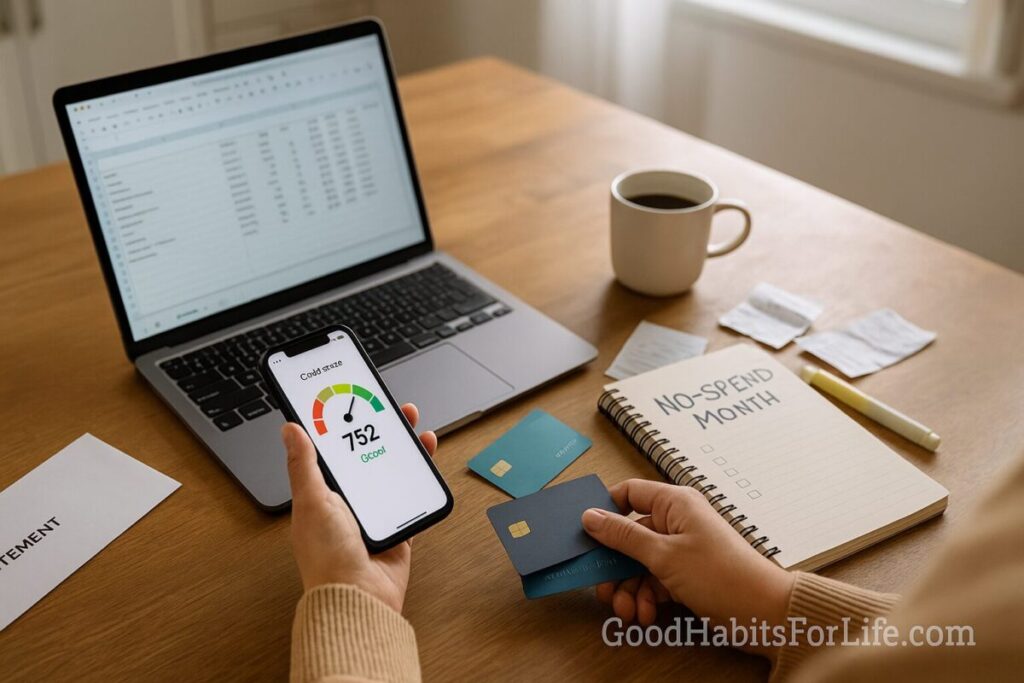
Credit Scores 101: What Moves the Needle: No-Spend Challenge (2025)
Credit Scores 101: What Moves the Needle (No-Spend)
Table of Contents
🧭 What & Why
What is a credit score?
A credit score predicts how likely you are to repay debt on time, based on your credit report data. Lenders, landlords, and insurers use it to set approvals, rates, and limits. Consumer Financial Protection Bureau
Which models matter?
Two major models are used widely in the U.S.: FICO® and VantageScore®. Both look at similar behaviors, though the exact math differs. myFICOVantageScore
What really moves the needle? (typical FICO® weights)
| Factor | Why it matters | Typical FICO® weight | Moves you can make |
|---|---|---|---|
| Payment history | On-time payments signal reliability | ~35% | Autopay minimums; never miss due dates. myFICO |
| Amounts owed / Utilization | How much of your credit you use | ~30% | Pay balances early/often; request limit increases; avoid maxing out. myFICOConsumer Financial Protection Bureau |
| Length of history | Age of accounts | ~15% | Keep old accounts open; use them lightly. myFICO |
| New credit / inquiries | Recent applications | ~10% | Batch rate-shopping; avoid unnecessary apps. Consumer Financial Protection Bureau |
| Credit mix | Variety of accounts | ~10% | Build responsibly over time; it’s a minor factor. myFICO |
Note: VantageScore doesn’t publish fixed percentages; it labels factors (e.g., payment history) as more or less influential. VantageScore
✅ Quick Start (Do This Today)
-
Pull your free credit reports (Equifax, Experian, TransUnion) at AnnualCreditReport.com—the only site authorized by U.S. law. Scan for errors. Consumer Financial Protection Bureauannualcreditreport.comConsumer Advice
-
Dispute any inaccuracies with both the bureau and the furnisher (the company that reported it). Use the FTC’s step-by-step and sample letter. Consumer Advice+1
-
Set autopay for at least minimums on every account to protect payment history. (Payment history is the biggest factor.) myFICO
-
Lower utilization fast:
-
Make a mid-cycle payment before the statement closes.
-
Target the card with the highest utilization first.
-
Ask for a credit limit increase (without hard pull when possible). Keep overall and per-card use under 30%; <10% is ideal. Consumer Financial Protection Bureau+1
-
-
Avoid unnecessary hard inquiries. Hard pulls can nudge scores down temporarily; rate-shopping windows are often treated as a single inquiry. Consumer Financial Protection Bureau+1
-
Consider rent/utility reporting (fees vary) if you’re new to credit. Positive rent data can build or reveal credit history. Consumer Financial Protection BureauNational Low Income Housing Coalition
🛠️ 30-60-90 Habit Plan (with a 30-Day No-Spend Challenge)
Why a no-spend month? Implementation-intention research (say “If it’s a weekday lunch, then I’ll eat from home”) shows medium-to-large effects on follow-through. Pairing a no-spend challenge with debt payoff frees cash and reduces utilization. ScienceDirectPMC
Days 1–30: No-Spend Challenge (Core Rules)
-
Define allowed essentials (rent, utilities, groceries, transport, meds) and blocked categories (eating out, fashion, gadgets, impulse buys).
-
Write 5–7 if-then plans for triggers (e.g., “If I see a flash sale, then I wait 24 hours”).
-
Track every rupee/dollar. Redirect all savings to the highest-utilization card every Friday.
Weekly checkpoints
-
Week 1: Pull reports; fix errors; set autopay; pay down highest-utilization card. Consumer Financial Protection BureauConsumer Advice
-
Week 2: Request credit limit increases where soft-pull; set payment reminders 3 days pre-due. Consumer Financial Protection Bureau
-
Week 3: Add rent reporting (if cost-effective) and keep new apps at zero. Consumer Financial Protection Bureau
-
Week 4: Review spending leaks; extend no-spend to 45 days if balances remain >30% utilization.
Days 31–60
-
Shift from blanket no-spend to a “needs-only” budget with a cash envelope for one discretionary category.
-
Continue Friday pay-downs and mid-cycle payments on any card >10% utilization. Consumer Financial Protection Bureau
Days 61–90
-
Add one small recurring savings transfer (commitment device). Pre-commitment programs like Save More Tomorrow demonstrate why this works. Chicago Journals
-
Build a one-bill buffer in checking to avoid accidental late payments.
🧠 Techniques & Frameworks that Move Scores
-
Implementation Intentions: Write specific if-then rules for spending and payments (e.g., “If it’s salary day, then I immediately pay ₹X toward Card A”). ScienceDirect
-
Avalanche vs. Snowball: Mathematically, prioritize highest interest rate (avalanche), but if motivation is waning, knock out a small balance (snowball) to sustain adherence—behavioral momentum matters (implementation intentions help either path). PMC
-
Statement-Date Payments: Pay before the statement closes so lower balances get reported to bureaus. (Helps utilization even if you pay in full monthly.) Consumer Financial Protection Bureau
-
Inquiry batching: Rate-shop mortgages/auto within a focused window so scoring models count multiple pulls as one. Consumer Financial Protection Bureau
-
Positive file building: Consider secured cards or credit-builder loans if thin/no file. Federal Reserve research outlines these as credit-building products. Federal Reserve
👥 Variations by Audience
-
Students / New-to-Credit: Start with a secured card; keep one streaming bill on it; pay in full monthly; consider authorized user status with a trusted family member (less impact than primary accounts, but can help). myFICO
-
Professionals: Automate minimums + add a twice-monthly principal sweep to the priciest card; watch corporate-card reporting differences.
-
Parents of Teens: Add teens as authorized users with low limits and written rules; monitor. Investopedia
-
Seniors: Guard against fraud; freeze credit if not seeking new accounts; keep oldest accounts open to preserve age.
⚠️ Mistakes & Myths to Avoid
-
“I should carry a balance to build credit.” Myth—paying in full is best; interest doesn’t help scores. (Utilization and on-time payments do.) Consumer Financial Protection Bureau
-
Closing old cards “to be safe.” Can raise utilization and reduce age—both can hurt. Consumer Financial Protection Bureau
-
Multiple new cards at once. Hard inquiries/new accounts can dip scores; batch rate-shopping where allowed. Consumer Financial Protection Bureau+1
-
Ignoring errors. Dispute with both the bureau and the furnisher—use the FTC templates. Consumer Advice+1
-
BNPL blind spot. Starting fall 2025, new FICO 10 BNPL/10T BNPL scores will incorporate BNPL data where reported—late BNPL payments could now count. FICO
💬 Real-Life Examples & Scripts
-
Credit limit increase (chat/app):
“Hi, I’ve been a customer for X years with on-time payments. I’d like to request a credit limit increase to ₹/__ (no hard inquiry if possible) to improve my utilization ratio.” -
Goodwill adjustment (email):
“In [MM/YYYY], I had a one-time late payment due to [brief reason]. Since then I’ve paid on time. Would you consider a one-time courtesy adjustment?” -
Rent reporting (landlord/PM):
“Do you participate in a rent-reporting program that shares on-time payments with the bureaus? If not, are you open to enabling one?” Consumer Financial Protection Bureau -
Dispute letter (error on report):
Use the FTC’s sample to list the item, why it’s inaccurate, and request correction; send to the bureau and furnisher. Consumer Advice
🧰 Tools, Apps & Resources (pros/cons)
-
AnnualCreditReport.com — Free reports (official). Pro: comprehensive; Con: scores not included. annualcreditreport.com
-
CFPB Guides — Plain-English explainers on scores, inquiries, and improvement. Pro: authoritative; Con: U.S.-centric. Consumer Financial Protection Bureau+2Consumer Financial Protection Bureau+2
-
FTC Dispute Resources — How to fix errors + sample letters. Pro: templates; Con: DIY time. Consumer Advice+1
-
myFICO Education — Official FICO factor weights and tips. Pro: model specifics; Con: paid products upsell. myFICO
-
VantageScore Knowledge Center — Factor influence and examples. Pro: model clarity; Con: no fixed % weights. VantageScore
-
Rent/Utility Reporting Services — Can help thin files. Pro: builds history for some; Con: fees; not all bureaus/models use the data. Consumer Financial Protection Bureau
📌 Key Takeaways
-
On-time payments and low utilization are your biggest levers.
-
Pull free reports, fix errors, and automate payments now.
-
A 30-day no-spend challenge frees cash to cut balances fast.
-
Don’t close old cards; avoid unnecessary hard inquiries.
-
Watch BNPL—FICO’s 2025 update could make those payments count.
❓ FAQs
1) How fast can my credit score improve?
Minor gains can appear in one to two statement cycles after lowering utilization or fixing errors; payment-history strength builds over months/years. myFICO
2) What’s the best utilization target?
Stay under 30% overall and on each card; <10% is even better for top tiers. Consumer Financial Protection Bureau+1
3) Does checking my own credit hurt my score?
No. That’s a soft inquiry and doesn’t affect your score. Consumer Financial Protection Bureau
4) Should I close unused cards?
Usually no—closing can raise utilization and reduce average age, both negative. Consumer Financial Protection Bureau
5) How many cards should I have?
There’s no perfect number. Focus on on-time payments and low utilization; avoid opening several at once. myFICOConsumer Financial Protection Bureau
6) What’s the difference between FICO and VantageScore?
Both predict credit risk using similar inputs; FICO publishes typical weight ranges, while VantageScore lists factors by influence rather than fixed percentages. myFICOVantageScore
7) Do BNPL plans affect my score?
They typically haven’t—but FICO 10 BNPL/10T BNPL will begin incorporating BNPL data where reported starting fall 2025. FICO
8) I found an error—who do I contact?
Dispute with both the credit bureau and the furnisher (company that reported it). Use the FTC template. Consumer Advice+1
9) Can being an authorized user help?
Sometimes—especially for thin files—but it has less impact than accounts where you’re the primary. myFICO
10) Where do I get my free reports?
AnnualCreditReport.com—the only site authorized by U.S. law. Consumer Financial Protection Bureauannualcreditreport.com
📚 References
-
Consumer Financial Protection Bureau. What is a credit score? https://www.consumerfinance.gov/ask-cfpb/what-is-a-credit-score-en-315/ Consumer Financial Protection Bureau
-
myFICO. What’s in your FICO® Scores? https://www.myfico.com/credit-education/whats-in-your-credit-score myFICO
-
VantageScore. Credit Scoring 101: Factors that Affect Your VantageScore. https://vantagescore.com/resources/knowledge-center/credit-scoring-101-factors-that-affect-your-vantagescore-credit-score VantageScore
-
CFPB. How do I get and keep a good credit score? https://www.consumerfinance.gov/ask-cfpb/how-do-i-get-and-keep-a-good-credit-score-en-318/ Consumer Financial Protection Bureau
-
FTC. Disputing Errors on Your Credit Reports + Sample Letter. https://consumer.ftc.gov/disputing-errors-your-credit-reports ; https://consumer.ftc.gov/sample-letter-disputing-errors-credit-reports-business-supplied-information Consumer Advice+1
-
AnnualCreditReport.com + CFPB confirmation link. https://www.annualcreditreport.com ; https://www.consumerfinance.gov/ask-cfpb/how-do-i-get-a-free-copy-of-my-credit-reports-en-5/ annualcreditreport.comConsumer Financial Protection Bureau
-
CFPB. What’s a credit inquiry? and Which inquiries don’t affect scores? https://www.consumerfinance.gov/ask-cfpb/whats-a-credit-inquiry-en-1317/ ; https://www.consumerfinance.gov/ask-cfpb/what-kind-of-credit-inquiry-has-no-effect-on-my-credit-score-en-321/ Consumer Financial Protection Bureau+1
-
Federal Reserve (FEDS Notes). Developments in the Credit Score Distribution over 2020—utilization’s role. https://www.federalreserve.gov/econres/notes/feds-notes/developments-in-the-credit-score-distribution-over-2020-20210430.htm Federal Reserve
-
Federal Reserve (FEDS Notes). An Overview of Credit-Building Products (secured cards/credit-builder loans). https://www.federalreserve.gov/econres/notes/feds-notes/an-overview-of-credit-building-products-20241206.html Federal Reserve
-
FICO Newsroom. FICO Unveils Scores Incorporating BNPL Data (FICO 10 BNPL/10T BNPL), Fall 2025. https://www.fico.com/en/newsroom/fico-unveils-groundbreaking-credit-scores-incorporate-buy-now-pay-later-data FICO
-
Gollwitzer & Sheeran (2006). Implementation Intentions and Goal Achievement: A Meta-analysis. (summary access) https://www.sciencedirect.com/science/article/pii/S0065260106380021 ; open-access review: https://pmc.ncbi.nlm.nih.gov/articles/PMC8149892/ ScienceDirectPMC
Disclaimer: This guide is for general educational purposes and isn’t financial advice; consider consulting a qualified professional for your situation.