
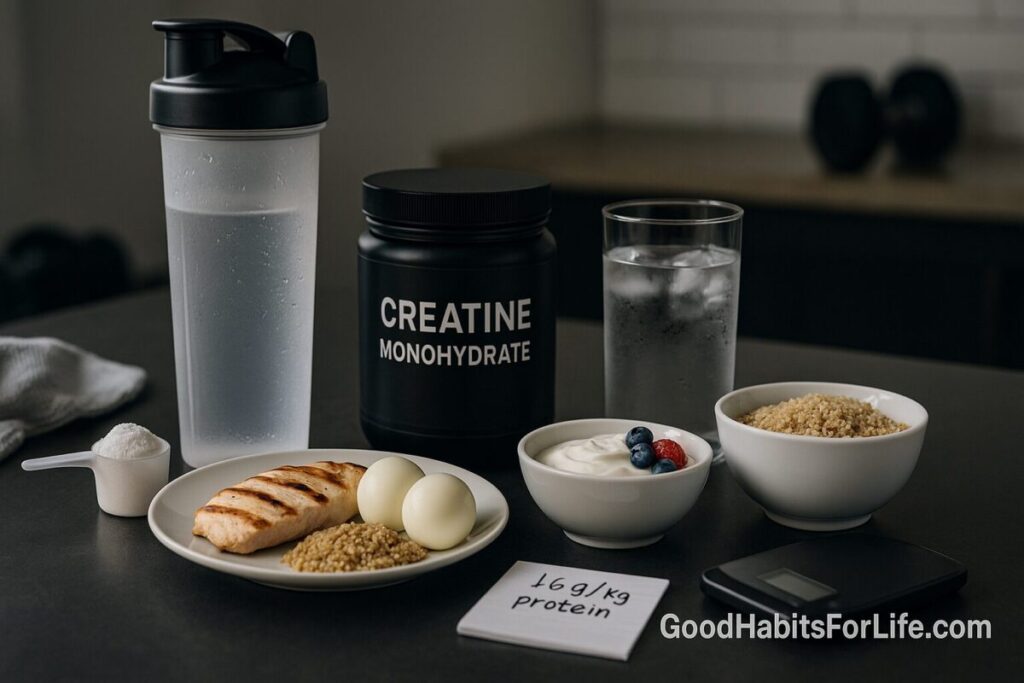
Creatine & Hydration: What to Know: Protein-Forward Plan (2025)
Creatine & Hydration: Protein-Forward Plan (2025)
Table of Contents
🧭 What & Why
Creatine 101. Creatine monohydrate increases muscle phosphocreatine, improving high-intensity work and training quality. Position stands classify it as one of the few supplements with consistent performance benefits. British Journal of Sports MedicinePubMed
Hydration link. Contrary to old locker-room myths, creatine does not dry you out. Research shows it increases total body water (mostly inside muscle cells) and does not impair thermoregulation—even in the heat. PMCBioMed Central
Safety snapshot. In healthy adults using recommended doses (3–5 g/day or ~0.1 g/kg/day), creatine is well-tolerated and not associated with kidney damage; creatinine may rise on labs without reflecting kidney injury. People with kidney disease should seek medical advice before use. BioMed CentralPubMed
Why “protein-forward.” For strength & physique goals, daily protein around ~1.6 g/kg/day maximizes hypertrophy gains; spreading protein across meals enhances synthesis. Creatine complements this by enabling harder training and lean mass gains. PubMedMDPI
✅ Quick Start: Today’s Checklist
-
Pick your form: Creatine monohydrate (micronized if you prefer) from a brand certified by NSF Certified for Sport® or Informed Sport. nsf.orgInformed Sport
-
Dose it:
-
Standard: 3–5 g once daily.
-
Optional loading (faster saturation): ~0.3 g/kg/day split into 4 doses for 5–7 days, then 3–5 g/day. Taylor & Francis Online
-
-
Hydrate smart: With your daily creatine, drink 500–750 ml water. For workouts >1 h, aim ~0.6–1.2 L/h, include 30–60 g carbs/h, and 0.5–0.7 g sodium/L. Adjust to sweat rate and conditions. PubMedkhsaa.org
-
Go protein-forward: Hit ~1.6 g/kg/day total protein, roughly 0.3–0.4 g/kg per meal, 3–5 times daily. PubMed
-
Timing: Take creatine any time daily; pairing with post-workout carbs/protein is convenient. Consistency matters more than clock time. Taylor & Francis Online
-
Track: Morning body mass, urine color (aim pale-straw), session RPE, and performance notes each week. (See “Sweat-Rate” below.)
🛠️ 30-60-90 Protein-Forward Roadmap
Days 1–30: Load Habits, Not Just Muscles
-
Creatine: 3–5 g daily with 500–750 ml water.
-
Hydration: Weigh pre/post key sessions for sweat rate (guide below).
-
Protein: Hit 1.6 g/kg/day. Example 70 kg: ~110 g/day across 4 meals (≈28 g each).
-
Training: 3–4 resistance sessions/week; log key lifts/reps.
-
Checkpoint (Day 30): +0.5–1.5 kg body mass from water/glycogen is common; strength and work capacity up.
Days 31–60: Dial in Fuel & Fluids
-
Session fueling (>1 h): 30–60 g carbs/h via drink/chews; 0.5–0.7 g sodium/L in bottle. PubMedkhsaa.org
-
Protein distribution: Add a pre-sleep 20–30 g protein if daily target is missed.
-
Habits: Pre-pack a shaker with creatine + maltodextrin or sip with a meal.
Days 61–90: Performance Push
-
Progressive overload: +2.5–5 % on key lifts where reps are comfortably met.
-
Heat strategy: Increase fluids 10–20 % on hot/humid days; consider an extra 250–500 ml with sodium during warm-ups.
-
Review (Day 90): Compare logs; if plateaued, audit protein intake, sleep, and in-session carb/sodium.
🧠 Hydration Frameworks (Sweat-Rate, Sodium, Carbs)
1) Sweat-rate calculator (simple):
Pre-exercise body mass − post-exercise body mass + fluids consumed − urine (if measured) = sweat loss (kg) ≈ L. Divide by session hours for L/h. Replace ~75–100 % over the next 2–4 h. (Method aligned with ACSM/NATA practice.) PubMednata.org
2) Sodium targets:
For sessions >1 h or heavy sweaters/salty white stains: 0.5–0.7 g sodium per liter of fluid (≈500–700 mg/L). khsaa.org
3) Carbohydrates during training:
For endurance or mixed sessions >1 h: 30–60 g carbs/h (drink/chew/gel), often via 6–8 % carb beverages (60–80 g/L). PubMed
4) Euhydration cue:
Aim to start training with pale-straw urine and normal body mass for you; avoid >2 % body-mass loss during sessions. PubMed
🛠️ Techniques: Timing, Stacking & Heat Strategy
-
Timing matters less than consistency. Daily adherence saturates muscle stores; choose a time you never miss. Taylor & Francis Online
-
Stack with carbs + sodium around training to support fluid absorption (sodium-glucose co-transport) and steady energy. Use the sodium/carbs targets above. khsaa.orgPMC
-
Heat & humidity: Since creatine raises intracellular water, many athletes perceive better heat tolerance; still prioritize fluids/electrolytes and cooling. BioMed Central
-
Vegetarians/low-meat eaters: Often start with lower muscle creatine; may see pronounced benefits. BioMed Central
-
Sick days / GI upset: Pause loading; resume maintenance once well.
👥 Audience Variations
-
Students / Busy professionals: Keep a desk drawer kit: 1 scoop creatine in a labeled tub + 750 ml bottle. One scoop daily at lunch = done.
-
Parents training early: Pre-mix a 750 ml bottle the night before; sip 1/2 during warm-up, 1/2 in session.
-
Seniors (strength & function): Creatine plus resistance training supports lean mass and functional strength—stick to 3 g/day with adequate hydration and protein at each meal. BioMed Central
-
Endurance athletes: For long runs/rides, prioritize carb/sodium delivery; creatine won’t directly fuel endurance but may aid sprint surges and strength work. British Journal of Sports Medicine
⚠️ Mistakes & Myths to Avoid
-
“Creatine dehydrates you.” Evidence shows increases in total body water and no impairment of hydration or thermoregulation. PMCBioMed Central
-
Skipping sodium. Plain water alone during long/hot training dilutes plasma sodium and can risk hyponatremia; include 0.5–0.7 g/L sodium. khsaa.org
-
Overcomplicating dosing. Fancy forms aren’t better; monohydrate is the gold standard. Taylor & Francis Online
-
Ignoring protein spread. Hitting 1.6 g/kg/day matters; cluster it into 3–5 meals for best effect. PubMed
-
Buying uncertified supplements. Risk of contamination exists; choose NSF Certified for Sport® or Informed Sport products. nsfsport.comInformed Sport
💬 Real-Life Examples & Scripts
A. Daily routine (70 kg lifter, 90-min gym):
-
08:00 Breakfast: 30 g protein (eggs/curd), 500 ml water.
-
12:30 Lunch: 30 g protein.
-
16:30 Shaker: 3–5 g creatine + 600 ml bottle with 36–48 g carbs (6–8 % mix) + 0.5–0.7 g sodium/L.
-
17:00–18:30 Train; sip ~800–1000 ml total (≈30–60 g carbs).
-
19:00 Dinner: 30 g protein.
-
22:00 Yogurt/milk 20–25 g protein if target short.
B. Quick script to set sweat-rate habit:
“Weigh before and after two typical sessions this week. If I lose 1.0 kg in 90 min and drank 500 ml, my sweat rate ≈ (1.0 kg + 0.5 L) / 1.5 h = 1.0 L/h. I’ll aim to sip 0.8–1.0 L/h next time.”
C. Label-check for a creatine tub:
-
Ingredient: Creatine monohydrate (no blends).
-
Third-party mark: NSF Certified for Sport® or Informed Sport.
-
Serving: 3–5 g.
🧰 Tools & Resources
-
Certification databases: NSF Certified for Sport® and Informed Sport to find tested products. nsfsport.comInformed Sport
-
Nutrition trackers: Use any macro tracker to hit ~1.6 g/kg/day protein and monitor carbs.
-
Hydration log: Record pre/post body mass, session length, bottle volume, and conditions; compute L/h weekly.
-
Position stands for coaches: ISSN (creatine) and ACSM (fluid replacement) linked below for deeper guidance. Taylor & Francis OnlinePubMed
📌 Key Takeaways
-
Creatine monohydrate works, is safe for healthy adults at 3–5 g/day, and does not cause dehydration. Taylor & Francis OnlinePMC
-
Hydration for >1 h sessions: 30–60 g carbs/h, 0.5–0.7 g sodium/L, ~0.6–1.2 L/h fluid—personalize via sweat-rate. PubMedkhsaa.org
-
A protein-forward target of ~1.6 g/kg/day complements creatine for strength and physique goals. PubMed
-
Choose third-party-certified supplements to minimize contamination risk. nsfsport.com
❓ FAQs
1) Does creatine make you cramp or dehydrate?
No. Studies show increased total body water and no negative impact on hydration or temperature regulation. Keep normal hydration habits. PMCBioMed Central
2) Loading or not?
Loading (~0.3 g/kg/day for 5–7 days) saturates stores faster, but 3–5 g/day works over several weeks. Taylor & Francis Online
3) Best time to take creatine?
Any time you’ll remember daily. Many pair it with post-workout protein/carb for convenience. Taylor & Francis Online
4) Will I gain weight?
Often 0.5–1.5 kg in the first weeks from water/glycogen within muscle—usually helpful for performance. PMC
5) Is creatine safe for kidneys?
In healthy adults using recommended doses, evidence shows no kidney harm; creatinine may rise without indicating dysfunction. People with kidney disease or on nephrotoxic meds should consult a clinician. PubMed
6) What about endurance athletes?
Creatine is not an endurance fuel, but may aid sprints/finishes and strength work. Prioritize the carb/sodium/fluid plan for long sessions. British Journal of Sports Medicine
7) Do vegetarians need more?
Not necessarily “more,” but they often start lower in muscle creatine and may see robust responses at standard doses. BioMed Central
8) Is any creatine form better than monohydrate?
No strong evidence supports superiority over monohydrate; it’s the best-studied and most cost-effective. Taylor & Francis Online
9) How much should I drink with creatine?
With the daily dose, ~500–750 ml water is a simple rule of thumb; adjust total daily fluids to thirst, urine color, and sweat-rate. PubMed
10) How do I avoid contaminated supplements?
Buy only NSF Certified for Sport® or Informed Sport certified products. nsfsport.comInformed Sport
📚 References
-
International Society of Sports Nutrition (ISSN) Position Stand—Creatine safety & efficacy. Journal of the ISSN (2017). Taylor & Francis OnlinePubMed
-
ISSN—Common questions & misconceptions about creatine (2021). BioMed Central
-
Creatine increases total body water without altering distribution. Int J Sport Nutr Exerc Metab (2003). PMC
-
Creatine, hydration & thermoregulation review. JISSN (2012). BioMed Central
-
American College of Sports Medicine (ACSM) Exercise & Fluid Replacement Position Stand—carb, sodium, fluid guidance (2007). PubMed
-
ACSM Position Stand details (carb 30–60 g/h; 0.5–0.7 g sodium/L). PubMedkhsaa.org
-
NIH Office of Dietary Supplements—Exercise & Athletic Performance fact sheet (overview of ergogenic aids including creatine). Office of Dietary Supplements
-
Protein for hypertrophy meta-analysis: ~1.6 g/kg/day maximizes gains. Br J Sports Med (2018). PubMedBritish Journal of Sports Medicine
-
Joint Position—Nutrition & Athletic Performance (ACSM/AND/DC, 2016). PubMed
-
Supplement certification: NSF Certified for Sport®; Informed Sport—program overviews and batch testing. nsfsport.comInformed Sport
Disclaimer: This guide is educational and not a substitute for personal medical advice; consult your healthcare professional if you have kidney disease, take medications, are pregnant/breastfeeding, or have other health concerns.