
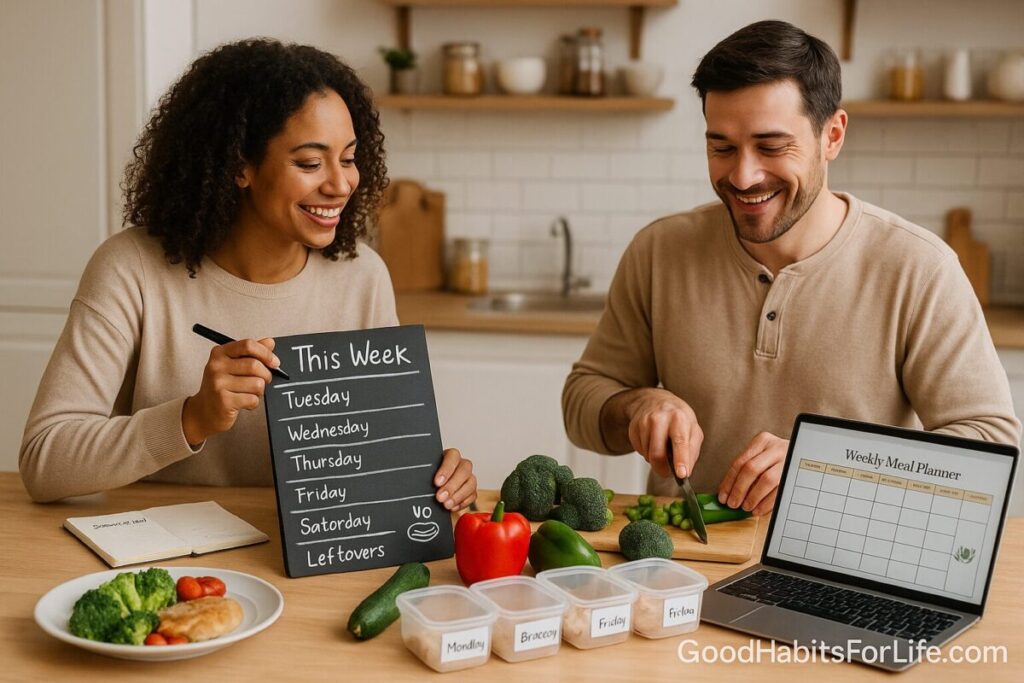
Couples Meal Planning: Fair, Flexible, Fun
Couples Meal Planning: Fair, Flexible, Fun
Table of Contents
🧭 What Couples Meal Planning Is (and Why It Works)
Definition. Couples meal planning is a shared, repeatable rhythm for deciding what to eat, who does what, and when, so you both eat well without one person carrying the invisible “mental load.”
Why it works
-
Healthier eating patterns. Planning is linked with better diet quality and food variety in large populations.
-
Less waste, lower spend. A plan reduces impulse buys and helps use what you have—key levers for cutting household food waste.
-
Fairer division of labor. Naming roles and decisions reduces the “cognitive labor” that often falls on one partner, which is associated with better relationship satisfaction.
-
Family benefits. When kids are involved, simple, predictable meals support balanced plates and calmer mealtimes.
Evidence snapshot (see References): Harvard Healthy Eating Plate and WHO “Healthy Diet” outline composition basics; research connects meal planning with diet quality; FAO/WRAP highlight food-waste drivers; Daminger’s work details the mental load of household management; APA/USDA resources show skills that support shared routines.
✅ Quick Start: Do This Today (30–45 minutes)
1) Kitchen audit (10 min).
Open fridge/freezer/pantry. List quick-to-use items (e.g., 500 g paneer, 4 eggs, 1 kg potatoes, 2 cans chickpeas).
2) Decide 7 easy dinners (10 min).
Choose familiar, 20–30-minute options. Example rotation:
-
Veggie curry + brown rice
-
Lentil dal + roti + cucumber raita
-
Stir-fry (tofu/chicken) + mixed veg + noodles
-
Omelette + sautéed veg + toast
-
Chole + jeera rice
-
Pasta + tomato-lentil sauce + salad
-
“Leftovers night” / soup & sandwiches
3) Split this week’s roles (5 min).
-
Menu & list owner: drafts list in the shared app.
-
Shopping & storage owner: buys, labels, and stores.
-
Prep owner: does Sunday batch prep (see below).
Rotate these weekly.
4) Shop once (or click & collect) (5–10 min).
Stick to the list; add 2 flexible veg (e.g., bell peppers, spinach) and 1 “wild card” for fun.
5) 60-minute prep block (same day or next).
Cook 1 base grain (e.g., 1 kg rice), 1 protein (e.g., 600 g chicken or 2 cups cooked lentils), chop 3–4 veg, make 1 sauce (e.g., yogurt-mint or tomato masala). Store in clear boxes.
6) Daily rhythm (5 min).
Each evening, glance at the plan, pull what needs thawing, confirm tomorrow’s cook. That’s it.
🧱 Build a Fair System (Not Just “Help”)
The problem: Many couples “wing it,” and one partner ends up being the CEO of food—planning, remembering, troubleshooting. The fix is shared ownership of decisions and recurring tasks.
Use the FAIR Model (F-A-I-R):
-
Frame the week: 10-minute Weekly Meal Stand-Up (Sundays).
-
Assign rotating roles (Menu/List, Shop/Store, Prep/Label, Clean-up/Reset).
-
Inventory made simple: one Staples List (shared note) + a Use-First bin in the fridge.
-
Review & remix: 5-minute Mid-week Check-In (Wed).
Mental-Load Map (15 minutes once):
-
List all meal-related tasks (brainstorm from “idea → plate → dishes → reset”).
-
Mark each as Decide, Do, or Both.
-
Reassign so each partner owns some “Decide” tasks, not just chores.
Two rules that prevent resentment
-
“Done beats perfect.” A 70% plan you both follow beats a 100% plan one person manages.
-
“No heroics in a crisis.” If the plan derails, default to a freezer meal, eggs-on-toast, or dal-chawal. No guilt.
🧠 Techniques & Frameworks That Keep It Flexible
1) Cook Once, Eat Twice.
Make double rice/lentils/protein; remix with a new sauce (e.g., tomato-onion masala → next day yogurt-spice sauce).
2) Theme Nights.
Mon: Indian veg; Tue: Stir-fry; Wed: Pasta; Thu: Eggs; Fri: Leftovers; Sat: Curry; Sun: Grill/roast. Predictability lowers decision fatigue.
3) The 2-3-4 Plate.
Aim for ~2 handfuls veg, ~3 fingers protein (~75–120 g cooked), ~4 cupped-hand carbs (whole grains/starchy veg), plus healthy fats. Adjust for energy needs.
4) The “Rule of 7.”
Keep 7 default dinners the household enjoys; swap one new idea each week.
5) Prep Matrix (1–1–1–1).
Each week: 1 grain (e.g., quinoa/rice), 1 protein (tofu/beans/chicken), 1 sauce/dal, 1 snack (cut fruit or yogurt cups).
6) Use-First Box.
Create a bin labeled “Use First” for cut veg, cooked items, leftovers. Check it before cooking.
7) Batch-Base Sauces (3 cups each).
Tomato-lentil, yogurt-mint, peanut-ginger, coconut-curry. Freeze in 250 ml portions.
8) Balanced Kids’ Plates (if applicable).
Use plate models from Harvard/NHS/MyPlate: half veg/fruit, quarter protein, quarter whole grains; offer water or milk.
🗓️ 30-60-90 Habit Plan
Days 1–30 (Foundation).
-
Run the Weekly Stand-Up every Sunday (10 min).
-
Build the Staples List and 7 default dinners.
-
Do one 60-min prep block weekly.
-
Track 3 metrics: meals cooked at home, food wasted (rough guess), and how fair it felt (1–5).
Days 31–60 (Optimization).
-
Rotate roles; try click-and-collect to control cost.
-
Add one new 20-minute recipe to the rotation.
-
Start “Cook Once, Eat Twice” with one base each week.
-
Add a “freezer buffer” (2 emergency meals).
Days 61–90 (Sustain & Personalize).
-
Shorten prep with the 1–1–1–1 matrix.
-
Refine portions and snacks to match energy needs.
-
If kids/flat-mates: create one “Build-Your-Own” night (wraps, bowls, dosas).
-
Quarterly review: keep 7 hits, retire 2 misses, add 2 fresh ideas.
👥 Variations by Life Stage & Household
Students / Roommates.
Use a shared sheet; each person takes one night. Buy family-size basics and split costs; mark containers with masking tape.
Busy Professionals.
Outsource one step (groceries or prep kits). Default to “protein + bagged salad + microwavable grains” for weeknights.
Parents of Young Kids.
One family meal; optional sides keep the peace (e.g., fruit, yogurt, roti). Apply the Division of Responsibility: parents decide what/when/where; kids decide whether/how much.
Seniors.
Favor soft textures, adequate protein (~1.0–1.2 g/kg/day—check with a clinician), and hydration. Freeze half of batch cooks in single servings.
Vegetarian/Vegan.
Anchor meals on beans, lentils, tofu, tempeh, dairy/curd (if vegetarian). Keep iron-rich foods + vitamin C pairings (e.g., chana + lemon).
⚠️ Mistakes & Myths to Avoid
-
Myth: “Meal planning kills spontaneity.”
Reality: It protects spontaneity by removing weekday chaos. -
Mistake: One person owns all decisions.
Fix: Share “Decide” tasks explicitly. -
Mistake: Planning 14 unique meals.
Fix: Make 7, repeat 4–5 across two weeks. -
Myth: “Healthy = expensive.”
Reality: Planned legumes, eggs, seasonal veg are budget-friendly. -
Mistake: Skipping a mid-week check.
Fix: 5 minutes on Wednesday saves takeout.
💬 Real-Life Examples & Copy-Paste Scripts
Weekly Meal Stand-Up (10 min)
“Let’s pick 7 dinners from our list. I’ll own Menu/List this week; you take Shop/Store. We’ll swap next week.”
Mid-Week Check-In (Wed)
“We’ve got cooked rice and chickpeas. OK to switch tonight to chole + salad? I’ll cook; can you do dishes and label leftovers?”
Conflict-Light Reassignment
“I notice I’m doing most of the deciding. Can we move ‘Menu & List’ to you for the next two weeks so it feels fair?”
When You’re Exhausted
“Plan B night: eggs-on-toast and sliced fruit. No guilt, we protected the budget.”
🧰 Tools, Apps & Resources (Pros/Cons)
-
Shared notes (Google Keep/Apple Notes).
Pros: free, instant sync; Cons: light structure. -
AnyList / Bring!
Pros: best-in-class grocery lists, sharing; Cons: paid features for recipes. -
Paprika / MealBoard.
Pros: recipe clipping, meal calendar, pantry; Cons: paid apps, learning curve. -
Mealime / Yummly.
Pros: quick recipes, auto lists; Cons: recipes vary; watch portions. -
Trello/Notion template.
Pros: GREAT for roles, check-ins, retros; Cons: setup time. -
Google Calendar.
Pros: reminders, visibility; Cons: separate from shopping unless linked.
📌 Key Takeaways
-
Plan simply: 7 dinners, one prep block, rotate roles.
-
Share decisions and chores to reduce mental load.
-
Use “cook once, eat twice” and theme nights to stay flexible.
-
A 10-minute weekly stand-up + 5-minute mid-week check prevents chaos.
-
Track small wins; iterate every 30 days.
❓ FAQs
1) How do we make it fair if one person loves cooking?
Split decisions and supporting tasks. The cook handles stove time; the other owns shopping, storage, and dishes—then rotate monthly.
2) What if our schedules change daily?
Choose 3 “fast” meals (≤20 min), 2 batch-friendly, 1 leftovers, 1 freezer meal. Decide each morning which fits the day.
3) How much should we budget?
Anchor on staples (legumes, eggs, grains, seasonal produce). Shopping with a list and one weekly trip helps control spend and waste.
4) Is meal planning still useful if we order in sometimes?
Yes—plan for 1 takeout night. Treat it as part of the system, not a failure.
5) How do we handle picky eaters or kids?
Offer one family meal with 1–2 safe sides (fruit, yogurt, roti). Parents decide what/when/where; kids decide whether/how much.
6) What containers do we need?
A few 1-litre and 500-ml clear containers with labels; one “Use-First” bin; zip bags for sauces; a permanent marker.
7) How do we reduce food waste?
Inventory first, buy to the plan, store properly, and use a “Use-First” box. Batch-cook base ingredients you can remix.
8) How much protein per person?
General plates include a palm-sized portion (~75–120 g cooked). Personal needs vary; athletes/older adults may require more—check with a clinician.
9) Can we plan without recipes?
Absolutely. Use frameworks: protein + veg + grain + sauce. Keep a cheat-sheet of combinations you like.
10) We tried before and quit. Now what?
Shrink the scope. Plan 3 dinners, not 7. Protect the weekly 10-minute stand-up. Add one new element each month.
📚 References
-
Harvard T.H. Chan School of Public Health. Healthy Eating Plate & Healthy Eating Pyramid. https://www.hsph.harvard.edu/nutritionsource/healthy-eating-plate/
-
World Health Organization. Healthy diet: Fact sheet. https://www.who.int/news-room/fact-sheets/detail/healthy-diet
-
USDA MyPlate. Build healthy eating habits. https://www.myplate.gov/
-
USDA SNAP-Ed. Meal Planning. https://snaped.fns.usda.gov/nutrition-education/healthy-eating/meal-planning
-
WRAP (UK). Household food waste: resources and guidance. https://wrap.org.uk/resources/guide/household-food-waste
-
FAO. Food loss and food waste. https://www.fao.org/food-loss-and-food-waste/en/
-
Ducrot P, et al. Meal planning is associated with food variety, diet quality and body weight status. Int J Behav Nutr Phys Act. 2017. https://ijbnpa.biomedcentral.com/articles/10.1186/s12966-017-0461-7
-
Daminger A. The Cognitive Dimension of Household Labor. American Sociological Review. 2019. https://doi.org/10.1177/0003122419859007
-
American Psychological Association. Who does the chores? Sharing the mental load. https://www.apa.org/topics/parenting/mental-load
-
NHS. The Eatwell Guide. https://www.nhs.uk/live-well/eat-well/food-guidelines-and-food-labels/the-eatwell-guide/
-
American Heart Association. Healthy Eating Basics. https://www.heart.org/en/healthy-living/healthy-eating/eat-smart
-
Ellyn Satter Institute. Division of Responsibility in Feeding. https://www.ellynsatterinstitute.org/
⚖️ Disclaimer
This article is for general information only and is not a substitute for personalized nutrition or medical advice.