
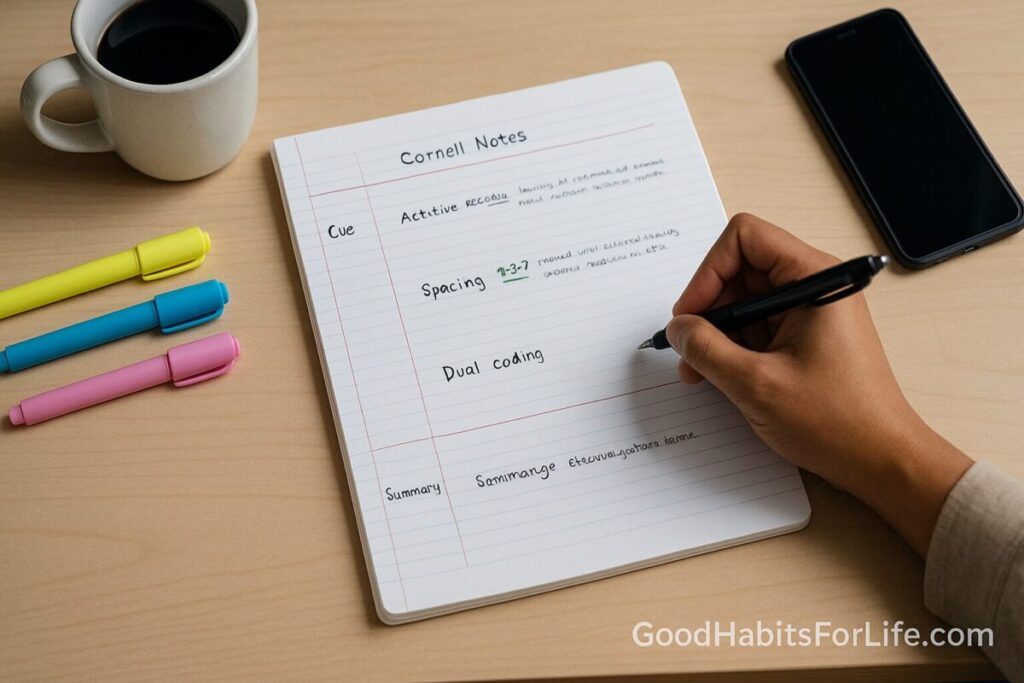
Cornell Notes 2.0: Cues, Colors, and Recall
Cornell Notes 2.0: Cues, Colors & Recall
Table of Contents
🧭 What & Why
What is Cornell Notes 2.0?
A modernized Cornell layout that keeps the classic three sections—Notes (right), Cue/Questions (left), Summary (bottom)—and layers on active recall, color-coding, and spaced review so you retain more with less study time. The method originated at Cornell University and emphasizes recording, questioning, reciting, reflecting, and reviewing. Learning Strategies Center
Why upgrade it?
-
Active recall beats rereading. Quizzing yourself from the cue column produces bigger long-term gains than re-studying. Psychnet
-
Spacing wins. Short, repeated reviews (1–3–7+ days) outperform cramming, especially for exams weeks away. PubMed+1
-
Color + visual supports. Thoughtful color-coding and simple visuals can improve attention and recognition memory. PMC
-
Words + pictures. Combining concise text with simple diagrams leverages dual-coding for faster understanding. Cambridge University Press & Assessment
✅ Quick Start: Cornell Notes 2.0 (10 minutes)
-
Divide the page (or template). Right = Notes. Left = Cue/Questions. Bottom = Summary. Learning Strategies Center
-
During class/reading (live notes).
-
Capture telegraphic bullets (short phrases).
-
Mark ? where unclear; circle key terms; draw quick arrows/boxes.
-
-
Right after (3–5 min).
-
Convert highlights into cue-column questions (e.g., “Define ischemia,” “Why does X cause Y?”).
-
Add one mini-diagram (timeline, flow, T-chart) next to dense text.
-
-
Summary (2–3 sentences). What’s the gist? What would be on a one-card cheat sheet?
-
First recall check (2–3 min). Cover the right panel; answer from cues out loud or on scrap.
-
Schedule spaced reviews. Add Day 1, Day 3, Day 7 to your planner; each review is 5–8 minutes. ERIC
🗓️ Habit Plan — 7-Day Starter
Goal: Build the “take-convert-quiz-space” routine.
-
Day 0 (class/reading): Take Cornell notes; create 6–12 cue questions; 2-sentence summary.
-
Day 1 (5–8 min): Cover → recall from cues; add 2 new cues; refine summary.
-
Day 3 (5–8 min): Mix questions; shuffle order; add 1 tiny diagram/table.
-
Day 5 (optional 5 min): Create a 6-item self-quiz from the cue column.
-
Day 7 (8–12 min): Final mixed recall; tag any weak items for next week’s loop; archive.
Checkpoint: You should answer ≥80% of cues from memory in <10 minutes by Day 7. If not, split complex pages into two and add examples.
🧠 Techniques & Frameworks that Work
Retrieval practice (make the cue column do the heavy lifting)
-
Write cues as prompts you could grade (define, compare, explain steps, prove, sketch).
-
Use “2 wrongs and a right”: For each cue, draft two plausible wrong answers and one correct; then quiz. This reduces recognition bias.
-
End each session with brain dump: 60 seconds to recall everything without looking, then check gaps. Testing strengthens memory, not just measures it. Psychnet
Spaced review (1–3–7… cadence)
-
For units ≥2 weeks away, keep expanding gaps (1, 3, 7, 14 days).
-
Longer gap if recall ≥90%; shorter if <70%. Classic spacing research shows distributed practice beats massed study. PubMed
Dual coding (words + visuals)
-
Pair a micro-diagram with dense text: a labeled sketch, flow arrow, or cause→effect chain.
-
Rule of thumb: one visual per block of 8–12 lines. Avoid decorative art; keep it functional. Cambridge University Press & Assessment
Color-coding (attention & recognition, not decoration)
-
Assign consistent meanings (examples below); use 2–3 colors max.
-
Color helps with attention and recognition when used purposefully (headings, categories, contrasts). PMC
Suggested palette (keep it consistent):
| Color | Use | Example |
|---|---|---|
| Blue | Definitions / formulas | “Ohm’s Law: V=IR” |
| Green | Examples / cases | “Patient A vs B” |
| Amber | Dates / timelines | “1947 → 1950 policy changes” |
| Red dot (•) | Common errors | “Confuses meiosis vs mitosis” |
Encoding specificity (better cues = better recall)
-
Write cues that match how you’ll be tested—show your work for math, “explain why” for essays, label diagrams for anatomy. Aligning retrieval with encoding context improves recall. Alice Kim, PhD
👥 Audience Variations
Students (school/college):
-
Pre-fill course learning objectives as cues; after class, answer them from memory.
-
Weekly “mix & match” review: shuffle cues from multiple lectures.
Professionals:
-
Meeting notes → cue column becomes action-checklist (“Status? Blockers? Owner?”).
-
Add a decision log in the summary panel (“Decision, Rationale, Next review”).
Seniors / Lifelong learners:
-
Go larger font and wider margins. Use high-contrast colors; avoid neon.
-
Do 5-minute recall walks—explain cues while strolling.
Teens:
-
Keep cues short (“3 reasons”, “draw circuit”).
-
Pair with flashcards (export cues into cards for quick bus-ride practice).
⚠️ Mistakes & Myths to Avoid
-
Myth: “Highlighting equals learning.” → Only if you convert highlights into cue questions.
-
Mistake: Writing paragraphs in the notes panel. → Use telegraphic bullets + arrows.
-
Mistake: 8 colors and doodles everywhere. → 2–3 functional colors max. PMC
-
Myth: “I’ll remember without quizzing.” → No. Retrieval practice is what locks it in. Psychnet
-
Mistake: Reviewing only the latest page. → Space and interleave across older pages. LapLab
🗣️ Real-Life Examples & Scripts
Convert notes → cues (science example):
-
Note: “Enzymes lower activation energy; induced fit model.”
-
Cues:
-
“Define activation energy and explain how enzymes lower it.”
-
“Sketch induced fit vs lock-and-key with one example.”
-
“Predict: What happens to Vmax if enzyme conc. doubles?”
-
History example:
-
Note: “Marshall Plan; economic aid; containment strategy.”
-
Cues:
-
“Argue: 2 economic & 1 political outcome of the Marshall Plan.”
-
“Timeline 1947–1951: key milestones (dates + one-line effects).”
-
Math example:
-
Note: “Derivative rules; product & chain.”
-
Cues:
-
“Differentiate y = (3x²+1)·sin x (show steps).”
-
“When does chain rule reduce to power rule? Give example.”
-
Self-quiz script (2 minutes):
Cover notes → read each cue → speak/write answer → check → star the weak ones → schedule a 24-hour retry.
🛠️ Tools, Apps & Resources (pros/cons)
-
Paper notebook
-
Pros: friction = focus; easy sketching. Cons: search/backup.
-
-
OneNote / GoodNotes / Apple Notes (Cornell templates)
-
Pros: stylus + typing; easy color; template reuse. Cons: can overdecorate.
-
-
Notion / Obsidian
-
Pros: backlinks; spaced-review plugins; export cues to flashcards. Cons: setup time.
-
-
Anki / RemNote / Quizlet
-
Pros: automatic spaced recall from cue column. Cons: can detach from context if you only use cards.
-
Template tip: Create a reusable page with:
-
Header (Topic | Date | Source)
-
Notes (right, 70%)
-
Cue/Questions (left, 30%)
-
Summary (3–4 lines)
-
Footer: “Next review: __ (D1) | __ (D3) | __ (D7)”
📚 Key Takeaways
-
Convert highlights into questions—then answer them from memory. Psychnet
-
Review with spaced mini-sessions (1–3–7 days) instead of cramming. PubMed
-
Use 2–3 purposeful colors and one visual per chunk to support attention and recognition. PMC+1
-
Keep cues aligned with how you’ll be tested (definitions, proofs, diagrams). Alice Kim, PhD
-
Make it a habit with a 7-day loop and the Study Cycle. LSU
❓ FAQs
1) Is Cornell Notes still relevant if slides are provided?
Yes—slides are sources, not learning. Converting slides into cue questions + recall is what creates memory. Psychnet
2) How many cues per page?
Aim for 6–12 that sample definitions, processes, comparisons, and one diagram.
3) What if I’m slow at drawing?
Use simple shapes (arrows, boxes, timelines). One purposeful visual beats fancy art. Cambridge University Press & Assessment
4) What spacing schedule should I start with?
Try D1–D3–D7; lengthen gaps when you can answer ≥90% correctly. LapLab
5) Do colors really help memory?
They can, when used to guide attention and differentiate categories—avoid decoration. PMC
6) Paper or digital?
Both work. Choose what you’ll actually maintain. If digital, resist over-formatting; keep cues crisp.
7) Can I combine Cornell with flashcards?
Yes—export cues to cards for quick reps, but keep the full page for context on complex topics.
8) How long should a review take?
Most pages can be reviewed in 5–8 minutes once cues are set. Focus on items you missed.
9) I already highlight—why change?
Highlighting is passive; quizzing is active and more effective for long-term retention. Psychnet
10) What’s the “Study Cycle”?
A weekly rhythm (preview → class → review → focused study → self-test) that pairs perfectly with Cornell Notes. LSU
📚 References
-
Cornell University Learning Strategies Center — Cornell Note-Taking System (overview & steps). https://lsc.cornell.edu/how-to-study/taking-notes/cornell-note-taking-system/ Learning Strategies Center
-
Cornell University LSC — The Cornell Note-taking System (Record–Question–Recite–Reflect–Review). https://lsc.cornell.edu/notes.html Learning Strategies Center
-
Roediger, H. L., & Karpicke, J. D. (2006). The Power of Testing Memory. Perspectives on Psychological Science. (Testing/retrieval practice). https://psychnet.wustl.edu/memory/wp-content/uploads/2018/04/Roediger-Karpicke-2006_PPS.pdf Psychnet
-
Cepeda, N. J., et al. (2006). Distributed practice in verbal recall tasks: A review and quantitative synthesis. Psychological Bulletin. (Spacing effect). https://pubmed.ncbi.nlm.nih.gov/16719566/ PubMed
-
Cepeda, N. J., et al. (2008). Spacing Effects in Learning. Psychological Science. https://laplab.ucsd.edu/articles/Cepeda%20et%202008_psychsci.pdf LapLab
-
Dzulkifli, M. A., & Mustafar, M. F. (2013). The Influence of Colour on Memory Performance: A Review. Malaysian Journal of Medical Sciences. https://pmc.ncbi.nlm.nih.gov/articles/PMC3743993/ PMC
-
Mayer, R. E. (2020). Multimedia Learning (3rd ed.). Cambridge University Press. https://www.cambridge.org/highereducation/books/multimedia-learning/FB7E79A165D24D47CEACEB4D2C426ECD Cambridge University Press & Assessment
-
Clark, J. M., & Paivio, A. (1991). Dual Coding Theory and Education. (Foundational dual-coding account). https://nschwartz.yourweb.csuchico.edu/Clark%20%26%20Paivio.pdf NSchwartz
-
Tulving, E., & Thomson, D. M. (1973). Encoding specificity and retrieval processes in episodic memory. Psychological Review. (Cue-dependent retrieval). https://alicekim.ca/9.ESP73.pdf Alice Kim, PhD
-
LSU Center for Academic Success — The Study Cycle (handout). https://www.lsu.edu/cas/files/student_resources_page/study-cycle.pdf LSU
-
UNC Learning Center — Effective Note-Taking handouts. https://learningcenter.unc.edu/tips-and-tools/effective-note-taking-in-class/ Learning Center