
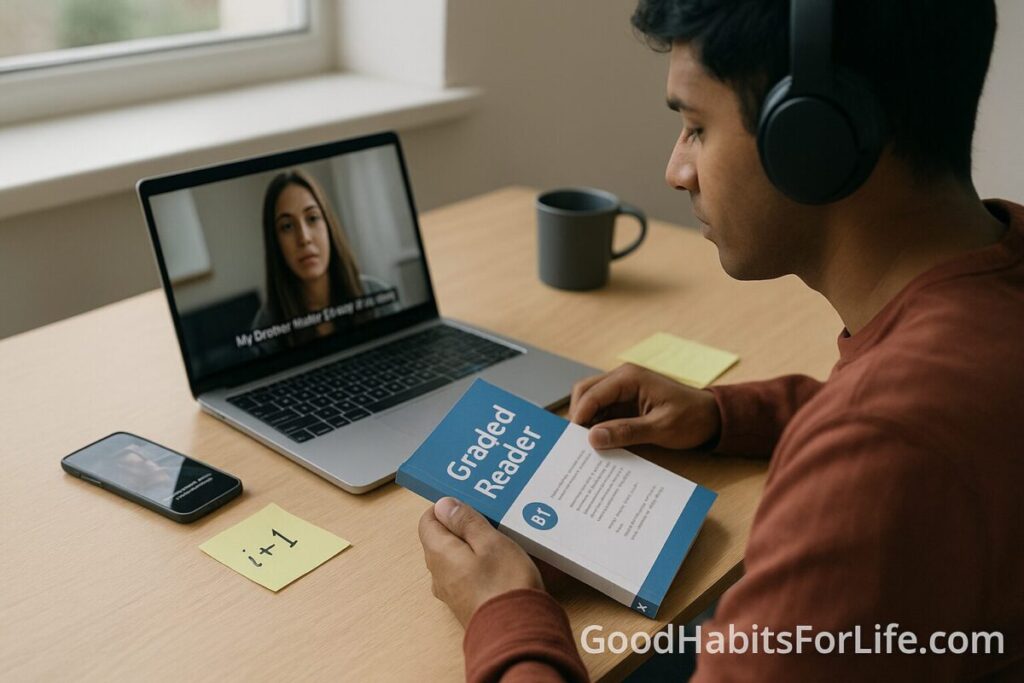
Comprehensible Input 2025: Make It Actually Comprehensible
Comprehensible Input in 2025: Make It Work
Table of Contents
🧭 What & Why
Comprehensible input (CI) is language you mostly understand with a gentle stretch—often expressed as “i+1.” When the message is clear, your brain acquires patterns implicitly while you focus on meaning. That core idea traces back to Krashen’s work and remains a foundation of many successful programs. Stephen D Krashen
CI isn’t “only listening.” In 2025, strong implementations combine leveled input, captions or glosses, and judicious focus on form so input becomes intake (you notice and retain it). Meta-analyses consistently show benefits from captioned viewing (listening + same-language subtitles) for vocabulary and comprehension, especially when content is level-appropriate. Wiley Online Library+1
A second pillar is extensive reading: lots of easy, interesting text. Multiple meta-analyses report positive effects (small-to-medium) on reading rate, comprehension, and vocabulary across ages and languages when learners read a lot at the right level. ERIC+1
Finally, map your input to CEFR levels so difficulty steps up in sensible bands (A1→C2). The 2020 Companion Volume expands descriptors for online interaction and mediation—useful for planning tasks around your input diet. Portal
✅ Quick Start (Do This Today)
Goal: 30–60 minutes of enjoyable, level-matched input with tiny form-focus.
-
Pick a level and topic. Use a CEFR self-check and choose topics you care about. Start one notch below your comfortable level for momentum. Portal
-
Watch 10–15 minutes with captions in the target language. If you’re pausing every sentence, drop difficulty; if you sail through with zero friction, nudge up. Wiley Online Library
-
Read 10–15 minutes of graded or learner-friendly text (aim for 95–98% known words). ERIC
-
Micro-noticing (5 minutes). Pull 3–5 useful chunks you actually want to reuse (“on the other hand…”, “could you…?”). Noticing accelerates intake. ScienceDirect
-
Speak or write 3 lines using those chunks (message first, accuracy later).
-
One SRS card per chunk, max 5/day. Keep review tiny so input time stays king.
Subtitle setting by level (rule-of-thumb)
| Level | Subtitles | Notes |
|---|---|---|
| A1–A2 | L2 captions + option to peek L1 | Pause as needed; very short clips |
| B1 | L2 captions full-time | Occasional rewind; harvest chunks |
| B2 | L2 captions → off on second view | Push comprehension; take fewer notes |
| C1 | Off first pass; captions for nuance | Focus on speed, idioms, tone |
Evidence supports captions for building vocabulary/listening; as you advance, toggling captions helps stretch comprehension. ScienceDirect
🛠️ 30-60-90 Habit Plan
North Star: 300–600 minutes/week of joyful, level-matched input.
Days 1–30 (Stability & Ease)
-
30 min/day CI: 15 min captioned video + 15 min graded text.
-
Micro-noticing: 3–5 chunks/day.
-
Checkpoint (Day 30): Should understand >90% without stopping; if not, drop one level. Captions should feel helpful, not crutches. Wiley Online Library
Days 31–60 (Stretch & Mix)
-
45–60 min/day CI: Alternate narrow listening (same speaker/topic series) with graded readers. Narrowing reduces cognitive load and boosts retention of recurring patterns. ScienceDirect
-
Light output: 2×/week voice notes or short posts recycling your chunks.
Days 61–90 (Performance & Transfer)
-
Task-based input (podcast episodes with tasks, documentaries, live streams).
-
Caption tapering at B2+: first watch no captions, second watch with captions to confirm details. ScienceDirect
-
Checkpoint (Day 90): Faster processing (less pausing), larger passive vocab, and easier spontaneous phrasing.
🧠 Techniques & Frameworks that Work
1) Captioned Viewing (CV).
Same-language captions reliably aid vocabulary growth and comprehension—especially at B1–B2—with positive effects found in recent syntheses. Use normal speed first; slow only for short difficult segments. Wiley Online Library+1
2) Extensive Reading (ER).
Read a lot of easy material. The big wins come from volume and interest, not difficulty. Meta-analyses show ER improves rate, comprehension, and vocab. Keep 95–98% known-word coverage; abandon boring books. ERIC+1
3) Narrow Listening/Reading.
Stay with one speaker, series, or subtopic for several weeks. You’ll meet the same phrases repeatedly, which accelerates pattern pickup. ScienceDirect
4) Processing Instruction (PI).
When a grammar form keeps tripping you (e.g., past vs. present), brief structured input tasks that force correct form-meaning mapping can help—without derailing CI. Reviews in Language Teaching summarize consistent PI benefits. Cambridge University Press & Assessment
5) Noticing & Mediation.
A minute or two of conscious attention—highlighting a chunk, paraphrasing, or explaining to someone—helps input become intake. The noticing hypothesis underpins this micro-focus, and the CEFR 2020 adds mediation descriptors that fit these tasks. ScienceDirect+1
6) Interaction Built on Input.
Brief meaning-focused exchanges (commenting on a clip, clarifying) add negotiation of meaning without turning your session into grammar drills. Classic research on interaction highlights how it complements input. CORE
🗺️ Level-wise Variations (A1→C1)
-
A1–A2: Children’s shows, slow news, short graded readers (100–300 headwords). Captions on; repeat short segments.
-
B1: Learner podcasts, daily vlogs, graded readers (600–1200 headwords). Start mining chunks for everyday tasks.
-
B2: Native podcasts on familiar topics, documentaries, easy novels. First pass no captions, second pass captions for nuance. ScienceDirect
-
C1: Debates, lectures, investigative journalism, essays. Focus on speed, idioms, and style; use captions only for dense sections.
Use CEFR descriptors as your compass for can-do targets each quarter. Portal
⚠️ Mistakes & Myths to Avoid
-
Myth: “Only input matters—output is useless.”
Reality: Input drives acquisition, but tiny, stress-free output helps recycle chunks and confirm form-meaning mappings (see PI and interaction research). Cambridge University Press & Assessment+1 -
Mistake: Consuming content that’s too hard.
If you can’t summarize the gist after 2–3 minutes, drop a level or switch to narrower content. -
Myth: Captions are cheating.
Evidence shows they support vocabulary and comprehension; taper them as you advance. Wiley Online Library+1 -
Mistake: Turning CI into study marathons.
Keep sessions short, frequent, and fun; save heavy analysis for brief noticing windows.
🗣️ Real-Life Examples & Scripts
-
Comment on a video (B1):
“I really liked how you explained ___ because ___. One question: ___.” -
Ask for clarification (B1/B2):
“Could you run that by me again? I caught the part about ___, but missed ___.” -
Paraphrase a chunk (B2):
“So, what you’re saying is ___, right?” -
PI-style mini task (any level):
After a clip with past vs present, choose which sentence fits the clip:-
“She goes to class at 9.”
-
“She went to class at 9.” (✔ if the clip shows yesterday.) Cambridge University Press & Assessment
-
📚 Tools, Apps & Resources (pick 1–2 per category)
-
Video with captions: YouTube + Language Reactor, Yabla, Netflix with L2 captions.
-
Graded readers: Oxford Bookworms, Cambridge English Readers, Black Cat Cideb.
-
Podcasts: News in Slow ___, learner podcasts, easy vlogs on one topic (narrow listening). ScienceDirect
-
Dictionaries: Learner’s dictionaries with example sentences; bilingual only for quick checks.
-
SRS: Anki, Mochi—cap at 5 new cards/day so input time stays high.
-
Leveling guides: CEFR Companion Volume descriptors (use for quarterly planning). Portal
Pros/Cons (quick):
-
Captions: +boost vocab/comprehension; −can reduce listening strain if never tapered. Wiley Online Library
-
Graded readers: +confidence/volume; −need consistent supply. ERIC
-
Narrow listening: +repetition of useful patterns; −variety comes later. ScienceDirect
-
PI tasks: +fix persistent form-meaning issues; −use sparingly to keep flow enjoyable. Cambridge University Press & Assessment
📌 Key Takeaways
-
Make input easy-interesting and steady-stretching.
-
Captions + leveled content are evidence-backed levers; taper captions over time. Wiley Online Library+1
-
Read a lot at your level—ER grows comprehension and vocab. ERIC
-
Use micro-noticing, narrow listening, and occasional PI to turn input into intake. ScienceDirect+1
-
Plan with CEFR and execute a 30-60-90 habit you can actually keep. Portal
❓ FAQs
1) How much should I understand for input to count as “comprehensible”?
Aim for 90–98% of the words; if you’re pausing constantly, it’s too hard. Extensive reading research favors high coverage for progress. ERIC
2) Should I use L1 or L2 captions?
Use L2 captions for learning; they reliably support vocabulary and comprehension. Use L1 only for a quick rescue or to confirm a tricky line. ScienceDirect
3) Is output necessary?
Input is the engine; small, stress-free output helps recycle chunks and reveal gaps—especially when paired with processing-instruction-style tasks. Cambridge University Press & Assessment
4) How do I choose levels?
Use CEFR can-do descriptors; pick materials slightly easier than your level for fluency, then nudge difficulty. Portal
5) Does “narrow listening” get boring?
It trades variety for speed of acquisition. Stay narrow for a few weeks per theme/speaker, then rotate topics. ScienceDirect
6) I only have 20 minutes/day. Worth it?
Yes—short, daily CI beats long, sporadic sessions. Keep input easy and enjoyable; do micro-noticing in 2 minutes.
7) Can I learn grammar just from input?
You’ll absorb a lot implicitly, but brief focus on form (PI) for stubborn contrasts can accelerate accuracy without killing flow. Cambridge University Press & Assessment
8) Where do I find good graded materials?
Start with major graded reader series and learner podcasts; scale volume, not difficulty. ERIC
📚 References
-
Council of Europe. CEFR Descriptors & 2020 Companion Volume. (Official portal). Portal
-
Krashen, S. Principles and Practice in Second Language Acquisition (book PDF). Stephen D Krashen
-
Jeon, E-Y., & Day, R. (2016). The effectiveness of extensive reading on reading proficiency: A meta-analysis. Reading in a Foreign Language. ERIC+1
-
Nakanishi, T. (2015). A Meta-Analysis of Extensive Reading Research. TESOL Quarterly. Wiley Online Library
-
Teng, M. F. (2022). Incidental L2 vocabulary learning from viewing captioned videos. System. ScienceDirect
-
Language Learning (2024). Incidental Vocabulary Acquisition Through Captioned Viewing (journal article). Wiley Online Library
-
Benati, A. (2019). Processing Instruction: Findings and implications. Language Teaching (Cambridge). Cambridge University Press & Assessment
-
Day & Bamford (2002). Ten Principles for Teaching Extensive Reading (University of Hawai‘i). scholarspace.manoa.hawaii.edu
-
Mackey, A. (1999). Input, interaction, and second language development (review of Long’s interaction hypothesis). CORE
-
Hardy, J. E. (2025). Incorporating Extensive Reading into the Foreign Language Classroom (ERIC review). ERIC+1