
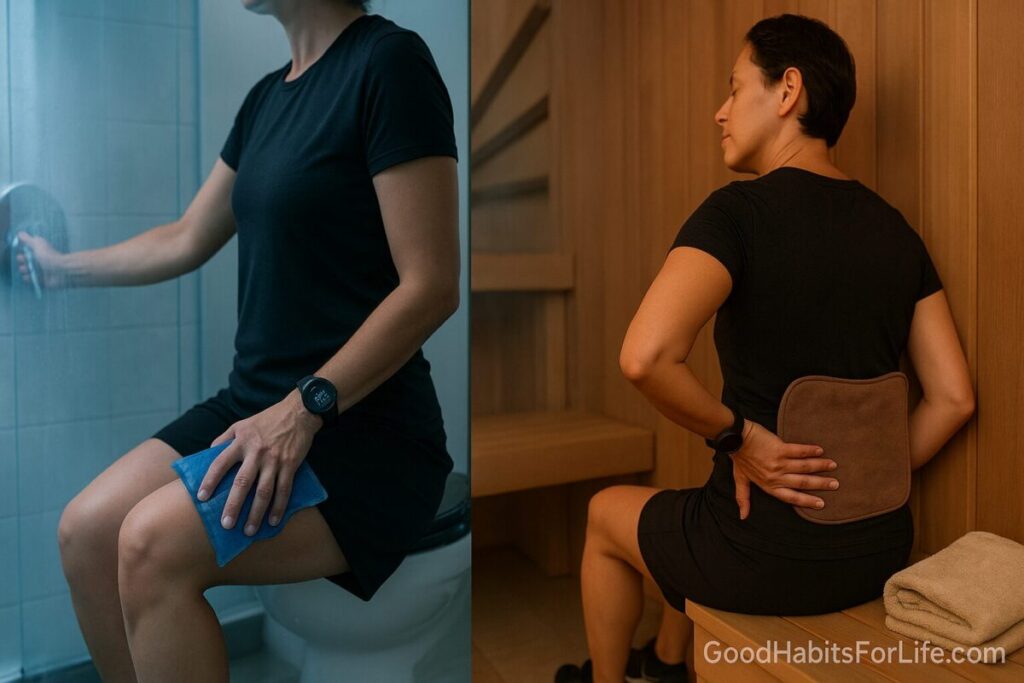
Cold vs Heat: What Actually Helps: Zone 2 + NEAT (2025)
Cold vs Heat: What Works for Zone 2 + NEAT (2025)
Table of Contents
🧭 What & Why
Cold (ice packs, cold showers, cold-water immersion) and heat (warm packs, sauna, warm bath/shower) are simple levers to change circulation, nerve signaling, and tissue feel.
-
Cold reduces pain perception and fatigue in the short term. Used regularly after lifting, it can dampen anabolic signaling and slow hypertrophy-related gains. Use strategically. SpringerOpenPubMed+1
-
Heat increases local blood flow, reduces stiffness, and can improve range of motion and comfort, helping you move more freely and relax for sleep. archives-pmr.org
But the base of better recovery isn’t baths—it’s movement:
-
Zone 2 cardio = easy-to-moderate effort where you can talk but not sing (roughly 60–70% HRmax for many).
-
NEAT = all the steps and everyday movement beyond workouts. Both improve circulation, mitochondrial fitness, and energy without heavy stress. CDCPubMed
✅ Quick Start (Do This Today)
-
Set your base: 30–45 min Zone 2 (brisk walk, easy cycle) 3–5×/wk + 7–10k steps/day (adjust to your level). PubMedCDC
-
If sore from training: try 10–15 min cool shower or a single short ice pack session (10–15 min with a cloth barrier). Skip daily ice baths if chasing strength/muscle. PubMed
-
If stiff/tight: use 10–20 min gentle heat (heat pack or warm shower), then do easy mobility and your Zone 2 session. archives-pmr.org
-
If you tweaked something: follow PEACE & LOVE for the first days—protect, elevate, compression; then gradual loading and easy, pain-free movement. British Journal of Sports Medicine
-
Sleep boost tonight: take a warm shower/bath 1–2 h before bed. PubMed
🛠️ The Habit Plan: 30–60–90 Days
Days 1–30 (Build the base)
-
Zone 2: 3×/wk 30–40 min (or 20 min if new).
-
NEAT: add +1,000 daily steps above your current baseline.
-
Heat before easy days: 10 min warm shower/pack + mobility.
-
Cold for soreness only: at most 1–2×/wk brief sessions.
-
Sleep cue: warm bath/shower 60–120 min pre-bed, 10–15 min. PubMed
Days 31–60 (Layer performance & resilience)
-
Zone 2: 4×/wk 40–50 min.
-
NEAT: aim 8–10k steps/day on average.
-
Optional sauna (post-exercise) 2–3×/wk, 15–30 min if you tolerate heat, to support plasma volume and heat tolerance for endurance. Hydrate well. PubMed
Days 61–90 (Refine & personalize)
-
Zone 2: 4–5×/wk 45–60 min (or mix with one tempo day if trained).
-
NEAT: 9–12k steps/day or “move each hour” rule.
-
Cold use: only around key tournaments/matches/long runs when fast turnaround matters, not as an every-session habit if hypertrophy is a goal. PubMed
-
Keep sleep ritual; adjust water temp and timing to preference. PubMed
🧠 Zone 2 + NEAT: Your Recovery Engine
-
Zone 2 raises mitochondrial density and capillary function with low stress—perfect on “recovery days.”
-
NEAT (walking, chores, stairs) meaningfully increases daily energy expenditure and improves metabolic health—small movements add up. PubMed+1
-
Talk Test: If you can talk but not sing, you’re likely in Zone 2. CDC
🧊 Cold: When, Why, How
Best for:
-
Short-term pain relief & perceived recovery after hard efforts or tournaments. CochranePubMed
-
Acute tweaks with swelling (use briefly for comfort alongside protection/compression). Pair with PEACE & LOVE. British Journal of Sports Medicine
Use with caution if muscle size/strength is a goal:
-
Regular post-lift cold-water immersion attenuates anabolic signaling and hypertrophy (strength usually less affected). Not ideal after every resistance session. PubMed+1
Endurance nuance:
-
Some studies suggest cold exposure can support endurance signaling (e.g., PGC-1α upregulation) without hurting performance—but findings are mixed. Use judiciously, and prioritize training quality. PubMedSpringerLinkFrontiers
How to apply (practical):
-
Ice pack: 10–15 min, cloth barrier, 1–2×/day as needed for pain.
-
Cold shower: 2–5 min cool (not extreme) focusing on legs.
-
Cold-water immersion: reserve for tournament blocks or very hard endurance sessions when next-day freshness matters; 10–15 min at ~10–15 °C, no more than 1–2×/wk if you lift for size.
Avoid: prolonged numbing, open wounds, poor circulation/neuropathy, or if you don’t warm back up easily.
🔥 Heat: When, Why, How
Best for:
-
Stiffness & mobility: local heat can ease pain and increase range of motion, especially before light training and mobility work. archives-pmr.org
-
Relaxation & sleep: warm bath/shower 1–2 h before bed shortens sleep latency and improves efficiency. PubMed
-
Endurance support: post-exercise sauna blocks over weeks have improved plasma volume and time-to-exhaustion in trained runners; good add-on for endurance blocks if you tolerate heat. PubMed
How to apply (practical):
-
Warm pack/shower: 10–20 min before mobility/easy cardio.
-
Sauna: Start with 10–15 min, build to 20–30 min post-exercise, 2–3×/wk. Hydrate; exit if dizzy.
Avoid: open wounds, acute swelling that’s still “angry,” or if heat worsens throbbing pain.
⚖️ Special Cases: DOMS, Sleep, Swelling & “Tweaks”
-
DOMS (48–72 h soreness): cold may reduce soreness perception; heat may help you move. Either is optional—Zone 2 + steps likely do more for recovery overall. Cochrane
-
Sleep: warm bath/shower 40–43 °C for 10–15 min, 60–120 min before bed works well. PubMed
-
Swelling from an acute tweak: follow PEACE & LOVE; use brief ice only for pain; prioritize compression, gradual loading, and optimistic mindset. British Journal of Sports Medicine
👥 Audience Variations
-
Students/Busy pros: choose micro-heat (5–8 min warm shower) before commuting or an evening walk; short cool rinse after long desk days if puffy.
-
Parents: stroller walks (Zone 2), floor play (NEAT), warm family bath/shower routines.
-
Seniors: emphasize talk-test cardio and frequent gentle heat for mobility; mind hydration if trying sauna; add balance work. World Health Organization
-
Strength-focused athletes: limit post-lift cold immersion; save it for meets or brutal conditioning days only. PubMed
-
Endurance-focused athletes: consider post-exercise sauna blocks in base/build; test cold only when rapid turnaround is needed—and monitor how you feel in subsequent sessions. PubMed
⚠️ Mistakes & Myths to Avoid
-
Myth: “Ice cures injuries.” Reality: it can numb pain, but tissue healing needs graded loading and circulation. Follow PEACE & LOVE. British Journal of Sports Medicine
-
Mistake: Using daily ice baths after every lift when chasing muscle size. PubMed
-
Mistake: Overheating right before bed (too close to bedtime). Aim for 1–2 h gap. PubMed
-
Myth: “Zone 2 is too easy to matter.” It’s a cornerstone for endurance and recovery. PubMed
🧩 Real-Life Examples & Scripts
Morning (work day, desk-heavy):
-
10 min warm shower → 20–30 min Zone 2 walk/cycle → 5 min mobility.
-
Hourly 2–3 min “NEAT bursts” (stairs, hallway walk).
Evening (post-strength day, want sleep):
-
Light walk 15–20 min (Zone 2) → dinner → warm bath/shower 10–15 min, 60–120 min pre-bed → stretch/reading → lights out. PubMed
After a hard match/long run (need fast turnaround):
-
10 min spin-down (very easy) → protein/carb meal → optional 10–12 min cool immersion (skip if you’re chasing hypertrophy) → early bedtime routine.
Acute tweak (mild ankle/hamstring pull):
-
Day 1–3: PEACE (protect, elevate, compression, education), pain-free range-of-motion; brief ice only for pain.
-
Day 3+: LOVE (load gradually, optimism, light cardio to vascularize, simple exercises). British Journal of Sports Medicine
🧰 Tools, Apps & Resources
-
Timers & habit trackers: any interval timer; Streaks/Habitify for daily Zone 2 + NEAT goals.
-
Wearables: heart-rate monitor for Zone 2; step counter for NEAT.
-
Sleep: phone reminder for the warm-bath window (1–2 h pre-bed). PubMed
-
Recovery gear: basic heat pack and a soft cloth; compression sleeve/wrap for acute tweaks.
🧾 Key Takeaways
-
Move first: Zone 2 + NEAT is the backbone of recovery capacity.
-
Cold is a tool for short-term relief and tight turnarounds—not a daily post-lift habit. PubMed
-
Heat supports mobility, relaxation, and sleep; post-exercise sauna blocks can support endurance adaptations. PubMed
-
For tweaks: use PEACE & LOVE, then return to graded loading. British Journal of Sports Medicine
❓ FAQs
1) What’s the simplest way to know I’m in Zone 2?
Use the talk test: you can speak in sentences but can’t comfortably sing. Pair with an easy, steady heart rate. CDC
2) Will cold showers after lifting kill my gains?
Occasional use won’t ruin progress, but habitual post-lift cold-water immersion can blunt hypertrophy signaling; use sparingly if muscle size is a priority. PubMed+1
3) Is contrast therapy (hot–cold–hot) better than either alone?
Evidence is mixed; some reviews show modest benefits for fatigue or soreness, but study quality is variable. It’s optional, not essential. PLOSPubMed
4) How long should a sauna be to help endurance?
Studies used ~20–30 min post-exercise, several times per week for weeks, improving plasma volume and time-to-exhaustion in trained runners. Start shorter and hydrate. PubMed
5) What temperature for a sleep-helping bath?
Warm (about 40–43 °C / 104–109 °F), 10–15 min, 1–2 hours before bed—don’t take it right before sleep. PubMed
6) Is icing ever wrong?
Avoid prolonged numbing, frostbite risk, or icing areas with poor blood flow/nerve sensation. For acute injuries, think brief for pain only, then load gradually (PEACE & LOVE). British Journal of Sports Medicine
7) How much NEAT matters really?
A lot. NEAT varies widely between people and plays a meaningful role in energy balance and cardiometabolic health. Aim to move more throughout the day. PubMedMayo Clinic Proceedings
8) Can heat worsen inflammation?
If an area is hot/throbbing/swollen from a fresh injury, skip heat early on; once it calms, gentle heat can help mobility. Use symptoms to guide you. British Journal of Sports Medicine
📚 References
-
Dubois B, Esculier J-F. Soft-tissue injuries simply need PEACE & LOVE. Br J Sports Med. 2020. https://bjsm.bmj.com/content/54/2/72 British Journal of Sports Medicine
-
Bleakley C et al. Cold-water immersion for preventing and treating muscle soreness after exercise. Cochrane Review. 2012 (updated 2022). https://www.cochrane.org/evidence/CD008262_cold-water-immersion-preventing-and-treating-muscle-soreness-after-exercise Cochrane
-
Haghayegh S et al. Before-bedtime warm bath/shower and sleep. Sleep Med Rev. 2019. https://pubmed.ncbi.nlm.nih.gov/31102877/ PubMed
-
Lorenzo S et al. Heat acclimation improves exercise performance. J Appl Physiol. 2010. https://pmc.ncbi.nlm.nih.gov/articles/PMC2963322/ PMC
-
Scoon G et al. Post-exercise sauna and endurance performance. J Sci Med Sport. 2007. https://pubmed.ncbi.nlm.nih.gov/16877041/ PubMed
-
Roberts LA et al. CWI attenuates anabolic signaling & hypertrophy after strength training. J Physiol. 2015. https://physoc.onlinelibrary.wiley.com/doi/full/10.1113/JP270570 physoc.onlinelibrary.wiley.com
-
Fyfe JJ et al. CWI blunts muscle fiber hypertrophy, not strength. J Appl Physiol. 2019. https://pubmed.ncbi.nlm.nih.gov/31513450/ PubMed
-
Clijsen R et al. Local heat applications: pain, ROM, function. Arch Phys Med Rehabil. 2022. https://www.archives-pmr.org/article/S0003-9993(21)00505-0/fulltext archives-pmr.org
-
CDC. Measuring Physical Activity Intensity (Talk Test). https://www.cdc.gov/physicalactivity/basics/measuring/index.html CDC
-
Levine JA. Non-exercise activity thermogenesis (NEAT). Proc Nutr Soc. 2003; & Mayo Clin Proc. 2002. https://pubmed.ncbi.nlm.nih.gov/12468415/ PubMed
-
WHO. 2020 Guidelines on Physical Activity and Sedentary Behaviour. https://www.who.int/publications/i/item/9789240015128 World Health Organization
-
Bieuzen F et al. Contrast water therapy & recovery (systematic review). PLOS ONE. 2013. https://journals.plos.org/plosone/article?id=10.1371/journal.pone.0062356 PLOS
Disclaimer: This article is general education, not medical advice; consult a qualified professional for personal injuries, heat/cold sensitivity, or medical conditions.