
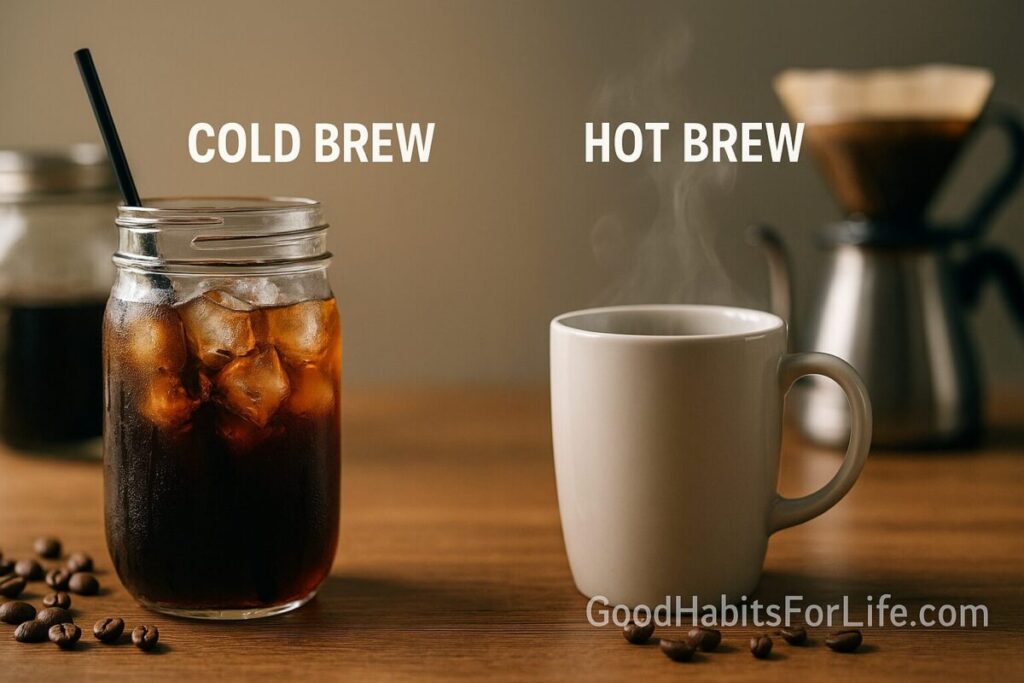
Cold Brew vs Hot Brew: Flavor, Acidity, and Habit
Cold Brew vs Hot Brew: Flavor, Acidity, and Habit
Table of Contents
🧭 What’s the Difference & Why It Matters
Cold brew extracts coffee at cool temperatures (typically 4–20 °C / 39–68 °F) for many hours. It often creates a low-effort, low-noise routine: brew once, sip all week.
Hot brew (pour-over, French press, drip) uses 92–96 °C (197–205 °F) water and finishes in minutes, maximizing fresh aroma and brightness.
Why it matters for habits:
-
Consistency: Cold brew supports batch preparation; hot brew rewards a brief daily ritual.
-
Taste preferences: Cold brew skews chocolaty/smooth; hot brew highlights fruit/acid clarity.
-
Digestive comfort: Many people perceive cold brew as gentler; chemistry suggests similar pH but different acids extracted.
-
Control: Hot brewing variables (grind, temperature, contact time) make fine-tuning fast; cold brew variables (ratio, steep time, dilution) govern weekly convenience.
🧪 Flavor & Acidity: What the Science Says
-
Acidity & pH: Research shows cold and hot brews often have similar pH, but hot brews tend to have higher titratable acidity—the amount of acid that actually affects taste—so they taste brighter.
-
Antioxidants & solubles: Hot water extracts antioxidants and other soluble compounds more efficiently and quickly.
-
Perceived smoothness: Because fewer bright acids and volatile aromatics dissolve at low temperatures, cold brew can taste smoother, rounder, and less sharp.
-
Caffeine: It varies widely by dose, grind, brew time, and dilution. A cold-brew concentrate may contain more caffeine before dilution; many people cut it 1:1 (or more), ending near typical hot-brew strengths.
Bottom line: Choose cold brew for smoothness and batchability. Choose hot brew for sparkle, aroma, and on-the-spot control.
✅ Quick Start: Brew Both Ways Today
A. 10-Minute Hot Brew (Pour-Over or Drip)
-
Ratio: 1:16 (e.g., 25 g coffee → 400 g water).
-
Grind: Medium (table salt).
-
Water: 92–96 °C (197–205 °F); fresh, filtered.
-
Steps:
-
Rinse filter, warm the brewer.
-
Bloom with 2× coffee weight of hot water for 30–45 s.
-
Pour in steady pulses until target weight; total time ~3–3:30.
-
Taste; adjust grind finer for more strength/brightness, coarser for less.
-
B. Overnight Cold Brew (Ready-to-Drink)
-
Ratio: 1:8 to 1:10 (e.g., 100 g coffee → 800–1 000 g water).
-
Grind: Coarse (coarser than French press).
-
Method:
-
Combine in a jar or brewer; stir.
-
Steep 12–18 h in the fridge (or 8–12 h at cool room temp).
-
Strain; store refrigerated up to a week (best flavor in 3–5 days).
-
Serve over ice; optionally dilute 1:1 if strong.
-
C. Cold-Brew Concentrate
-
Ratio: 1:4 to 1:6 (e.g., 120 g coffee → 500 g water).
-
Steep 12–18 h cold; strain; dilute 1:1 (or to taste) when serving.
🧠 30-60-90 Habit Plan
Goal: Lock in a brew style that fits your energy needs, flavor preference, and schedule.
Days 1–30: Foundations
-
Pick a base method: Hot pour-over (daily) or cold-brew concentrate (weekly).
-
Standardize ratio: Hot 1:16; Cold concentrate 1:5.
-
Journal: Note flavor words (bright, chocolaty, bitter, thin), digestion comfort, and energy curve.
-
Week 2 tweak: Adjust grind one notch finer/coarser.
-
Week 3 tweak: Adjust ratio by ±1 (e.g., 1:15 or 1:17 hot; 1:4 or 1:6 cold).
Days 31–60: Personalization
-
Try two beans: a washed East African (fruit/brightness) and a natural Latin American (chocolate/berry).
-
Hot brew users: Test 2 pouring patterns (pulse vs continuous).
-
Cold brew users: Test steep time 12 h vs 18 h and dilution 1:1 vs 2:1.
-
Lock a weekday routine (e.g., cold-brew batch on Sunday night; hot brew for weekend).
Days 61–90: Performance & Lifestyle
-
Align dose with caffeine limits (generally up to 400 mg/day for healthy adults).
-
Habit stack: Brew while reviewing a 3-item daily plan.
-
Create a backup plan: If mornings are chaotic, keep 250 ml of concentrate in the fridge.
🛠️ Techniques & Frameworks
Brew Ratio & Strength
-
Strength (how concentrated it tastes) comes mainly from the brew ratio and dilution, not roast level.
-
Use a coffee scale; log your favorite settings.
Grind Size & Extraction
-
Finer grind → faster extraction, more body/bitterness if overdone.
-
Coarser grind → slower extraction, cleaner but can be sour/weak if too coarse.
-
For cold brew, start coarse to ease filtration and reduce fines.
Water & Minerals
-
Coffee is ~98% water. Aim for moderate hardness and clean taste. If your coffee tastes flat or sour, try filtered water.
Temperature & Time
-
Hot brew: 92–96 °C for ~3–5 min is a reliable window.
-
Cold brew: Longer time replaces high temperature—12–18 h is a sweet spot.
Dilution Framework (for Concentrate)
-
Brew 1:5 concentrate.
-
Start with 1:1 dilution (equal parts concentrate and water/ice/milk).
-
Shift 10–20% each way to find your “house” cup.
👥 Variations by Audience
-
Students: Batch cold brew on Sunday; fill 300 ml travel bottle for morning classes. Add 1–2 tsp sugar or milk only if it helps you drink less soda.
-
Parents: Keep concentrate for school-rush mornings; save hot pour-over for quiet weekend moments.
-
Professionals: Pair hot brew with your daily stand-up; switch to decaf or half-caf after 14:00 to protect sleep.
-
Seniors: If acidity bothers you, try cold brew or a lower-acid roast; sip with food to reduce stomach upset.
-
Teens: Limit caffeine; choose half-caf or small servings and avoid late-day coffee to protect sleep.
⚠️ Mistakes & Myths to Avoid
-
Myth: “Cold brew is always less acidic.” → pH is often similar; it just tastes smoother because fewer bright acids are extracted.
-
Mistake: Grinding too fine for cold brew → sludgy texture, bitter extraction.
-
Mistake: Letting cold brew sit at room temp for long periods. Keep it refrigerated.
-
Myth: “More caffeine = better focus.” → Overshooting your tolerance can cause jitters and a crash.
-
Mistake: Ignoring water quality—bad water, bad coffee.
-
Myth: “Dark roast equals stronger coffee.” → Strength is about dose and ratio, not roast color.
🎯 Real-Life Scripts & Use-Cases
Busy Week Mornings (Concentrate Script)
-
Sunday 20:00: 150 g coarse coffee + 750 g water (1:5). Steep 14 h in fridge.
-
Monday morning: Strain; bottle.
-
Daily: 150 ml concentrate + 150 ml cold water/milk over ice → out the door in 60 seconds.
Flavor Exploration Weekend (Pour-Over Script)
-
Two cups, same ratio (1:16), different beans. Note differences in aroma, acidity, sweetness, aftertaste. Decide your “weekday bean.”
Gentler Cup Trial (Comfort Script)
-
Try cold brew 1:8 ready-to-drink with food; if fine, increase strength gradually to preference.
🧰 Tools, Apps & Resources
-
Grinder: Burr grinder with repeatable settings (hand or electric).
-
Kettle: Variable temperature for hot brew.
-
Brewer: Pour-over cone, drip machine with 92–96 °C capability, or dedicated cold-brew pot/filter.
-
Scale & Timer: For accurate ratio and consistency.
-
Apps:
-
Filtru, Brew Timer – recipe timing and logs.
-
BeanHunter – discover roasters/beans.
-
Water tracking – sync coffee with hydration habits.
-
📌 Key Takeaways
-
Choose cold brew if you value smoothness and make-ahead convenience.
-
Choose hot brew if you value brightness, aroma, and on-the-spot control.
-
Ratios, grind, and time—not roast color—determine strength and balance.
-
Keep caffeine within healthy limits and avoid late-day doses to protect sleep.
-
Build a repeatable routine with the 30-60-90 plan to lock in your “house” method.
❓ FAQs
1) Is cold brew actually less acidic than hot coffee?
It often tastes less sharp. Chemically, pH is similar, but hot brews extract more titratable acids, which increases perceived acidity.
2) Which has more caffeine: cold brew or hot brew?
Either can. Concentrates are strong before dilution; once diluted, many cups end up similar. Dose, ratio, and brew time dominate.
3) How long does homemade cold brew last?
Refrigerated and cleanly prepared, about a week for safety; best flavor in 3–5 days.
4) What grind size should I use?
-
Cold brew: coarse (reduces fines, easier filtering).
-
Hot brew: medium for pour-over/drip; coarse for French press.
5) What’s the ideal water temperature for hot brew?
92–96 °C (197–205 °F) is the standard sweet spot.
6) Can I make hot coffee from cold-brew concentrate?
Yes. Dilute concentrate with hot water 1:1 or to taste—flavor will be smooth but less aromatic than freshly hot-brewed.
7) Is cold brew better for sensitive stomachs?
Some people find it gentler. Individual responses vary; try small servings and avoid empty-stomach coffee.
8) Does iced coffee equal cold brew?
No. Iced coffee is hot-brewed then chilled; cold brew is extracted cold from the start, yielding a different flavor profile.
9) Do paper filters reduce bitterness?
They trap fines and some oils, often producing a cleaner, less bitter cup compared with metal mesh.
10) What’s a safe daily caffeine limit?
For most healthy adults, up to ~400 mg/day is generally considered safe; pregnant individuals should stay lower.
📚 References
-
Rao, N. Z., & Fuller, M. (2018). Acidity and antioxidant activity of cold brew coffee. Scientific Reports. https://www.nature.com/articles/s41598-018-34392-w
-
Angeloni, S., et al. (2019). Chemical and sensory profile of cold brew coffee: effect of time and temperature. Food Chemistry. https://www.sciencedirect.com/science/article/pii/S0308814619304765
-
Specialty Coffee Association (SCA). Brewing temperature & standards. https://sca.coffee/research/coffee-standards
-
National Coffee Association (NCA USA). How to Brew Coffee (Golden Ratio guidance). https://www.ncausa.org/About-Coffee/How-to-Brew-Coffee
-
U.S. Food & Drug Administration. Spilling the Beans: How Much Caffeine is Too Much? https://www.fda.gov/consumers/consumer-updates/spilling-beans-how-much-caffeine-too-much
-
European Food Safety Authority (EFSA). Scientific opinion on caffeine (2015). https://www.efsa.europa.eu/en/efsajournal/pub/4102
-
Cordoba, N., et al. (2019). Effects of extraction methods on bioactive compounds in coffee. Food Research International. https://www.sciencedirect.com/science/article/pii/S0963996919302183
-
Hendon, C. H., & Colonna-Dashwood, J. (2014). The role of water in coffee extraction. Coffee Science (overview). https://www.sciencedirect.com/topics/food-science/coffee-extraction
Disclaimer: Coffee and caffeine affect people differently; if you have digestive issues, heart conditions, are pregnant, or take medications, consult a healthcare professional about caffeine intake.