
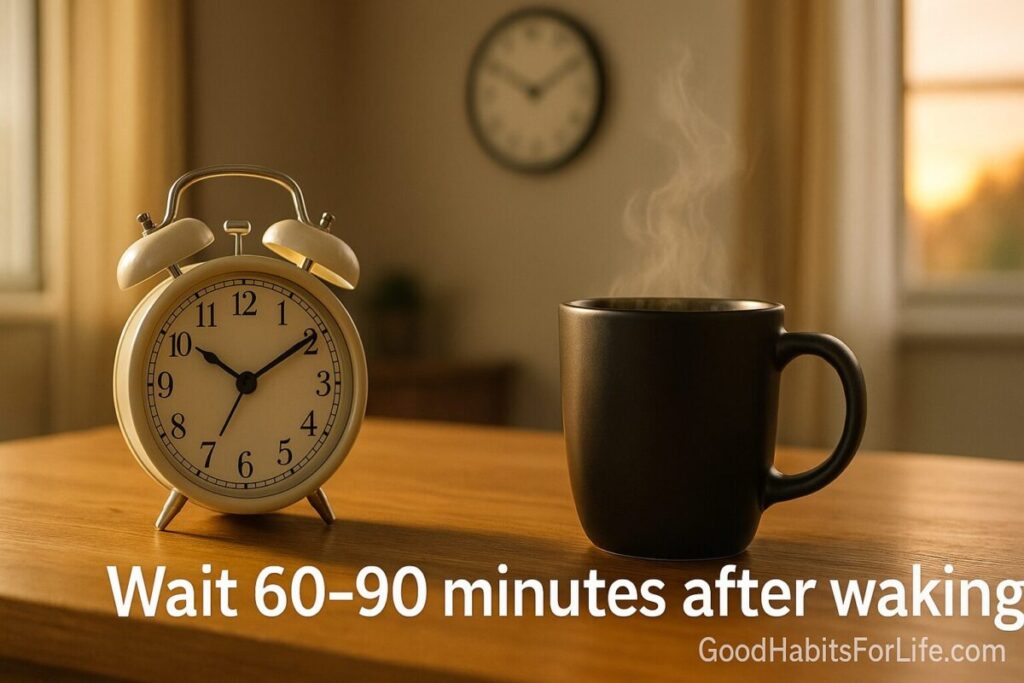
Coffee Timing 101: The 90Minute Rule After Waking
Coffee Timing 101: The 90-Minute Rule After Waking
Table of Contents
🧭 What the 90-Minute Rule Is (and Why It Works)
The idea: Wait ~60–90 minutes after waking before your first coffee. That delay lets your cortisol-awakening response (CAR)—a natural 30–45-minute surge in the stress-alertness hormone cortisol—peak and begin to decline. Then caffeine can “stack” on your own alertness rather than compete with it. PubMed+1
The physiology (plain-English):
-
Adenosine builds sleep pressure while you’re awake. Caffeine works by blocking adenosine receptors, making you feel more alert. Timing caffeine after some natural adenosine clearance can mean steadier energy. PubMed
-
Caffeine’s half-life averages ~5 hours (varies 1.5–9.5 h person-to-person), so smart timing matters for both daytime energy and sleep. NCBI
-
Caffeine can raise cortisol in some people, so pairing it with the tail end of the CAR may reduce an “over-spike” feeling for sensitive folks. PMC
Why 90 (not 0) minutes?
CAR usually peaks within 30–45 minutes post-waking and settles thereafter. A 60–90-minute delay is a simple, testable window most people can try without over-complicating the schedule. PubMed+1
✅ Quick Start: Do This Today
-
Wake → hydrate → light. Get natural light or bright indoor light in your eyes (not staring at the sun) and drink water.
-
Start the 60–90-minute clock. No coffee yet; if needed, take a brief walk or do 2–3 minutes of gentle movement.
-
Eat (optional). If you get jittery on empty stomachs, take coffee with or after breakfast.
-
Brew window (T+60–90). Have 1 cup (≈80–120 mg caffeine) and notice energy, focus, and mood for 3–4 hours.
-
Optional top-up (late morning). If needed, have a smaller second cup by early afternoon; stop at least 6 hours before bedtime. PubMed
-
Stay within safe daily ranges. For most healthy adults, ≤400 mg/day is a common safety threshold. PubMed
🛠️ Techniques & Frameworks
The “CAR-Friendly” Stack
-
Light first, coffee later. Natural light anchors your body clock; caffeine comes after. PubMed
-
Food buffer (if needed). A little protein/fat (e.g., eggs + toast, yogurt + nuts) can blunt jitters.
The “Caffeine Cutoff” Rule
-
Set your personal cutoff = Bedtime minus 6–8 hours (start with 6; adjust if sleep suffers). Even a 6-hour gap can still reduce total sleep time. PubMed
Dose Framework (mg)
-
Small: 50–100 mg (espresso shot, small cup) → gentle alertness.
-
Moderate: 100–200 mg → most people’s sweet spot.
-
Daily max (healthy adults): up to 400 mg total. PubMed
Alternate Day “Reset”
If tolerance creeps up, try one lower-caffeine day per week (half-caf or tea) to re-sensitize adenosine receptors.
Hydration Reality Check
Moderate coffee doesn’t dehydrate you; it contributes to daily fluids in habitual coffee drinkers. Still, keep plain water handy. PMC
📅 7-Day Starter Plan
Goal: Test whether waiting 60–90 minutes improves energy stability and sleep quality.
-
Day 1–2: Delay 60 minutes; 1 cup (100–150 mg). No caffeine after 8 hours before bed. Log energy (0–10), focus, and sleep score. PubMed
-
Day 3–4: Delay 75 minutes; same dose. Add a small top-up (50–100 mg) late morning if needed.
-
Day 5–6: Delay 90 minutes; keep top-up only if you truly need it.
-
Day 7: Pick your best delay (60/75/90). Lock it in for next week.
Checkpoints:
-
Morning alertness without coffee? Mid-morning crash? Jitters? Sleep latency? Adjust dose/timing accordingly.
👥 Variations by Lifestyle
Students & Exam Prep
-
Use 90-minute delay then 100–150 mg with your first study block. For spaced sessions, micro-dose 50–75 mg rather than a big second cup. Stop 6–8 hours before sleep. PubMed
Busy Professionals
-
Early meetings? Bring decaf/herbal for the first hour, then switch to regular at T+60–90. Protect your cutoff window to keep executive function high tomorrow. PubMed
Parents of Young Kids
-
If you were up at night, take a small early dose (50–75 mg) to function, but keep your main cup at T+60–90. Nap > caffeine when severely sleep-deprived.
Athletes & Morning Training
-
For high-intensity morning sessions, a small pre-workout dose might be helpful; otherwise take your main coffee after training, still respecting the cutoff. Follow general intake limits. PubMed
Shift Workers
-
Treat “wake time” as your clock zero. Still delay ~60–90 minutes post-wake and avoid caffeine in the last 6–8 hours of your intended sleep window. PubMed
Pregnancy & Breastfeeding
-
Many guidelines advise ≤200 mg/day during pregnancy; discuss with your clinician. Timing tips still apply. ACOG
Teens (12–18)
-
Pediatric groups advise avoiding energy drinks and keeping caffeine to ≤100 mg/day if used at all. Timing and early cutoffs matter even more. CDCaacap.org
⚠️ Mistakes & Myths to Avoid
-
Myth: “Coffee dehydrates you.”
Reality: Moderate coffee hydrates similarly to water in habituated drinkers. PMC -
Mistake: Sipping all afternoon.
Fix: Set a hard cutoff ≥6 hours pre-bed; many need 8 hours. PubMed -
Mistake: Overshooting dose.
Fix: Cap daily intake around ≤400 mg (adults), track cups vs. mg. PubMed -
Myth: “The earlier the coffee, the better.”
Reality: Your cortisol is already high on waking; delaying 60–90 minutes lets caffeine complement—not clash with—natural alertness. PubMed -
Mistake: Ignoring jitters/anxiety.
Fix: Eat first, down-dose, or switch to half-caf. If sensitive, you may skip the second cup entirely. PMC
💬 Real-Life Examples & Scripts
-
Morning routine script (workdays):
“Wake → water + light → inbox triage (15 min) → quick stretch → 90-min mark → brew 250 ml coffee → log energy at 30/120 min → stop caffeine by 15:00.” -
If you’re flagging at 11:30:
“Glass of water → 5-minute brisk walk → optional 75 mg top-up (half-cup or tea).” -
If sleep was poor last night:
“Tiny early dose (50 mg) → main cup at T+75 with breakfast → no afternoon caffeine.” -
If anxiety shows up:
“Eat first, switch to 100 mg max per serving, use box breathing (4-4-4-4) before sipping. Consider decaf after lunch.” PMC
🧰 Tools, Apps & Resources
-
Track caffeine: Any notes app, or health apps that let you log mg per drink.
-
Timers: Phone timer set to 60–90 minutes post-wake.
-
Sleep tracking: If you use a wearable or sleep app, watch sleep latency and total sleep time as you adjust timing. Evidence supports avoiding caffeine within 6 hours of bed. PubMed
-
Decaf / half-caf options: Keep beans or pods on hand to fine-tune dose without losing the ritual.
🔑 Key Takeaways
-
Your body gives you a natural alertness surge after waking; let it work first, then layer caffeine. PubMed
-
Delay 60–90 minutes, then have 1 cup; consider a modest late-morning top-up if needed.
-
Protect sleep with a 6–8-hour caffeine-free runway before bedtime. PubMed
-
Stay within common safety limits (adults ≤400 mg/day; pregnancy ≤200 mg/day; teens ≤100 mg/day). PubMedACOGaacap.org
-
Use the 7-day plan to test and personalize.
FAQs
1) Is the 90-minute rule “proven”?
It’s a practical, physiology-informed heuristic based on the cortisol-awakening pattern and caffeine’s pharmacology. Research supports CAR timing and caffeine mechanisms; exact “best minute” varies by person. PubMedNCBI
2) How much caffeine is in common coffees?
A small brewed cup often has 80–120 mg; espresso ≈ 60–80 mg per shot; large café drinks may exceed 200 mg—check shop estimates and keep totals ≤400 mg/day. PubMed
3) Does coffee on an empty stomach cause problems?
Some feel jittery; pairing coffee with food or milk can help. If sensitive, reduce dose or use half-caf. (Cortisol and caffeine can both be stimulating.) PMC
4) What about afternoon slumps?
First, assess sleep, hydration, and meals. If needed, try 50–75 mg before your cutoff, then stop ≥6 hours before bed. PubMed
5) Will I get dehydrated if I drink coffee instead of water?
Moderate coffee hydrates comparably to water in habitual drinkers; still aim for regular water intake across the day. PMC
6) Is caffeine safe for pregnancy?
Many authorities recommend ≤200 mg/day in pregnancy; speak to your clinician about your context. ACOG
7) Is caffeine okay for teens?
Pediatric guidance advises ≤100 mg/day (12–18 years) and no energy drinks for youth. aacap.orgCDC
8) When should I not use caffeine?
If you have specific heart rhythm issues, severe anxiety, GI disorders, are on interacting meds, or your clinician advises otherwise. (See general limits and personalize with care.) NCBI
9) How do I taper if I’m over-relying on coffee?
Cut 25–50% of your dose every 2–3 days, switch some servings to decaf, and keep hydration/sleep on point. Temporary headaches/fatigue can occur during withdrawal. NCBI
10) Does espresso vs. drip change timing?
Not really; it’s the mg of caffeine and your cutoff that matter most. Adjust serving size to fit your plan. NCBI
📚 References
-
Stalder T, et al. Assessment of the cortisol awakening response: Expert consensus guidelines. Psychoneuroendocrinology (2016). PubMed
-
Stalder T, et al. Evaluation and update of the expert consensus guidelines for the CAR. Psychoneuroendocrinology (2022). PubMed
-
Evans J. Caffeine. StatPearls/NCBI Bookshelf (2024). Half-life and sleep hygiene evidence. NCBI
-
Drake C, et al. Caffeine effects on sleep taken 0, 3, or 6 hours before bedtime. J Clin Sleep Med (2013). PubMed
-
EFSA. Scientific Opinion on the safety of caffeine. (2015). Adult intake thresholds. PubMed
-
Lovallo WR, et al. Caffeine stimulation of cortisol secretion across the waking day. (2005). PMC
-
Killer SC, et al. No evidence of dehydration with moderate daily coffee intake. PLoS ONE (2014). PMC
-
ACOG. Moderate Caffeine Consumption During Pregnancy. (Committee Opinion). ACOG
-
AACAP/CDC. Caffeine & Children/Teens; energy-drink guidance. (2023–2024). aacap.orgCDC
-
Fredholm BB, et al. Actions of caffeine in the brain (adenosine antagonism). Pharmacol Rev (1999). PubMed
Disclaimer: This article is for general education only and is not medical advice; consult your healthcare professional for personal guidance.