
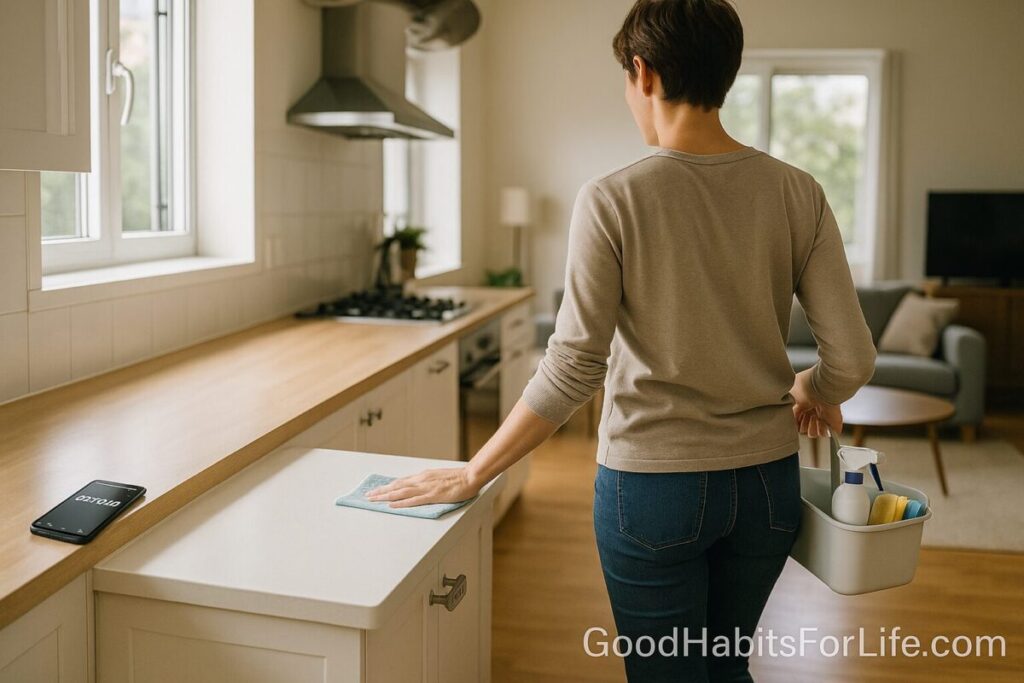
Cleaning Circuits: 20 Minutes a Day
Cleaning Circuits: Twenty Minutes a Day
Table of Contents
🧭 What & Why
What is a cleaning circuit?
A cleaning circuit is a fixed, repeatable route through your home (or a single zone) with a short checklist of micro-tasks (e.g., clear, wipe, reset, quick vacuum). You move continuously, timer on, without stopping to ponder or reorganize the plan. The goal is consistency over perfection.
Why it works
-
Less decision fatigue: a predetermined path removes moment-to-moment choices.
-
Standards stay visible: a 20-minute pass keeps counters clear, floors crumb-free, and “visual noise” down so deep cleaning doesn’t snowball.
-
Health-aligned housekeeping: in most households, regular cleaning with soap/detergent removes most germs; reserve disinfectants for illness or high-risk messes. CDC+1
-
Cleaner air & safer habits: opening windows or using exhaust fans helps dilute indoor pollutants; safe storage of products prevents accidental exposures—crucial with children. US EPA+1
✅ Quick Start (Do This Today)
-
Pick one 20-minute window (e.g., after dinner, 8:00–8:20 p.m.).
-
Choose your route (example for a 1–2-bed home):
-
Kitchen → Living → Entry → Bathroom speed pass.
-
-
Build a tiny checklist (max 5 items/room):
-
Kitchen: clear dishes, wipe counters/stove, load dishwasher, spot-sweep.
-
Living: reset surfaces (bin clutter), fluff cushions, quick crumb sweep, fold throw.
-
Entry: shoes lined, mail sorted, surfaces wipe.
-
Bathroom: replace towels, wipe sink/tap, quick mirror swipe, empty bin if ¾ full.
-
-
Pack a grab-and-go caddy: microfiber cloths, dish/hand soap, all-purpose cleaner, small brush, liners, gloves.
-
Set a 20-minute timer (or 2 × 10-minute sprints). Move continuously; don’t deep-dive.
-
Ventilate briefly (crack a window/turn on exhaust) while using sprays; keep chemicals in original child-resistant containers, locked away after. US EPA+1
📅 7-Day Starter Plan
Goal: complete one circuit daily, same time, same route.
-
Day 1: Time the baseline. Note bottlenecks (e.g., dishes pile).
-
Day 2: Pre-reset: 3-minute tidy before the timer to speed the circuit.
-
Day 3: Trim tasks: keep only what fits in 20 minutes.
-
Day 4: Add an if-then cue (e.g., “If I finish dinner, then I start the circuit.”). cancercontrol.cancer.gov
-
Day 5: Add a playlist or single podcast segment (~20 min) as a consistency anchor.
-
Day 6: Introduce a weekly bolt-on (5 extra minutes for one rotating “boost”: stovetop grates, mirror polish, baseboard swipe).
-
Day 7: Review & lock the route; post the checklist where you start (inside a cabinet door).
🗺️ 30-60-90 Roadmap
30 Days — Consistency First
-
Lock the same trigger (time/after-dinner).
-
Keep the route identical; aim for 80–90% adherence.
-
Track a single metric: “days completed” (checkbox calendar).
60 Days — Speed & Flow
-
Trim micro-steps that slow you down (e.g., swapping tools).
-
Add a weekly “deep” slot (30–45 min on weekends) for bathrooms, bedding, or oven.
-
Expect the routine to feel easier and more automatic with repetition across stable cues. Wiley Online Library
90 Days — Sustain & Elevate
-
Create two circuits (A weekday, B weekend) or AM micro-circuit (entry/bathroom) + PM circuit (kitchen/living).
-
Consider an air-quality upgrade: maintain HVAC filters; evaluate a portable HEPA air cleaner if needed. US EPA
🧠 Techniques & Frameworks (That Actually Work)
-
If-Then Planning (Implementation Intentions):
“If the kettle clicks off at night, then I start the circuit.” This simple plan reliably bridges intention and action across many contexts. ScienceDirect -
Habit Formation Reality Check:
Habits often take weeks to months to automate; in one field study, the median was ~66 days (range 18–254). Expect variability; repetition is key. Wiley Online Library -
Friction-cutting: A single caddy, cordless tools, and a fixed path remove switching costs.
-
Timeboxing + music: A 20-minute timer (or one playlist) sets a crisp boundary that prevents scope creep.
-
Visual finish line: Snap a quick “after” photo of the sink and coffee table—your two standards of “done.”
-
Environment design: Keep daily cleaners where they’re used; label shelves; use small bins to make resets obvious.
-
Safety protocol: Ventilate while using sprays; wear gloves if needed; store products locked, original containers. US EPA+1
👥 Audience Variations
-
Students/Roommates: One shared circuit after dinner; assign roles (runner/wiper/bin). Keep a communal caddy; rotate the weekly deep task.
-
Parents: Run a 10-minute Kid Circuit before bedtime (toy corral, laundry hamper sweep, table wipe) + your own 10 minutes later.
-
Professionals (long hours): Split into 2 × 10 (pre-work entry/bath; post-dinner kitchen/living).
-
Seniors: Favor lighter tools (cordless stick vac, lightweight caddy). Consider seated tasks (folding, sorting) and balance-safe motions.
-
Couples: Make it a micro-ritual: one leads, one follows; swap weekly. Keep it short to avoid friction—“done, not perfect.”
⚠️ Mistakes & Myths to Avoid
-
“I must disinfect everything daily.” For most healthy households, cleaning with soap/detergent is sufficient; disinfect when someone is sick or after high-risk messes. CDC+1
-
Over-packing the circuit. If it doesn’t fit in 20 minutes, move it to the weekly deep slot.
-
Random routes. Changing order invites decision fatigue. Fix your path.
-
Unventilated spraying. Always ventilate; avoid mixing products (never mix bleach with ammonia). US EPA
-
Unlocked storage. Keep products out of reach and in original child-resistant containers. U.S. Consumer Product Safety Commission
💬 Real-Life Examples & Scripts
If-Then Scripts (copy-paste):
-
“If the dishwasher finishes, then I start the circuit.”
-
“If we put down forks after dinner, then the 20-minute timer starts.”
-
“If I hang up my keys, then I clear the entry bench and mail.”
Two-Zone Apartment (Weeknights):
-
Kitchen (8 min): dishes in, counters/stove wipe, sink rinse, spot-sweep.
-
Living/Entry (12 min): surfaces reset, couch swipe, floor crumbs, shoes lined, bin out if full.
Family Home (Weekends):
-
AM Micro (10): bathrooms quick pass (sink/mirror/towels).
-
PM Micro (10): kitchen/living reset.
-
Deep (30–45): rotate (tub/shower, bedding, fridge, baseboards).
🛠️ Tools, Apps & Resources
Physical tools
-
Compact caddy; microfiber cloths; small brush; liners; gloves.
-
Cordless stick vac/handheld, squeegee, scrub pads.
-
Optional: portable HEPA air cleaner for rooms with dust/allergen issues (choose CADR/room size appropriately). US EPA
Apps (pros/cons quick hits)
-
Tody / Sweepy: room-based schedules; + gamified; – premium features paywalled.
-
Todoist / TickTick / Microsoft To Do: flexible recurring tasks; + cross-platform; – setup time.
-
Routinery / Streaks: habit streaks and routines; + strong cues; – limited task depth.
-
Focus To-Do: Pomodoro + checklist; + built-in timer; – basic reporting.
Reference guidance
-
CDC: when to clean vs disinfect; how to clean safely. CDC+1
-
EPA: ventilation and portable air cleaners. US EPA+1
-
CPSC: poison-prevention storage basics. U.S. Consumer Product Safety Commission
📚 Key Takeaways
-
One fixed 20-minute circuit beats irregular deep cleans.
-
Anchor to a daily cue (after dinner) with an if-then plan. ScienceDirect
-
Clean first, disinfect when appropriate—and ventilate. CDC+1
-
Expect 2–3 months to feel truly automatic; repetition matters. Wiley Online Library
-
Keep products locked and labeled to prevent accidents. U.S. Consumer Product Safety Commission
❓ FAQs
1) Does a 20-minute daily sweep really make a difference?
Yes—because standards never fall too far. You’re preventing backlog and grime. Also, short bouts are easier to sustain, and any movement is better than none. CDC
2) How many rooms should I include?
As many as comfortably fit in 20 minutes. For larger homes, rotate zones or run two 10-minute passes (AM/PM).
3) Do I need to disinfect every day?
No. In healthy households, routine cleaning with soap/detergent removes most germs. Disinfect mainly when someone is sick or after higher-risk messes. CDC+1
4) What about indoor air when I clean?
Open windows or run exhaust fans while using sprays; consider a portable HEPA air cleaner if needed for allergens or odors. US EPA+1
5) Is this safe with kids and pets around?
Yes—if you store products locked, in original containers, and ventilate during use. U.S. Consumer Product Safety Commission
6) Can I count this as exercise?
Light housework adds to your daily movement; health guidelines allow breaking activity into smaller chunks across the week. CDC+1
7) What if I miss a day?
Resume at the next scheduled cue. Avoid catch-up marathons; consistency beats intensity.
8) How do I prevent scope creep (getting stuck deep-cleaning)?
Use a 20-minute timer and a written checklist. Park deep tasks into a weekly “bolt-on.”
9) Which cleaners should I keep in the caddy?
An all-purpose cleaner, dish soap, glass cleaner (or diluted vinegar for glass only), microfiber cloths, and gloves. Follow labels; don’t mix products; ventilate.
10) How do I involve a partner or roommate?
Assign roles (runner/wiper), keep the route fixed, and make it a quick shared ritual tied to after-dinner.
References
-
Centers for Disease Control and Prevention. Cleaning and Disinfecting (overview). https://www.cdc.gov/hygiene/cleaning-disinfecting/index.html CDC
-
CDC. When and How to Clean and Disinfect Your Home. https://www.cdc.gov/hygiene/about/when-and-how-to-clean-and-disinfect-your-home.html CDC
-
U.S. Environmental Protection Agency. Improving Indoor Air Quality (Ventilation). https://www.epa.gov/indoor-air-quality-iaq/improving-indoor-air-quality US EPA
-
U.S. EPA. Guide to Air Cleaners in the Home. https://www.epa.gov/indoor-air-quality-iaq/guide-air-cleaners-home US EPA
-
U.S. Consumer Product Safety Commission. Poison Prevention (Home Chemicals & Storage). https://www.cpsc.gov/Safety-Education/Safety-Education-Centers/Poison-Prevention-Information-Center U.S. Consumer Product Safety Commission
-
Pacini A, et al. Unintentional pediatric exposures to household cleaning products. Clin Exp Emerg Med. 2023. https://pmc.ncbi.nlm.nih.gov/articles/PMC10422824/ PMC
-
Lally P, et al. How are habits formed: Modelling habit formation in the real world. Eur J Soc Psychol. 2010. https://onlinelibrary.wiley.com/doi/abs/10.1002/ejsp.674 Wiley Online Library
-
Gollwitzer PM, Sheeran P. Implementation intentions and goal achievement: A meta-analysis of effects and processes. Adv Exp Soc Psychol. 2006. https://www.sciencedirect.com/science/article/pii/S0065260106380021 ScienceDirect
-
CDC. Physical Activity Basics—Adults & What Counts. https://www.cdc.gov/physical-activity-basics/guidelines/adults.html and https://www.cdc.gov/physical-activity-basics/adding-adults/what-counts.html CDC+1
-
CDC. Physical Activity—Intro Script (examples include light housework). https://www.cdc.gov/physicalactivity/everyone/videos/scripts/pag_physical-activity-guidelines-introduction_508tagged.pdf CDC
Disclaimer: This guide includes general health and safety information. For personal medical or chemical-safety advice, consult a qualified professional.