
City Fuel Savings 2025: Idle Off, Route Smart
City Fuel Savings 2025: Idle Off, Route Smart
Table of Contents
🧭 What & Why
City fuel savings is the practice of cutting fuel use in stop-and-go, short-trip urban driving by combining three levers: (1) idle-off habits, (2) route optimization, and (3) eco-driving & maintenance.
Why it matters in 2025:
-
Stop-and-go penalties: Frequent accelerations, short trips, and cold engines raise consumption versus highway driving.
-
Idling waste: A typical petrol car can burn ~0.6–1.0 L/hour while stationary (≈0.15–0.25 gal/hr) delivering zero distance.
-
Money & emissions: Small daily wins stack—cutting 10–20% of fuel in cities saves cash and CO₂, while also reducing local air pollution.
-
No new car needed: Most savings come from behavior and planning, not hardware.
✅ Quick Start: Do This Today
-
Set an Idle-Off Rule. If you’ll be stopped >60 seconds (rail crossing, long light, school pick-up), and it’s safe/legal, switch off and restart when ready to move. (Use judgment for climate/visibility and traffic.)
-
Plan your loop. Batch 3–6 errands into a single warm-engine loop: farthest stop first if parking is easier later; otherwise follow eco-routing.
-
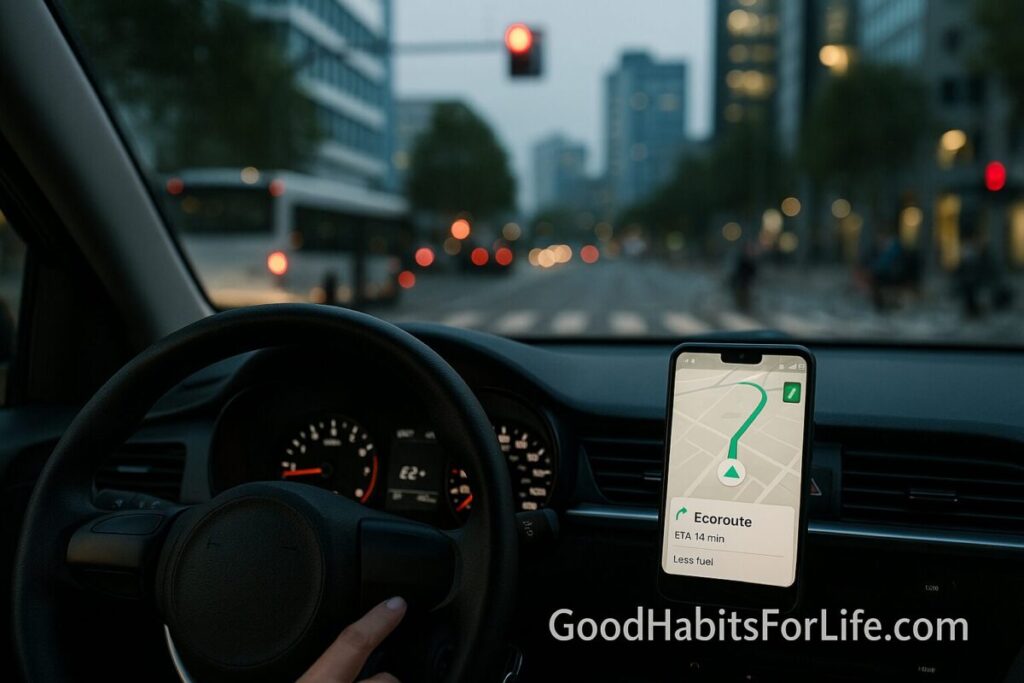
Use live traffic. In Maps/Waze, enable eco-friendly routing or “avoid congested roads.” Departure-time planning beats detouring mid-trip.
-
Check tires cold. Inflate to the door-jamb sticker (not the sidewall max). Under-inflation quietly eats fuel.
-
Drive “glass of water” smooth. Imagine a brim-full glass on your dash: gentle launches, early lift-off, and roll to reds.
-
Drop dead weight. Remove roof racks/boxes and unnecessary boot items (≈+45 kg ≈ +1% fuel).
-
Track a baseline. Log fuel and odometer in L/100 km (or mpg). Use any app; measure weekly.
🛠️ 30-60-90 Day Habit Plan
Days 0–30: Foundation
-
Baseline: Record current L/100 km, cost/km, and city share of trips.
-
Rules:
-
Idle-off >60 s (safe/legal).
-
Smooth launches to 20–30 km/h, short-shift/early upshift where appropriate.
-
-
Setup:
-
Turn on eco-routing in your maps app.
-
Buy a reliable tire gauge; set reminder to check monthly.
-
Clear roof racks and heavy cargo.
-
-
Target: –5% fuel vs. baseline.
Days 31–60: Optimization
-
Eco-coast & anticipate: Look far ahead; ease off early to ride the green wave at 25–40 km/h.
-
Errand batching: Aim for 2–3 fewer cold starts per week.
-
AC optimization: Use recirculate; pre-ventilate a hot car; prefer shade parking.
-
Maintenance: Oil/filters per schedule; fix any engine light.
-
Target: –10–15% fuel vs. baseline.
Days 61–90: Lock-In & Scale
-
Route analytics: Compare 2–3 common routes for the same trip at different departure times; keep the top 1–2.
-
Driving score: Many apps/telematics show “harsh accel/brake” counts—reduce by 20–30%.
-
Household scaling: Share the playbook with other drivers; standardize tire checks and idle-off.
-
Target: –15–25% fuel vs. baseline.
🧠 Techniques & Frameworks (Eco-Driving for Cities)
1) Idle-Off Protocol
-
When: Long lights, level crossings, curb-side waiting, school pick-ups, secure car parks.
-
When not: In moving queues, on steep grades, when HVAC/defrost is required for safety, or where prohibited.
-
Why it works: Idling yields 0 km/L; modern engines use less fuel to restart than to idle for a minute.
2) Anticipative Driving
-
Read traffic lights 2–3 phases ahead; if the next light is red, lift early and coast to arrive as it turns green.
-
Keep space: A 2–3 second gap gives buffering, so you brake less and reuse momentum.
3) Gentle Throttle, Low Peaks
-
Urban efficiency peaks around 30–50 km/h (20–30 mph). Hard launches spike fuel flow; aim for ≤2,000–2,500 rpm in petrol cars where safe.
4) Route & Timing
-
Departure-time shifting (±15–30 min) often beats any detour.
-
Prefer fewer turns and fewer stops even if distance is slightly longer—stops cost fuel.
5) Thermal Strategy
-
Cold engines are rich. Combine trips so the engine stays warm; start with the farthest stop if parking/traffic allow.
6) Mass & Drag
-
Weight: Every extra 45 kg (100 lb) ≈ ~1% more fuel in smaller vehicles.
-
Aerodynamics: Roof racks/boxes add drag at any speed; remove when not needed.
7) Tire Care
-
Under-inflated tires increase rolling resistance. Check monthly cold; expect +0.6–3% economy from correct pressures.
8) AC & Cabin
-
Cabin cooling can raise consumption (range varies by vehicle). Use pre-ventilation and recirculate; aim for moderate set-points.
9) Gearing & Modes
-
Use Eco mode if equipped; it dulls throttle spikes. In automatics, ease off slightly to encourage earlier upshifts.
10) Visibility & Safety First
-
Never sacrifice clear windows, power steering/brakes, or legal compliance for a tiny fuel gain.
👥 Audience Variations
-
Students & New Drivers: Practice the “glass of water” drill in low-traffic areas; use a small notebook to log fuel until the habit sticks.
-
Parents: School lines are prime idle-off time. Keep a sunshade and window vent clips to reduce AC load.
-
Professionals/Commuters: Test two departure times for a week; calendar-block the better slot.
-
Seniors: Prioritize comfort and visibility; gentle driving already suits eco-driving—add tire checks and simpler routes.
-
Gig/Delivery Drivers: Batch pickups, reduce U-turns, and use apps that minimize left-turns across traffic (smoother flow, fewer stops).
⚠️ Mistakes & Myths to Avoid
-
Myth: “Warming up” the car by idling saves fuel.
Reality: Drive off gently after a brief start; the engine warms faster under light load. -
Mistake: Chasing the shortest distance only.
Fix: In cities, fewest stops/turns often wins. -
Myth: Restarting the engine uses more fuel than idling.
Reality: A modern restart typically uses less fuel than idling for ~1 minute. -
Mistake: Over-inflating tires to “reduce drag.”
Fix: Stick to manufacturer pressures for safety, grip, and even wear. -
Mistake: Aggressive bursts to “beat the light.”
Fix: Anticipate and roll—arrive as it turns green.
🗣️ Real-Life Examples & Scripts
-
At a long red:
“This one’s a long cycle—engine off, neutral, handbrake on. Lights green? Start, gear in, go.” -
School pick-up:
“We’ll be 3–4 minutes. Engine off, windows cracked, recirculate when we start rolling.” -
Weekly fuel check:
“Tyres are at 2.3 bar all round (≈33 psi). Log filled. We’re at 7.8 L/100 km this week—down from 8.6.” -
Family rule:
“If we’re parked or stopped for >60 seconds, and it’s safe/legal, we switch off.”
🧰 Tools, Apps & Resources
Routing & Traffic
-
Google Maps / Apple Maps / Waze / HERE WeGo — Live congestion, eco-routing, departure-time planning.
Pros: Free, wide coverage. Cons: ETA variability; eco-routes may be slightly longer.
Tracking & Telemetry
-
Fuelio, Drivvo, Simply Auto — Fuel logs, L/100 km graphs.
Pros: Easy trend tracking. Cons: Manual entry unless OBD-linked. -
OBD-II + App (Car Scanner, Torque Pro) — Live fuel flow, speed, throttle data.
Pros: High feedback; great for habit tuning. Cons: Setup and learning curve.
Hardware Basics
-
Quality tire gauge (digital), sunshade, cabin air filter (clean), roof-rack keys (so you’ll remove it!).
📚 Key Takeaways
-
Idle-off + smooth driving + smart routes are the big three for city savings.
-
Combine trips to reduce cold starts; check tire pressures monthly.
-
Use eco-routing and departure-time planning more than detours.
-
Track L/100 km weekly; what gets measured, improves.
-
Safety and legality are non-negotiable; fuel savings should never compromise them.
❓ FAQs
1) How much can eco-driving save in cities?
Commonly 10–20%, and higher if your baseline is aggressive driving with lots of idling.
2) Is turning the engine off at lights bad for the starter or turbo?
Modern systems are designed for frequent restarts (start-stop tech proves this). Use judgment after high-load/turbo runs—cooldown idling may be appropriate.
3) Does AC or open windows use less fuel in town?
At low speeds, either can be okay; AC adds load, while windows add drag (minimal in city speeds). Use recirculate and moderate settings.
4) Should I choose the shortest route or the fewest stops?
In urban driving, fewer stops and fewer turns usually beat the absolute shortest distance.
5) Do premium fuels improve city economy?
Only if your engine requires higher octane; otherwise gains are negligible. Follow the owner’s manual.
6) How often should I check tire pressure?
At least monthly and before long trips; pressure drops with temperature changes.
7) Will hybrid or stop-start vehicles still benefit?
Yes—route timing, smoothness, and mass/drag matter for all vehicles.
8) Is coasting in neutral better?
In modern fuel-injected cars, coasting in gear with foot off throttle often uses zero fuel (fuel cut-off), but always prioritize control and the law.
9) Do app “eco-routes” really help?
They often reduce stops/grades and heavy congestion; test against your baseline over a week.
10) Can I see savings without gadgets?
Absolutely—idle-off, anticipate, smooth throttle, and monthly tire checks deliver most gains.
References
-
U.S. Department of Energy — FuelEconomy.gov: Driving More Efficiently and Keeping Your Car in Shape. https://www.fueleconomy.gov
-
Natural Resources Canada: Idling — Get the Facts and Fuel-Efficient Driving Techniques. https://natural-resources.canada.ca
-
U.S. EPA: What You Can Do to Reduce Pollution from Vehicles and Engines and idling guidance. https://www.epa.gov
-
International Energy Agency (IEA): Digitalization and Energy — Eco-routing & traffic optimization. https://www.iea.org
-
Federal Highway Administration (FHWA): Eco-Driving: Concepts and Benefits. https://ops.fhwa.dot.gov
-
Transport for London: Engine Idling — Advice for Drivers. https://tfl.gov.uk
-
AAA: Gas-Saving Tips & Myths. https://exchange.aaa.com
-
Consumer Reports: How to Save Fuel. https://www.consumerreports.org
-
European Environment Agency: Reducing Emissions from Transport — Driving Behaviour & Congestion. https://www.eea.europa.eu
-
National Renewable Energy Laboratory (NREL): Impacts of Driver Behavior on Fuel Economy. https://www.nrel.gov