
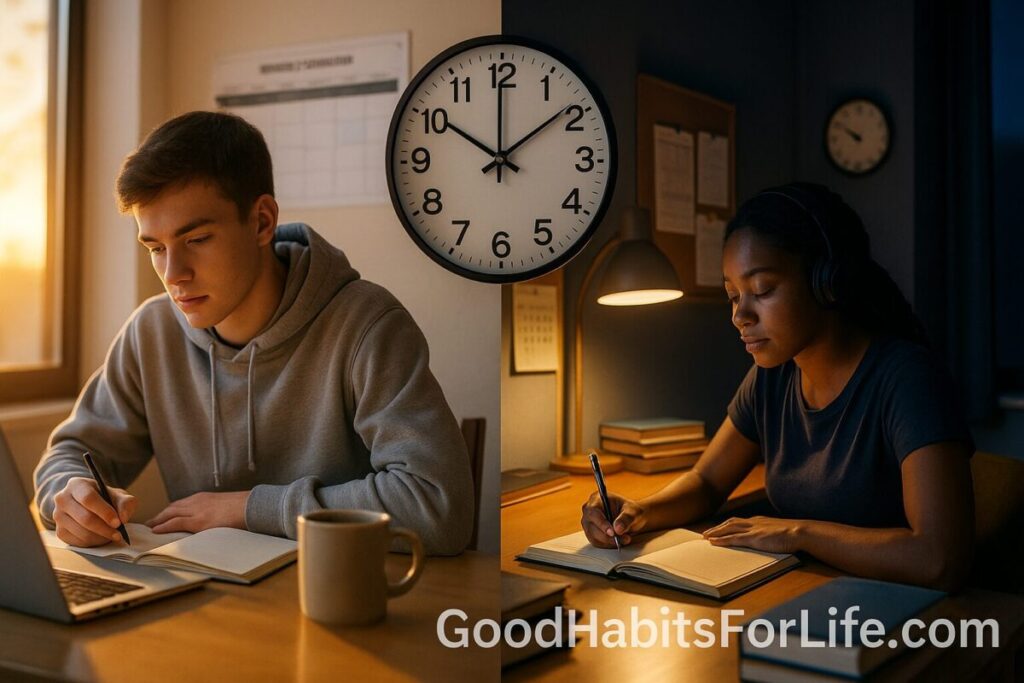
Chronotypes & Classes: Study When Your Brain Peaks
Chronotypes & Classes: Study at Your Peak
Table of Contents
🧭 What & Why: Chronotypes for Learners
Chronotype is your natural timing preference for sleep and alertness (e.g., “lark” vs “owl”). It’s measurable via validated questionnaires like the Munich Chronotype Questionnaire (MCTQ) and Morningness-Eveningness Questionnaire (MEQ). Aligning study with your chronotype improves focus, motivation, and learning efficiency. American Thoracic Society+1
Why it matters for classes: chronic mismatch between your internal clock and your timetable—“social jetlag”—is linked with poorer alertness, shorter sleep, and lower performance. Meta-analytic and policy evidence shows timing matters for grades and that early schedules disadvantage later chronotypes (especially teens). schoolstarttime.org+2PMC+2
Age effects: during adolescence, clocks naturally delay (later bed/wake), so early classes often collide with biology; adults trend earlier again. Plan study blocks accordingly. PubMed
Sleep is the ceiling on cognition. Teens generally need 8–10 h/night; adults ≥7 h. Under-sleeping erodes attention, memory, and mood—no study hack outruns that. CDC+1
✅ Quick Start: Do This Today
-
Find your type (10 min). Take MCTQ or MEQ; note usual bed/wake times and when you feel sharpest. American Thoracic Society+1
-
Block two daily peaks.
-
Larks: aim 08:00–11:00 and 16:00–18:00 for heavy study.
-
Owls: aim 10:00–13:00 and 19:00–22:00 (or later if sleep allows).
-
-
Time caffeine. Use it at the start of a study block; cut off ≥6 h before bed. PMC
-
Power nap if needed. Set a 20–26-minute alarm; avoid late-evening naps. NASA Technical Reports Server
-
Morning light, consistent wake. If you need to shift earlier, get outside light soon after waking; advance wake/bed by 15–30 minutes daily. ScienceDirect+1
🧠 Habit Plan: 30-60-90 Roadmap
Days 0–30 (Assess & Align)
-
Take MCTQ/MEQ; keep a 7-day energy log (note 2–3 daily focus peaks).
-
Protect sleep duration (teens 8–10 h; adults ≥7 h).
-
Schedule 4–6 deep-work blocks/week at your peaks; move routine tasks to troughs. CDC+1
Days 31–60 (Optimize & Shift if needed)
-
If mornings are mandatory, phase-advance gradually (15–30 min/day), add 20–30 min outdoor light after waking, and dim bright light at night.
-
Standardize caffeine (first dose only after waking; last dose ≥6 h pre-bed). ScienceDirect+2Frontiers+2
Days 61–90 (Stabilize & Scale)
-
Lock a weekly rhythm: classes, office hours, study groups aligned to peaks.
-
Use strategic NASA-style naps on heavy days (early afternoon). NASA Technical Reports Server
-
Review metrics: time-on-task, quiz scores, and perceived effort.
🛠️ Techniques & Frameworks
1) Peak Mapping (7 days).
Track alertness (0–10) every 90–120 minutes. Circle two highest windows per day; that’s where deep study lives.
2) Two-Peak Method.
-
Peak A = Deep Work (new concepts, problem sets, writing).
-
Peak B = Practice/Recall (spaced retrieval, quizzes).
-
Troughs = admin, formatting, slides, email.
3) Light & Routine Levers (phase & alertness).
-
Morning outdoor light anchors your clock; dim/warmer light 2–3 h pre-bed.
-
Weekend consistency: keep wake time within ±60–90 min to reduce social jetlag. PMC
-
If you’re a night owl needing earlier classes: combine morning light, consistent wake, earlier mealtimes, and small earlier exercise bouts to help advance phase. ScienceDirect
4) Stimulant Strategy.
-
First caffeine once naturally alert (30–90 min after waking).
-
Last caffeine ≥6 h before bed; consider tea or decaf later. PMC
5) NASA Power Nap.
Set 20–26 minutes, dark/quiet, and a quick walk + water after. Avoid after ~17:00 if it steals nocturnal sleep. NASA Technical Reports Server
6) Exam-Day Shift Protocol (start 5–7 days prior).
Advance wake/bed 20 minutes daily; morning light; rehearse at exam hour (do a timed set). Maintain caffeine cut-off.
👥 Audience Variations
Secondary School Students (& Parents). Teens’ clocks run later; advocate for later sections where possible; protect 8–10 h sleep; use light to nudge earlier if you must make early periods. PMC+1
University Students. Register for sections aligning with peaks (skip 8 a.m. labs if you’re a strong owl); book office hours inside your Peak A; use nap + spaced recall before evening seminars.
Working Learners / Evening MBAs. If classes run late, schedule Peak A on weekend mornings for new material; Peak B on class days; keep a strict caffeine cut-off.
Older Adults Returning to Study. Chronotype often shifts earlier; try mid-morning deep work; respect earlier bedtime windows. PMC
⚠️ Mistakes & Myths to Avoid
-
Myth: “5 a.m. = productivity.” Truth: productivity = sleep-aligned timing + sufficient sleep. JCSM
-
Mistake: Late-day caffeine “to push through.” It costs you sleep and tomorrow’s focus. PMC
-
Myth: You can flip chronotype overnight. Phase shifts are incremental. ScienceDirect
-
Mistake: Weekend 3–4 h sleep swing (heavy social jetlag). Keep within ~1 h. PMC
-
Myth: Naps must be 90 minutes. Short naps (≈20–26 min) boost alertness with minimal inertia. NASA Technical Reports Server
🗣️ Real-Life Schedules & Scripts
Sample Day — Lark (Peak A 08:30–10:30; Peak B 16:30–18:00)
-
07:00 Wake + outdoor light → 08:30 Deep Work → 12:30 Admin/lunch → 16:30 Practice/recall → 22:00 Wind-down.
Sample Day — Owl (Peak A 10:30–12:30; Peak B 19:00–21:00)
-
08:30 Wake → late-morning Deep Work → 14:00 NASA nap (20–26 min) → 19:00 Practice/recall → caffeine cut-off 16:00 → 00:00 Bed. NASA Technical Reports Server
Email Script — Change Section Time (student → coordinator)
Subject: Request to move to later lab section
Hi [Name], I’m enrolled in [Course/Lab Code] on [Day/Time]. I handle complex work best in the late morning, and the [10:00] section would help me perform at my best. If a seat opens, could you please move me or add me to the waitlist? Thank you!
Study Group Script — Peak Alignment
“Can we shift our problem-set session to [your Peak A window]? I’ll bring the outline so we can finish faster.”
📚 Tools, Apps & Resources (pros/cons)
-
MCTQ (questionnaire) — research-validated chronotype measure; simple; self-report. Cancer Control
-
MEQ / AutoMEQ — quick morningness-eveningness screener. Perelman School of Medicine
-
Calendar time-boxing — color code Peak A/B; repeat weekly blocks.
-
Light tools — outdoor AM light is best; light boxes help some when used correctly (follow device guidelines; avoid late-evening bright light). ScienceDirect
-
Pomodoro timers & recall apps — build 25–50 min cycles and spaced quizzes.
-
Sleep trackers — helpful awareness; trust how you feel, not just the score.
🔑 Key Takeaways
-
Your best study windows are biologically timed—find and guard them.
-
Reduce social jetlag with consistent wake time and weekend sanity. PMC
-
Sleep first, then schedule: teens 8–10 h; adults ≥7 h. CDC+1
-
Caffeine timing and short naps are tactical boosts, not substitutes. PMC+1
-
If needed, shift earlier gradually using light and routine—don’t force a 180° flip. ScienceDirect
❓ FAQs
1) How do I find my chronotype quickly?
Use MCTQ (mid-sleep on free days) or the MEQ screener. They’re validated and fast. American Thoracic Society+1
2) Can a night owl become a morning person?
You can shift earlier by ~0.5–1.0 h over days/weeks with light timing, consistent wake, and routine tweaks—but it’s gradual. ScienceDirect
3) What’s the ideal nap length for students?
About 20–26 minutes to boost alertness without sleep inertia; avoid too late in the day. NASA Technical Reports Server
4) When should I stop caffeine?
Aim for ≥6 hours before bedtime to protect sleep. PMC
5) How much sleep do I actually need?
Teens: 8–10 hours; adults: 7+ hours nightly. CDC+1
6) My classes are fixed at 8 a.m.—now what?
Phase-advance 15–30 min/day for a week, get morning light, and rehearse at exam hour; protect sleep the night before. ScienceDirect
7) Do weekend sleep-ins ruin my rhythm?
A small catch-up is fine, but big swings create social jetlag; keep within ~1 hour. PMC
8) Do blue-light filters/glasses help?
Dimming bright/blue-rich light at night helps timing; prioritize behavior (light exposure) over gadgets. ScienceDirect
References
-
Preckel F, et al. Chronotype, Cognitive Abilities, and Academic Achievement: A Meta-Analytic Investigation. (2011, PDF). https://schoolstarttime.org/wp-content/uploads/2011/03/preckel-et-al-chronotype-cognitive-abilities-and-academic-achievement-a-meta-analytic-investigation.pdf
-
American Academy of Pediatrics. School Start Times for Adolescents. Pediatrics (2014, PMC). https://pmc.ncbi.nlm.nih.gov/articles/PMC8194457/
-
Roenneberg T, et al. Chronotype and Social Jetlag: A (Self-)Critical Review. Biology (2019, PMC). https://pmc.ncbi.nlm.nih.gov/articles/PMC6784249/
-
CDC. How much sleep do students need? (2024). https://www.cdc.gov/physical-activity-education/staying-healthy/sleep.html
-
AASM & Sleep Research Society. Recommended Amount of Sleep for a Healthy Adult (2015). https://jcsm.aasm.org/doi/10.5664/jcsm.4758
-
Drake C, et al. Caffeine effects on sleep taken 0, 3, or 6 hours before bed. J Clin Sleep Med (2013, PMC). https://pmc.ncbi.nlm.nih.gov/articles/PMC3805807/
-
Rosekind MR, et al. Crew Factors in Flight Operations IX: Effects of Planned Cockpit Rest… (NASA, 1994, PDF). https://ntrs.nasa.gov/api/citations/19950006379/downloads/19950006379.pdf
-
Crowley SJ, Acebo C, Carskadon MA. Sleep, circadian rhythms, and delayed phase in adolescence. Sleep Med (2007). https://pubmed.ncbi.nlm.nih.gov/17383934/
-
Facer-Childs ER, et al. Resetting the late timing of ‘night owls’… (2019). https://www.sciencedirect.com/science/article/abs/pii/S1389945719301388
-
Misiunaite I, et al. Circadian Phase Advances in Response to Weekend Morning Light. Front Neurosci (2020). https://www.frontiersin.org/journals/neuroscience/articles/10.3389/fnins.2020.00099/full
-
ATS. Munich Chronotype Questionnaire (MCTQ). https://site.thoracic.org/assemblies/srn/sleep-related-questionnaires/mctq
-
University of Pennsylvania CBT-I. Morningness–Eveningness Questionnaire (MEQ). (PDF). https://www.med.upenn.edu/cbti/assets/user-content/documents/Morningness-Eveningness%20Questionnaire.pdf
Disclaimer: This guide is educational and not medical advice; see a qualified clinician for personal sleep or health concerns.