
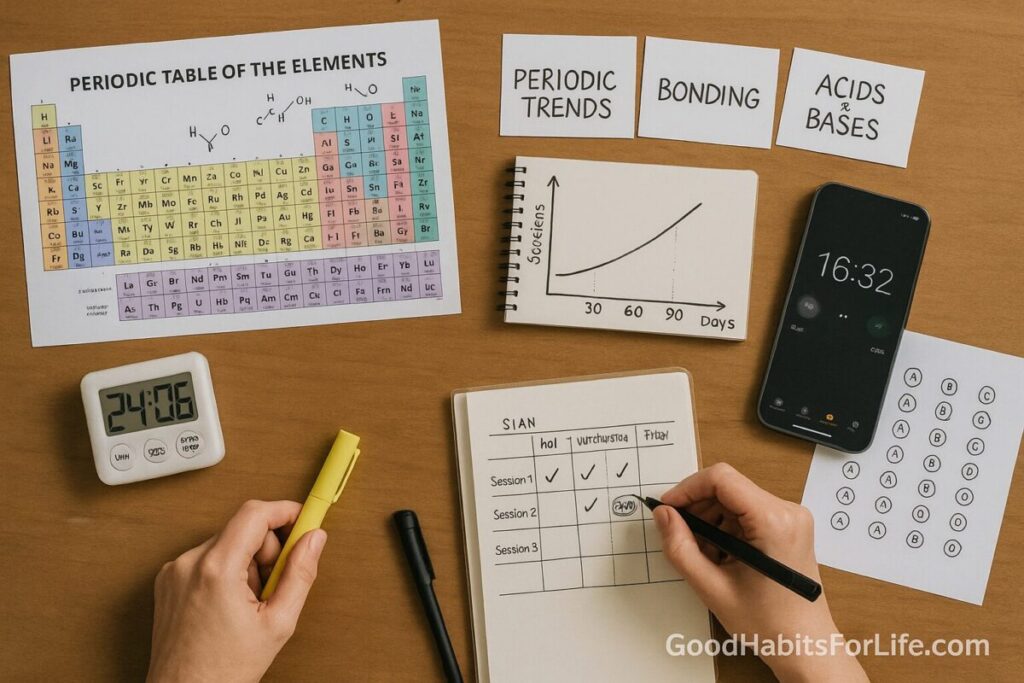
Chemistry Spaced Practice: Tables, Trends, Tests
Chemistry Spaced Practice: Tables, Trends, Tests
Table of Contents
🧭 What & Why
What: Spaced practice means reviewing chemistry concepts multiple times with increasing gaps, using active recall and brief tests. It replaces marathon rereads with short, scheduled sessions that grow further apart. Decades of research show spaced practice and practice testing are among the most effective learning techniques for durable retention and transfer. SAGE Journals
Why it works:
-
Spacing effect: Information reviewed across time sticks better than massed study. Optimal gaps depend on how far in the future you need to remember the material (e.g., exam in 30 days vs. final in 120 days). PubMed+1
-
Testing effect: Low-stakes quizzes and self-tests strengthen memory more than extra study alone. psychnet.wustl.edu+1
-
Desirable difficulties: Small, productive challenges (retrieval, interleaving, varied practice) feel harder now but pay off later. bjorklab.psych.ucla.edu
-
Interleaving: Mixing related topics improves your ability to choose the right method when problems look similar (e.g., periodic trends vs. bonding vs. intermolecular forces). Gwern+1
✅ Quick Start (Do This Today)
-
Pick two topics you’ve covered this week (e.g., Periodic Trends and Types of Bonds).
-
Build a mini-deck (10–20 items per topic):
-
Definition → “What is effective nuclear charge (Z*eff*)?”
-
Concept check → “Rank Na, Al, Cl by atomic radius (largest → smallest). Why?”
-
Trap item → “True/False: Ionization energy always increases down a group.”
-
-
Active recall, not reread: Close notes and answer from memory. Then peek.
-
Log it in a simple table you can maintain daily:
| Due | Topic/Item | Last Score (0–2) | Difficulty (E/M/H) | Next Interval |
|---|---|---|---|---|
| Today | Periodic Trends Q1–Q10 | 1.6 | M | +2 days |
| Today | Bonding Q1–Q10 | 1.2 | H | +1 day |
-
Schedule the next two reviews now: +1–2 days, then +4–6 days (adjust with performance).
-
Finish with a micro-quiz (5 items, 5 minutes). Track accuracy % in your table.
🧠 30-60-90 Habit Plan (with Checkpoints)
Goal: Retain core Gen-Chem topics for the term and exam windows.
Days 1–30: Build & Stabilize
-
Cadence: 20–30 min/day.
-
Intervals (example for a 30-day exam horizon): Day 0 → Day 3 → Day 9 → Day 20. Research suggests first gaps of roughly 10–20% of the target retention interval are efficient; adjust by accuracy. PubMed+1
-
Focus: Periodic trends, bonding, stoichiometry basics, solution concepts.
-
Checkpoint (Day 15): 70%+ on mixed, interleaved 20-item quiz.
Days 31–60: Expand & Interleave
-
Cadence: 30–40 min, 5×/week.
-
Add topics: Thermochemistry, equilibrium, acids/bases.
-
Interleave blocks: 3 rounds × 10 mins each (Trends ↔ Bonding ↔ Equilibrium). Gwern
-
Checkpoint (Day 45): Two 25-min practice tests this week; 75%+ target.
Days 61–90: Test-Ready & Transfer
-
Cadence: 40–60 min, 4×/week.
-
Simulate exams: Every week, 30–45 min timed mixed set; analyze misses.
-
Stretch intervals to 2–3 weeks for mastered decks; keep tough items at 3–7 days.
-
Checkpoint (Day 75): Full mock exam; ≥80% and <10% careless errors.
-
Final week: Only light spaced reviews + error-type drills; sleep, hydration, light movement.
🛠️ Techniques & Frameworks (Chem-Specific)
1) Active Recall Templates
-
Define & Apply: “Define electron affinity. Then explain why Cl has higher EA than Na.”
-
Rank & Reason: “Rank S, O, Se by electronegativity. Justify with Z*eff* and atomic size.”
-
Detect the Trap: “Down a group, atomic radius decreases (T/F)? Correct it.”
-
Worked Example → Flashcard: Turn each solved problem into a 3-prompt mini-set: setup → step → why this step.
Why: Retrieval beats rereading for long-term retention. psychnet.wustl.edu
2) Smart Spacing Formula (Practical)
-
Pick the horizon: midterm in 28 days.
-
Start gaps: first review ~3–5 days after initial learning (≈10–20% rule).
-
Then widen: x2–x3 each successful pass; shrink when accuracy <70% or effort feels “blank.”
-
Cap gaps for fragile concepts at ≤14 days until accuracy stabilizes.
Rationale: Spacing tuned to the retention goal outperforms arbitrary schedules. PubMed+1
3) Interleaving for Look-Alike Problems
Rotate Trends → Bonding → IMFs → Trends in one session so you must choose the right idea rather than mindlessly repeating one procedure. Expect lower fluency during study but higher exam transfer. Gwern
4) Desirable Difficulties, Safely
-
Make it slightly hard: closed-book first pass, then reveal hints.
-
Vary examples: include atypical elements (e.g., Ga vs. Al) to prevent formulaic thinking.
-
Mix formats: written, oral, whiteboard, mini-MCQs.
These “good” difficulties feel effortful now but improve long-term learning. bjorklab.psych.ucla.edu
📚 Audience Variations
Students (secondary & undergrad): Keep decks short (≤20 items/topic); schedule reviews inside your calendar app.
Parents (supporting learners): Ask for 3-minute “teach-back”s after each review; reward process, not only grades.
Professionals refreshing chemistry: Use 10-minute stand-ups: 3 recall questions, 1 mixed calculation, 1 concept link (e.g., battery chemistry ↔ redox).
Teachers/Tutors: Interleave homework sets by intent (identify trend vs. compute value); include one “trap” per set to provoke explanation.
⚠️ Mistakes & Myths to Avoid
-
Myth: “Rereading and highlighting = learning.”
-
Fix: Replace with retrieval + spaced quizzes; reserve rereads for clarifying steps. SAGE Journals
-
-
Mistake: Waiting until you’re “ready” to test yourself.
-
Fix: Start testing immediately with tiny sets; testing drives learning, not just assessment. psychnet.wustl.edu
-
-
Myth: “Interleaving is confusing, so it can’t help.”
-
Fix: Confusion ≠ failure; that productive difficulty is the point. Gwern
-
-
Mistake: Static intervals.
-
Fix: Adapt gaps to your target exam date and accuracy (10–20% rule to start). PubMed
-
✍️ Real-Life Examples & Scripts (Copy-Paste)
A. Spaced-Practice Table (Periodic Trends Focus)
| Date | Deck | Items | Score | Next Gap | Notes |
|---|---|---|---|---|---|
| Sept 15 | Trends #1: radius, IE, EN | 18 | 67% | +3d | Missed Z*eff* reasoning |
| Sept 18 | Trends #1 | 18 | 83% | +7d | Fixed group vs. period mix-ups |
| Sept 25 | Trends #1 | 18 | 91% | +14d | Add 3 trap items |
B. “If-Then” Scheduling Script
-
If I learn a new topic today (IMFs), then I schedule reviews for +3d, +9d, +20d.
-
If my quiz score is <70%, then I shrink the next gap to +2–3d and add 2 fresh examples.
-
If two passes hit ≥90%, then I extend the next gap by ×2 and move to mixed sets.
C. Interleaving Drill (20 minutes)
-
7 mins → Rank & reason (radius, ionization, electronegativity).
-
7 mins → Classify & justify: ionic/covalent/metallic + bond polarity.
-
6 mins → Mixed 10-item quiz pulling from both sets.
D. Teach-Back Prompt
“Explain why ionization energy generally increases across a period and name one exception. Use Z*eff* and electron shielding in your explanation.”
🧩 Tools, Apps & Resources (Quick Pros/Cons)
-
Anki — Algorithmic spacing; flexible cards; steep-ish setup curve; great analytics.
-
RemNote — Notes + flashcards + spaced repetition in one; good for concept linking.
-
Quizlet (test mode + spaced features) — Fast to build; check access to spaced features in your plan.
-
Mochi — Minimal, Markdown-friendly; easy tagging for chemistry decks.
-
Spreadsheet + calendar — Total control; ideal for the simple table method above.
-
Past papers & item banks — Essential for realistic retrieval; tag misses by concept (trend, bonding, IMF, etc.).
📌 Key Takeaways
-
Spaced practice and active recall are high-impact for chemistry mastery. SAGE Journals
-
Start with gaps ≈10–20% of your goal horizon, then adapt by accuracy. PubMed
-
Interleave related topics to sharpen method selection on mixed exams. Gwern
-
Keep tables simple, track scores, and script your next review before you close the book.
❓ FAQs
1) How many cards per topic is ideal?
10–20 items are enough to cover definitions, applications, and traps without bloat. Split big topics into themed mini-decks.
2) What if I’m starting one week before a test?
Do daily reviews and keep intervals short (e.g., Day 0 → Day 1 → Day 3 → Day 5). Use micro-quizzes and one mixed set per day.
3) Should I study until I feel confident?
Confidence can be misleading. Track scores and time-spaced passes; stop after a planned pass and schedule the next one.
4) How do I interleave without getting lost?
Rotate topics with time boxes (e.g., 10-10-10 minutes). End with a 5-item mixed quiz tagged by concept.
5) Do I need fancy apps to space practice?
No. A spreadsheet + calendar reminders works well. Apps help with automation and analytics.
6) How do I handle exceptions in periodic trends?
Add “exception” cards (e.g., EA of O < S). Force a why explanation every time (shielding/subshells).
7) How much testing vs. studying?
Aim for a 2:1 ratio of retrieval to reading during review sessions; increase reading only to fix conceptual gaps.
8) What if interleaving tanks my practice scores?
That’s normal. Expect lower practice fluency but stronger exam transfer—stick with it.
9) How do I know when to lengthen gaps?
If two passes hit ≥85–90% with low effort, extend the next gap ×2. If <70%, shrink it and add fresh examples.
10) Can I space labs/calculations too?
Yes—convert procedures into step cards (setup → key calculation → unit check) and interleave with concept cards.
📚 References
-
Dunlosky, J., et al. (2013). Improving Students’ Learning With Effective Learning Techniques. Psychological Science in the Public Interest. https://journals.sagepub.com/doi/pdf/10.1177/1529100612453266 SAGE Journals
-
Cepeda, N. J., et al. (2008). Spacing effects in learning: A temporal ridgeline of optimal retention. PNAS / summary. PubMed record: https://pubmed.ncbi.nlm.nih.gov/19076480/ ; UC summary: https://escholarship.org/uc/item/0kp5q19x PubMed+1
-
Roediger, H. L., & Karpicke, J. D. (2006). The Power of Testing Memory. Perspectives on Psychological Science. (open PDF via WUSTL). https://psychnet.wustl.edu/memory/wp-content/uploads/2018/04/Roediger-Karpicke-2006_PPS.pdf psychnet.wustl.edu
-
Roediger, H. L., & Karpicke, J. D. (2006). Test-Enhanced Learning. Psychological Science. (open PDF). https://colinallen.dnsalias.org/Readings/2006_Roediger_Karpicke_PsychSci.pdf colinallen.dnsalias.org
-
Bjork, E. L., & Bjork, R. A. (2011). Making things hard on yourself, but in a good way: Creating desirable difficulties to enhance learning. (UCLA PDF). https://bjorklab.psych.ucla.edu/wp-content/uploads/sites/13/2016/04/EBjork_RBjork_2011.pdf bjorklab.psych.ucla.edu
-
Rohrer, D. (2014). The benefit of interleaved practice. (overview PDF). https://gwern.net/doc/psychology/spaced-repetition/2014-rohrer.pdf Gwern
-
Rohrer, D. (2015). Interleaved Practice Improves Mathematics Learning. ERIC report. https://files.eric.ed.gov/fulltext/ED557355.pdf ERIC
-
Smith, C. D., & Scarf, D. (2017). Spacing Repetitions Over Long Timescales: A Review and Meta-Analysis. Psychonomic Bulletin & Review. https://pmc.ncbi.nlm.nih.gov/articles/PMC5476736/ pmc.ncbi.nlm.nih.gov