
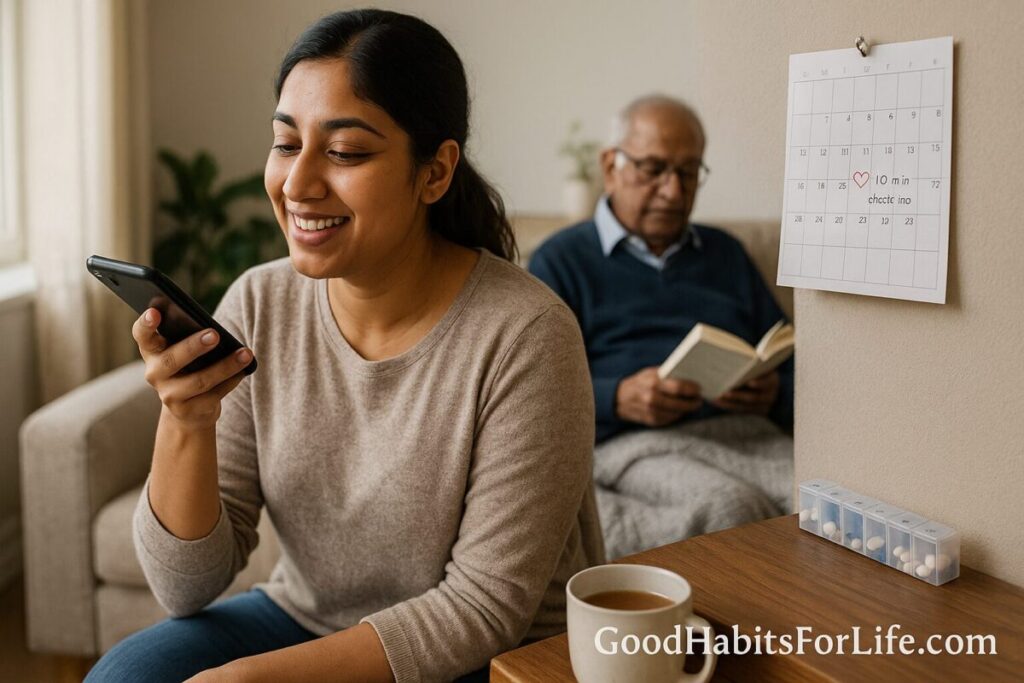
Caregiver Season: Stay Connected with Less Time
Caregiver Season: Stay Connected with Less Time
Table of Contents
🧭 What This Guide Is & Why It Matters
Caregiving compresses your calendar, energy, and attention. Friendships are often the first thing to slip—not because they matter less, but because they’re the easiest to postpone. This guide shows you how to protect those bonds with short, repeatable connection habits that fit into real-life care schedules.
Why it matters: loneliness and social isolation increase risks for depression, dementia, heart disease, and earlier mortality; strong relationships are protective. Caregivers report rising isolation, with nearly 1 in 4 feeling alone. Treating connection like medication—dosage, frequency, adherence—improves resilience and health. CDC+1MediaRoom
Care is a long season, not a weekend. Building a lightweight, sustainable social rhythm keeps you tethered to identity, humor, and hope—fuel you’ll need for the road ahead. Global bodies and national advisories now frame social connection as a public-health priority; it’s not “nice to have,” it’s necessary. World Health OrganizationHHS.gov
✅ Quick Start: A 10-Minute Connection System (Do This Today)
Goal: Touch 3 relationships today in ≤10 minutes total.
-
Pick your 3 (one “anchor” friend, one “cheer” friend, one “practical help” friend).
-
Use a 60-second ping:
-
“Thinking of you. Quick win from today: ____. Hope you’re okay. No reply needed.”
-
-
Book one 10-minute call in the next 7 days (send 2 time windows).
-
Place a monthly 30-minute “porch/tea” block with your anchor friend (virtual or in-person).
-
Park a standing message in your Drafts titled “Check-in,” with 3 lines you’ll reuse.
Why micro-touchpoints? Even very brief breaks (as short as ~30–40 seconds) can aid attention and performance; translated socially, micro-moments keep bonds warm without large time costs. PMCHarvard Business Review
Bonus (if bandwidth allows): Forward a photo or a one-line voice note during your care recipient’s rest period.
🛠️ 30-60-90 Day Caregiver Connection Plan
North Star: Maintain 3 tiers of connection—Daily micro, Weekly mini, Monthly meaningful—with predictable slots so friends learn your new rhythm.
Days 0–30: Stabilize (Protect Micro-Habits)
-
Daily (≤2 min): One 60-second ping to a rotating friend list.
-
Weekly (10 min): One scheduled catch-up (speakerphone while folding laundry; walk-and-talk).
-
Monthly (30 min): A porch visit, coffee, or video tea with your anchor friend.
-
Boundary script: “I’m in caregiver season. Replies may be delayed, but our friendship isn’t. My best windows are Tue/Thu 19:30–20:00.”
Checkpoint (Day 30): You kept ≥20 micro-pings and ≥3 mini-calls? If not, shrink the goal (e.g., 3 pings/week).
Days 31–60: Strengthen (Ask for Specific Help)
-
Map tasks someone else could do (groceries, rides, 1-hour sit-in).
-
Post a shared list (“Ways that help us this month”).
-
Rotate roles among 3–5 friends to prevent burnout.
-
Add one community link (support group, memory café, or ALZConnected). alzheimers.gov
Checkpoint (Day 60): You’ve delegated at least one recurring task? Celebrate with a 30-minute friend date.
Days 61–90: Expand (Reclaim Identity Time)
-
One 90-minute “you” slot every two weeks (class, game, run, creative hour) while a friend or respite covers.
-
Plan a low-friction micro-gathering at home (pot of tea, no cleanup rules).
-
Review your friend map: who energizes, who supports, who makes you laugh.
-
Formalize cadence (e.g., first Sundays = sibling call; Wednesdays = neighbor walk).
Checkpoint (Day 90): You have a repeatable connection calendar and 2–3 friends who understand your windows and how to help.
🧠 Techniques & Frameworks That Work
1) The DOSAGE Model (Dose–Often–Simple–Anchored–Guilt-free–Explicit)
-
Dose: Keep touchpoints 60–120 seconds on busy days.
-
Often: Small and frequent beats big and rare (habit science + microbreaks). PMC
-
Simple: Text templates, recurring calendar slots, one-tap voice notes.
-
Anchored: Stack to existing tasks (meds → ping; kettle → voice note).
-
Guilt-free: “No-reply-needed” messages reduce pressure.
-
Explicit: Tell friends your constraints and preferred windows.
2) Stress-Buffering Through Support
Close relationships act as a buffer against stress physiology—one reason caregiver connection is protective. Make support visible: ask, receive, reciprocate later. PMC
3) Expectation Reset Framework (CARE)
-
Context: “I’m in an intense caregiver season.”
-
Access: “Best times: Tue/Thu evenings; 10-minute calls work.”
-
Requests: “Could you host a Saturday porch tea once a month?”
-
Ease: “No gifts, no fuss, just company.”
4) Asynchronous + Low-Bandwidth Tools
Broadcast updates via CaringBridge, Lotsa Helping Hands, or a small WhatsApp group to reduce one-off texting. Friends get news and practical requests in one place. WIRED
5) Respite & Community
Support groups, memory cafés, and national programs (e.g., NFCSP in the U.S.) open time and reduce isolation. ACL Administration for Community Living
📣 Audience Variations
Students
-
Study buddies double as support: 20-minute co-study + 3-minute debrief.
-
Use campus counseling and student caregiver groups; share a “finals blackout” note early.
Parents of young kids
-
Pair playdates with caregiver chats; swap “park shifts.”
-
Keep a bin of shelf-stable snacks and paper cups for “porch teas.”
Professionals
-
Convert commute or walk breaks into walk-and-talks; calendar a recurring 12:40–12:50 “friend ring.”
-
Protect one meeting-free block weekly for personal calls.
Seniors
-
Enlist neighbors for short porch visits; explore Eldercare Locator to find local help and friendly call programs. Elder CareACL Administration for Community Living
⚠️ Mistakes & Myths to Avoid
-
Myth: “If we can’t talk for an hour, it’s not real.” Truth: short, frequent touchpoints maintain closeness and reduce isolation risk. PMC
-
Myth: “Asking for help is a burden.” People under-estimate how willing others are to help; make specific asks. WIRED
-
Mistake: Ghosting during hard weeks. Send a “bookmark text”: “Intense week—bookmarking you. More soon.”
-
Mistake: Waiting for the perfect time. Schedule tiny windows you can actually keep.
-
Mistake: One friend for everything. Diversify: practical help friend, laugh friend, quiet-company friend.
🗣️ Real-Life Examples & Copy-Paste Scripts
Expectation Reset (first message)
“Hey! I’m in a heavy caregiver season. My best windows are Tue/Thu 19:30–20:00 or Sat 11:30. I’ll be slower to reply, but I still want us. Quick 10-minute calls or voice notes work great for me. No pressure to respond fast!”
No-Reply Micro-Ping
“Thinking of you. Today’s small win: Mom smiled at the radio. Hope your week has a bright spot too. No reply needed ❤️.”
Specific Help Ask
“Could you sit with Dad next Wed 17:30–18:30 so I can take a walk and call Priya? If not, any 60 minutes Thu/Fri works.”
Group Update (CaringBridge / WhatsApp)
“Weekly update: Stable. Needs: two dinner drop-offs (Tue/Thu), 1 pharmacy run, 1 porch visit. Sign up here: [link].”
Reconnection After Silence
“I went quiet under water. Miss you. Ready to rebuild in small steps—start with a 10-minute catch-up this week?”
Decline Without Guilt
“Love the invite. I’m at bandwidth zero this month—can we pencil a 30-minute porch tea on the first Sunday next month?”
📚 Tools, Apps & Resources (quick picks)
| Tool/Resource | What it’s best for | Pros | Considerations |
|---|---|---|---|
| CaringBridge / Lotsa Helping Hands / Give InKind / Meal Train | Broadcast updates, coordinate help | Centralizes info & sign-ups; reduces 1:1 texts | Some friends won’t check apps—send periodic summaries |
| ALZConnected (Alzheimer’s Association) | 24/7 online caregiver community | Peer support; topic-specific groups | Skews dementia-care; still useful for general coping alzheimers.gov |
| Family Caregiver Alliance (CareNav) | Personalized caregiver resources | Free dashboard; education library | U.S.-centric resources Caregiver+1 |
| Eldercare Locator (ACL) | Find local programs & respite | Government-run; phone/chat help | Availability varies by county Elder CareACL Administration for Community Living |
| Timer + Drafts (your phone) | 60-sec pings & templates | Always with you; zero cost | Needs discipline to use daily |
| Support Groups / Memory Cafés | Social connection + learning | Reduces isolation; structured time | Try 2–3 groups to find fit Verywell Health |
🔑 Key Takeaways
-
Social connection is preventive care for caregivers—protect it on purpose. CDC
-
Swap “big plans” for small, frequent contact; micro-moments count. PMC
-
Set expectations, publish your windows, and ask for specific help. WIRED
-
Use a simple 30-60-90 roadmap to stabilize, strengthen, and expand your social rhythm.
-
Plug into community programs (ALZConnected, Eldercare Locator, NFCSP) to open time and support. alzheimers.govElder CareACL Administration for Community Living
❓ FAQs
How often do I need to check in to keep friendships alive?
Aim for weekly mini-touch (10 minutes) and daily micro-pings when possible; monthly 30-minute moments keep depth alive.
What if my friends don’t “get” my season?
Send the CARE script (Context, Access, Requests, Ease). Share two specific time windows and one specific task.
Is social media enough?
It’s a booster, not a base. Pair passive scrolling with active 60-second pings or voice notes that carry warmth.
How do I ask for help without feeling guilty?
People underestimate how much others want to help. Make specific, time-boxed asks (e.g., “1 hour next Wed”). WIRED
What if I keep canceling?
Schedule shorter and closer: 10 minutes by phone at home beats a 90-minute dinner you’ll bail on.
What about the health side of loneliness?
Isolation and loneliness are tied to higher risks for depression, heart disease, stroke, dementia, and earlier death—another reason to prioritize connection. CDC
Any quick science I can remember on “micro” habits?
Micro-breaks as brief as ~30–40 seconds support attention and performance—use that principle for micro-connections. PMC
Where can I find reliable local support?
In the U.S., start with Eldercare Locator (ACL) and the National Family Caregiver Support Program. Elder CareACL Administration for Community Living
We’re dealing with dementia—any communication tips?
Maintain routine, keep language simple, and allow extra time to respond; the Alzheimer’s and related resources have practical guides. alzheimers.gov
How do I rebuild after a long silence?
Own the gap and propose a tiny step: “I went quiet; can we start with a 10-minute call this week?”
📚 References
-
AARP & National Alliance for Caregiving. New Report Reveals Crisis Point for America’s 63 Million Family Caregivers (2025). https://press.aarp.org/2025-07-24-New-Report-Reveals-Crisis-Point-for-Americas-63-million-Family-Caregivers MediaRoom
-
CDC. Health Effects of Social Isolation and Loneliness (2024). https://www.cdc.gov/social-connectedness/risk-factors/index.html CDC
-
Office of the U.S. Surgeon General. Our Epidemic of Loneliness and Isolation: The Healing Effects of Social Connection and Community (2023). PDF. https://www.hhs.gov/sites/default/files/surgeon-general-social-connection-advisory.pdf HHS.gov
-
WHO. Commission on Social Connection (2024–2025). https://www.who.int/groups/commission-on-social-connection World Health Organization
-
Albulescu P. et al. “Give me a break!” A systematic review and meta-analysis on micro-breaks (2022). https://pmc.ncbi.nlm.nih.gov/articles/PMC9432722/ PMC
-
Hostinar C.E., et al. Social support can buffer against stress (2015). https://pmc.ncbi.nlm.nih.gov/articles/PMC4607089/ PMC
-
CDC MMWR. Loneliness, Lack of Social and Emotional Support (2024). https://www.cdc.gov/mmwr/volumes/73/wr/mm7324a1.htm CDC
-
Alzheimer’s.gov. Tips for Caregivers and Families of People With Dementia (2025). https://www.alzheimers.gov/life-with-dementia/tips-caregivers alzheimers.gov
-
Zhou Y., et al. Technology-based interventions for caregivers (2024). https://pmc.ncbi.nlm.nih.gov/articles/PMC11070124/ PMC
-
Yuan S., et al. Social support interventions for caregivers of older adults with dementia (2025). https://pmc.ncbi.nlm.nih.gov/articles/PMC12142170/ PMC
-
Administration for Community Living. Eldercare Locator (2025). https://eldercare.acl.gov/home Elder Care
-
Administration for Community Living. National Family Caregiver Support Program (2025). https://acl.gov/programs/support-caregivers/national-family-caregiver-support-program ACL Administration for Community Living
Disclaimer: This guide is for general information and is not a substitute for professional medical, mental-health, or legal advice.