
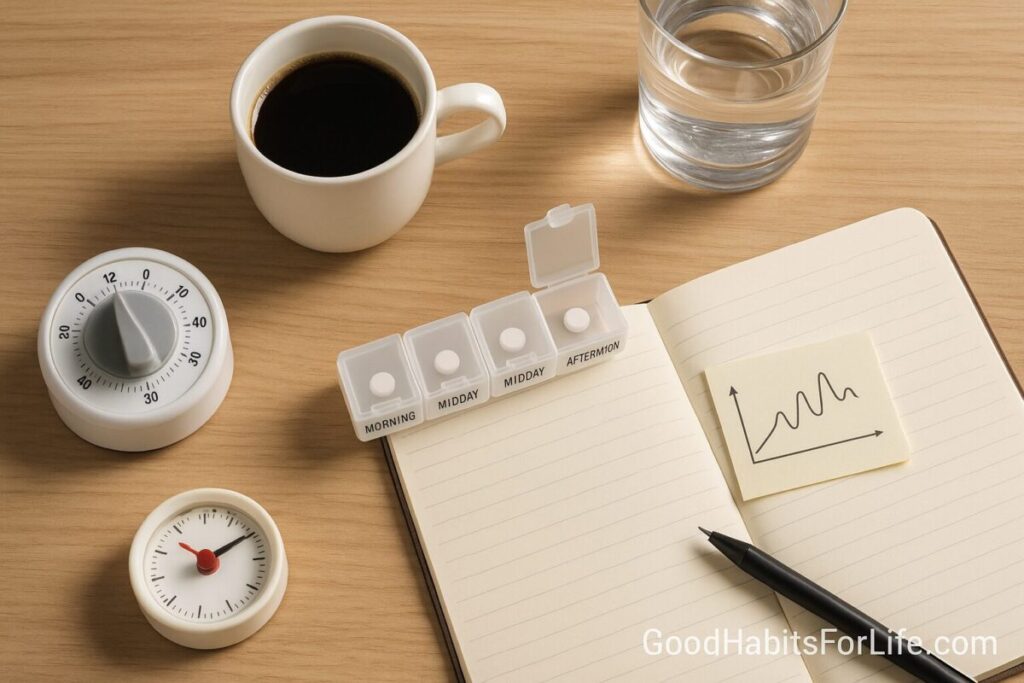
Caffeine MicroDoses: Stay Sharp Without the Crash
Caffeine Microdosing: Stay Sharp Without the Crash
Table of Contents
🧭 What Is Caffeine Microdosing?
Caffeine microdosing means taking small, repeated amounts (about 20–40 mg) at intervals (typically every 2–3 hours) instead of one large hit. It aims to keep blood caffeine levels steadier, supporting vigilance while reducing jitters, energy “crashes,” and sleep disruption. Evidence shows frequent low doses during extended wakefulness maintain performance better than single large doses (e.g., Wyatt et al., 2004; Killgore et al., 2020). Pharmacokinetics matter: caffeine’s half-life averages ~4–5 h (range ~1.5–9.5 h), varying by genetics, medications, and physiology, so timing is key. (NCBI Bookshelf; Frontiers in Pharmacology 2022)
Safety guardrails: For most healthy adults, ≤400 mg/day is the general safety cap. During pregnancy, keep ≤200 mg/day; lactation guidance is commonly ≤200–300 mg/day. (FDA 2024; EFSA 2015; ACOG; MotherToBaby)
✅ Why Microdose? Benefits vs. Big Doses
Potential benefits (when within daily limits):
-
Sustained attention & reaction time without the peak-and-crash of a large bolus. (Wyatt 2004; McLellan 2016; Killgore 2020)
-
Fewer side effects (jitters, palpitations) compared with large doses in sensitive people. (Temple 2017 review)
-
More precise timing around cognitive tasks and circadian dips (late morning/early afternoon). (Harty 2020; PK reviews)
Why not just take one big coffee?
Large single doses spike levels, then decline as sleep pressure rises. Controlled trials show small, frequent doses maintain vigilance more evenly—especially under fatigue or long workdays. (Wyatt 2004; military gum multi-dose studies)
Sleep matters: A 400 mg dose can impair sleep even 6 hours before bedtime; many people need a cut-off 8–10 hours before planned sleep. (Drake 2013; PK variability)
🛠️ Quick Start: Your First Week
Goal: Try a conservative microdose loop that respects daily limits and your bedtime.
Assumptions: Bedtime 23:00; wake 07:00; no medical contraindications.
-
Choose a source (estimate mg; values vary):
-
Coffee: ~80–100 mg per 240 ml (8 oz). Use ¼ cup (60 ml) ≈ 20–25 mg.
-
Black tea: ~30–50 mg per 240 ml; ½ cup (120 ml) ≈ 15–25 mg.
-
Espresso: ~60–80 mg per 30 ml; ⅓ shot ≈ 20–25 mg.
(Typical ranges from USDA FoodData Central/major reviews.)
-
-
Set a safe cap:
-
Adults: max 300–350 mg/day for week 1 (below the 400 mg ceiling).
-
Pregnant: ≤200 mg/day.
-
Breastfeeding: ≤200–300 mg/day (watch infant sensitivity).
-
-
Run the loop (Mon–Fri):
-
T+60–90 min after wake: 20–30 mg (avoid right on waking to ride the natural cortisol rise).
-
Every 2–3 h while working: another 20–30 mg as needed.
-
Hard stop: ≥8 h before bedtime.
-
Hydration: water between microdoses.
-
Track: note dose/time, focus, and any jitters or sleep effects.
-
-
Week-end check-in: Review your log. If sleep suffered, move the cut-off earlier and/or lower per-dose mg.
📈 30-60-90 Day Habit Plan
Day 1–30 (Foundation):
-
Define your “alertness windows.” Many feel a dip late morning and post-lunch. Plan microdoses just before those windows.
-
Standard loop: 3–5 microdoses of 20–30 mg (max ~120 mg during work hours), plus one optional early-afternoon microdose.
-
Sleep protection: Keep the last microdose 8–10 h pre-bed; adjust earlier if you’re a slow metabolizer.
Day 31–60 (Personalize):
-
Titrate by task: Up to 40 mg before high-stakes work; skip during low-cognitive blocks.
-
Cycle tolerance: Build in one low-caffeine day/week (or switch to decaf/tea) to reduce tolerance.
Day 61–90 (Optimize):
-
Event-based protocol: For long driving, night shifts, travel: use 20–40 mg pulses every 2–3 h, within daily limits; pair with light, timed snacks and movement breaks.
-
Performance audit: Compare productivity and sleep vs. your “old” single-dose habit; keep what works.
🧠 Techniques & Frameworks
1) The 20-20-20 Microdose Loop
-
Dose: 20–30 mg
-
Interval: every ~2 h
-
Max daytime window: from +60–90 min after wake until 8–10 h pre-bed
-
Use for: writing, analysis, calls—steady cognitive output.
2) Task-Triggered Pulsing
-
Dose: 30–40 mg 15–45 min before a demanding block (presentation, exam prep).
-
Combine with: 2–3 min breathwork and standing/walking to reduce jitters.
3) Circadian-Aware Timing
-
Delay first dose 60–90 min post-wake to avoid stacking with the cortisol peak.
-
Place doses before normal dips (late morning, early afternoon). (Timing literature & performance studies)
4) Sleep-Safe Cut-off
-
Default 8–10 h before bedtime; earlier if sensitive. (Drake 2013; PK variability)
🧑🎓 Audience Variations
-
Students/Exam prep: Use task-triggered 30–40 mg before study sprints; avoid late-evening dosing.
-
Professionals/Knowledge work: The 20-20-20 loop fits deep-work blocks; schedule “no-caffeine” afternoons if sleep is light.
-
Parents/Caregivers: Favor tea-based microdoses (15–25 mg) to reduce jitters; mind the sleep cut-off.
-
Shift workers/Drivers (when unavoidable): Frequent low doses during extended wakefulness can preserve vigilance; still plan sleep ASAP afterward. (Wyatt 2004; Killgore 2020)
-
Pregnancy/Lactation: Limit to ≤200 mg/day (ACOG/EFSA). Monitor infant irritability when breastfeeding (MotherToBaby).
-
Seniors/Anxiety/Arrhythmia: Consider lower doses and medical advice; watch for palpitations, tremor, or sleep disturbance.
⚠️ Mistakes & Myths to Avoid
-
Myth: “More caffeine = more focus.”
Reality: Benefits plateau; side effects rise. (Temple 2017; EFSA/FDA limits) -
Mistake: Dosing within 6–8 h of bedtime.
Fix: Hard stop 8–10 h pre-bed; build a decaf routine. (Drake 2013) -
Mistake: Ignoring total daily mg.
Fix: Track all sources (coffee, tea, energy drinks, soda, chocolate, pills). -
Mistake: Chasing microdoses with sugary energy drinks.
Fix: Prefer coffee/tea/water; high-sugar mixes can cause rebound fatigue. -
Mistake: Not checking medication interactions (e.g., certain antibiotics, stimulants).
Fix: Ask your clinician/pharmacist if unsure; review drug facts.
💬 Real-Life Scripts & Examples
-
Barista script: “Could I have a single espresso, please? I’ll sip ~⅓ shot now and save the rest for later.”
-
Desk routine (tea): “11:00 timer—brew ½ mug black tea (120 ml). 13:00—repeat. 15:00—switch to herbal.”
-
Driving long haul: “Start with 25 mg at 09:00; walk/stretch 5 min every 90–120 min; dose again only if alertness drops—cut off 8–10 h pre-bed.”
-
Deep-work block: “15 min pre-block: 30 mg + water; 90-min sprint; reassess—skip next dose if focus remains high.”
🧰 Tools & Resources
-
Dose tracking: Any notes app or habit tracker; log time, mg, task, effect, sleep.
-
Kitchen measures: Small cups, graduated shot glass, scale for consistent volumes.
-
Nutrition databases: USDA FoodData Central for typical caffeine values across drinks.
-
Sleep apps/wearables: Track bedtime, sleep latency, and awakenings to refine your cut-off time.
📌 Key Takeaways
-
Microdosing (20–40 mg every 2–3 h) can smooth energy and focus versus big spikes.
-
Respect daily caps (most adults ≤400 mg; pregnancy ≤200 mg; lactation commonly ≤200–300 mg).
-
Cut off caffeine 8–10 h before bedtime; adjust earlier if sensitive.
-
Track and personalize—dose, timing, source, and your sleep response.
-
When in doubt, go smaller, prioritize sleep, and talk to a clinician if you have medical conditions or take interacting meds.
❓ FAQs
1) How much is a “microdose” of caffeine?
About 20–40 mg—roughly ¼ cup brewed coffee, ½ cup black tea, or ⅓ shot espresso (actual values vary by product and brew). (USDA FDC ranges)
2) Does microdosing really prevent the crash?
It can reduce peaks and troughs, maintaining steadier alertness versus a single large dose—shown in frequent low-dose protocols under extended wakefulness. (Wyatt 2004; Killgore 2020)
3) When should I take the first dose?
Often 60–90 minutes after waking to avoid stacking with the cortisol peak; then every 2–3 h as needed, stopping 8–10 h pre-bed. (Timing & sleep studies)
4) Is tea better than coffee for microdosing?
Tea typically has lower caffeine per ml and includes L-theanine, which some find smoother; either works if you track mg and timing. (Content ranges; cognition literature)
5) What about energy drinks?
They can contain high caffeine plus sugars/stimulants; read labels and consider coffee/tea alternatives for microdosing. (FDA/EFSA safety guidance)
6) Can I microdose on night shifts or long drives?
Yes—evidence supports multiple small doses to maintain vigilance during extended wakefulness; still prioritize planned sleep and breaks. (Wyatt 2004; Killgore 2020)
7) Will microdosing hurt my sleep?
Any caffeine too close to bedtime can impair sleep; a single 400 mg dose affected sleep even 6 h before bed in a lab study. Use a long cut-off. (Drake 2013)
8) I have anxiety/arrhythmia—safe to microdose?
Caffeine can exacerbate symptoms. Consult your clinician and consider very low doses or decaf. (Temple 2017 review)
9) How do I find exact caffeine amounts?
Not all labels show mg; check USDA FoodData Central and brand sites; track your personal response. (USDA FDC; FDA consumer guidance)
10) Pregnancy or breastfeeding?
Keep ≤200 mg/day in pregnancy; ≤200–300 mg/day while breastfeeding and monitor infant sensitivity. (ACOG; EFSA; MotherToBaby)
📚 References
-
FDA. Spilling the Beans: How Much Caffeine is Too Much? (2024). https://www.fda.gov … U.S. Food and Drug Administration
-
EFSA. Scientific Opinion on the safety of caffeine. EFSA Journal (2015). https://efsa.onlinelibrary.wiley.com … EFSA Journal
-
ACOG. Moderate Caffeine Consumption During Pregnancy. (2010; patient guidance updated). https://www.acog.org … ACOG+1
-
NCBI Bookshelf. Pharmacology of Caffeine. (updated). https://www.ncbi.nlm.nih.gov/books/NBK223808/ NCBI
-
Frontiers in Pharmacology. Pharmacokinetics of Caffeine: Systematic Analysis (2022). https://www.frontiersin.org … Frontiers
-
Journal of Clinical Sleep Medicine. Drake et al. Caffeine effects on sleep taken 0, 3, or 6 h before bedtime (2013). https://jcsm.aasm.org … jcsm.aasm.org
-
Sleep (Oxford Academic/PubMed). Wyatt et al. Low-Dose Repeated Caffeine Administration for Circadian-Phase-Dependent Performance Degradation (2004). https://pubmed.ncbi.nlm.nih.gov/15164887/ PubMed
-
Neuroscience & Biobehavioral Reviews. McLellan et al. Caffeine’s effects on cognitive & physical function (2016). https://www.sciencedirect.com … ScienceDirect
-
Psychopharmacology Review. Temple JL. Safety of Ingested Caffeine (2017). https://pmc.ncbi.nlm.nih.gov/articles/PMC5445139/ PMC
-
Nature/Scientific Reports. Gardiner et al. Dose and timing effects of caffeine on subsequent sleep (2024). https://pmc.ncbi.nlm.nih.gov/articles/PMC11985402/ PMC
-
MotherToBaby (NCBI Bookshelf). Caffeine Fact Sheet (2023). https://www.ncbi.nlm.nih.gov/books/NBK582613/ NCBI
-
PLOS One/PMC (Review example). Killgore et al. Multiple caffeine doses maintain vigilance (2020). https://pmc.ncbi.nlm.nih.gov/articles/PMC7752712/ PMC
Disclaimer: This guide is educational and not a substitute for personalized medical advice; consult your clinician about caffeine use, especially if pregnant, breastfeeding, or managing health conditions.