
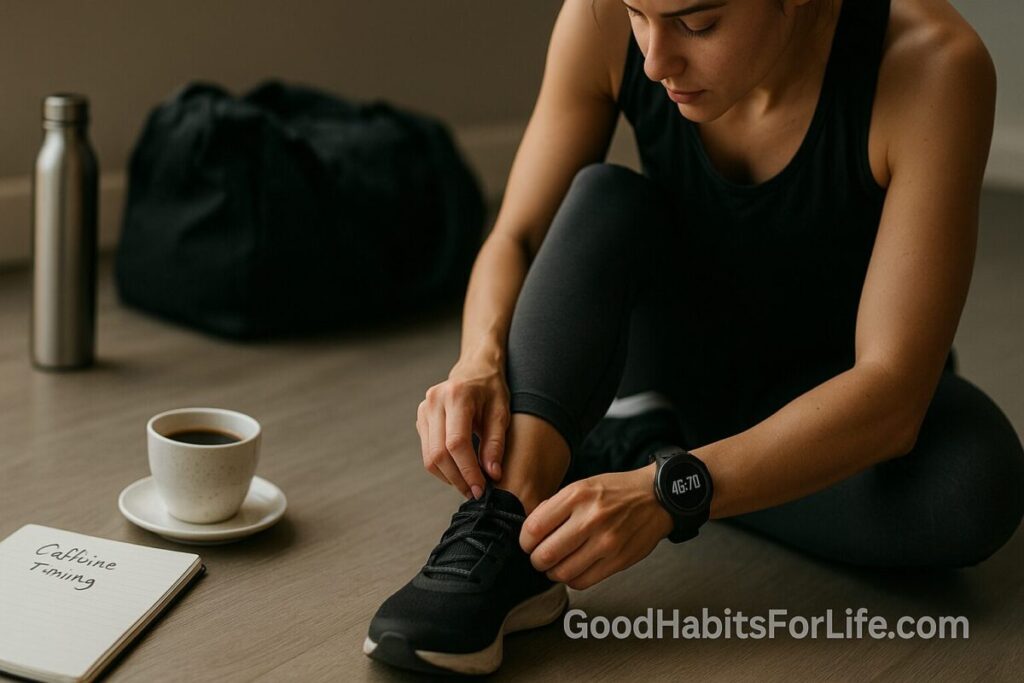
Caffeine for Training: Timing & Dose Basics
Caffeine for Training: Timing & Dose Basics
Table of Contents
🧭 What is “caffeine for training” & why it works
Caffeine is a proven ergogenic aid (performance enhancer) that acts primarily by blocking adenosine receptors in the brain. Result: reduced perceived exertion, improved alertness, and—at the right dose—better endurance, time-trial performance, repeated sprints, and some strength/power outcomes. Benefits are most consistent for endurance and high-intensity intermittent efforts; effects on 1RM strength and pure power vary but are often positive when dosing is right.
Core benefits shown in research
-
2–4% improvements in endurance time-trial performance in many studies.
-
Better reaction time, vigilance, and decision-making during prolonged efforts.
-
Small-to-moderate increases in high-intensity repeat sprints and some strength tasks.
⏱️ Timing: when to take it for endurance, strength, and sprints
Caffeine absorption peaks in blood ~30–60 minutes after ingestion for coffee/capsules. Gum and mouth-absorbed forms work faster (10–20 min). Its half-life is roughly 3–7 hours, so late-day use can harm sleep.
Guidelines by goal
-
Endurance (runs/rides 30–180 min): 3–6 mg/kg 45–60 min pre-start; optional maintenance of 1–2 mg/kg via gels or drinks every 60–90 min for very long events.
-
Strength/Power (lifting sessions, short metcons): 2–4 mg/kg 30–45 min pre-warm-up. For early sets/explosive lifts, gum 10–20 min pre-session can help.
-
Team sports / repeated sprints: 2–4 mg/kg 45 min pre-match; top-up 1–2 mg/kg at halftime for long matches if tolerated.
-
Early-morning training: absorption may be slower with heavy meals; choose capsule/espresso or gum for more predictable onset.
-
Evening training: use lower doses (1–2 mg/kg) and earlier timing; avoid within 8 h of bedtime to protect sleep.
⚖️ Dose: mg/kg guide + real-world equivalents
Most athletes respond well to 3–6 mg/kg body weight. Many get 80–90% of the benefit at 1–3 mg/kg with fewer side effects (jitters, heart racing, GI upset). High doses (>6–9 mg/kg) rarely add benefits and often feel lousy.
Quick mg/kg table
| Body mass | 1 mg/kg | 2 mg/kg | 3 mg/kg | 4 mg/kg | 6 mg/kg |
|---|---|---|---|---|---|
| 55 kg (121 lb) | 55 mg | 110 mg | 165 mg | 220 mg | 330 mg |
| 70 kg (154 lb) | 70 mg | 140 mg | 210 mg | 280 mg | 420 mg |
| 85 kg (187 lb) | 85 mg | 170 mg | 255 mg | 340 mg | 510 mg |
Rough caffeine content (brands vary—check labels)
-
Brewed coffee (250 ml / ~8 fl oz): 80–150 mg
-
Espresso (30 ml / 1 fl oz): 60–75 mg
-
Black tea (250 ml): 40–70 mg
-
Energy drink (250 ml): 80 mg; (500 ml): 160 mg
-
Pre-workout (1 scoop): 150–300+ mg (read the label)
-
Caffeinated gel (1 packet): 25–100 mg
-
Caffeine gum (1 piece): 40–100 mg
Tip: If your calculated dose is 210 mg, a single 200 mg capsule or a double espresso (~120–150 mg) plus a gum (~40–80 mg) gets you close.
☕ Sources & forms: coffee vs capsules vs gum vs gels
Capsule/Tablet (anhydrous): Predictable dose, low cost, few GI issues; peak ~45 min.
Coffee/Espresso: Widely available and enjoyable; variability in caffeine content and potential GI upset in some.
Energy Drinks/Pre-workouts: Convenient mix of caffeine + other ingredients (beta-alanine, taurine, etc.); check sugar and total dose.
Gum/Strips: Buccal absorption; fastest onset (10–20 min); great for late-race boosts or early-set sharpness.
Gels/Colas: Useful mid-event; combine fuel + moderate caffeine.
Hydration note: At typical training doses, caffeine does not meaningfully dehydrate active people; it’s safe to count caffeinated drinks toward fluid intake during training—so long as you practice it before race day.
🧬 Tolerance, genetics & cycling
-
Tolerance: Daily users may perceive less “kick,” but performance benefits often persist. If you want to “freshen” sensitivity, reduce intake for 7–14 days before a key event—or at minimum for 3–4 days.
-
Genetics (CYP1A2, ADORA2A): Some are “fast” or “slow” metabolizers; slow metabolizers may feel more side effects and possibly fewer benefits at higher doses. You don’t need a DNA test—self-testing during training is enough.
-
Habitual intake: If you drink a lot of coffee, start at 2–3 mg/kg; n=1 testing will reveal your sweet spot.
🛠️ Quick Start (do this today)
-
Pick your session: a quality run/ride or heavy lifting day.
-
Calculate dose: 2–3 mg/kg (e.g., 70 kg → 140–210 mg).
-
Choose form & timing: capsule/espresso 45 min pre-warm-up; or gum 15 min prior.
-
Log response: RPE, performance (interval splits, reps @ load), side effects, sleep that night.
-
Adjust: If wired or nauseous, drop by 0.5–1 mg/kg; if no effect, increase by 0.5–1 mg/kg next time.
-
Protect sleep: schedule caffeine trials for morning or midday until you know your window.
📅 7-Day Starter Plan
Goal: Find your individualized “best dose” and “best timing” without wrecking sleep.
-
Day 1: No caffeine; collect baseline (RPE, time, reps).
-
Day 2: 2 mg/kg, capsule 45 min pre-session. Record outcomes.
-
Day 3: Rest or easy day; no supplemental caffeine.
-
Day 4: 3 mg/kg, coffee/espresso 45 min pre; compare to Day 2.
-
Day 5: 3 mg/kg using gum 15 min pre; evaluate onset and “feel.”
-
Day 6: Optional long session: 1–2 mg/kg top-up mid-session via gel/cola if going >90 min.
-
Day 7: Review data. Lock in the dose and form that balanced performance + side effects + sleep.
👥 Audience variations
Students & early-career pros: Keep daily caffeine modest (200–300 mg total). For study sessions, consider 1–2 mg/kg in the morning; save higher doses for training.
Parents with broken sleep: Avoid caffeine after 14:00–15:00; micro-doses (50–100 mg) before short workouts can be enough.
Seniors: Metabolism may be slower; start at 1–2 mg/kg and monitor blood pressure and sleep.
Teens: Energy drinks and high-dose pre-workouts are not recommended. If used at all, keep ≤100 mg/day and avoid close to bedtime; talk to a healthcare professional.
Pregnancy/Breastfeeding: Aim for ≤200 mg/day from all sources; many skip performance dosing entirely—discuss with your clinician.
⚠️ Mistakes & myths to avoid
-
“More is better.” Doses >6 mg/kg usually add jitters, not speed.
-
Too late in the day. Half-life means a 16:00 espresso can still be active at bedtime.
-
New form on race day. Practice your exact coffee/gel/gum plan first.
-
Empty stomach GI surprises. If sensitive, sip with a small snack.
-
“Caffeine dehydrates you.” At normal training doses, not meaningfully.
-
“Caffeine cancels creatine.” The evidence is mixed; most lifters do fine—if worried, separate timing (e.g., creatine post-workout).
🧰 Real-life scripts & examples
Endurance race (70 kg runner, 10 km TT, morning):
-
200 mg capsule 45 min pre-warm-up + 1 piece caffeine gum (40–80 mg) 10 min pre-start.
Half-marathon (70–80 kg, 1 h 30 min–2 h):
-
200–240 mg 45 min pre + 50–75 mg gel at 60–75 min.
Heavy squat day (85 kg lifter):
-
200–300 mg 30–45 min pre. If the first working set feels flat, add gum (40 mg).
Football match (90 min):
-
2–3 mg/kg 45 min pre-kickoff + 1–2 mg/kg at halftime via gel/cola if you tolerate it.
Evening HIIT (sleep-sensitive):
-
1 mg/kg ~8 h before bed—or skip and focus on fueling/warm-up.
🧩 Tools & resources
-
Caffeine calculator: Use any mg/kg calculator or a spreadsheet to match your body mass.
-
Label literacy: Check serving size and per-scoop totals on pre-workouts.
-
Food databases: USDA FoodData Central lists caffeine content for common drinks/foods.
-
Training log: Track dose, timing, RPE, performance, side effects, and sleep for 2–3 weeks.
✅ Key takeaways
-
Most athletes profit from 2–4 mg/kg; 3–6 mg/kg is the classic research range.
-
Timing matters: 45 min for coffee/capsules; 10–20 min for gum.
-
Practice, then perform: test dose, form, and timing in training first.
-
Sleep rules: avoid within 8 h of bedtime; choose morning/lunchtime sessions for trials.
-
Personalize: start low, adjust by 0.5–1 mg/kg, and log responses.
❓ FAQs
1) Is coffee as good as a caffeine pill?
Often, yes. Pills/capsules are more precise; coffee varies in mg and can bother some stomachs. Many athletes perform equally well with either.
2) What’s the best dose for strength?
Start with 2–3 mg/kg ~30–45 min pre-lifting. Pure 1RM results are mixed, but many lifters report better focus and rep performance.
3) Does caffeine dehydrate me during workouts?
Not at typical training doses. It can be mildly diuretic at rest, but studies show no performance-limiting dehydration during exercise when fluids are available.
4) How late is too late?
To protect sleep, avoid caffeine within 8 hours of bedtime. If you’re very sensitive, extend to 10–12 hours.
5) Is caffeine allowed in sport?
Yes. It’s not banned by WADA, though it’s on the Monitoring Program. Still, use responsible doses.
6) Can I stack caffeine with creatine or beta-alanine?
Yes. Most athletes do fine. If you worry about GI upset or potential interactions, separate caffeine pre-workout and creatine post-workout.
7) Do I need to cycle off caffeine?
Not required, but a 3–14 day taper before an A-race can sharpen perceived effects.
8) Are energy drinks safe before training?
Check total caffeine and sugar. Many 500 ml cans contain 160–200 mg—which may be enough already. Avoid highly concentrated “shots” if you’re jitter-prone.
9) What about teenagers?
High-dose energy drinks and pre-workouts are not recommended. If any caffeine is used, keep it ≤100 mg/day and never near bedtime; consult a clinician.
10) I’m pregnant—can I use caffeine for performance?
Guidelines suggest keeping ≤200 mg/day total; many choose to skip performance dosing. Discuss with your healthcare provider.
📚 References
-
Grgic J, et al. International Society of Sports Nutrition position stand: Caffeine and exercise performance. JISSN. 2021. https://jissn.biomedcentral.com/articles/10.1186/s12970-021-00401-5
-
Spriet LL. Exercise and Caffeine. Sports Med. 2014; and updates. https://link.springer.com/article/10.1007/s40279-014-0257-8
-
McLellan TM, et al. Caffeine as a Central Nervous System Stimulant. Neurosci Biobehav Rev. 2016. https://www.sciencedirect.com/science/article/pii/S0149763415002523
-
EFSA Panel on Dietetic Products, Nutrition and Allergies. Scientific Opinion on Caffeine. EFSA Journal. 2015. https://efsa.onlinelibrary.wiley.com/doi/10.2903/j.efsa.2015.4102
-
WADA. Caffeine – Monitoring Program. https://www.wada-ama.org/en/prohibited-list/monitoring-program
-
Guest N, et al. Caffeine, Genetics, and Performance. Sports Med. 2021. https://link.springer.com/article/10.1007/s40279-020-01328-3
-
Higgins S, et al. Caffeine Gum and Exercise Performance: A Systematic Review. Sports Med. 2020. https://link.springer.com/article/10.1007/s40279-019-01241-0
-
Thomas DT, et al. Position of the Academy of Nutrition and Dietetics, Dietitians of Canada, and the American College of Sports Medicine: Nutrition and Athletic Performance. 2016/updated guidance. https://www.ncbi.nlm.nih.gov/pubmed/26626946
-
Armstrong LE, et al. Caffeine, hydration, and exercise performance. Curr Sports Med Rep. 2007; later commentary. https://journals.lww.com/acsm-csmr/Fulltext/2007/04000/Caffeine,_Fluids,_and_Exercise_Performance.10.aspx
-
American College of Obstetricians and Gynecologists (ACOG). Moderate Caffeine Consumption During Pregnancy. https://www.acog.org/womens-health/faqs/nutrition-during-pregnancy
-
American Academy of Pediatrics. Sports Drinks and Energy Drinks for Children and Adolescents. Pediatrics. 2011 with subsequent statements. https://publications.aap.org/pediatrics/article/127/6/1182/30383
-
Australian Institute of Sport. Caffeine Factsheet (Sports Supplement Framework). https://www.ais.gov.au/nutrition/supplements/caffeine
Disclaimer: This article is for general education about training and nutrition and is not medical advice; speak with a qualified professional if you have health conditions, are pregnant, or take medications.