
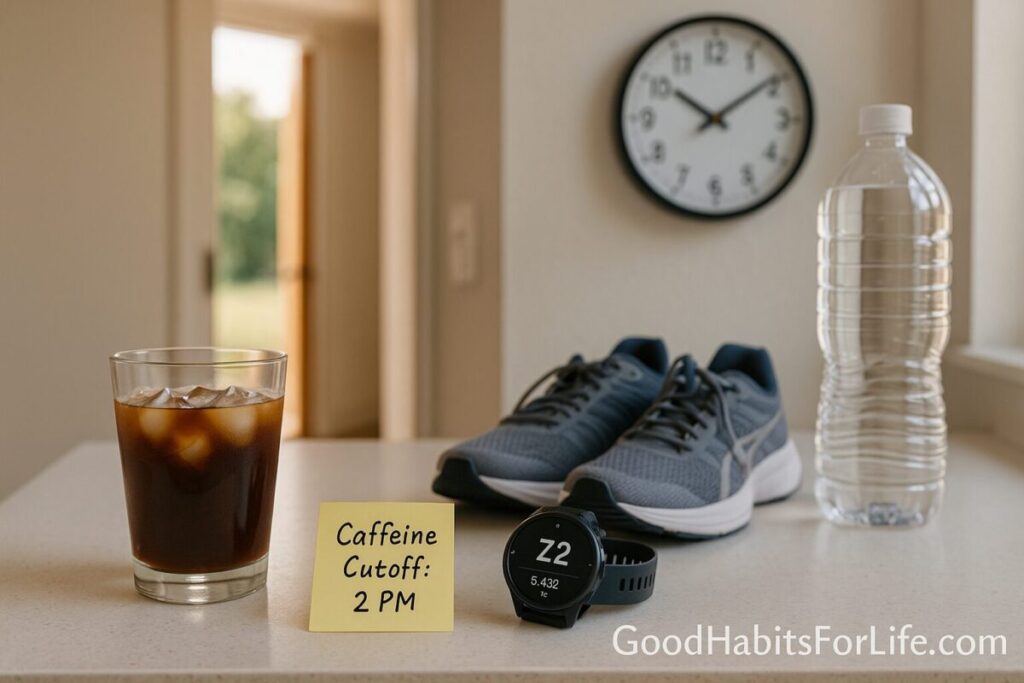
Caffeine Cutoff Times: Find Your Personal Window: Zone 2 + NEAT (2025)
Caffeine Cutoff Times 2025: Find Your Window (Zone 2 + NEAT)
Table of Contents
🧭 What “Caffeine Cutoff” Means—and Why It Matters
Caffeine cutoff = the latest time you can consume caffeine without harming your sleep that night. Because caffeine blocks adenosine receptors, it reduces sleep pressure and can fragment sleep. Poor sleep undermines recovery, appetite control, mood, and next-day training quality. A personal cutoff lets you keep the alertness and workout benefits of caffeine without the sleep tax.
Rule of thumb: Start with bedtime minus 8 hours. Most people land between 6 and 9 hours before lights-out; some need even longer.
Why it matters for Zone 2 + NEAT
-
Zone 2 training (easy conversational cardio) improves mitochondrial function, metabolic health, and endurance.
-
NEAT (non-exercise activity—steps, standing, fidgeting) quietly lifts daily energy expenditure.
-
Both depend on good sleep. Dialing in your cutoff preserves deep sleep, making training feel easier and keeping NEAT naturally higher.
🧪 The Science: Half-life, Sleep, and Individual Factors
-
Half-life: In healthy adults, caffeine’s half-life averages ~5 hours (range 3–7+). After 6 hours, a meaningful amount can still circulate and delay sleep or reduce slow-wave (deep) sleep.
-
Timing study: A placebo-controlled trial found caffeine taken 6 hours before bedtime still reduced total sleep time and worsened sleep quality compared with placebo.
-
Individual variability:
-
Genetics (CYP1A2, ADORA2A): slow metabolizers may need 9–12+ hours.
-
Pregnancy and oral contraceptives slow caffeine clearance (longer buffer).
-
Smoking speeds clearance (shorter half-life), but quitting reverses that.
-
Age and liver function can extend half-life.
-
-
Dose guidance: For most healthy adults, up to 400 mg/day is considered safe; in pregnancy, keep under 200 mg/day (medical org guidance).
-
Performance: For exercise, 3–6 mg/kg caffeine 30–60 min pre-workout can improve endurance and perceived effort—if it doesn’t violate your cutoff.
(Full citations in References.)
🛠️ Quick Start: Today’s 15-Minute Setup
-
Pick a fixed target bedtime (e.g., 23:00).
-
Choose an initial cutoff: bedtime –8 h (15:00 here).
-
Log (phone notes or spreadsheet): time + drink + estimated mg.
-
Espresso 30–75 mg; 240 ml brewed coffee 80–120 mg; black tea 40–70 mg; green tea 20–45 mg; cola 20–40 mg; dark chocolate ~20–40 mg/40 g; many “decafs” 2–15 mg.
-
-
Set alerts: 30-min “last call” reminder before cutoff; water/tea prompt at cutoff.
-
Replace the afternoon cup: decaf, herbal tea, or sparkling water; add a 5-minute movement break.
📅 7-Day Starter Plan: Find Your Personal Window
Goal: Determine the latest caffeine you can drink without harming sleep.
What to track: last caffeine time, total daily mg, bedtime, sleep latency (mins to fall asleep), night wakings, morning sleepiness (1–5), and resting heart rate (if wearable).
Day 1–2
-
Use –8 h cutoff. Keep total caffeine ≤300–400 mg.
-
Add NEAT snacks: 3× 3–5-minute brisk walks (post-meal is great).
-
Zone 2: 30–45 minutes at conversational pace (HR ~60–70% HRmax).
Day 3–4
-
If sleep was consistently good (sleep latency ≤20 min, ≤1–2 wakeups, good morning alertness), experiment with –7 h cutoff.
-
If sleep suffered, stay at –8 h or move to –9 h.
Day 5–6
-
Re-test on workday + weekend to control for schedule shifts.
-
Keep pre-workout caffeine 30–60 min before Zone 2 only if inside your cutoff.
Day 7 (Review)
-
If ≥4 good-sleep nights: that cutoff is likely safe.
-
If mixed: choose the stricter buffer (longer).
-
Write your Personal Rule (e.g., “No caffeine after 14:30; single espresso before 10:30 if needed.”)
📈 30-60-90 Roadmap: Make It Automatic
Days 1–30 (Stabilize)
-
Lock bedtime/wake time within ±30 min.
-
Fix daily caffeine cap (e.g., 250 mg).
-
Standardize a morning brew and an AM Zone 2 slot 3–6 days/week.
-
Build two default afternoon swaps: herbal tea + 5-min walk; decaf + 2-min breathwork.
Days 31–60 (Optimize)
-
If sleep is excellent, consider small pre-workout caffeine (1–2 mg/kg) for late-morning Zone 2—still inside your cutoff.
-
Increase NEAT to 8–10k steps/day via micro-walks after meals and standing intervals.
Days 61–90 (Automate & Review)
-
Review monthly: sleep metrics, training quality, mood, cravings.
-
Keep a “caffeine budget” for travel/social days (plan earlier cups + longer buffer).
🏃 Zone 2 + NEAT: Train and Move Without Harming Sleep
Zone 2 basics
-
Intensity: easy, nose-breathing, conversational; roughly 60–70% HRmax.
-
Duration: build from 20–30 to 45–60 minutes most days.
Caffeine timing for workouts
-
If you train morning/midday: caffeine 30–60 min pre-workout can help.
-
If you train after work: prefer decaf or skip caffeine; rely on carbs + music + partner. Keep your cutoff intact.
NEAT boosters that replace “coffee breaks”
-
5-minute stair climbs
-
10-minute walking calls
-
Standing desk + calf raises
-
20 bodyweight squats before meetings
-
3-minute stretch/mobility blocks every hour
👥 Audience Variations
Students: Late study pushes caffeine late; move deep work to mornings; use 2-hour caffeine curfew before classes that end near bedtime; pair breaks with campus walks.
Professionals: Shift “afternoon slump” fix from coffee to light exposure + 5–10-minute brisk walk + protein snack.
Parents: Fragmented nights? Use very early small doses (≤100–150 mg) and strict –9 h cutoff; guard naps (20–30 min) over caffeine.
Seniors: Metabolism may slow; longer cutoff (–9 to –12 h). Be cautious with meds that interact with caffeine.
Teens: Prioritize sleep duration; avoid energy drinks; aim ≤100 mg/day and no caffeine after late morning.
⚠️ Mistakes & Myths to Avoid
-
Myth: “I fall asleep fine, so caffeine doesn’t affect me.” You may still lose deep sleep and wake less restored.
-
Mistake: Using caffeine to mask chronic sleep loss. It’s a short-term patch that can worsen the cycle.
-
Myth: Decaf is zero. Many decafs contain 2–15 mg—track it if you’re sensitive.
-
Mistake: Pre-workout at 18:00. Performance bump now, sleep debt later—and tomorrow’s session suffers.
-
Myth: Afternoon tea is harmless. Black tea can be 40–70 mg; it still counts toward your cutoff.
💬 Real-Life Scripts & Swaps
-
To your team: “I’m trialing a caffeine cutoff—after 2:30 pm I’ll walk for 5 minutes instead of grabbing coffee. Join me?”
-
At cafés: “One small decaf or herbal tea, please.”
-
Self-prompt at 14:00: “Water + 5-minute walk + sunlight, then back to work.”
-
Evening craving: “Hot decaf + book for 10 minutes.”
Smart swaps
-
Americano → half-caf → decaf
-
Energy drink → sparkling water with citrus
-
Afternoon latte → herbal tea (rooibos, peppermint, chamomile)
🧰 Tools & Resources
-
Timers/Apps: phone alarms for cutoff; Pomodoro + movement reminders.
-
Sleep & training logs: Apple Health, Google Fit, Oura, Garmin, WHOOP, or a simple spreadsheet.
-
Caffeine calculators/labels: check brand sites; keep a personal mg table for your go-to drinks.
Pros: awareness, trends, accountability. Cons: over-tracking can be tiring—make it lightweight.
🔑 Key Takeaways
-
Start with –8 h and adjust to 6–9+ hours based on your sleep.
-
Keep daily caffeine ≤400 mg (≤200 mg if pregnant).
-
Align pre-workout caffeine with your cutoff; prefer morning/midday training.
-
Replace afternoon coffee with NEAT snacks and decaf/herbals.
-
Review weekly; codify your Personal Rule and stick it on your fridge or phone.
❓ FAQs
1) What’s the fastest way to find my cutoff?
Run the 7-day test with a fixed bedtime, start at –8 h, and adjust ±1 hour based on sleep quality.
2) Does switching to tea solve the problem?
Not automatically. Tea still carries 20–70 mg per mug. Keep it before your cutoff.
3) Can I use caffeine and still train in the evening?
If evening is your only option, skip caffeine and lean on carbs, music, partner workouts, and a longer wind-down.
4) Is decaf safe at night?
Most decafs have 2–15 mg; many people tolerate it, but very sensitive sleepers should stop liquids 2–3 hours before bed.
5) What if I’m a smoker or recently quit?
Smoking increases caffeine clearance (shorter half-life); quitting slows it—so you may need a longer cutoff after quitting.
6) How much is too much caffeine in a day?
Most healthy adults: ≤400 mg/day; pregnancy: ≤200 mg/day. Consider lower limits if you’re anxious or sleep-sensitive.
7) Can genetics testing help?
Yes, variants in CYP1A2 and ADORA2A relate to caffeine metabolism and sensitivity, but behavioral testing (the 7-day plan) is still the practical route.
8) What if I nap?
Short 20–30-minute power naps before 15:00 are fine. Don’t use caffeine to “force through” tiredness late in the day.
9) Will caffeine hurt hydration?
Normal intakes are not meaningfully dehydrating; still, match each caffeinated drink with water, especially around workouts.
10) Can I cycle off caffeine?
A 7–14-day taper lowers tolerance and reveals your true sleep need; expect 2–3 days of withdrawal headaches/fatigue.
📚 References
-
EFSA. Scientific Opinion on the safety of caffeine. EFSA Journal (2015). https://efsa.onlinelibrary.wiley.com/doi/10.2903/j.efsa.2015.4102
-
FDA. Spilling the Beans: How Much Caffeine is Too Much? https://www.fda.gov/consumers/consumer-updates/spilling-beans-how-much-caffeine-too-much
-
Drake, C. et al. Caffeine effects on sleep taken 0, 3, or 6 hours prior to bedtime. J Clin Sleep Med (2013). https://pubmed.ncbi.nlm.nih.gov/24235903/
-
AASM Sleep Education. Caffeine and Sleep. https://sleepeducation.org/sleep-hygiene/caffeine-and-sleep/
-
ACOG. Moderate Caffeine Consumption During Pregnancy. https://www.acog.org/womens-health/faqs/nutrition-during-pregnancy
-
International Society of Sports Nutrition. Position Stand: Caffeine and Exercise Performance (2021). https://jissn.biomedcentral.com/articles/10.1186/s12970-021-00426-6
-
CDC. Target Heart Rates for Physical Activity. https://www.cdc.gov/physicalactivity/basics/measuring/heartrate.htm
-
Levine, J. Non-Exercise Activity Thermogenesis (NEAT). Proc Nutr Soc (2003). https://pubmed.ncbi.nlm.nih.gov/14692610/
-
Nehlig, A. Interindividual differences in caffeine metabolism and factors of sensitivity. Food Chem Toxicol (2018). https://pubmed.ncbi.nlm.nih.gov/29753114/
-
National Sleep Foundation. How Caffeine Affects Sleep. https://www.thensf.org/caffeine-and-sleep/
-
WHO. Guidelines on physical activity and sedentary behaviour (2020). https://www.who.int/publications/i/item/9789240015128
-
Zhou, S.-F. et al. Effects of smoking and oral contraceptives on CYP1A2 activity. Curr Drug Metab (2009). https://pubmed.ncbi.nlm.nih.gov/19594418/
Disclaimer: This guide is for general education and is not a substitute for personalized medical advice; consult your clinician for guidance specific to your health, medications, or pregnancy.