
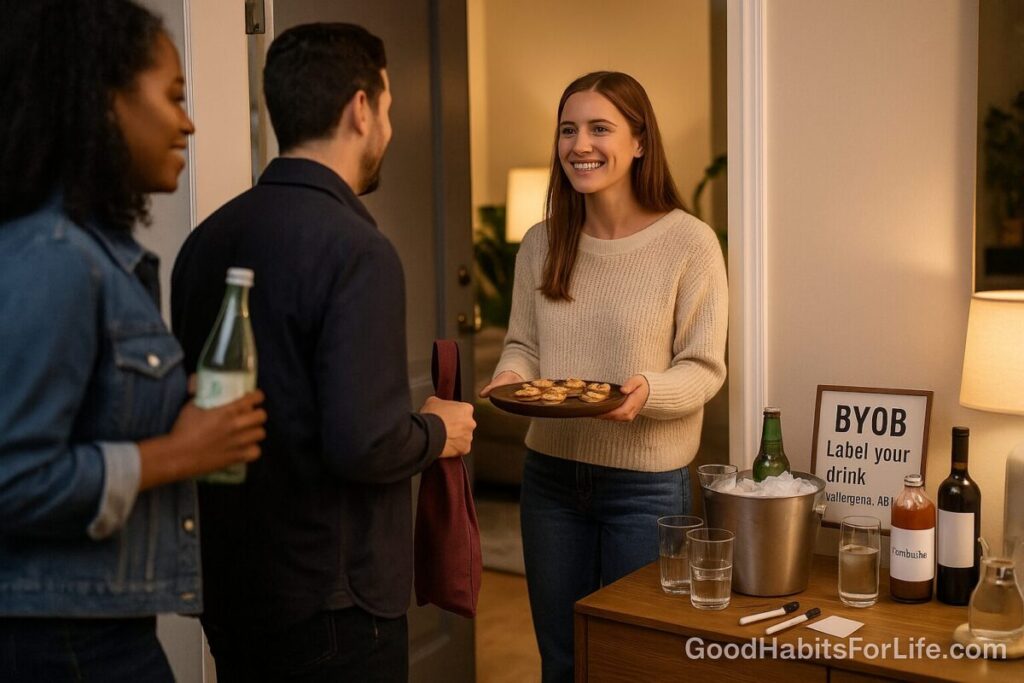
BYOB Etiquette 2025: What Hosts Appreciate
BYOB Etiquette 2025: What Hosts Appreciate
Table of Contents
🧭 What BYOB Means in 2025 (and Why Hosts Choose It)
BYOB = Bring Your Own Beverage/Bottle. In 2025, hosts use BYOB for three main reasons:
-
Budget & logistics: Cuts the host’s cost and shopping time while still letting people enjoy what they like.
-
Choice & dietary needs: Guests can bring alcohol-free, gluten-free, low-sugar, or favorite styles.
-
Local rules: Some venues or apartments restrict serving alcohol; BYOB shifts responsibility to guests.
Standard drink basics (helps with quantity):
-
US guideline: ~14 g pure alcohol per standard drink ≈ 355 ml (12 oz) beer @ 5% ABV, 150 ml (5 oz) wine @ 12%, 44 ml (1.5 oz) spirits @ 40%.
-
UK “units”: 1 unit = 8 g alcohol; a 175 ml glass of 12% wine ≈ 2.1 units; a 568 ml pint of 4% beer ≈ 2.3 units.
These aren’t “targets” to hit—just a neutral way to gauge how much you’re bringing and consuming.
Health & safety: Global public-health guidance advises moderation and, for some people (e.g., pregnancy, certain medications), avoidance. If you’re driving or supervising kids, choose alcohol-free.
✅ Quick-Start Checklist (Do This Today)
-
Confirm the vibe: “BYOB—beer/wine only or spirits okay? Any NA options needed?”
-
Estimate quantity: For a 3-hour gathering, plan 2–3 servings for yourself (plus 1 extra to share or leave).
-
Make it easy on the host:
-
Bring pre-chilled drinks (cool to ~4 °C/39 °F).
-
Pack an opener and reusable cup if unclear.
-
Label bottle/cans with your name + style.
-
-
Share nicely: Offer tastes or a pour if your bottle’s open.
-
Transport plan: Arrange ride-share/public transit/designated driver.
-
Next-day thank-you: Short text + offer to share photos/recipes.
🛠️ 7-Day BYOB Habit Plan (From Invite to Thank-You)
Day 1 – Clarify: Reply to the invite with two questions: beverage type & quantity expectations.
Day 2 – Choose smart: Pick something you genuinely like and that others might enjoy (e.g., crisp lager, mid-body red, citrusy NA spritz).
Day 3 – Prep the kit: Reusable cup, opener, bottle stopper, small label/marker, insulated tote with ice pack.
Day 4 – Chill & stage: Move drinks to the fridge; freeze ice packs; pre-slice citrus if making NA spritzers.
Day 5 – Confirm transport: Book ride-share times or designate a sober driver; save the address.
Day 6 – Party day routine: Bring pre-chilled drinks, label them, place where the host directs, share tastes, help with recycling.
Day 7 – Close the loop: Send a thank-you; offer to leave/replace a bottle the host loved; share any photos or NA recipes.
🧠 Techniques & Frameworks That Keep It Classy
The 3-M Framework: Message • Measure • Manners
-
Message: Proactively ask: “Beer/wine? Spirits? NA?” You’ll look thoughtful and avoid mismatches.
-
Measure: Use standard-drink estimates to avoid over- or under-bringing.
-
Manners: Label your bottle, share with a smile, offer to leave unopened bottles.
The BYOB Matrix (Venue × Format)
-
Small flat + casual: Cans/screw-caps; minimal glass; bring your own cup.
-
Back-yard BBQ: Mix of beer, light wine, NA beer/seltzer; bring ice.
-
Apartment lounge/roof: Check building rules; avoid glass; no messy mixers.
-
Kid-friendly brunch: Emphasize alcohol-free (sparkling NA, juices, cold brew).
Rule of Thirds for Inclusivity
Bring one you love, one easy-crowd-pleaser, one alcohol-free. Even a 330–355 ml NA can shows thoughtfulness.
🧡 What Hosts Appreciate Most (A Practical List)
-
Clear RSVP + checks: “I’m bringing a chilled rosé (750 ml) and 2 NA seltzers. Need ice/cups?”
-
Ready-to-serve beverages: Pre-chilled, screw-cap/cans; opener in your pocket.
-
Labels: “Priya — Malbec 12.5%.” Hosts can park it in a shared cooler without confusion.
-
Sharing etiquette: Open bottle → offer a pour; last glass → ask before taking it.
-
Cleanup help: Rinse your glass, flatten can boxes, take your empties if bins are full.
-
Leftovers grace: If the host enjoyed your unopened bottle, offer to leave it. If they insist, take it back—no drama.
-
Inclusivity: Always add one alcohol-free option; it signals care for drivers, pregnant guests, meds interactions, or those who prefer not to drink.
👥 Audience Variations
Students (18+/local legal age):
-
Check campus/tenant rules; no minors. Prefer cans/screw-caps. Keep it light and inclusive; bring NA options.
Parents hosting with kids around:
-
Store alcohol out of reach; use lids; model moderation; prioritize alcohol-free choices.
Professionals / Work-adjacent events:
-
If a colleague hosts, keep servings modest; avoid strong odors/spills; skip controversial labels.
Seniors / Med interactions:
-
Double-check medications; many interact with alcohol. Alcohol-free beer/wine and botanical spritzers are great alternatives.
⚠️ Mistakes & Myths to Avoid
-
Myth: “BYOB means bring as much as you can.”
Reality: Bring enough for yourself plus a little to share—not a stash to dominate the fridge. -
Mistake: Showing up with warm bottles and no opener.
-
Mistake: Bringing only high-proof spirits to a light social. Ask first.
-
Myth: “If I brought it, I must take it home.”
Reality: Offer to leave unopened bottles your host loved; accept their preference. -
Mistake: No NA option. It’s 2025—someone will appreciate it.
-
Mistake: Driving after drinking. Plan sober transport.
🗣️ Real-Life Scripts You Can Copy
Before the party (text):
“Hey! For BYOB—beer/wine only or are simple mixers okay? I’ll bring a chilled sauvignon blanc and a couple of NA seltzers. Need ice or cups?”
At arrival (doorway):
“Hi! I pre-chilled these; Malbec’s labeled. Where should I set them? Need help with the cooler?”
Sharing moment:
“I’ve opened the rosé—want a taste before I park it in the ice bath?”
Leaving time:
“I can leave this unopened bottle if you’d like for tomorrow—what’s easier for you?”
Next day thank-you:
“Thanks again for hosting—so fun! Want me to share the NA spritz recipe? Also happy to bring ice next time.”
📚 Tools, Apps & Resources (Pros/Cons)
-
Cooler backpack / insulated tote
-
Pros: Hands-free, keeps 6–8 cans cold. Cons: Takes freezer pack space.
-
-
Reusable cup + silicone lid
-
Pros: No glass risk, spill-safe. Cons: You must remember to bring/clean it.
-
-
Simple bottle stoppers
-
Pros: Saves half-finished wine. Cons: Not for sparkling.
-
-
Group messaging / RSVPs (WhatsApp/Signal/Telegram)
-
Pros: Easy headcount, drink coordination. Cons: Notification overload.
-
-
Split costs (e.g., bill-split apps)
-
Pros: Fairly share ice/cups/snacks. Cons: Overkill for tiny gatherings.
-
🔑 Key Takeaways
-
Ask what BYOB means for this event; expectations vary.
-
Bring pre-chilled, labeled, easy-to-serve beverages (plus one alcohol-free).
-
Share generously; help with cleanup; offer to leave unopened bottles.
-
Use standard-drink logic to estimate quantity and plan safe transport.
-
A short thank-you afterward is the finishing touch hosts remember.
❓ FAQs
How much should I bring?
For ~3 hours, plan 2–3 servings for yourself plus 1 to share. If you’re unsure, ask the host or bring a standard 750 ml bottle of wine or a 4-pack/6-pack of cans.
Should I leave unopened bottles?
Offer to leave them if the host enjoyed your selection; follow their lead.
Is it okay to bring spirits?
Only if the host says so. Spirits require mixers, ice, and glassware—more work for the host.
Do I need to bring ice and cups?
Ask. If the host is short on space/supplies, offering to bring ice and reusable cups is gold.
What about alcohol-free choices?
Always welcome. NA beer/wine, seltzers, or a simple citrus spritz (sparkling water + orange slice) are inclusive and refreshing.
Can I BYOB at a restaurant?
Check the venue’s policy and local laws; there may be corkage fees or outright bans. When allowed, bring sealed bottles, and tip as usual.
What if I don’t drink?
Bring an NA option you enjoy. You fully belong at the party—no explanations needed.
How do standard drinks help?
They help you estimate quantity and pace: e.g., 150 ml wine ≈ 1 standard drink (US), but remember UK “units” are different. Always prioritize safety.
What if the host says ‘no alcohol’?
Respect it. BYOB can also mean Bring Your Own Beverage (non-alcoholic). Show up with great NA choices.
What about open-container rules or social-host liability?
Laws vary widely by country/state. Keep drinks inside private venues and follow local rules; when in doubt, choose NA or ask the host.
References
-
National Institute on Alcohol Abuse and Alcoholism (NIAAA). “What Is A Standard Drink?” https://www.niaaa.nih.gov
-
U.S. Departments of Health & Human Services and Agriculture. Dietary Guidelines for Americans, 2020–2025 (Alcohol guidance). https://www.dietaryguidelines.gov
-
World Health Organization. “Alcohol.” Key facts and health impact. https://www.who.int
-
NHS UK. “Alcohol units.” https://www.nhs.uk/live-well/alcohol-advice/calculating-alcohol-units/
-
National Conference of State Legislatures (NCSL). “Social Host Liability for Underage Drinking.” https://www.ncsl.org
-
Emily Post Institute. “Party Hosting & Guest Etiquette (BYOB, Potlucks).” https://emilypost.com
-
NHMRC (Australia). Australian Guidelines to Reduce Health Risks from Drinking Alcohol (2020). https://www.nhmrc.gov.au
-
Drinkaware (UK). “Low and no alcohol drink options & tips.” https://www.drinkaware.co.uk
Disclaimer
This article shares general etiquette and safety information; it is not medical or legal advice. Always follow local laws and your healthcare provider’s guidance.