
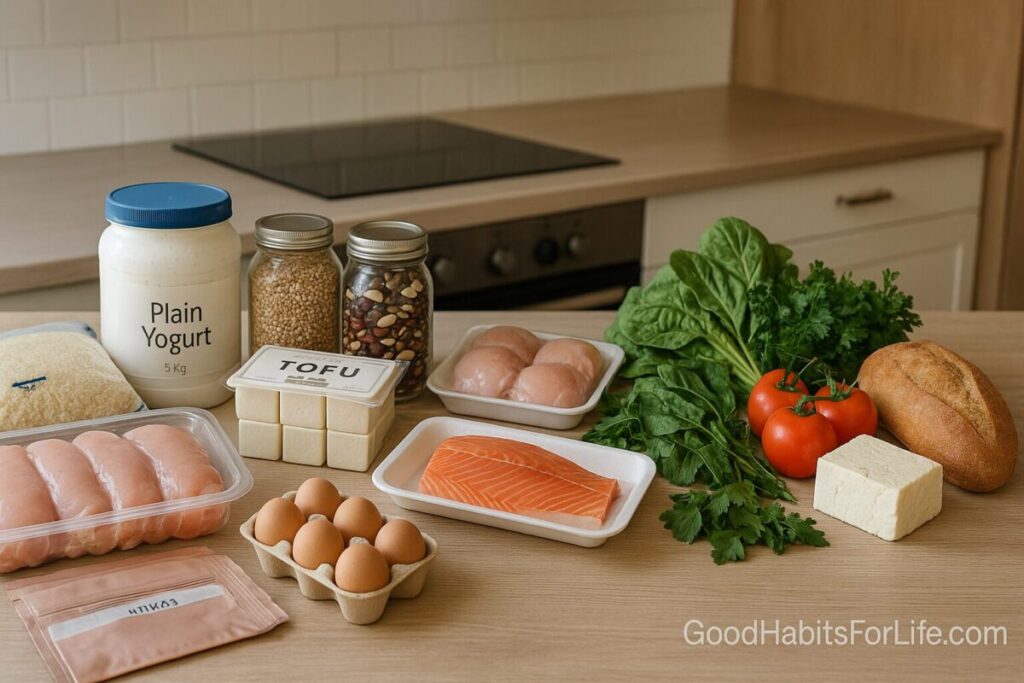
Bulk vs Fresh: What Actually Saves Money: Protein-Forward Plan (2025)
Bulk vs Fresh: Save More on Protein (2025 Guide)
Table of Contents
🧭 What “Bulk vs Fresh” Actually Means
Bulk = larger packs or multipacks of meat, dairy, eggs, tofu, legumes, grains; also dry goods and frozen items. Fresh = items intended for immediate use (produce, bakery, fresh meat/fish in small packs).
When bulk wins: shelf-stable or freezable proteins, staple carbs, and condiments you regularly use. When fresh wins: short-life produce or specialty items you’re unlikely to finish.
Safety note: Freezing keeps food safe indefinitely; quality degrades over time, so portion, wrap well, and label. fsis.usda.govFoodSafety.gov
Why the decision matters now: Food price growth has cooled but remains elevated vs. pre-pandemic; optimizing format and waste matters more than ever. Economic Research Service+2Economic Research Service+2
📊 Does Bulk Really Save? (Math + Myths)
1) Always check “unit price”
Look for the shelf tag’s price per kilogram (or liter); it’s the fairest comparison across sizes and brands. Many regions follow uniform unit pricing guidance, making apples-to-apples comparisons easier. NISTNIST Publications
2) Waste flips the result
You don’t save if 15–30% gets binned. Globally, ~19% of consumer-level food is wasted; households cause about 60% of that waste. Buy sizes you will portion/freeze in time. UNSDunescwa.org
3) Category volatility
Protein categories move differently (e.g., eggs surged in 2022–23). Use unit price plus protein math (below) instead of chasing headlines. Economic Research Service
🧠 The Protein-Forward Lens (Cost per 100 g protein)
Why protein? It’s satiating, preserves muscle, and anchors meals. For healthy adults, the RDA is 0.8 g/kg body weight; seniors may benefit from 1.0–1.2 g/kg (check with your clinician). National Academies Pressacl.gov
How to compare fairly
-
Find protein content from a trusted database (e.g., USDA FoodData Central). fdc.nal.usda.gov
-
Compute:
-
Cost per 100 g protein = (pack price ÷ total grams of protein in pack) × 100.
-
Example (illustrative): 1 kg chicken thighs at ₹280 with 180 g protein per 1 kg edible → ₹(280 ÷ 180) × 100 ≈ ₹156 per 100 g protein.
-
-
Compare across beans, tofu, eggs, dairy, poultry, fish, and mixes (beef often costs more per protein gram than pulses; chicken thighs often beat breast when on sale). myplate.govPMC
Typical budget-friendly winners (per gram of protein):
-
Dried beans & lentils (bulk bags), tofu/tempeh, milk/yogurt, eggs, chicken thighs/drumsticks, canned tuna/sardines. myplate.gov
⚡ Quick Start: Do This Today
-
Audit your week’s protein needs (e.g., 70 kg adult ≈ 56–84 g/day depending on age/activity). National Academies Pressacl.gov
-
Pick 2 bulkable proteins you eat weekly (e.g., chicken thighs, dried lentils).
-
Check unit price and calculate ₹/100 g protein for 2–3 brands/sizes. NIST
-
Buy, portion, and freeze same day: label by item • weight • date. Use the cold-storage chart for quality windows. FoodSafety.gov
-
Plan two “stretch” meals (e.g., chicken-and-lentil chili; tofu fried rice) to use leftovers before they spoil.
🗺️ 30-60-90 Protein-Forward Savings Plan
Days 1–30 (Foundation)
-
Build a price book (sheet or app) with unit prices for your top 15 items.
-
Batch-cook one protein (e.g., 2 kg chicken or 1 kg dry beans) and freeze in 250 g packs. fsis.usda.gov
-
Swap one dinner for pulses weekly; test canned vs dried for cost + convenience. myplate.gov
Days 31–60 (Optimization)
-
Add a second bulk category (tofu/tempeh, yogurt, paneer, oats).
-
Standardize leftover night + soup/stir-fry to clear the fridge.
-
Track waste (by weight or by “handfuls lost”)—aim for 50% reduction.
Days 61–90 (Mastery)
-
Lock in rotations: 3 cheap proteins / 2 mid-price / 1 premium.
-
Shop value packs and freeze what you won’t use in 48 hours. myplate.gov
-
Review your ₹/100 g protein list monthly; update when prices shift.
🛠️ Techniques & Frameworks
The 3-Bucket Cart
-
Bulk Staples: pulses, rice, oats, frozen veg, canned fish.
-
Fresh Now: produce you’ll eat in 3–5 days; small bakery packs.
-
Deal-Driven Protein: family-pack meats, dairy tubs, tofu—portion/freeze on day 0. fsis.usda.gov
FIFO + Labeling
First-In-First-Out; label packs with date and weight to prevent “freezer amnesia.” Use the cold-storage chart to set reminders. FoodSafety.gov
No-Waste Fresh Protocols
Pre-wash greens, keep herbs in jars (water change 2–3×/week), store cut veg in clear boxes at eye level, and assign a “Use-Me Box” for near-term items. (Why? Household waste is the biggest slice of consumer-level waste.) UNSD
Unit-Price Habit
Train your eye to the per-kg number; many jurisdictions publish unit-pricing standards to improve label clarity. NIST
👥 Audience Variations
-
Students: Choose pulses, eggs, canned fish, yogurt; buy half-kilo packs to match dorm storage.
-
Parents/Families: Double recipes and freeze single-meal trays; rotate “build-your-own wrap/bowl” nights.
-
Busy Professionals: Use frozen stir-fry veg + tofu/chicken; pre-portion lunch boxes on Sundays.
-
Seniors: Prioritize higher protein per meal (20–30 g/meal) and softer textures; consider Greek yogurt, eggs, fish, and lentil soups. acl.gov
-
Vegetarian/Vegan: Pulses + grains for complete proteins; add soy or dairy alternatives for convenience. The Nutrition Source
⚠️ Mistakes & Myths to Avoid
-
Myth: “Bulk always saves.” Reality: Only if you’ll use/freeze it before quality declines. fsis.usda.gov
-
Myth: “Fresh is always healthier.” Frozen/canned can be equally nutritious, cheaper, and lower-waste.
-
Mistake: Ignoring unit price and focusing on discounts. NIST
-
Mistake: Not portioning day-of-purchase—highest predictor of waste. UNSD
💬 Real-Life Examples & Scripts
-
At the meat counter: “If I buy 2 kg (≈4.4 lb), can you split into 500 g packs for freezing?”
-
At checkout (family pack): “What’s the per-kg price after the loyalty discount?”
-
At home (freezer label): “Chicken thighs • 500 g • 06-Sep-2025 • Use within 3 months for best quality.” FoodSafety.gov
🧰 Tools, Apps & Resources
-
USDA FoodData Central — authoritative nutrient/protein data. fdc.nal.usda.gov
-
MyPlate: Shop Smart — low-cost protein tips; buy family packs and freeze. myplate.gov
-
SNAP-Ed Budget Guides — unit-pricing and planning checklists. snaped.fns.usda.gov+1
-
Cold-Storage Charts — know quality windows for fridge/freezer. FoodSafety.gov
-
Price Book (DIY) — spreadsheet with columns: Item • Size • Unit price • ₹/100 g protein • Store • Date.
🧾 Key Takeaways
-
Decide by math: unit price + ₹/100 g protein beats sticker price. NIST
-
Freeze to win: portion on purchase day; frozen stays safe indefinitely (quality varies). fsis.usda.gov
-
Pulses & value dairy/meats usually deliver the lowest cost per protein gram. myplate.gov
-
Waste is the enemy—design your cart and week to avoid it. UNSD
❓ FAQs
1) Is it cheaper to buy chicken breast fresh or frozen?
Usually frozen family packs win on unit price; check per-kg tags and portion immediately. Frozen remains safe indefinitely; aim to use within 9 months for best quality (pieces). fsis.usda.govFoodSafety.gov
2) Are canned beans as nutritious as dried?
Both are good protein/fiber sources; dried is cheaper per serving, canned is time-saving. Rinse canned beans to reduce sodium.
3) How long can I keep bulk-cooked meat in the freezer?
Safety is indefinite at −18 °C (0 °F). For best quality, use cooked poultry within 2–6 months; label and rotate. fsis.usda.govFoodSafety.gov
4) What if my store doesn’t show unit prices clearly?
Many regions follow unit-pricing standards—ask staff where to find the per-kg label, or calculate: price ÷ weight (kg). NIST
5) How much protein do I actually need?
Most adults: ~0.8 g/kg/day; older adults often benefit from 1.0–1.2 g/kg (ask your clinician, especially with kidney disease). National Academies Pressacl.gov
6) What’s the best “first bulk” buy for a small freezer?
Chicken thighs/drumsticks, tofu, or portioned cooked beans—cheap, versatile, and easy to freeze in 250 g packs. myplate.gov
7) Does buying produce in bulk ever make sense?
Yes—items with longer life (carrots, onions, potatoes, cabbage) if you plan recipes and store correctly. Quick-spoil produce is better bought fresh as needed.
8) Are eggs still a good value in 2025?
They’re typically competitive but volatile; compare ₹/100 g protein every trip. Economic Research Service
9) Is frozen fish a downgrade?
Not necessarily; it’s often flash-frozen at peak freshness and can be better value with lower waste risk.
10) What single habit cuts the most cost?
Portion-and-freeze on purchase day—it converts bulk savings into real savings and slashes waste. fsis.usda.gov
📚 References
-
USDA ERS — Food Price Outlook: Summary Findings (Aug 2025). Economic Research Service
-
USDA ERS — Amber Waves: Food price inflation slowed in 2023 and 2024 (Jun 2025). Economic Research Service
-
USDA ERS — Chart Gallery: Food-at-Home prices increased 1.2% in 2024 (Feb 2025). Economic Research Service
-
NIST — Handbook 130: Uniform Unit Pricing Regulation (2024). NISTNIST Publications
-
USDA FSIS — Freezing and Food Safety; Steps to Keep Food Safe. fsis.usda.gov+1
-
FoodSafety.gov — Cold Food Storage Charts (quality guidance). FoodSafety.gov
-
UNEP — Food Waste Index Report 2024 (Global data: 19% wasted; 60% in households). UNSDunescwa.org
-
FAO — Food loss and waste: evaluation/estimates (context on loss vs waste). FAOHome
-
National Academies (IOM) — Dietary Reference Intakes: Protein & Amino Acids (0.8 g/kg RDA). National Academies Press
-
U.S. ODPHP/HHS — Dietary Guidelines for Americans (overview). Health.gov
-
USDA MyPlate — Shop Smart: low-cost protein & family packs (buy-and-freeze). myplate.gov
-
USDA ERS — Eggs per gram of protein price variability (context). Economic Research Service
⚖️ Disclaimer
This guide is informational and not a substitute for personalized medical or financial advice.