
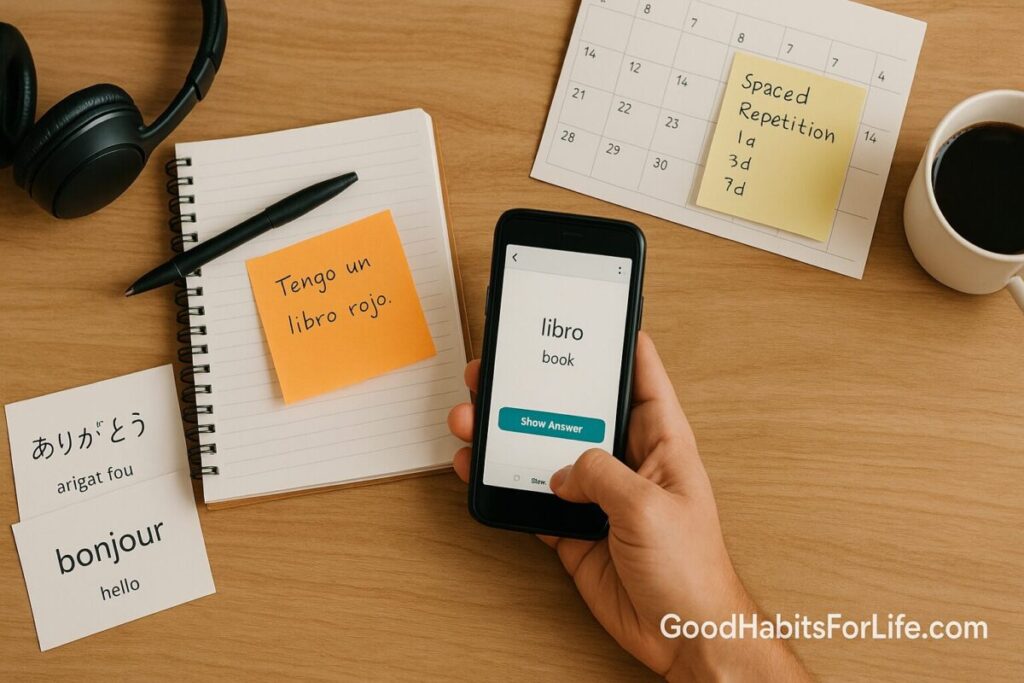
Build an SRS Deck for Any Language
Build an SRS Deck for Any Language
Table of Contents
🧭 What & Why
What is an SRS deck?
A spaced repetition system (SRS) schedules reviews right before you’re likely to forget, turning forgetting into a feature. Compared with massed study (cramming), spaced practice and retrieval practice produce stronger, longer-lasting learning across skills and ages. SAGE Journals+1
Why it works (short version):
-
Spacing effect: information reviewed at expanding intervals sticks better over time. SAGE Journals
-
Retrieval practice: testing yourself (actively recalling) strengthens memory more than re-reading. Science
-
Desirable difficulties: a bit of effort (not too easy, not impossible) leads to durable learning. bjorklab.psych.ucla.edu
Why it matters for languages:
Languages are high-volume (thousands of words, forms, chunks). SRS keeps daily workload manageable while steadily increasing coverage. Well-designed cards also capture pronunciation, context, and collocations, not just “L1 ↔ L2” glosses. Evidence-based reviews of study techniques consistently rate practice testing and spaced practice among the highest-utility methods. SAGE Journals
⚙️ Quick Start (Today)
-
Pick your SRS app.
-
Anki (desktop + mobile): free/open on desktop; robust add-ons and automation. See background on algorithms (SM-2 and FSRS). docs.ankiweb.net
-
Others: SuperMemo (Windows), RemNote, etc. Choose what you’ll use daily.
-
-
Create a “Language – Core” deck.
-
Set New cards/day: 10–20 (start small).
-
Set Review limit high enough to clear due cards daily (e.g., 100–150 while ramping).
-
-
Define a note type (fields):
Expression | Meaning | Example | Audio | IPA/Pronunciation | PartOfSpeech | Picture | Notes | Tags -
Add your first 20 cards:
-
Use short, frequent expressions (A1–A2), each with an example sentence.
-
Record or attach audio for the expression and sentence.
-
Add tags like
A1,greetings,travel.
-
-
Review rules:
-
Daily, same time window (10–20 min).
-
If a card is too big, refactor it (split into two).
-
If you repeatedly fail a card, rewrite it (simpler cue; better example).
-
-
Track a weekly metric:
-
Retention target: ~85–90% on mature reviews (tweak new-card counts or ease if too high/low).
-
🗺️ 30-60-90 Habit Plan
Days 1–30 (Foundation)
-
New cards/day: 10–15; keep daily reviews under ~20 minutes.
-
Build templates; standardize tags (
A1,travel,food). -
Source frequency words to maximize impact early (e.g., Leipzig/COCA lists). wortschatz.uni-leipzig.de+1
Days 31–60 (Acceleration)
-
Nudge new cards/day to 15–25 only if your review queue stays comfortable.
-
Add cloze deletion for grammar patterns and chunks (e.g., “I’m looking ___ a book”).
-
Layer audio-first cards to train listening.
Days 61–90 (Specialization)
-
Create topic subdecks: Work, Travel, Exams (CEFR B1/B2). Portal+1
-
Start sentence mining from input (podcasts, graded readers).
-
Automate batch imports (CSV) and TTS audio (see “Automation”).
🧠 Card Design: Techniques & Frameworks
1) Minimal information principle (atomic cards).
One idea per card → faster reviews, lower lapse rates. Wozniak’s “20 rules” remain a practical playbook for formulation. SuperMemo+1
2) Retrieval modes you should mix:
-
Recognition → Production: Front: audio/picture; Back: expression. Later invert.
-
Cloze deletions: Hide a key word or inflection inside a real sentence.
-
Audio-only prompts: Train perception; reveal text after you answer.
-
Example-first: Show the sentence; ask for meaning of the target chunk.
3) Context is king.
Always pair the headword with an authentic sentence that models usage and collocation (e.g., “make a decision,” not just “decision = …”). Tatoeba provides downloadable, attribution-friendly sentences for many languages. Tatoeba+1
4) Pronunciation & form.
Include IPA, stress, and audio. Early phonology prevents fossilized errors. Use TTS or native clips (see add-ons).
5) Interleaving & difficulty tuning.
Mix parts of speech and topics; keep difficulty slightly challenging (“desirable difficulties”). bjorklab.psych.ucla.edu
6) Align to CEFR goals.
Tag content by level (A1→C2) so you can filter for exam or job prep. Portal
🛠️ Building at Scale: Automation & Pipelines
A) Frequency-first seeding
-
Download frequency lists (Leipzig; COCA) to seed your first 1–2k items. Map each word to a short example. wortschatz.uni-leipzig.de+2wortschatz.uni-leipzig.de+2
B) Sentence mining with licensing in mind
-
Tatoeba: export bilingual sentence pairs (tab-separated) → import to Anki; check CC-BY/CC0 licensing and attribute where required. Tatoeba+1
C) CSV pipeline (repeatable)
-
Keep a spreadsheet with these columns:
Expression | Meaning | Example | Example_Translation | Audio_URL | IPA | Picture_URL | Tags -
Export CSV → Anki > Import (map fields). Save an import preset.
D) Audio, IPA, and images
-
Generate TTS audio with an add-on (AwesomeTTS) or record native clips. Anki Web
-
Fetch IPA from reputable dictionaries; add stress marks.
-
Use images only when they truly aid recall (avoid decorating). For heavy visual content (e.g., kanji, signs), Image Occlusion can help. Anki Web
E) Programmatic creation (advanced)
-
AnkiConnect exposes a local API so scripts can add notes, tags, and media from frequency lists, readers, or browser extensions. Anki Web+1
F) Scheduling upgrades
-
In Anki, the modern FSRS algorithm is available as an alternative to classic SM-2; consider enabling it once you have a few hundred cards to optimize intervals. docs.ankiweb.net
👥 Audience Variations
-
Students (exams/CEFR): Align decks to syllabi; tag by unit/week; add cloze cards for grammar points that appear in past papers. Portal+1
-
Professionals (work vocabulary): Focus on collocations, email phrases, and meeting scripts (“Could you clarify…?”). Use audio-first to speed listening.
-
Teens: Keep sessions short (≤15 min); gamify streaks; add picture cues sparingly.
-
Seniors/returning learners: Favor larger fonts, slower-paced audio, and fewer new cards/day (5–10) for comfort.
⚠️ Mistakes & Myths to Avoid
-
Myth: “More new cards = faster progress.” → Overloading nukes retention. Keep reviews comfortable and sustainable.
-
Myth: “Translations are enough.” → Without example + audio, you’ll know about the word, not how to use it.
-
Mistake: Giant cards (“Everything about the subjunctive”). → Split into atomic pieces. SuperMemo
-
Mistake: Skipping daily reviews. → Spacing only works if you show up.
-
Mistake: Ignoring lapses. → When you fail a card, rewrite it (better cue/context), don’t just press “Again.”
📝 Real-Life Examples & Copy-Paste Scripts
A) Note type template (Anki):
B) CSV header for bulk import:
C) Cloze deletion examples:
-
I’m looking {{c1::for}} a book on gardening.
-
She {{c1::turned}} {{c2::down}} the offer.
D) Tagging scheme (copy/paste):A1 A2 B1 B2 C1 C2 travel food work exam email phrasal-verbs collocations
E) Daily review script (self-talk):
-
“I’ll clear due cards before adding new.”
-
“If I fail twice, I’ll rewrite the card.”
-
“If reviews > 25 min, I’ll reduce new cards tomorrow.”
🧰 Tools, Apps & Resources (Pros/Cons)
-
Anki (desktop, AnkiDroid, AnkiMobile) — Pros: free/open desktop, powerful scheduling, templates, add-ons, APIs (AnkiConnect). Cons: learning curve; iOS app is paid; UI is utilitarian. docs.ankiweb.net+1
-
Add-ons (optional):
-
Frequency lists & corpora: Leipzig, COCA (English). Seed high-value vocabulary first. wortschatz.uni-leipzig.de+1
-
Sentence sources: Tatoeba (downloadable, CC-BY/CC0 options—attribute appropriately). Tatoeba
-
Leveling frameworks: CEFR descriptors for A1–C2 targets. Portal
📌 Key Takeaways
-
Consistency beats intensity. Small daily sessions win.
-
Atomic, context-rich cards reduce confusion and speed reviews. SuperMemo
-
Mix recognition, production, cloze, and audio to learn meaning and usage.
-
Automate sourcing (frequency lists), formatting (CSV), audio (TTS), and imports (AnkiConnect). wortschatz.uni-leipzig.de+1
-
Aim for 85–90% retention and adjust new-card counts to keep reviews pleasant.
-
Tie content to goals (CEFR level, work tasks, travel) for immediate payoff. Portal
❓ FAQs
1) How many new cards should I add per day?
Start with 10–15 until reviews stay under ~20 minutes. If easy, nudge to 15–25; if stressful, drop to 5–10.
2) Should I make translation-only cards?
Use them sparingly. Prefer sentence-based or audio-first cards to build usage and listening.
3) What retention rate should I aim for?
~85–90% mature-card retention typically balances speed and durability. If you’re far above 90%, add more challenge; below 80%, simplify cards or reduce new cards.
4) Isn’t re-reading enough?
No—testing yourself (retrieval) outperforms re-study for long-term retention. Science
5) Do I need images?
Only when they sharpen the cue (e.g., concrete nouns, signs). Otherwise they add clutter without benefit.
6) What about grammar?
Use cloze cards to capture patterns in context (e.g., prepositions, tense endings) rather than isolated rules.
7) Can I import thousands of items at once?
You can, but you shouldn’t. Import in batches of 100–300 and iterate card quality. Automation helps with formatting; humans still edit for clarity. Anki Web
8) Which algorithm is best in Anki—SM-2 or FSRS?
Both work. FSRS is a newer option you can enable; test it once your deck has history. docs.ankiweb.net
9) Is it legal to mine sentences from the web?
Respect licenses. Tatoeba offers CC-BY/CC0 downloads (attribute as required). Many corpora (e.g., Leipzig) provide CC-BY lists. Tatoeba+1
10) How do I stay motivated?
Keep sessions short, track streaks, and connect cards to what you actually read, hear, and say each week.
📚 References
-
Cepeda, N. J., et al. “Spacing Effects in Learning: A Temporal Ridgeline of Optimal Retention.” Psychological Science (2008). SAGE. SAGE Journals
-
Karpicke, J. D., & Roediger, H. L. “The Critical Importance of Retrieval for Learning.” Science (2008). science.org. Science
-
Dunlosky, J., et al. “Improving Students’ Learning With Effective Learning Techniques.” Psychological Science in the Public Interest (2013). SAGE. SAGE Journals
-
Bjork, E. L., & Bjork, R. A. “Creating Desirable Difficulties to Enhance Learning.” (2011). PDF. bjorklab.psych.ucla.edu
-
Council of Europe. CEFR Level Descriptions (A1–C2). coe.int. Portal
-
Anki Manual — Background (SM-2 & FSRS). docs.ankiweb.net. docs.ankiweb.net
-
Pimsleur, P. “A Memory Schedule.” The Modern Language Journal (1967). Wiley. Wiley Online Library
-
SuperMemo. “Effective Learning: Twenty Rules of Formulating Knowledge.” supermemo.com. SuperMemo
-
Tatoeba Project — Downloads & Licensing (CC-BY/CC0). tatoeba.org/downloads. Tatoeba
-
Leipzig Corpora Collection — Download & Licensing. wortschatz.uni-leipzig.de. wortschatz.uni-leipzig.de
-
Cepeda, N. J., et al. “Optimizing Distributed Practice.” (additional analysis PDF). Mozer Lab PDF. home.cs.colorado.edu