
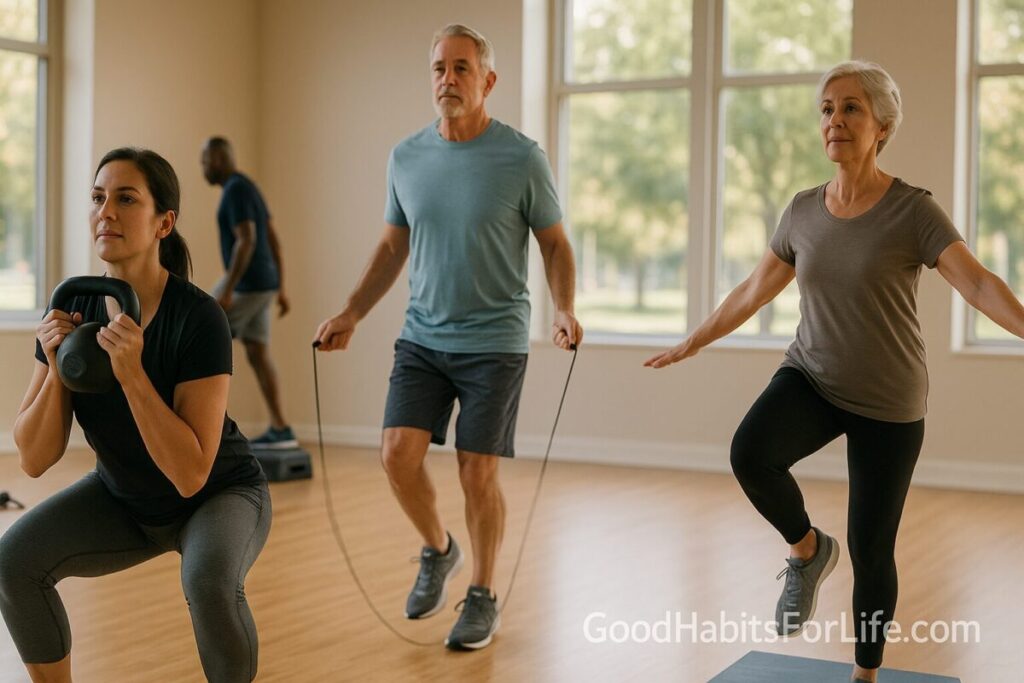
Bone Density Boosters: Lift, Impact, Balance: Zone 2 + NEAT (2025)
Bone Density Boosters: Lift, Impact, Balance (2025)
Table of Contents
🧭 What “Bone Density Boosters” Means (and Why It Works)
“Bone density boosters” are habit-friendly training elements that stimulate your skeleton: muscle-strengthening (lifting), impact/loading, balance/posture, plus aerobic activity and NEAT (non-exercise movement).
-
Strength & impact deliver the clearest osteogenic (bone-building) signal. Authoritative guidelines emphasize weight-bearing and muscle-strengthening exercise for building/maintaining BMD. Bone Health & Osteoporosis FoundationNIAMS
-
Balance & functional training cut the rate of falls and the number of people who fall (high-certainty evidence). Cochrane LibraryPubMed
-
Zone-2 aerobic (easy-moderate, conversational pace ~60–75% HRmax) supports cardiovascular and metabolic health and can be done with weight-bearing modes like brisk walking or stair climbing; on its own, walking has modest BMD effects. Harvard HealthNIAMSPMC
-
NEAT (standing more, extra steps, chores, taking stairs) raises daily mechanical loading and energy expenditure, reinforcing the habit loop between sessions. PubMed
Evidence snapshot: Meta-analyses and trials show combined or high-intensity resistance + impact training can improve BMD; walking alone is often small/neutral for spine/hip BMD. JOSPTPubMed+1
✅ Quick Start: Do This Today (20–30 minutes)
-
Warm-up (4 min): Brisk walk + arm swings; 2×20-sec heel raises.
-
Strength A (10 min):
-
Goblet squat or sit-to-stand: 3×8–10 (load you could lift ~10–12 reps).
-
Hip hinge (Romanian deadlift or hip-hinge drill): 3×8.
-
Standing overhead press (dumbbells): 2×8.
-
-
Impact (3–4 min):
-
Low-amplitude hops or quick step-ups (work toward 3×20 contacts).
-
If impact is not appropriate, do fast stair climbs or marches with foot strike.
-
-
Balance (3 min):
-
Single-leg stand eyes open 3×30s/side; progress to head turns.
-
-
Zone-2 finish (5–10 min):
-
Conversational-pace walk up/down stairs or outdoors.
-
-
NEAT nudge (all day): 8–10 mini-bouts (1–2 min) of movement: stairs, standing phone calls, hallway laps.
Safety: If you have osteoporosis/vertebral fracture risk, avoid deep loaded spinal flexion/rotation (e.g., heavy sit-ups, toe-touch twists); favor neutral-spine patterns and get personalized clearance. Bone Health & Osteoporosis FoundationPMC
🛠️ 30-60-90 Day Habit Plan (with checkpoints)
Weeks 1–4 (Build the base)
-
2–3×/wk Strength: Full-body (squat/hinge/push/pull/calf), 2–3 sets of 8–12 reps at moderate load.
-
2×/wk Impact/Power: Hops, bounds, or step-ups: start with 40–60 total foot contacts/session.
-
3–5×/wk Zone-2: 25–40 min brisk walking/stairs (conversational pace).
-
Daily Balance/Posture: 5 min (single-leg, tandem walk, wall slides).
-
NEAT Goal: +2,000 steps/day above baseline.
Checkpoint: Technique feels solid; RPE ≤7/10 on hardest sets; no back pain.
Weeks 5–8 (Progressive overload)
-
Strength: Increase load 5–10% when you can do 2 extra reps (double-progression).
-
Impact: 80–120 contacts; introduce multidirectional hops (if appropriate).
-
Zone-2: 150–300 min/week total (aligns with WHO). World Health Organization
-
Balance: Add perturbations (foam, head turns) and “dual task” (count backwards).
-
NEAT: Install hourly “move breaks”; micro-commutes on foot.
Checkpoint: Add a DEXA-aligned goal with your clinician if indicated.
Weeks 9–12 (Bone-smart performance)
-
Strength: 3×/wk, include high-intensity resistance blocks (e.g., 5×5 at ~80% 1RM) under supervision if you’re trained—shown safe/effective in selected postmenopausal women (LIFTMOR). PubMed
-
Impact: Short “contrast sets” (e.g., squats → low hops).
-
Zone-2: Maintain; add hills once/week.
-
Balance: Agility ladder, quick foot taps, carry variations.
-
NEAT: Target 8–12k steps/day (adjust for context).
Checkpoint: Reassess: stronger lifts, steadier balance, fewer near-falls.
🧠 Techniques & Frameworks
🏋️ Strength (muscle-strengthening)
-
Why: Muscle tugging on bone (via tendons) signals remodeling; consistent overload preserves/improves BMD. Bone Health & Osteoporosis Foundation
-
Do: Squat/hinge/lunge/push/pull/calf; 2–4 sets, 6–12 reps; 2–3×/wk.
-
Progress: More load, reps, sets, or slower eccentrics; keep spine neutral.
🦘 Impact & Mixed Loading
-
Why: Short, sharp ground-reaction forces (safe, progressed) are highly osteogenic; mixed loading beats monotonous patterns. PubMed
-
Do: Line hops, skipping, step-ups, lateral shuffles; start low amplitude; build contacts gradually.
🧘 Balance & Posture
-
Why: Fewer falls → fewer fractures; balance/functional training has high-certainty fall-reduction evidence. Cochrane Library
-
Do: Single-leg stance, tandem walking, head-turns, carries; posture work (wall slides, thoracic extension).
🚶 Zone-2 (Easy-Moderate Aerobic)
-
Why: Supports heart/metabolic health; choose weight-bearing modes for bone (brisk walk, hills, stairs, hiking). Zone-2 ≈ you can talk in sentences (~60–75% HRmax). On its own, walking gives limited spine/hip BMD change; keep lifting/impact. Harvard HealthNIAMSPMC
🧭 NEAT (Non-Exercise Activity Thermogenesis)
-
Why: All-day movement expands loading opportunities and energy outflow—stairs, carrying shopping, yardwork, pacing calls. PubMed
-
Do: “Two-for-one” rule: pair every sit-down hour with a 2-minute move break.
👥 Age/Stage Variations
-
Teens/Young Adults: Favor multidirectional sports (court/field), jumping, and progressive lifting to peak bone mass. (Follow good coaching/supervision.) PubMed
-
Pregnancy/Postpartum: Prioritize posture, pelvic stability, brisk walking; avoid new impact starts unless already trained (get clearance).
-
Peri/Postmenopause: Emphasize progressive resistance + safe impact; supervised high-intensity resistance has shown benefits in selected low-BMD women. PubMed
-
Older Adults (65+): Balance & functional strength are cornerstone; add low-to-moderate impact if appropriate; fall-prevention programs are strongly supported. Cochrane Library
-
Diagnosed Osteoporosis/Vertebral Fracture: Keep moving—benefits outweigh risks—but avoid deep loaded spinal flexion/rotation; learn hip hinge, neutral spine, and safe carry strategies with a PT. Bone Health & Osteoporosis FoundationPMC
⚠️ Mistakes & Myths to Avoid
-
Myth: “Walking is enough for bone density.” → Helpful for health, but often small/neutral effects at spine/hip unless intensity/variety increase. Add lifting + impact. PMC
-
Mistake: Doing crunches/toe-touch twists if you have low BMD. → Swap for anti-flexion/anti-rotation core (bird dog, dead bug). Bone Health & Osteoporosis Foundation
-
Myth: “Impact is unsafe for everyone over 50.” → Not universally true; graded, supervised impact can be effective and safe for selected people. PubMed
-
Mistake: Only cardio, no strength. → Bone needs tension from muscles; lift 2–3×/wk. Bone Health & Osteoporosis Foundation
-
Myth: “Balance training is optional.” → It’s a primary fracture-prevention tool. Cochrane Library
🗂️ Real-Life Mini-Programs & Scripts
A) 20-Minute Apartment Plan (3×/wk)
-
Circuit ×3: Sit-to-stand (10), wall push-ups (10), backpack deadlift (8), step-up (10/leg), standing press with bands (10).
-
Finish: 2×30s single-leg balance; 3×20 light in-place hops (or fast marches).
B) Park Bench Plan (2×/wk + daily Zone-2)
-
Bench squats (3×10), split-squat holds (3×20s/side), incline push-ups (3×8), stair climbs (5–10 min), line hops (3×20).
-
Zone-2 walk 30–40 min most days.
C) “Osteo-Care” Script (with low BMD; 3×/wk)
-
Hip hinge with dowel 3×8, sit-to-stand 3×8, wall slides 2×10, calf raise 3×12, band row 3×10.
-
March-to-step-up progression (no jumping) 3×12.
-
Balance 3×30s.
(Avoid deep spinal flexion/rotation; keep neutral spine.) Bone Health & Osteoporosis Foundation
D) Office NEAT Script (daily)
-
Every hour: 90-sec walk + 20 heel raises.
-
Calls: stand or lap the corridor.
-
Coffee line: single-leg balance 30s/side (subtle!).
🧰 Tools, Apps & Resources (quick picks)
-
WHO Guidelines (2020): volume targets for adults/older adults. World Health Organization
-
BHOF Exercise Guides: exercise types + safety with osteoporosis. Bone Health & Osteoporosis Foundation
-
NIAMS Bone Health: weight-bearing lists; fall-prevention basics. NIAMS
-
Heart-Rate Guidance: conversational “talk test” aligns with Zone-2 ranges (60–75% HRmax). Harvard Health
-
Wearables & Apps: any step counter/HR monitor; look for alerts that prompt move breaks (NEAT).
📌 Key Takeaways
-
Lift 2–3×/week; add safe, progressive impact and daily balance. Bone Health & Osteoporosis Foundation
-
Do 150–300 min/week of Zone-2 weight-bearing cardio; keep it conversational. World Health OrganizationHarvard Health
-
Layer NEAT to accumulate loading and consistency. PubMed
-
If you have low BMD/osteoporosis, avoid deep loaded spinal flexion/rotation and get individualized guidance. Bone Health & Osteoporosis Foundation
❓ FAQs
1) Is walking enough to improve bone density?
Great for health and Zone-2 goals, but walking alone often has small or no effect on spine/hip BMD. Add strength and varied impact. PMC
2) How much “impact” is safe to start with?
Begin with low-amplitude contacts (e.g., step-ups, small hops), 40–60 total per session, and build gradually; get clearance if you have low BMD. Bone Health & Osteoporosis Foundation
3) What’s the best Zone-2 activity for bones?
Weight-bearing modes (brisk walking, hills, stairs, hiking); keep it conversational (~60–75% HRmax). NIAMSHarvard Health
4) Do I need heavy weights?
Progressive loading matters more than “heavy” per se. For some groups, high-intensity resistance under supervision has improved bone outcomes. PubMed
5) I have osteoporosis—what should I avoid?
Avoid deep loaded spinal flexion/rotation (e.g., heavy sit-ups, toe-touch twists). Train neutral spine, hinge at hips, and prioritize balance/strength. Bone Health & Osteoporosis FoundationPMC
6) Can balance training really prevent fractures?
It reduces falls, the biggest fracture driver, with high-certainty evidence. Cochrane Library
7) How fast will BMD change?
Bone adapts slowly (months). Combined programs preserve or modestly increase BMD; consistency is key. JOSPT
8) Does NEAT really matter?
Yes—NEAT can meaningfully raise daily energy burn and multiplies low-level loading opportunities (stairs, carrying, chores). PubMed
📚 References
-
Bone Health & Osteoporosis Foundation. Osteoporosis Exercise for Strong Bones. https://www.bonehealthandosteoporosis.org. Bone Health & Osteoporosis Foundation
-
NIAMS (NIH). Exercise for Your Bone Health. https://www.niams.nih.gov. NIAMS
-
ACSM Position Stand. Physical activity and bone health. Med Sci Sports Exerc. 2004. PubMed
-
Cochrane Review. Exercise for preventing falls in older people living in the community. 2019. Cochrane LibraryPubMed
-
Watson SL et al. LIFTMOR Randomized Controlled Trial—high-intensity resistance & impact in low-BMD women. 2017/2018. PubMed+1
-
WHO. Guidelines on Physical Activity and Sedentary Behaviour. 2020. World Health Organization
-
Martyn-St James M, Carroll S. Meta-analysis of walking for preservation of BMD in postmenopausal women. Bone. 2008. PubMed
-
Royal Osteoporosis Society & UK Consensus. Strong, Steady and Straight. 2022. PMC
-
Healthy People 2030. Exercise for preventing and treating osteoporosis in postmenopausal women (Cochrane). odphp.health.gov
-
Harvard Health. Feel the beat of heart rate training (Zone-2-range guidance). Harvard Health
-
Levine JA. Non-exercise activity thermogenesis (NEAT). 2004. PubMed
-
Zhao R et al. Combined exercise interventions preserve BMD in postmenopausal women. JOSPT. 2017. JOSPT
Disclaimer: This article is educational and does not replace personalized medical advice; consult your clinician before starting or changing an exercise program, especially if you have low bone density or osteoporosis.