
BNPL in 2025: Pros, Cons & Boundaries
BNPL in 2025: Pros, Cons & Boundaries
Table of Contents
🧭 What BNPL Is (and how it works)
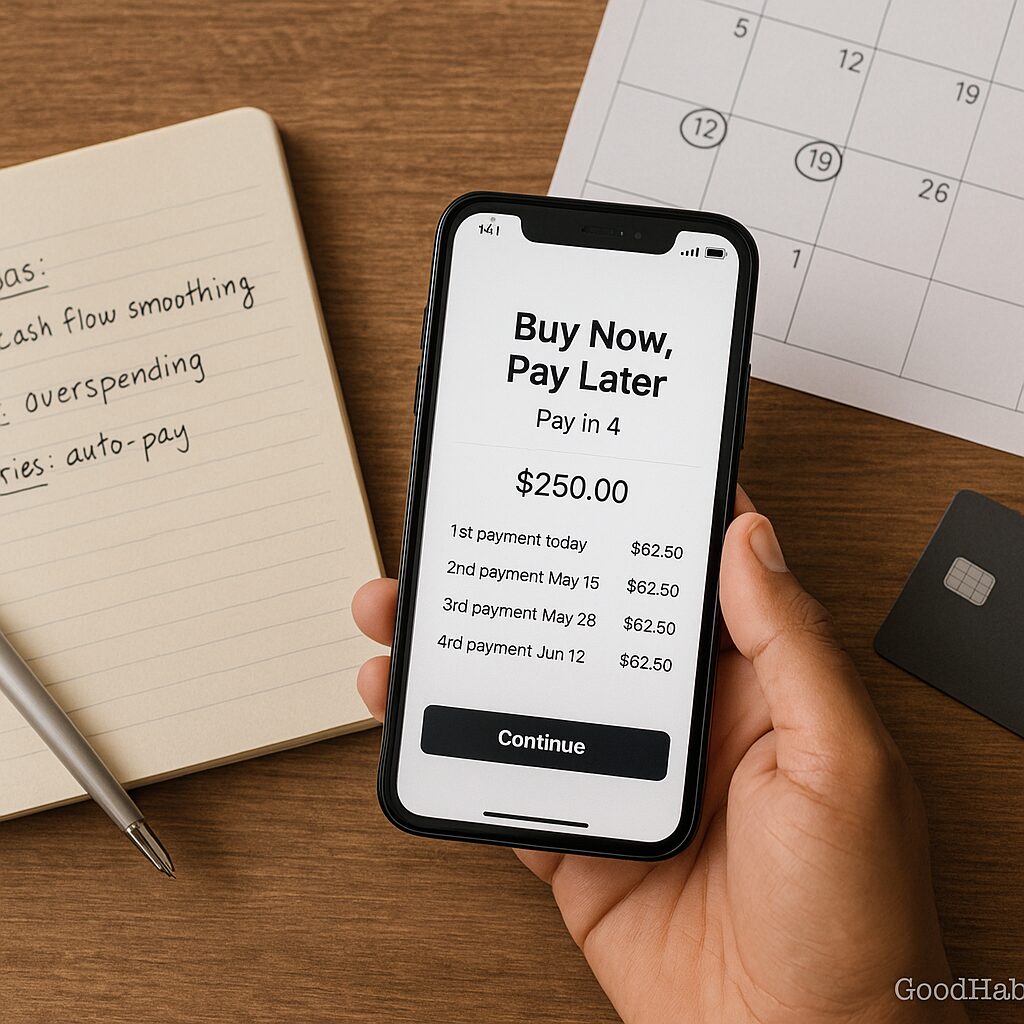
Buy Now, Pay Later (BNPL) lets you split a purchase into several interest-free payments—often “pay-in-4”—and is now common both online and in stores. Unlike traditional credit cards, approvals are fast and loan amounts are small, but multiple loans can run at the same time. Bank for International Settlements
In the U.S., 14% of adults reported using BNPL in the prior 12 months (2023 data), most often to spread payments or for convenience. Many also said BNPL made a purchase possible they otherwise couldn’t afford—highlighting both usefulness and risk. Federal Reserve
Credit reporting is inconsistent: some providers report BNPL activity, others don’t, and the three major bureaus differ in how they accept BNPL data. This means your BNPL debts may not fully appear in your credit history, reducing visibility for lenders—and for you. Consumer Finance.govTransUnion
⚖️ The 2025 Rulebook: What changed in the US, UK, Australia
-
United States. In 2024, the CFPB clarified that BNPL lenders issuing digital user accounts are treated as “credit card” providers for certain protections (e.g., dispute rights and refunds after returns). How these protections are enforced may evolve, but consumers have clearer rights than before. Consumer Finance.gov+1
-
United Kingdom. In July 2025, the FCA opened consultation on bringing “Deferred Payment Credit” (unregulated BNPL) into its regime, proposing affordability checks—even for small loans—and access to ombudsman redress. FCA+1
-
Australia. From 10 June 2025, BNPL providers must hold a credit licence and meet responsible lending-style obligations under new laws, with transitional arrangements in place. ASICTreasury
Global bodies flag the same pattern: BNPL can smooth cash flow but also accelerates impulse buying and over-indebtedness without strong literacy and guardrails. OECD+1
✅ Pros vs ⚠️ Cons (at a glance)
| ✅ Pros | ⚠️ Cons |
|---|---|
| Usually interest-free when paid on time | Late fees; missed payments can block future use |
| Predictable instalments, short payoff window | Easy to stack multiple loans across apps |
| Fast checkout; no hard credit pull in many cases | Returns/refunds can be messy across retailer and lender |
| Can be cheaper than revolving credit when used well | Inconsistent credit reporting; debts may be “invisible” |
| Helpful for budgeting pre-planned buys | Tempts impulse buys; may strain tight budgets |
Evidence on loss rates is mixed: some studies show BNPL charge-offs near or below other unsecured credit; others note higher delinquencies for young/financially stressed users and unreported balances. Richmond FedIDEAS/RePEc
🚀 Quick-Start: Use BNPL safely today (10-minute setup)
-
List active plans (provider, remaining payments, due dates). Put them in your calendar with reminders.
-
Switch on autopay from a bank account with buffer funds (avoid credit-card-to-BNPL loops).
-
Set a hard cap: “BNPL balance ≤ 5% of monthly take-home” (e.g., ₹3,000 on ₹60,000; ~$60 on $1,200).
-
Plan, don’t impulse: Only use BNPL on a pre-budgeted item you would buy anyway.
-
Know the return path: Save the order number; check the lender’s dispute/return timelines. Consumer Finance.gov
🛡️ 30-60-90 Boundary Plan
Goal: Keep BNPL helpful, not harmful.
Days 0–30 (Stabilise)
-
Freeze new BNPL unless the purchase is pre-planned.
-
Pay down any plan with fees first.
-
Create a one-page tracker (item, lender, next due date).
-
Boundary: Max 1 active BNPL at once; payment dates spread across pay cycles.
Days 31–60 (Optimise)
-
Consolidate autopay dates near income days.
-
Lower cap to 4% of take-home (or ₹2,400 on ₹60,000).
-
Add a “cool-off rule”: 24-hour wait before using BNPL on anything unplanned.
Days 61–90 (Lock-in)
-
Set final cap at 3% of take-home; never overlap more than one BNPL plan.
-
If you carry credit-card balances, prefer cash/debit over BNPL until your revolving APR debt is under control.
-
Quarterly review: continue BNPL only if no fees, no stress, no missed bills.
🧠 Techniques & Guardrails (research-aligned)
-
Budget first, BNPL second. If a purchase isn’t in this month’s budget, it’s a “no.”
-
Loan stacking check. Before checkout, ask: “Will this create overlap with another plan?” (Many users juggle simultaneous plans across providers.) kansascityfed.org
-
Return-ready. Screenshot confirmations; know how to dispute if goods are faulty/returned. Consumer Finance.gov
-
Credit-report awareness. Check your bureau(s) quarterly and note that BNPL may not fully appear. TransUnion
-
Impulse firewall. Use a browser extension or phone Focus Mode to block shopping apps after 9 pm.
-
Small-ticket rule. Keep BNPL for durable, necessary items—not groceries or recurring expenses.
👥 Variations by Audience
-
Students/early earners: Use BNPL only for study/work essentials (e.g., shoes, calculator). Cap at 2% of income; avoid stacking; enable autopay.
-
Parents: Coordinate in one family tracker; no BNPL for recurring kid costs (diapers, snacks).
-
Professionals: Keep BNPL separate from business expenses. If you already carry card balances, prioritise debt repayment strategies (e.g., avalanche).
-
Seniors: Avoid new BNPL accounts if on fixed income; use debit/credit with strong refund protections instead.
-
Teens (with parental oversight): Educate on instalments = debt; require parent approval and repayment plan.
⚠️ Mistakes & Myths to Avoid
-
“It’s not debt.” It is—just short-term, often invisible on your report. Consumer Finance.gov
-
“All providers report to credit bureaus.” False; reporting is inconsistent. TransUnion
-
“Returns are automatic.” They can be, but disputes and item returns have timelines; know them. Consumer Finance.gov
-
“BNPL is always riskier than credit cards.” Not always; total cost can be lower if you avoid fees—evidence on risk varies. Richmond FedIDEAS/RePEc
🗣️ Real-Life Scripts (copy-paste)
-
At checkout (decline BNPL): “I’m paying today—no instalments, thank you.”
-
Cooling-off self-talk: “If it’s not in the budget, I’ll revisit next month.”
-
Return/refund: “I returned Order #____ on //____. Please confirm the refund and adjust my BNPL schedule per your policy.”
-
Over-limit reset with partner: “Let’s pause new BNPL until our current plan finishes and we’re back under 3% of income.”
🧰 Tools & Resources
-
Budgeting: YNAB, Monarch, Goodbudget, or a simple spreadsheet template.
-
Bank alerts & calendars: Turn on SMS/app alerts + calendar reminders for instalments.
-
Credit files: Pull reports from your local/national bureaus quarterly; watch for BNPL entries. TransUnion
-
Financial literacy: OECD guides on short-term online credit/BNPL and consumer risk monitor. OECD+1
🧾 Key Takeaways
-
Use BNPL only for planned purchases you can clear on time.
-
Keep a single active plan and a <3–5% income cap.
-
Turn on autopay and calendar reminders.
-
Know your dispute/return rights and timelines. Consumer Finance.gov
-
Track policy changes—protections are expanding in several countries. FCAASIC
❓ FAQs
1) Does BNPL help my credit score?
Not reliably. Some lenders report; others don’t; and bureaus handle BNPL differently. Assume it may not build credit and monitor your files directly. TransUnionConsumer Finance.gov
2) Is BNPL cheaper than a credit card?
If you pay on time and avoid fees, pay-in-4 is often interest-free and can be cheaper than revolving balances. Missed payments can trigger fees and blocks. Consumer Financial Protection Bureau
3) What if I return something bought with BNPL?
Keep receipts and timelines. In the U.S., BNPL lenders that issue digital accounts are treated as “card issuers” for certain dispute/refund rights; follow the lender’s process promptly. Consumer Finance.gov
4) Can I run multiple BNPL loans at once?
Yes, and many people do—which raises risk. In 2022, a large share of users held simultaneous loans, sometimes across different firms. kansascityfed.org
5) What’s new in UK regulation?
The FCA proposes regulating unregulated BNPL with affordability checks and ombudsman access; consultation is open in 2025. FCA
6) What changed in Australia?
From 10 June 2025, BNPL is under the credit-licensing regime with responsible-lending-style checks. ASIC
7) Is BNPL “safer” than personal loans?
Cost can be lower (no ongoing interest) if you pay on time, but invisibility on credit files and stacking can still create stress. Consumer Finance.gov
8) Should I use BNPL for essentials?
Generally no. Essentials that repeat monthly (groceries, utilities) can create rolling instalments and cash-flow strain.
📚 References
-
CFPB. Interpretive Rule: Use of Digital User Accounts to Access BNPL Loans (May 22, 2024). https://www.consumerfinance.gov Consumer Finance.gov
-
CFPB Newsroom. CFPB Takes Action to Ensure Consumers Can Dispute Charges and Obtain Refunds on BNPL Loans (May 22, 2024). https://www.consumerfinance.gov Consumer Finance.gov
-
Federal Reserve. Report on the Economic Well-Being of U.S. Households in 2023 (May 31, 2024). https://www.federalreserve.gov Federal Reserve
-
BIS Quarterly Review. BNPL: A Cross-Country Analysis (Dec 2023). https://www.bis.org Bank for International Settlements
-
OECD. Supporting Informed and Safe Use of Short-Term Online Credit & BNPL (2024). https://www.oecd.org OECD
-
OECD. Consumer Finance Risk Monitor (Jan 2024). https://www.oecd.org OECD
-
FCA (UK). CP25/23: Deferred Payment Credit—Proposed Approach to Regulation (Jul 18, 2025). https://www.fca.org.uk FCA
-
FCA (UK). Protections to Help BNPL Borrowers Navigate Financial Lives (Jul 18, 2025). https://www.fca.org.uk FCA
-
ASIC (Australia). BNPL Providers to Apply for a Licence Under New Laws (Jan 17, 2025). https://www.asic.gov.au ASIC
-
Australian Treasury. BNPL – Draft Regulations 2025 (Feb 5, 2025). https://treasury.gov.au Treasury
-
Richmond Fed. BNPL: Market Impact and Policy Considerations (2025). https://www.richmondfed.org Richmond Fed
-
TransUnion. Buy Now, Pay Later and Credit Reporting (accessed 2025). https://www.transunion.com TransUnion
Disclaimer: This article provides general financial education, not personal financial advice; please consider your situation or consult a qualified adviser before acting.