
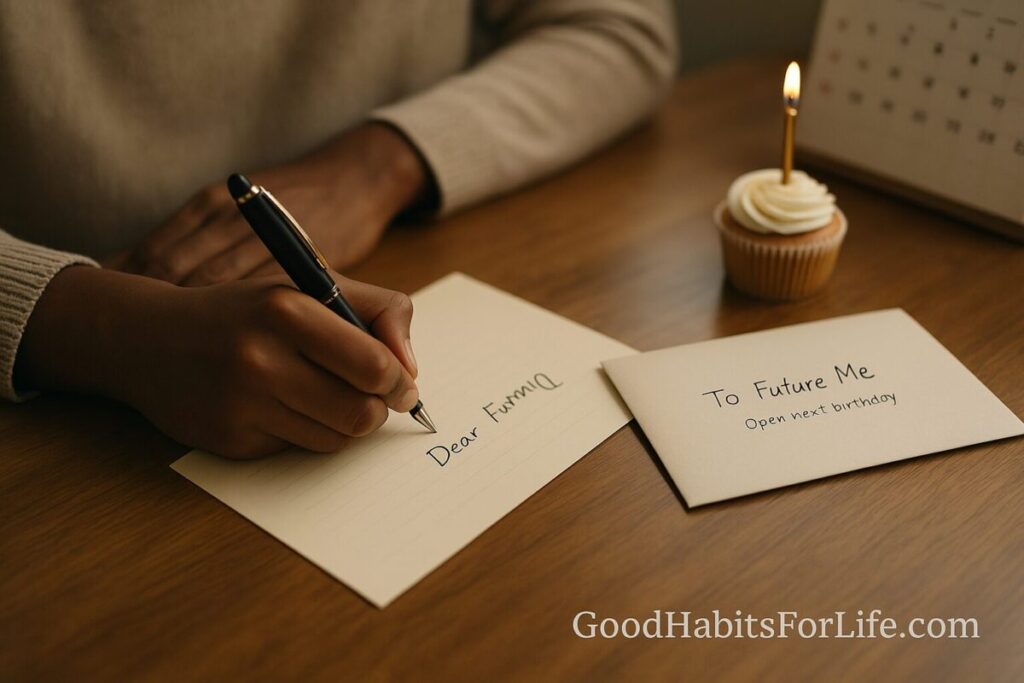
Birthday Gratitude Rituals: Letter to Future You
Birthday Gratitude Rituals: Letter to Future You
Table of Contents
🧭 What Is a Birthday Gratitude Letter & Why It Works
-
Definition. A birthday gratitude letter is a short message you write on (or near) your birthday to your future self. You:
-
Name specific people, moments, and abilities you’re grateful for this year,
-
Capture lessons you want Future-You to remember, and
-
Set 1–3 intentions you will act on.
You then seal it (envelope, time capsule, or scheduled email) to open next birthday.
-
-
Why it works.
-
Gratitude → well-being. Regular gratitude practices are linked with more positive emotion, better relationships, and reduced stress.
-
Expressive writing → clarity. Writing about meaningful experiences helps organize thoughts and emotions.
-
Future-self connection. Addressing Future-You increases motivation for follow-through.
-
Temporal landmark effect. Birthdays are psychological “reset points” that make change feel easier.
-
✅ Quick Start: Do It Today in 20 Minutes
-
Pick a quiet spot (phone on Do Not Disturb).
-
Title & date the page: “Letter to Future Me — [Age/Year].”
-
Three gratitude lines (5 minutes): people, moments, and strengths you used this year.
-
Three lessons (5 minutes): what you learned about health, work, relationships.
-
Three intentions (5 minutes): 1 tiny daily, 1 weekly, 1 monthly action. Make them “If-Then” plans (e.g., “If it’s 22:00, then I prep tomorrow’s clothes”).
-
Seal & schedule (5 minutes):
-
Paper: seal in an envelope labeled “Open on my next birthday.”
-
Digital: schedule an email to Future-You (see Tools below).
-
-
Optional 60-second voice note: read your letter out loud and save the audio.
🛠️ 7-Day Starter Plan (with Prompts)
-
Day 1 — Collect highlights (10 min). Scroll photos/messages and list 10 moments you’re glad happened.
Prompt: “What small moments made me smile this year?” -
Day 2 — People (10 min). Write 5 names and 1 line each: what you appreciate. Send 1 thank-you text.
-
Day 3 — Strengths (10 min). Identify 3 strengths you used (e.g., patience, curiosity) and 1 proof for each.
-
Day 4 — Lessons (10 min). “What did a challenge teach me? What would I do differently?”
-
Day 5 — Future-Self (10 min). Imagine you in 12 months—what does a good year look like in health, relationships, and work?
-
Day 6 — Draft the letter (20 min). Use the script templates below.
-
Day 7 — Seal & schedule (15 min). Sign, set a calendar reminder, and schedule delivery.
🧠 30-60-90 Habit Roadmap (Make It Annual)
-
Day 30 (Post-birthday check-in). Re-read your 3 intentions. Convert each into a habit cue (time, place, trigger). Add them to your calendar or habit app.
-
Day 60 (Mini-audit). Score 1–10: How consistently did I do the daily/weekly/monthly actions? Remove friction (e.g., lay out shoes the night before).
-
Day 90 (Quarterly letterette). Write a 5-line update to Future-You. Clip or append to your main letter.
-
Annually (new birthday). Open last year’s letter, celebrate wins (even messy ones), then write the next one.
📚 Techniques & Frameworks That Supercharge the Ritual
-
The 3×3 Structure (fast + powerful): 3 Gratitudes → 3 Lessons → 3 Intentions.
-
If-Then Plans (implementation intentions): “If it’s 18:00 and I’m leaving work, then I text my partner 1 good thing about today.”
-
WOOP (Wish, Outcome, Obstacle, Plan): For each intention, name 1 likely obstacle and a plan to overcome it.
-
Future-Self Visualization (2 minutes): Close eyes; picture next birthday—where you are, who’s with you, how you feel. Write one sentence that starts, “I’m proud that…”
-
Fresh-Start Anchors: Pair the ritual with steady anchors: birthday breakfast, sunset walk, or candle-blowing moment.
-
“Thank-Forward” Line: End your letter by thanking Future-You for staying kind to Present-You.
🧑🎓 Audience Variations
-
Students: Include 1 learning habit (e.g., spaced-repetition schedule) and 1 community habit (study buddy text).
-
Parents/Caregivers: Add 3 “micro-moments” of connection to repeat next year (bedtime chat, weekend walk, tech-free dinner).
-
Professionals: Tie intentions to quarterly OKRs; add a “Stop-Doing” line (meetings, apps, or tasks to drop).
-
Seniors: Include gratitude for abilities, relationships, and wisdom; add a health-maintenance intention (daily walk, balance exercises).
-
Teens: Keep it short and visual (stickers/photos); choose 1 habit related to sleep or screen boundaries.
⚠️ Mistakes & Myths to Avoid
-
Myth: “It has to be long.” → One page beats a forgotten manifesto.
-
Mistake: Vague intentions. → Use If-Then plans and specific times.
-
Mistake: Only listing “big wins.” → Small, ordinary joys count most.
-
Myth: “Digital isn’t meaningful.” → Scheduled emails can feel magical to open.
-
Mistake: Skipping review. → Re-read last year’s letter before writing the new one.
✉️ Real-Life Examples & Copy-Paste Scripts
Opening (choose one):
-
“Dear Future Me, if you’re reading this, you made it another lap around the sun. Here are the moments I’m grateful for…”
-
“Hi Me-Next-Year, today I turned [age]. Before the cake, I want to freeze a few good things from this year.”
3×3 Middle (fill-in):
-
Grateful for: “I’m grateful for ___ (person/moment/ability) because ___.” ×3
-
Lessons: “This year taught me ___, which means next time I’ll ___.” ×3
-
Intentions: “If it’s [time] on [days], then I’ll [action] because it helps me [value].” ×3
Closing:
-
“Thank you, Future Me, for carrying these hopes kindly. I’ll meet you next birthday.”
-
Sign with today’s date and a tiny doodle or selfie.
🧰 Tools, Apps & Resources (Pros & Cons)
-
FutureMe.org — Email your future self on a chosen date.
Pros: set-and-forget delivery; private or public options. Cons: relies on email longevity. -
Day One (iOS/Android/Mac) — Rich journaling with photos/audio; reminders.
Pros: beautiful; encrypted. Cons: paid features. -
Google Docs or Notion — Easy templates; searchable; shareable.
Pros: free; version history. Cons: distraction risk. -
Paper + Envelope — Classic; tactile; easy to seal.
Pros: zero tech; ceremonial. Cons: can be misplaced—use a “Birthday Box.” -
Voice Memo — Record yourself reading the letter.
Pros: emotion captured; quick. Cons: harder to skim later.
🔑 Key Takeaways
-
Birthdays are natural reset points—perfect for a gratitude + intention ritual.
-
Keep your letter one page using the 3×3 structure.
-
Seal or schedule delivery and set a calendar reminder for next year.
-
Turn intentions into If-Then habits and review at 30/60/90 days.
-
Repeat annually to build a personal archive of growth and joy.
❓ FAQs
1) When is the best time to write the letter?
On your birthday or within ±7 days. Pair it with a consistent cue (breakfast, candle, or evening walk).
2) How long should it be?
One page is ideal (200–400 words). Brevity keeps it doable every year.
3) Is a digital letter as good as handwritten?
Both work. Handwritten feels ceremonial; digital is searchable and schedulable. Choose the one you’ll repeat.
4) What if my year was tough?
Name one small bright spot, one lesson, and one support you’ll lean on. Gratitude isn’t denial; it’s balanced noticing.
5) Should I share it with someone?
Optional. Some people share with a partner or close friend for accountability; others keep it private and sacred.
6) Can kids/teens do this?
Yes—use fewer prompts, stickers/photos, and one simple intention (e.g., consistent bedtime).
7) What if I miss a year?
Pick the nearest meaningful date (New Year, first day of school, anniversary) and restart. Consistency over perfection.
8) What do I do with last year’s letter?
Read it, celebrate progress, extract any unfinished intentions, and attach it behind the new one.
9) Can I include photos or mementos?
Absolutely. Add one photo or ticket stub to your “Birthday Box” with the letter.
10) How do I keep this sustainable?
Block 30 minutes on your birthday calendar each year and reuse the same template.
📚 References
-
Emmons, R. A., & McCullough, M. E. (2003). Counting blessings versus burdens: An experimental investigation of gratitude and well-being. Journal of Personality and Social Psychology, 84(2), 377–389. https://doi.org/10.1037/0022-3514.84.2.377
-
Wood, A. M., Froh, J. J., & Geraghty, A. W. A. (2010). Gratitude and well-being: A review and theoretical integration. Clinical Psychology Review, 30(7), 890–905. https://pubmed.ncbi.nlm.nih.gov/20346962/
-
Harvard Health Publishing. (2021). Giving thanks can make you happier. https://www.health.harvard.edu/healthbeat/giving-thanks-can-make-you-happier
-
Greater Good Science Center (UC Berkeley). The Science of Gratitude. https://ggsc.berkeley.edu/what_we_do/major_initiatives/gratitude
-
Gollwitzer, P. M. (1999). Implementation intentions: Strong effects of simple plans. American Psychologist, 54(7), 493–503. https://doi.org/10.1037/0003-066X.54.7.493
-
Lally, P., Van Jaarsveld, C. H. M., Potts, H. W. W., & Wardle, J. (2010). How are habits formed in the real world? European Journal of Social Psychology, 40(6), 998–1009. https://doi.org/10.1002/ejsp.674
-
Dai, H., Milkman, K. L., & Riis, J. (2014). The fresh start effect: Temporal landmarks motivate aspirational behavior. Management Science, 60(10), 2563–2582. https://doi.org/10.1287/mnsc.2014.1901
-
Hershfield, H. E., et al. (2011). Increasing saving behavior through age-progressed renderings of the future self. Journal of Marketing Research, 48(SPL), S23–S37. https://doi.org/10.1509/jmkr.48.SPL.S23
-
Smyth, J. M. (1998). Written emotional expression: Effect sizes, outcome types, and moderating variables. Journal of Consulting and Clinical Psychology, 66(1), 174–184. https://doi.org/10.1037/0022-006X.66.1.174
-
American Psychological Association. Gratitude. https://dictionary.apa.org/gratitude
Disclaimer: This article is educational and not a substitute for professional mental-health advice.