
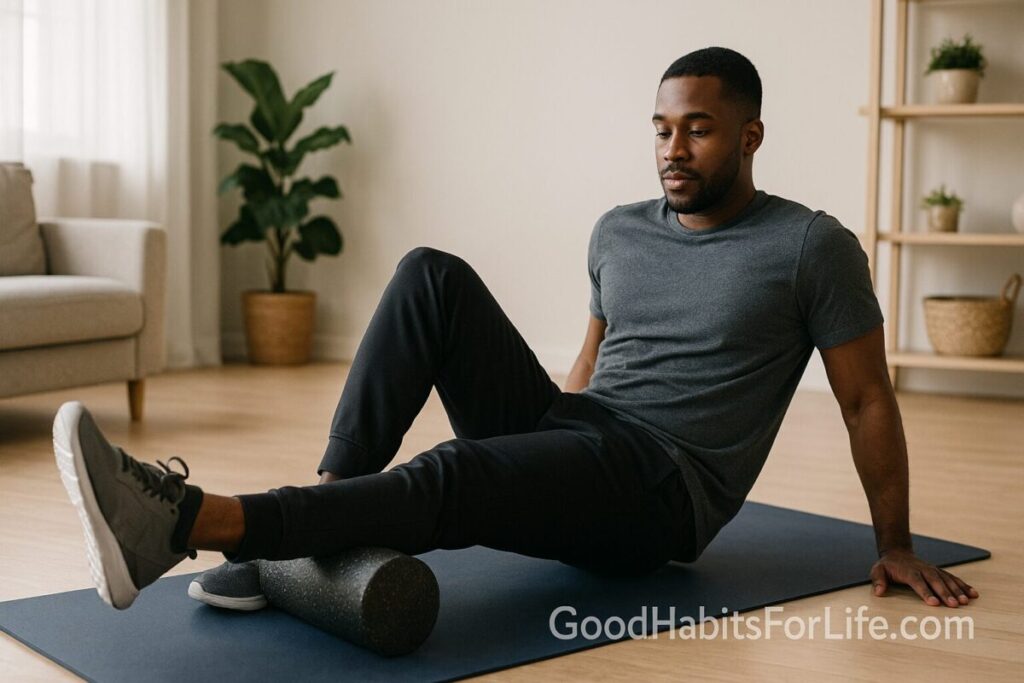
Beginner Foam Rolling with Intent in 2025: Science-Backed Tactics
Beginner Foam Rolling 2025: Science-Backed Tactics
Table of Contents
🧭 What Foam Rolling Is & Why It Helps
Foam rolling is a form of self-myofascial release (SMR)—using your bodyweight on a roller or ball to apply pressure to muscle and fascia. High-quality evidence shows small-to-moderate improvements in joint range of motion (ROM) and potential relief of post-exercise soreness, with no meaningful decrement in strength or power when used appropriately. PMC+1ScienceDirect
Meta-analyses comparing foam rolling vs. stretching report similar ROM gains acutely, so foam rolling is a legit alternative or complement to your warm-up—especially if you dislike static stretching. FrontiersPubMed
Bottom line: foam rolling is a useful, time-efficient tool to feel looser, warm up tissues, and nudge flexibility—not a cure-all for every ache. PMC
✅ Quick Start: Do This Today (10-Minute Routine)
Set-up (1 min)
-
Choose a medium-density roller.
-
Target: calves → quads → glutes → upper back (skip the low back).
-
Use a breath pace: inhale 4 s, exhale 6 s.
Technique & dosage (8–9 min total)
-
30–60 seconds per muscle group, ~1–2 cm/sec slow rolling; pause 10–15 s on tender spots (max 5/10 discomfort). Cardiac Rehab Center
-
Pre-workout: lighter pressure, quicker passes, then do dynamic moves (leg swings, squats).
-
Post-workout or rest days: slower passes and 10–15 s holds on hot-spots.
-
Avoid: rolling directly on bones/joints; long holds on one spot; rolling the lumbar spine.
Cool finish (30 s)
-
Stand, check a retest (e.g., deep squat or toe touch) to confirm change.
Tip: For max lifting sets, don’t roll the agonist between sets—it can reduce immediate reps for some tasks. PMC
🧠 7-Day Starter → 30-60-90 Day Habit Plan
Days 1–7 (Starter)
-
Daily 8–10 min: calves, quads, glutes, upper back (30–60 s each).
-
Checkpoints: note a ROM test (e.g., ankle dorsiflexion against wall, deep squat).
Days 8–30
-
Pre-workout 5–7 min: lighter, faster passes + dynamic mobility.
-
Post-workout 5 min: slower passes + 2 tender-spot holds per side.
-
Weekly review: compare ROM test and soreness ratings (0–10).
Days 31–60
-
Add hamstrings, adductors, lats (if needed). Maintain total ≤12 min.
-
Start micro-cycles: 2 heavier sessions/week (deeper pressure), 3 lighter.
Days 61–90
-
Personalize: keep 5–10 min most days; phase in mobility supersets (roll → 30 s mobility drill).
-
Progress only if ROM or comfort improves week-to-week.
🛠️ Techniques & Frameworks (with/without Vibration)
-
Scan → Find → Breathe: 2–3 slow passes to scan; when you find a tender spot, hold pressure 10–15 s with two slow exhales. Cardiac Rehab Center
-
Segment-by-Segment: divide each muscle into upper/middle/lower thirds; 20–30 s each.
-
Joint-by-Joint Pairing: roll the tissue then do a mobility drill for the neighbouring joint (e.g., calves → ankle dorsiflexion rocks).
-
Vibration rollers (VFR): some reviews suggest potential extra benefits for soreness and performance, though results are mixed; they’re optional, not required. SpringerOpenPMC+1
🧑🏃 Audience Variations
-
Runners: focus on calves, quads, lateral thigh, and glutes (5–8 min pre-run; 5 min post).
-
Lifters: pre-session: quads, glutes, thoracic spine; post: add lats/pecs if pressing. Keep it brief between sets (or skip). PMC
-
Desk workers: upper back, lats, hip flexors/glutes daily 5–8 min; pair with posture breaks.
-
Seniors/beginners with conditions: start with very light pressure and higher surfaces (wall/couch). If you have osteoporosis, vascular issues, or neuropathy, consult a clinician first.
-
Teens: teach pain rules (no sharp pain/numbness) and short total time (≤8 min).
⚠️ Mistakes & Myths to Avoid
-
Myth: “More pain = more gain.” → Aim for mild–moderate discomfort only.
-
Mistake: Rolling the low back aggressively—stick to upper back (thoracic).
-
Mistake: Treating rolling as your entire warm-up—it’s prep, not practice; follow with dynamic movement. Frontiers
-
Myth: “Foam rolling breaks up scar tissue.” → Benefits likely come from neuromodulation and fluid/mechanical effects—not literal “breaking up” tissue. PMC
-
Mistake: Over-voluming (15–20+ min) with minimal extra benefit; keep it efficient.
🗣️ Real-Life Examples & Scripts
-
Pre-run (5–6 min): calves 60 s/side → quads 60 s/side → glutes 45 s/side → upper back 60 s → 30 walking lunges.
-
Post-lift (7–8 min): quads 60 s/side → glutes 60 s/side → lats 45 s/side → upper back 60 s → child’s pose + thoracic rotations.
-
Desk break (3–4 min): upper back 60 s → lats 45 s/side → glutes 45 s/side → band pull-aparts x20.
-
DOMS day (5–8 min): lighter pressure on sore areas 30–45 s plus easy cycling or walking; expect subjective relief, not magic. PMC
📚 Tools, Apps & Resources
-
Rollers:
-
Medium density, 30–45 cm: good all-rounder for beginners.
-
Textured: more intense; add later if needed.
-
Vibration rollers: pricier; may reduce soreness and aid ROM for some. SpringerOpen
-
-
Balls: lacrosse-style or massage balls for glutes/feet.
-
Timer apps: any interval timer (e.g., 30–60 s) to keep sets honest.
-
Image sources for featured images: Pixabay and Pexels offer free-to-use photos (check licenses; attribution not required). PixabayPexels
🔑 Key Takeaways
-
Foam rolling improves ROM and can ease soreness; it doesn’t blunt performance when used sensibly. PMC
-
5–10 minutes total, 30–60 s per area, is a practical dose. Cardiac Rehab Center
-
Combine rolling with dynamic mobility and your training for the biggest payoff. Frontiers
-
Consider vibration only if you like it; it’s optional with mixed evidence. SpringerOpenPMC
❓ FAQs
1) Should I foam roll before or after workouts?
Both can work. Before: lighter, faster passes to prep tissue; after: slower, deeper passes to reduce soreness. Pair with movement either way. PMC
2) How hard should it feel?
Aim for mild–moderate discomfort (≤5/10); avoid sharp pain, tingling, or numbness. Cardiac Rehab Center
3) How often is ideal?
Most days for 5–10 minutes is fine. More is not always better. Track ROM/soreness to personalize. PMC
4) Does foam rolling replace stretching?
Not necessarily. Evidence shows similar acute ROM gains vs. stretching; many people combine both. Frontiers
5) Can I roll my low back?
Avoid direct pressure on the lumbar spine; roll upper back and use core work for lumbar stability. Cardiac Rehab Center
6) Is vibration worth it?
Vibration rollers may further reduce soreness and aid performance for some, but findings are mixed; not essential. SpringerOpenPMC
7) Any situations to avoid foam rolling?
Yes—acute injuries, fractures, severe osteoporosis, vascular/nerve issues, or if you’re on anticoagulant therapy. When in doubt, ask a clinician.
8) Can foam rolling hurt strength if I do it between sets?
Rolling the working muscle between heavy sets may reduce reps in some tasks—better to do it before or after, or roll non-agonist tissues. PMC
📚 References
-
Wiewelhove T, et al. A Meta-Analysis of the Effects of Foam Rolling on Performance and Recovery. Sports Med. 2019. (PMCID: PMC6465761). https://pmc.ncbi.nlm.nih.gov/articles/PMC6465761/ PMC
-
Cheatham SW, et al. The Effects of Self-Myofascial Release Using a Foam Roll or Roller Massager on Joint ROM, Muscle Recovery, and Performance: A Systematic Review. Int J Sports Phys Ther. 2015. https://pubmed.ncbi.nlm.nih.gov/26618062/ PubMed
-
Skinner B, et al. A systematic review and meta-analysis of the effects of foam rolling. J Bodyw Mov Ther. 2020. https://www.sciencedirect.com/science/article/abs/pii/S1360859220300218 ScienceDirect
-
Konrad A, Tilp M, Nakamura M. Foam Rolling vs. Stretching: A Systematic Review & Meta-analysis. Front Physiol. 2021. https://www.frontiersin.org/articles/10.3389/fphys.2021.720531/full Frontiers
-
Monteiro ER, et al. Effect of Different Foam Rolling Volumes on Strength Performance. J Nov Physiother. 2016 (PMCID: PMC5159632). https://pmc.ncbi.nlm.nih.gov/articles/PMC5159632/ PMC
-
Park SJ, et al. Effect of Vibration Foam Rolling on ROM in Healthy Adults: Systematic Review & Meta-analysis. J Exerc Rehabil. 2021. https://pmc.ncbi.nlm.nih.gov/articles/PMC8413912/ PMC
-
Alonso-Calvete A, et al. Does Vibration Foam Roller Influence Performance and Recovery? Systematic Review & Meta-analysis. Sports Med Open. 2022. https://sportsmedicine-open.springeropen.com/articles/10.1186/s40798-022-00421-2 SpringerOpen
-
Martínez-Aranda LM, et al. Self-Myofascial Release on Athletes’ Physical Performance: Systematic Review. Sports. 2024. https://www.mdpi.com/2411-5142/9/1/20 MDPI
-
UCSF Cardiac Rehab. A Road Map to Effective Muscle Recovery (foam-rolling guidance). https://cardiacrehab.ucsf.edu/sites/g/files/tkssra13261/files/wysiwyg/a-road-map-to-effective-muscle-recovery.pdf Cardiac Rehab Center
-
Pixabay License Summary. https://pixabay.com/service/license-summary/ ; Pexels License. https://www.pexels.com/license/ PixabayPexels
Disclaimer: This guide is educational and does not replace personalized medical advice; consult a qualified professional if you have injuries or medical conditions.