
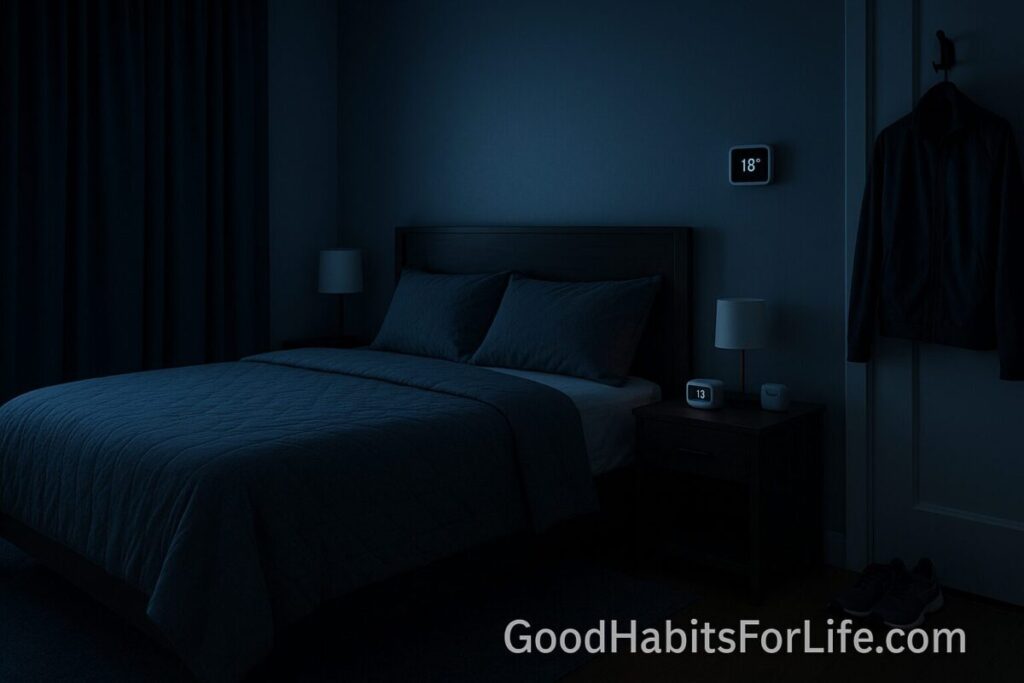
Bedroom Basics: Quiet, Dark, Cool: Zone 2 + NEAT (2025)
Bedroom Basics: Quiet, Dark, Cool + Zone 2 & NEAT (2025)
Table of Contents
🧭 What “Quiet, Dark, Cool” Means (and Why It Works)
Quiet. Night noise fragments sleep. The World Health Organization notes bedrooms should be under ~30 dB(A) at night; outdoor night noise (annual average) should be <40 dB Lnight to prevent health effects. Translation: tame traffic, TV, and fan hum. World Health Organization
Dark. Evening and night-time light—especially blue-enriched light—suppresses melatonin and shifts the body clock. Even standard room light before bed can delay melatonin and shorten its duration. Keep the glow down. Oxford AcademicPNAS
Cool. Most adults sleep best around 18–19 °C (≈65 °F); a few degrees either side is fine—aim for “a little cool under the covers.” Sleep Foundation
Bonus: Air & Humidity. Keep RH 30–50% to reduce mold/dust mites and improve comfort. Use a basic hygrometer to check. US EPA
Proof it matters. AASM guidance explicitly recommends a cool, quiet, relaxing bedroom and limiting evening light. Sleep Education
✅ Quick Start: Upgrade Your Bedroom Today
In 20 minutes:
-
Blackout: Close blinds; add a temporary blackout curtain or eye mask. Dim lamps to warm tones. Oxford Academic
-
Cool it: Set AC to 18–19 °C (65 °F). If that feels too cool, keep temp slightly higher but use a lighter duvet. Sleep Foundation
-
Quiet it: Turn on a white-noise fan or app; place a draft stopper under the door; keep phones on silent.
-
Measure: Open a decibel app (NIOSH SLM on iOS); keep reading <30 dB at the pillow. CDC
-
Evening light rule: No overheads after sunset. Use a low, warm lamp. Screens off or on night mode 60 minutes before bed. PNAS
🛠️ The 30-60-90 Sleep Upgrade Plan
Goal: Lock in “quiet, dark, cool” + daily activity so sleep gets easier every week.
Days 1–30 (Foundation)
-
Bedroom: Install blackout curtains; add felt pads to rattly doors; set a stable sleep temp; place a small hygrometer (target 30–50% RH). US EPA
-
Evenings: Dim by default after sunset; blue-light filters on all screens; phone out of bedroom. PNAS
-
Activity: 5 days/week of Zone 2 for 20–30 min (brisk walk/cycle where you can talk but not sing). Track steps; aim for 7,000+ baseline. CDCsochob.cl
-
Check-in: Use a decibel app at night; aim <30 dB at pillow. World Health OrganizationCDC
Days 31–60 (Build)
-
Noise: Add door sweep/weatherstrip; consider soft furnishings or a white-noise machine if readings remain >30–35 dB. World Health Organization
-
Light: Replace bright bulbs in bedside lamps with warmer, lower-lux bulbs; cover LEDs on chargers. Oxford Academic
-
Activity: Extend Zone 2 to 30–40 min; sprinkle NEAT: stairs, walking calls, standing breaks every 30–60 min. Cambridge University Press & Assessment
Days 61–90 (Lock-in)
-
Fine-tune temp/bedding by season; keep humidity in range. US EPA
-
Routine: Consistent sleep/wake times; 60-min wind-down (dim light, stretch, read). Sleep Education
-
Activity: Hold 150–300 min/wk moderate cardio total; keep 7,000–9,000+ steps as your easy NEAT floor. ACSMThe Lancet
🧠 Techniques & Frameworks
The “QDC” Checklist (Quiet-Dark-Cool):
-
Quiet: <30 dB at pillow; if you can hear speech from another room, add masking. World Health Organization
-
Dark: No overheads after sunset; black out window glow; cover LEDs. Screens? Night mode + distance, or off. Oxford AcademicPNAS
-
Cool: 18–19 °C target; adjust bedding, not just thermostat. Sleep Foundation
The “60-Minute Dim” Rule: For the last hour, keep light low and warm; reserve bright light for mornings. Oxford Academic
NEAT Ladder: Sit → Stand → Stroll → Stairs → 10-min errand walk. Every rung adds easy activity that supports sleep and health. Cambridge University Press & Assessment
Talk Test for Zone 2: During cardio, you can talk but not sing; this aligns with moderate intensity. CDC
🏃 Zone 2 Cardio & NEAT: How Activity Improves Sleep
Regular physical activity improves sleep quality, duration, and latency across many studies and meta-analyses. Moderate-intensity aerobic exercise (i.e., Zone 2) shows consistent benefits, including in people with insomnia. PubMedPMC+1
-
Zone 2 defined: A steady effort where breathing is faster but controlled; you can talk, not sing (roughly moderate intensity in guidelines). CDC
-
How much: Accumulate 150–300 min/week of moderate cardio; break it into 20–40-minute sessions. ACSM
-
NEAT matters: All non-exercise movement—walking to the shop, taking stairs, standing tasks—adds up and supports metabolic health; it’s easier to keep steps ≥7,000/day than to “out-exercise” a sedentary day. Cambridge University Press & Assessmentsochob.cl
Evening movement myth-bust: Vigorous late-night workouts can be too activating for some, but short, light resistance “activity breaks” in the evening can actually lengthen sleep, per a 2024 BMJ Open Sport & Exercise Medicine trial. BMJ Open Seminars
👥 Audience Variations
-
Students/Teens: Prioritize light control (devices down 60 minutes pre-bed); use a bedside warm lamp for reading. Keep rooms cool; run a small fan for sound masking. PNAS
-
Professionals: Schedule Zone 2 during lunch or commute (walk segments). Add standing breaks every hour in long meetings. Cambridge University Press & Assessment
-
Parents: Use blackout shades in kids’ rooms; maintain 30–50% humidity; white noise for naps. US EPA
-
Seniors: Keep bedroom 18–20 °C to avoid feeling chilled; earlier wind-down; gentle Zone 2 (brisk walk) most days. Sleep Foundation
⚠️ Mistakes & Myths to Avoid
-
Myth: “The exact temp doesn’t matter.”
Reality: Cooler rooms (≈18–19 °C) generally aid sleep onset/continuity. Sleep Foundation -
Mistake: Bright overhead lighting within an hour of bed.
Fix: Use low, warm lamps; avoid blue-rich light. Oxford Academic -
Myth: “Noise doesn’t wake me—I’m used to it.”
Reality: Even if you don’t remember, night noise causes micro-arousals. Aim <30 dB indoors. World Health Organization -
Mistake: Only counting gym time.
Fix: Add NEAT and steps to your day; they’re powerful and sustainable. Cambridge University Press & Assessmentsochob.cl
🗣️ Real-Life Examples & Scripts
-
Roommate/partner noise script:
“Hey—when the TV’s on after 10, I’m waking up more. Could we use headphones or switch to subtitles after 10? I’ll run the fan for masking too.” -
Household light script:
“From 9 p.m., let’s switch to the side lamps only. I’ll put a warm bulb in this lamp so it’s still cozy.” -
Workday NEAT script (self):
“Every hour, I’ll stand for 3 minutes. Two walking calls before lunch. Steps target: 7,000+.” -
Evening movement:
During a 2-hour show, do 3-minute breaks (calf raises, chair squats) every 30–40 minutes—no gear. BMJ Open Seminars
🧰 Tools, Apps & Resources (quick picks)
-
Decibel check: NIOSH Sound Level Meter (iOS) — validated accuracy; free. CDC
-
Humidity check: Simple hygrometer; keep 30–50% RH. US EPA
-
White noise: Fan or app to mask intermittent sounds.
-
Light control: Blackout curtains, eye mask; set devices to night mode. PNAS
-
Activity tracking: Pedometer/phone step count; target 7,000–9,000+ steps baseline. The Lancet
📌 Key Takeaways
-
QDC (Quiet-Dark-Cool) is the simplest, highest-ROI bedroom fix for sleep.
-
Add Zone 2 cardio and NEAT to make sleep deeper and more reliable. PubMed
-
Use simple measure-and-tweak loops: dB app, hygrometer, thermostat, and evening dimming. CDCUS EPA
-
Follow the 30-60-90 plan to hardwire the habits.
❓ FAQs
1) What exact bedroom temperature should I set?
Start at 18–19 °C (65 °F) and adjust by 0.5–1 °C every few nights until you fall asleep quickly without waking hot/cold. Sleep Foundation
2) How dark is “dark”?
If you can read normal text without effort, it’s too bright. Use blackout shades/eye mask and avoid overheads in the last hour. Evening room light alone can suppress melatonin. Oxford Academic
3) Do I really need to measure noise?
A quick decibel check helps. Aim <30 dB indoors at night; if it’s higher, add masking/insulation. World Health Organization
4) What is Zone 2 and how do I find it?
It’s moderate intensity cardio—breathing faster but able to talk, not sing. Brisk walking often qualifies. CDC
5) How many steps should I aim for?
A practical floor is ≥7,000 steps/day for general health; more is fine if you recover well. sochob.cl
6) Is evening exercise bad?
Heavy, late workouts can feel too activating for some, but short, light activity breaks in the evening may extend sleep time. BMJ Open Seminars
7) What humidity is best for sleep?
Keep 30–50% RH; too humid encourages mold/dust mites, too dry irritates airways/skin. US EPA
8) What if my partner likes it warmer/noisier?
Compromise with separate duvets, earplugs/white noise, and a cooler room overall.
📚 References
-
World Health Organization — Environmental Noise guidelines / bedroom targets. World Health Organization+1
-
Sleep Foundation — Best temperature for sleep (~18.3 °C/65 °F). Sleep Foundation+1
-
Harvard Health Publishing — Blue light and melatonin. Harvard Health
-
Gooley JJ et al., J Clin Endocrinol Metab (2011) — Room light before bed suppresses melatonin. Oxford Academic
-
American Academy of Sleep Medicine — Healthy Sleep Habits (cool, quiet room; limit evening light). Sleep Education
-
EPA — Indoor humidity 30–50% guidance. US EPA
-
NIOSH — Sound Level Meter App (validated; iOS). CDC
-
Kredlow MA et al., J Behav Med (2015) — Meta-analysis: exercise improves sleep. PubMed
-
Kline CE, Clin Sports Med (2014) — Bidirectional relationship between exercise and sleep. PMC
-
Levine JA, Proc Nutr Soc (2003/2004) — NEAT: non-exercise activity thermogenesis. Cambridge University Press & AssessmentPhysiological Journals
-
CDC — Talk test: moderate intensity = can talk, not sing. CDC
-
Paluch AE et al., JAMA Netw Open (2021) — ~7,000 steps/day & mortality. sochob.cl
-
BMJ Open Sport & Exercise Medicine (2024) — Evening activity breaks improve sleep length. BMJ Open Seminars
📝 Disclaimer
This article is educational and not a substitute for personalized medical advice. If you have a sleep disorder or health condition, speak with a qualified clinician.