
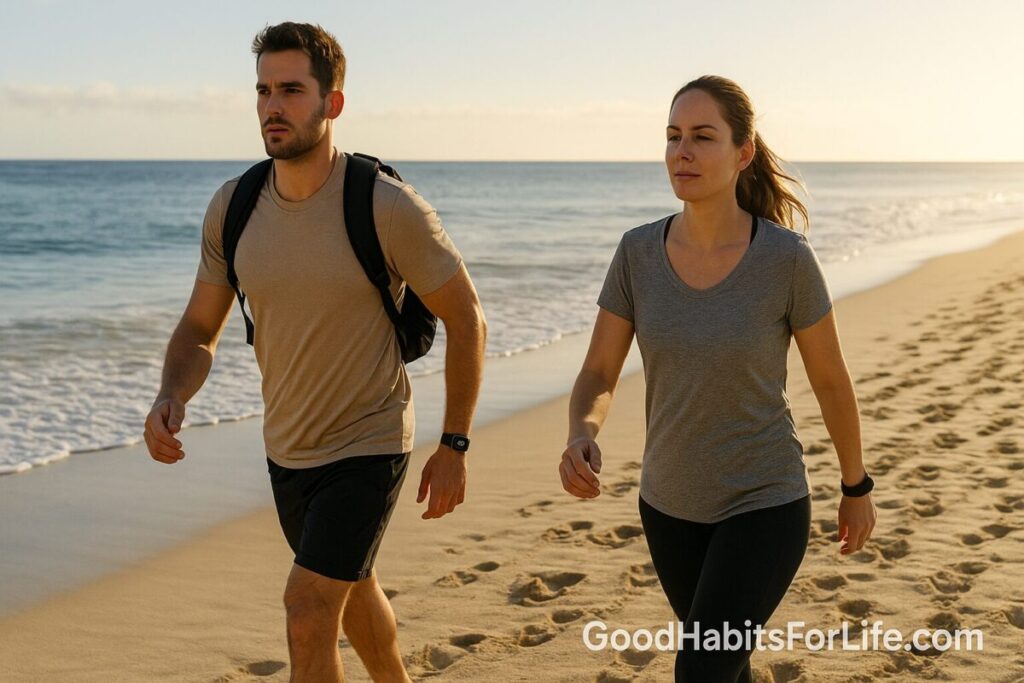
Beach & Park Workouts: Sand Resistance: Zone 2 + NEAT (2025)
Beach & Park Workouts: Sand Resistance + Zone 2 (2025)
Table of Contents
🧭 What These Workouts Are & Why They Work
Beach & park workouts combine low-impact aerobic movement (walking, easy jogging, rucking, mobility circuits) with sand resistance and Zone 2 intensity. Add daily NEAT (Non-Exercise Activity Thermogenesis)—all the little movements outside “workouts”—to compound results.
Why it works
-
Sand increases energy cost: Moving on dry sand can require ~1.6–2.7× more energy than on firm surfaces thanks to surface deformation and decreased rebound. This boosts stimulus at lower speeds and impact.
-
Zone 2 builds your engine: Training at an easy, conversational intensity (≈65–75% HRmax) improves mitochondrial function, fat oxidation, and endurance while enhancing recovery from hard days.
-
NEAT quietly stacks calories: Standing, strolling, playing with kids, carrying groceries—NEAT meaningfully raises total daily energy expenditure and supports weight management and metabolic health.
-
Outdoors = adherence: Natural settings improve mood and perceived exertion, making it easier to stick with the habit.
Where to do it
-
Beach: Dry sand for strength stimulus; firmer wet sand (near waterline) for easier work and steady pacing.
-
Park: Grass, dirt paths, playground sand pits, stairs, sled hills; pair with bodyweight stations.
✅ Quick Start: Your First Week
Goal: 3 sessions + daily NEAT. Keep it easy. Shoes recommended on sand at first.
Session recipe (20–30 min)
-
Warm-up (5 min): Ankles/calf rocks, hip circles, easy walk on firm surface.
-
Main (12–18 min):
-
Option A: Beach walk on wet sand out & back; if comfortable, sprinkle 3 × 30-sec brisk sand pushes.
-
Option B: Park loop: grass path walk, add 2 rounds of 6–8 bench step-ups.
-
-
Cool-down (3–5 min): Calf/hamstring stretch; short nasal-breathing walk.
Daily NEAT prompts (choose 3–5/day)
-
Park farther and walk 5–10 min extra.
-
Hourly 2–3 min loop around home/office.
-
Carry groceries 100–200 m (110–220 yd).
-
Play tag or catch for 10 min with kids.
-
Stairs: 2–3 easy flights anytime you pass them.
Intensity check: You can speak in full sentences (talk test). If not, slow down.
🛠️ 30-60-90 Habit Plan
Principle: Progress time first, then frequency, then terrain difficulty (firmer → softer sand), then optional light load (ruck).
Days 1–30 (Foundation)
-
Frequency: 3×/week workouts + daily NEAT.
-
Duration: Build to 30–40 min/session.
-
Terrain: Mostly wet sand or park paths.
-
Add-ons: 1 short drill block (e.g., 3 × 20-sec sand marches; 6–8 step-ups).
Days 31–60 (Capacity)
-
Frequency: 4×/week (2 beach/2 park).
-
Duration: 35–50 min.
-
Terrain: Add short dry-sand intervals (20–40 sec, 4–6 reps, walk back).
-
Optional: Light ruck 5–7 kg (11–15 lb) for park walks 1–2×/week.
Days 61–90 (Consistency & Variety)
-
Frequency: 4–5×/week + robust NEAT (8–10k steps/day).
-
Duration: 40–60 min; 1 longer Zone 2 day.
-
Terrain: More dry-sand segments; gentle dunes if available.
-
Optional: Ruck 8–12 kg (18–26 lb) on park day; still conversational.
Checkpoint markers (every 30 days)
-
Can you complete 40 min at talk-test pace without calf tightness?
-
Weekly step count trending upward?
-
RPE (perceived effort) for the same loop trending down? Good sign.
🧠 Techniques & Frameworks
Intensity anchors
-
Zone 2 by Heart Rate: ≈65–75% HRmax (220 − age = HRmax estimate).
-
Talk Test: Comfortable conversation = Zone 2; broken speech = too hard.
-
RPE 1–10: Aim 3–4/10 (easy).
Sand-specific drills (once/week, total 6–10 min)
-
Sand Marches: Drive knee high, foot lands lightly; 3 × 30 sec.
-
Lateral Shuffles: 4 × 20 m each direction; upright posture.
-
Mini Hill Walks (dunes): 4–6 short ascents, walk down easy.
-
Ankle-Calf Care: Alphabet ankles, calf raises 2 × 10 after sessions.
Footwear & surfaces
-
Start in shoes to protect calf/Achilles; progress to short barefoot segments only if pain-free.
-
Prefer wet sand for steady Zone 2; use dry sand for brief strengthy intervals.
Heat, sun, and hydration
-
Hydrate before/during; bring water for >30 min sessions.
-
Use shade windows (early morning/late afternoon), sunscreen, hat, and light clothing.
🧩 Audience Variations
-
Students: Short, daily 25-min park loops between classes; study breaks = 5-min NEAT walks.
-
Parents: “Playground circuits”—walk laps while kids play; 5 bench step-ups + 1 lap, repeat.
-
Busy professionals: Two 30-min beach/park sessions on workdays + 1 longer weekend Zone 2.
-
Seniors: Favor wet sand/firm grass; poles for balance; 15–25 min to start; mobility focus.
-
Teens: Skill games (shuttle relays, frisbee); keep it fun and conversational.
⚠️ Mistakes & Myths to Avoid
-
Too much too soon on dry sand. Ramp time first; soreness ≠ progress.
-
Turning Zone 2 into tempo. If you can’t chat, it’s not Zone 2.
-
Ignoring ankles/calves. Mobilize before and after.
-
Barefoot everything. Treat barefoot as a progression, not a default.
-
Skipping NEAT. Those tiny bouts add up; set hourly reminders.
📘 Real-Life Examples & Scripts
30-Minute Beach Loop (Zone 2)
-
5 min warm-up (firm walkway → wet sand).
-
20 min steady talk-test pace on wet sand.
-
3 × 20-sec dry-sand pushes (optional) with full recovery walk.
-
5 min cool-down + calf stretches.
Park “Benches & Loops” (35 min)
-
10 min easy path walk.
-
3 rounds: 8 step-ups/side + 10 incline push-ups + 1 lap easy.
-
5 min nasal-breathing walk; stretch.
NEAT Script at Work
“After each call, I walk one building loop (3–4 min). After lunch, I do 10 min in the nearest park.”
🧰 Tools, Apps & Resources
-
Heart-Rate monitor or watch (Polar, Garmin, Apple): objective Zone 2; Con: cost.
-
Apps (Strava, Polar Flow, Garmin Connect, Apple Fitness): track loops, pace, HR.
-
Minimal kit: cap, sunglasses, SPF, a soft-flask water bottle, light ruck (optional).
-
Footwear: Road shoes are fine; trail shoes grip sand/grass better.
✅ Key Takeaways
-
Sand naturally adds resistance for more stimulus at lower impact.
-
Keep most work in Zone 2—you should be able to chat.
-
Progress gradually (time → frequency → terrain → load).
-
NEAT multiplies results: many tiny walks beat one heroic session.
-
Prioritize ankle/calf care, hydration, and sun safety.
❓ FAQs
1) Is walking on sand enough for Zone 2?
Yes—use wet sand and the talk test. If speech breaks, slow down.
2) How many calories does sand walking burn?
It varies, but moving on dry sand can cost ~1.6–2.7× the energy of firm ground. You’ll work harder at lower speeds.
3) Barefoot or shoes on the beach?
Start with shoes. Try short barefoot segments only if calves/Achilles feel good for multiple sessions.
4) Is sand bad for knees?
Generally, impact is lower than asphalt because the surface absorbs force. Build gradually and avoid unstable, steep dune descents if you have knee issues.
5) Can I ruck on sand?
Yes—once you’re comfortable with 40 min Zone 2 walks. Start with 5–7 kg, keep conversational pace.
6) What if I don’t live near a beach?
Use parks: grass paths, playground sand pits, and stairs. The habit—not the scenery—is what matters.
7) How do I know I’m in Zone 2 without gadgets?
The talk test and RPE 3–4/10 are reliable proxies.
8) Are these workouts good for weight loss?
They can help by increasing daily energy expenditure (Zone 2 + NEAT). Pair with consistent nutrition and sleep.
9) How often should I do sand intervals?
1–2 small blocks/week (6–10 min total) is plenty alongside Zone 2.
10) Seniors and sand—safe?
Use wet sand or firm park paths, add poles if balance is a concern, and keep strides short.
📚 References
-
Lejeune, T. M., Willems, P. A., & Heglund, N. C. (1998). Mechanics and energetics of human locomotion on sand. Journal of Experimental Biology, 201(13), 2071–2080. https://journals.biologists.com/jeb/article/201/13/2071/8205
-
Pinnington, H. C., & Dawson, B. (2001). The energy cost of running on sand. Journal of Science and Medicine in Sport, 4(4), 347–357. https://www.sciencedirect.com/science/article/pii/S1440244001800563
-
Foster, C. et al. (2008). The Talk Test as a marker of exercise training intensity. Journal of Cardiopulmonary Rehabilitation and Prevention, 28(1), 24–28. https://journals.lww.com/jcrjournal/Abstract/2008/01000/The_Talk_Test_as_a_Marker_of_Exercise_Training.5.aspx
-
American College of Sports Medicine. (2021). ACSM Guidelines for Exercise Testing and Prescription (Intensity & RPE/HR guidance). https://www.acsm.org/
-
World Health Organization. (2020). Guidelines on physical activity and sedentary behaviour. https://www.who.int/publications/i/item/9789240015128
-
Levine, J. A. (2002; 2005). Non-exercise activity thermogenesis (NEAT). Proc Nutr Soc; Science. Overview via Mayo Clinic: https://www.mayoclinic.org/healthy-lifestyle/weight-loss/in-depth/nonexercise-activity-thermogenesis/art-20044763
-
Seiler, S. (2010). What is best practice for training intensity and duration distribution in endurance athletes? International Journal of Sports Physiology and Performance, 5(3), 276–291. https://journals.humankinetics.com/view/journals/ijspp/5/3/article-p276.xml
-
Kenneally, M., Casado, A., & Santos-Concejero, J. (2018). The scientific basis for the polarized training model. Sports Medicine, 48(1), 1–16. https://link.springer.com/article/10.1007/s40279-017-0760-3
-
Centers for Disease Control and Prevention. Heat & hydration guidance for outdoor activity. https://www.cdc.gov/disasters/extremeheat/
Disclaimer: This article provides general fitness information and is not a substitute for personalized medical advice; consult a professional if you have injuries or medical conditions.