
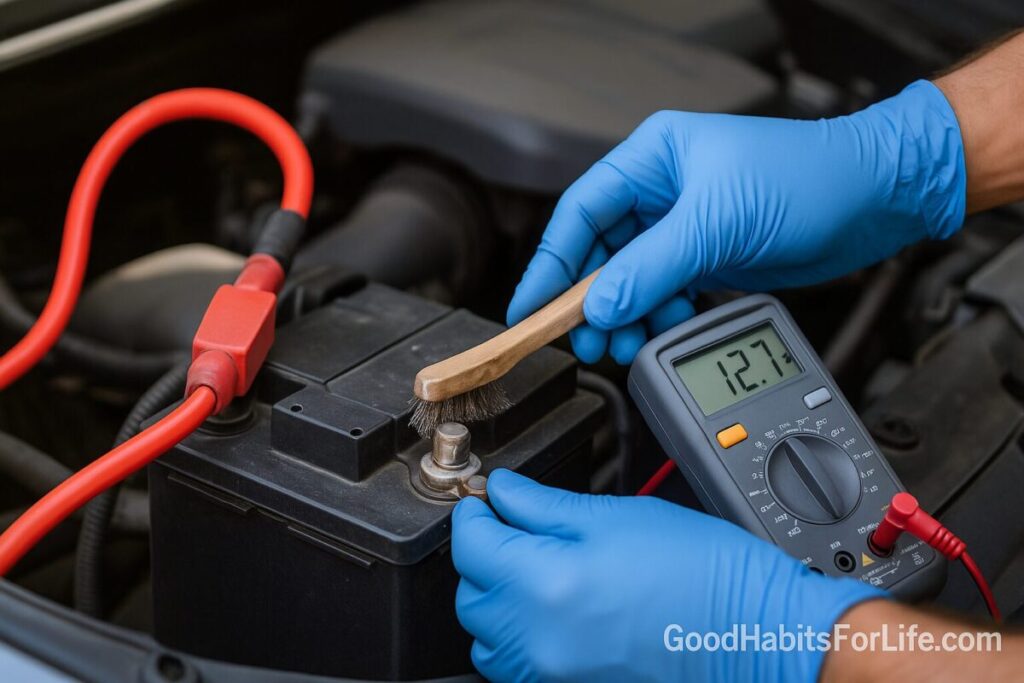
Battery Health: Cranks, Cables, and Care
Car Battery Health: Cranks, Cables & Care
Table of Contents
🧭 What Is “Battery Health” & Why It Matters
A car’s 12-volt battery delivers a high surge of current to crank the engine and powers electronics when the alternator isn’t charging. “Battery health” covers three things:
-
State of Charge (SoC): how full it is (≈12.6–12.7 V at rest is fully charged).
-
State of Health (SoH): overall capacity vs when new (age/heat/vibration reduce this).
-
Connections: clean, tight, low-resistance cables and grounds.
Why you should care
-
Reliable starts. Weak batteries crank slowly, stressing the starter.
-
Electronics protection. Voltage dips can trigger error lights and module resets.
-
Longevity. Simple habits—keeping it charged and the terminals clean—extend life from ~3 years to the upper end of 5+ years, especially in hot climates where heat accelerates plate corrosion.
-
Safety. Good cables/grounds reduce arcing, a common cause of jump-start mishaps.
✅ Quick Start: Do-This-Today Checklist
Time needed: 15–25 minutes
-
Identify battery age. Check the date code sticker on top/side (e.g., 23/10 = Oct 2023). Over 3 years? Plan a professional load test.
-
Measure resting voltage. After the car sits 3+ hours:
-
≥ 12.6 V: healthy/fully charged
-
12.4–12.5 V: ~70–80%—top off soon
-
12.2–12.3 V: ~50–60%—charge now
-
≤12.0 V: deeply discharged—charge before driving, then test
-
-
Check charging voltage. Engine idling, lights off: ~14.0–14.7 V (modern smart alternators may float lower at idle and rise with load).
-
Inspect terminals/cables. Look for white/green crust, looseness, frayed ground straps.
-
Clean if corroded.
-
Disconnect negative (–) then positive (+).
-
Neutralize with baking soda + water; scrub with a nylon brush.
-
Rinse, dry, reconnect positive (+) then negative (–).
-
Light coat of dielectric grease on terminals.
-
-
Secure the battery. Tight hold-down prevents vibration damage.
-
Top up (only if serviceable). Many modern batteries are sealed—do not open unless caps are clearly provided and the manual allows distilled-water top-ups.
If cranking is slow, lights flicker, or the battery is swollen/leaking: stop and have it tested/replaced professionally.
🧠 7-Day Battery-Care Starter Plan
Goal: Bring the battery to full charge, clean connections, and set a maintenance rhythm.
-
Day 1 — Baseline. Record date code, resting/charging voltages, and any symptoms.
-
Day 2 — Clean & Secure. Do the terminal cleaning/hold-down check.
-
Day 3 — Full charge. Use a smart charger/maintainer (AGM-compatible if applicable) to reach 100%.
-
Day 4 — Re-test. After 3+ hrs rest, confirm ≥12.6 V.
-
Day 5 — Short-trip fix. Plan a 30–40 minute continuous drive or keep the maintainer connected overnight.
-
Day 6 — Parasitic draw check (simple). With everything off, ensure no lights/accessories are left on (glovebox, trunk, dash cams).
-
Day 7 — Log & schedule. Add a monthly reminder to test voltage and a quarterly reminder to clean/inspect.
🛠️ Techniques & Frameworks
CCC Framework: Charge • Clean • Clamp
-
Charge: Keep resting voltage ≥12.6 V; use maintainers for cars driven <1–2 times/week.
-
Clean: Neutralize corrosion; protect with dielectric grease.
-
Clamp: Tighten terminals/hold-downs; check engine and chassis grounds.
30-60-90 Ownership Rhythm
-
30 days: Quick voltage check; look for slow cranks.
-
60 days: Visual inspection; re-grease terminals.
-
90 days/seasonal: Full charge + test (handheld tester or shop load test).
Storage Rules (2+ weeks parked)
-
Connect a smart maintainer (0.8–1.5 A is fine).
-
Or disconnect the negative cable (may reset memory—check radio/clock/codes).
-
Avoid idling the car “to charge”—inefficient and moisture-forming; use a charger or take a proper drive.
For Start-Stop/AGM Batteries
-
Many start-stop cars use AGM batteries and battery management systems (BMS). When replacing, use the same type and have the car coded/registered so the BMS knows a new battery is installed.
🌦️ Climate & Driving Patterns: What Changes
-
Hot climates (≥32 °C / 90 °F): Heat shortens life. Park in shade/covered areas; test more often in summer.
-
Cold climates (≤0 °C / 32 °F): Cranking amps drop. Keep it fully charged; consider a higher CCA rating when replacing.
-
Short-trip city driving: Alternator may never replenish the start. Bundle errands or use a maintainer.
-
High-draw accessories (subs, fridges, dash cams): Wire correctly, fuse properly, and consider a deep-cycle auxiliary battery rather than stressing the starter battery.
👥 Audience Variations
-
Students / first-car owners: Keep a compact lithium jump pack in the glovebox and a monthly reminder to test voltage.
-
Parents: Teach teens the safe jump-start sequence and where the engine-bay ground point is.
-
Professionals with fleet cars: Standardize a 30-day check log across vehicles; replace proactively at 3–4 years in hot regions.
-
Seniors / infrequent drivers: Install a quick-connect lead for an easy plug-in maintainer; avoid heavy lifting—ask for mobile battery service.
⚠️ Mistakes & Myths to Avoid
-
Myth: “A 10-minute idle will recharge the battery.”
Reality: Alternators aren’t designed to bulk-charge deeply discharged batteries; use a smart charger. -
Mistake: Connecting the final jumper clamp to the dead battery’s negative post.
Fix: Clamp negative to bare engine/chassis metal on the dead car to reduce spark risk near battery gases. -
Myth: “All grease is the same.”
Reality: Use dielectric grease sparingly on clean, tight terminals; it’s not a conductor. -
Mistake: Ignoring a loose hold-down.
Fix: Secure it—vibration destroys plates. -
Myth: “If it reads 12.0 V it’s fine.”
Reality: 12.0 V is very low; charge immediately and test. -
Mistake: Mixing battery types (EFB/AGM/flooded) in start-stop cars.
Fix: Replace like-for-like and reprogram the BMS where required.
🗣️ Real-Life Examples & Scripts
-
Calling roadside assistance:
“Hi, my vehicle won’t crank. Battery is about 4 years old. No crank, just clicking. I’m parked safely at [location]. Could you send a tech to test the battery and charging system and quote a replacement if it fails?” -
At the shop (test request):
“Please do a battery load test and charging system test. If the battery fails, quote an AGM of the same group size and CCA, and register it with the BMS.” -
Text when you’re late (copy-paste):
“Battery died—waiting on a jump. ETA 20–30 minutes. I’ll make up the time and send notes after.”
🧰 Tools, Apps & Resources
-
Smart charger/maintainer (AGM-safe): Fully charges without overcharging; great for infrequent driving.
-
Compact lithium jump pack: Safer/quicker than cables when alone. Keep it topped up quarterly.
-
Digital multimeter (DMM): Tracks resting/charging voltages.
-
Handheld battery tester: Gives SoH and cranking amps; many auto parts shops will test free.
-
OBD-II Bluetooth dongle + app: Monitors charging voltage on the go; logs trends.
-
Gloves & eye protection: Acid and sparks are real hazards.
Pros/cons: Maintainers and jump packs add upfront cost but save tows and extend battery life; DMM/testers improve decision-making; apps add visibility but rely on proper setup.
📌 Key Takeaways
-
Keep resting voltage ≥12.6 V; charge if ≤12.4 V.
-
Clean/tight terminals and a secure hold-down are non-negotiable.
-
Test more often in heat, with short trips, or after deep discharge.
-
Use maintainers for cars that sit; don’t try to “idle-charge.”
-
Replace proactively at ~3–5 years (earlier in hot climates or if test fails).
❓ FAQs
1) How long should a car battery last?
Typically 3–5 years. Heat, short trips, and deep discharges shorten life.
2) What voltage means “fully charged”?
Around 12.6–12.7 V after resting several hours. While running, the alternator should show roughly 14.0–14.7 V depending on load and temperature.
3) My car just clicks—what now?
Clicks usually mean low battery voltage or poor connections. Try a safe jump-start, then test the battery and charging system.
4) Is it okay to disconnect the battery for storage?
Yes—negative cable only is common, but you’ll lose radio/clock settings and some cars may need window/sunroof relearn. A maintainer avoids this.
5) Can I use any charger?
Use a smart charger that matches your battery type (AGM/EFB/flooded) and size. Avoid “dumb” trickle chargers that can overcharge.
6) Do short trips really hurt batteries?
Yes—frequent short hops don’t replace the energy used to start the engine; voltage remains low and sulfation builds.
7) How do I pick the right replacement?
Match group size, CCA/Ah, and type (AGM/EFB/flooded). For start-stop cars, use the OE type and have it registered/coded.
8) Should I coat the terminals with grease?
After cleaning and tightening, apply a thin layer of dielectric grease to limit corrosion. It’s an insulator, so don’t glob it between contact surfaces.
9) Is jump-starting safe for hybrids/EVs?
Most have 12-V systems that can be jump-started, but follow the owner’s manual—connection points differ and misuse can damage electronics.
10) Why does heat kill batteries?
High temperatures accelerate grid corrosion and electrolyte evaporation, permanently reducing capacity.
📚 References
-
AAA. How to Jump-Start a Car & When to Replace the Battery. https://www.aaa.com/autorepair/articles/how-to-jump-start-a-car
-
RAC (UK). How to jump start a car. https://www.rac.co.uk/drive/advice/breakdown/how-to-jump-start-a-car/
-
U.S. EPA. Lead-Acid Batteries: Recycling and Safe Handling. https://www.epa.gov/recycle/lead-acid-batteries
-
Battery Council International. Lead Battery Basics & Recycling Facts. https://www.batterycouncil.org/
-
U.S. Department of Energy, Energy Saver. Keeping Your Vehicle in Shape. https://www.energy.gov/energysaver/keeping-your-vehicle-shape
-
Consumer Reports. How Long Does a Car Battery Last? https://www.consumerreports.org/cars/car-maintenance-repair/how-long-does-a-car-battery-last/
-
Edmunds. Car Battery Care and Replacement Basics. https://www.edmunds.com/car-maintenance/how-to-jump-start-a-car.html
-
OSHA. Battery Charging Safety (general guidance). https://www.osha.gov/etools/powered-industrial-trucks/batteries-chargers