
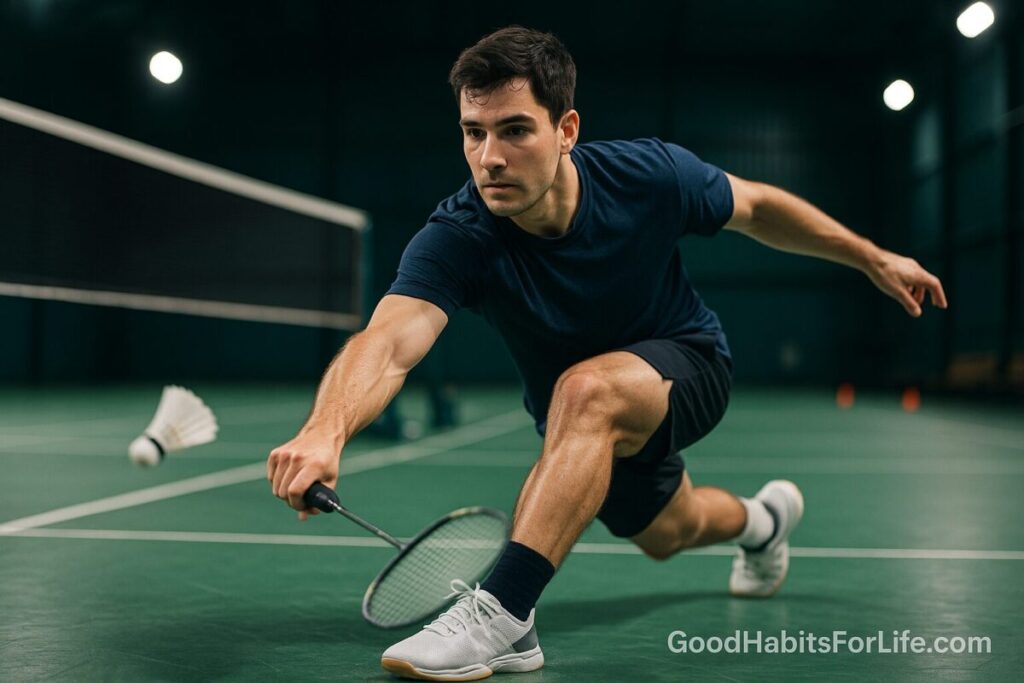
Badminton Footwork & Ankle Strength: Zone 2 + NEAT (2025)
Badminton Footwork & Ankle Strength: Zone 2 + NEAT (2025)
Table of Contents
🧭 What & Why
Footwork is how you initiate (split-step), move (chasse, crossover, lunge), and recover between shots. Efficient patterns shorten time-to-shuttle, reduce wasted steps, and keep you balanced to hit with accuracy.
Ankle strength & control (calf complex, peroneals, tibialis anterior, intrinsic foot) stabilize landings and directional changes—key for lunges and quick stops. Proprioceptive/balance work can significantly reduce ankle-sprain risk in court sports.
Zone 2 training (roughly 60–70% of max heart rate, conversational effort) builds an aerobic base so you recover faster between rallies and maintain quality footwork late in matches.
NEAT (Non-Exercise Activity Thermogenesis) is everyday movement—walking, stairs, chores. It quietly raises weekly energy expenditure and conditioning without stressing recovery.
Why this combo works
-
Strong, stable ankles → safer, deeper lunges and faster recoveries.
-
Zone 2 base → less fatigue → cleaner patterns and fewer sloppy steps.
-
NEAT → more work capacity and easier weight management that supports quickness.
✅ Quick Start Today
Time: ~30–40 minutes
-
Warm-up (8–10 min)
-
2–3 min easy jog or brisk walk.
-
Dynamic ankles/hips: ankle circles, marching calf raises, knee hugs, leg swings.
-
2 × 20 m side shuffles + 2 × 20 m carioca.
-
-
Courtless Footwork Primer (10–12 min)
-
Split-step → first step: 3 × 30 s (focus: soft feet, quick pre-load).
-
6-point star (front-R, front-L, side-R, side-L, rear-R, rear-L): 3 rounds, walk back recovery.
-
Shadow badminton: 3 × 60 s rally simulation (light racket optional), smooth recoveries to base.
-
-
Ankle Strength & Balance (10–12 min)
-
Calf raises: 3 × 12 straight-knee; 3 × 12 bent-knee (slow 2-1-2 tempo).
-
Peroneal eversions (band): 3 × 15/side.
-
Tibialis raises (heels down, toes lift against wall): 3 × 15.
-
Single-leg balance on floor → cushion: 3 × 30–40 s/side (progress eyes-closed).
-
-
Zone 2 Add-On (optional today, 20–30 min)
-
Easy cycle, jog, or incline walk at conversation pace (RPE 3–4/10).
-
Nasal-dominant breathing keeps effort honest.
-
-
NEAT Target
-
Hit 8,000–10,000 steps/day (or +2,000 above your baseline) via walks, stairs, and quick movement breaks.
-
🛠️ 30-60-90 Day Habit Plan
Days 1–30 (Foundation)
-
Footwork: 3×/week (20–25 min). Emphasis: split-step timing, 6-point star, shadow to base.
-
Strength/Balance: 3×/week after footwork. Calf (straight/bent), peroneals, tibialis, single-leg balance.
-
Zone 2: 2×/week, 25–35 min.
-
NEAT: Daily step goal +2,000 above baseline; set hourly 2–3 min movement breaks.
-
Checks: Film 1 drill/week; note RPE, steps, and any ankle niggles.
Days 31–60 (Build)
-
Footwork: 3–4×/week (25–35 min). Add chasse/crossover repeats, lunge matrix (front, diagonal, side), and reaction cues (partner point or clap).
-
Strength: Keep calves/peroneals/tibialis; add soleus raises (seated), hip abductors, and wobble-board balance.
-
Zone 2: 3×/week, 30–45 min.
-
NEAT: 9–11k steps/day average; add soft commute walks.
-
Checks: Shuttle to rear-court & recover × 6 reps; aim smoother landings, no wobble.
Days 61–90 (Performance)
-
Footwork: 4×/week (30–40 min). Layer pattern combos (e.g., split → backhand rear → recover → forehand net → recover), and short footwork sprints (10–15 s on/45 s off × 6–10).
-
Strength/Plyo (low-impact): Add pogos (ankle hops) 2×/week: 3 × 15–20 (pain-free only), and single-leg calf raises to 3 × 15.
-
Zone 2: 2–3×/week 35–45 min or one longer 55–60 min ride/walk on weekend.
-
NEAT: Lock in 10k+ steps; micro-walks after meals.
-
Checks: Timed 6-point star (10 touches). Compare week 4 vs week 12; track court coverage feel late in games.
🧠 Techniques & Frameworks
Footwork Fundamentals
-
Split-step: tiny hop timed with opponent’s contact; land on forefoot, immediate directional push.
-
Base position: racket foot forward, hips square, neutral spine, relaxed grip.
-
Movement patterns:
-
Chasse for short lateral or forward distances.
-
Crossover for longer lateral/backward moves.
-
Lunge (front or side): heel slightly off, knee tracking toes, torso tall, absorb softly.
-
Recovery: small adjustment steps back to base; don’t leap.
-
Drills (progress easy → advanced)
-
Line touches / cone taps: 3 × 20–30 s.
-
6-point star with call-outs: partner points to target; you move and shadow stroke.
-
Lunge matrix with stick points: cones at 30°, 60°, 90°.
-
Ladder (optional): in–in–out–out; lateral in–in–out–out; 2–3 runs each.
-
Shadow rallies: 30–60 s bouts, smooth recoveries, light racket.
-
Reactive light/app cues for randomisation.
Ankle Strength & Mobility
-
Calf complex: gastroc (straight-knee) and soleus (bent-knee) raises.
-
Peroneals: band eversions; help resist inversion sprains.
-
Tibialis anterior: wall tib raises for deceleration control.
-
Intrinsic foot: short-foot drills, towel scrunches.
-
Balance: single-leg stance → unstable surface → perturbations.
-
Mobility: half-kneeling dorsiflexion rock (knee to wall), 2 × 10 each side.
Zone 2 Made Simple
-
Target: conversational pace, RPE 3–4/10 or ~60–70% HRmax (or 70–80% HRR).
-
Modalities: incline walk, bike, rower, easy jog; keep joints happy.
-
Breathing: nasal-dominant to avoid drifting too hard.
NEAT Levers
-
Add 1–2 short walks (10–15 min) daily (post-meal is great).
-
Stairs over lifts; stand-up calls; park 5–10 min away from venues.
🧰 Audience Variations
-
Students/Teens: Short sessions (20–25 min) post-school; make drills reactive and game-like. Encourage daily steps between classes.
-
Busy Professionals: 2 micro-blocks/day (10–15 min a.m. footwork, p.m. Zone 2 walk). Calendar the sessions like meetings.
-
Seniors/Returners: Prioritize balance, calf/soleus strength, and walking/ cycling Zone 2. Keep lunges shallow; add support (stick/wall).
-
Doubles vs Singles: Doubles emphasizes shorter, sharper lateral moves; singles requires more rear-court coverage—bias patterns accordingly.
⚠️ Mistakes & Myths to Avoid
-
Skipping the split-step. It’s the trigger for speed.
-
Only doing plyos. Foundation is strength + balance + technique, then light plyo.
-
Going too hard on “easy cardio.” Zone 2 should feel easy; if you can’t talk, back off.
-
Neglecting dorsiflexion. Stiff ankles → poor lunges and higher sprain risk.
-
Shoes past their life. Replace badminton shoes every ~300–500 km of court wear or when grip/compression fades.
-
Braces forever. Useful during return-to-play, but don’t replace strength and balance long-term.
🎬 Real-Life Routines & Scripts
20-Minute Courtless Footwork (any room)
-
Warm-up 4 min.
-
Split-step to first step: 3 × 30 s.
-
6-point star with shadow strokes: 3 rounds.
-
Lunge matrix (front/diag/side): 2 × 6/leg.
-
Single-leg balance + 10 calf raises per leg as finisher.
30-Minute “Base Builder” Day
-
10 min Zone 2 brisk walk.
-
10 min shadow rallies (30 on/30 off).
-
10 min strength: calves (straight/bent), tib raises, peroneals.
Cues You Can Say Out Loud
-
“Soft land, hard push.”
-
“Split early, see the shuttle.”
-
“Tall chest, knee tracks toes.”
-
“Recover to base—don’t admire the shot.”
🧩 Tools, Apps & Resources
-
Heart-rate monitor / smartwatch (Polar, Garmin, Apple): keeps Zone 2 honest. Pros: objective; Cons: cost, setup.
-
Mini-bands & long band: peroneal/tibialis work anywhere. Pros: cheap; Cons: tension varies.
-
Wobble board/BOSU (optional): progress balance safely. Pros: proprioception; Cons: not essential.
-
Reactive light/app (e.g., phone flashlight cues, metronome): randomness for decision speed.
-
Step tracker (phone/watch): anchors NEAT.
📌 Key Takeaways
-
Clean footwork is a skill—practice it like strokes.
-
Ankle strength + balance are your insurance policy.
-
Zone 2 builds the engine; NEAT tops up capacity without fatigue.
-
Follow the 30-60-90 plan; track steps, RPE, and drill quality.
-
Think soft landings, fast first step, reliable recovery—every rally.
❓ FAQs
How often should I train badminton footwork?
3–4 short sessions/week (20–35 min) work well. Keep quality high; stop before sloppiness.
What heart-rate is Zone 2?
About 60–70% of HRmax (or roughly 70–80% of heart-rate reserve). If you can chat in full sentences, you’re likely there.
Can NEAT really help performance?
Yes—more daily movement raises total energy expenditure and general conditioning without extra stress, supporting weight control and recovery.
Best ankle exercises for players?
Calf (straight/bent-knee), peroneal eversions, tibialis raises, single-leg balance, and controlled lunge patterns.
Should I wear an ankle brace?
Braces can reduce re-sprain risk in the short term, especially after a recent sprain, but pair them with strength/balance work and review need periodically.
Singles vs doubles—does footwork change?
Principles are the same; doubles has shorter, sharper lateral moves, singles demands more rear-court coverage.
How do I know my split-step timing is right?
Land just as your opponent hits the shuttle; if you feel “stuck” on landing, you’re late—start earlier.
Any red flags to stop training?
Sharp pain, swelling, or instability after lunges/hops. Switch to Zone 2 + upper-body work and seek assessment.
What shoes should I use?
Court shoes with good lateral grip and low-to-ground feel; replace when grip or cushioning fades.
How long to see improvement?
Many feel cleaner movement in 4–6 weeks; objective quickness and stamina often improve by 8–12 weeks with consistent practice.
📚 References
-
Phomsoupha M, Laffaye G. The Science of Badminton: Game Characteristics, Anthropometry, Physiology, Biomechanics and Motor Skills. Sports Medicine (2015). https://link.springer.com/article/10.1007/s40279-015-0336-6
-
Kuntze G, Mansfield N, Sellers W. A biomechanical analysis of common lunge tasks in badminton. J Sports Sci (2010). https://www.tandfonline.com/doi/abs/10.1080/02640410903428533
-
Hupperets MDW et al. Effect of unsupervised home-based proprioceptive training on recurrences of ankle sprain. BMJ (2009). https://www.bmj.com/content/339/bmj.b2684
-
McKeon PO, Mattacola CG. Evidence for balance training in prevention of ankle sprains: a review. Clin Sports Med (2008). https://pubmed.ncbi.nlm.nih.gov/18185933/
-
American College of Sports Medicine. Quantity and Quality of Exercise for Developing and Maintaining Cardiorespiratory, Musculoskeletal, and Neuromotor Fitness in Apparently Healthy Adults. Med Sci Sports Exerc (2011). https://pubmed.ncbi.nlm.nih.gov/21694556/
-
Seiler S. What is best practice for training intensity and duration distribution in endurance athletes? Int J Sports Physiol Perform (2010). https://pubmed.ncbi.nlm.nih.gov/20861505/
-
World Health Organization. Physical activity factsheet. https://www.who.int/news-room/fact-sheets/detail/physical-activity
-
Levine JA. Non-exercise activity thermogenesis (NEAT). Best Pract Res Clin Endocrinol Metab (2002). https://pubmed.ncbi.nlm.nih.gov/12475450/
-
NHS. Ankle sprain. https://www.nhs.uk/conditions/ankle-sprain/
Disclaimer
This guide provides general fitness information and is not a substitute for personalized medical advice; consult a qualified professional if you have injuries or medical conditions.