
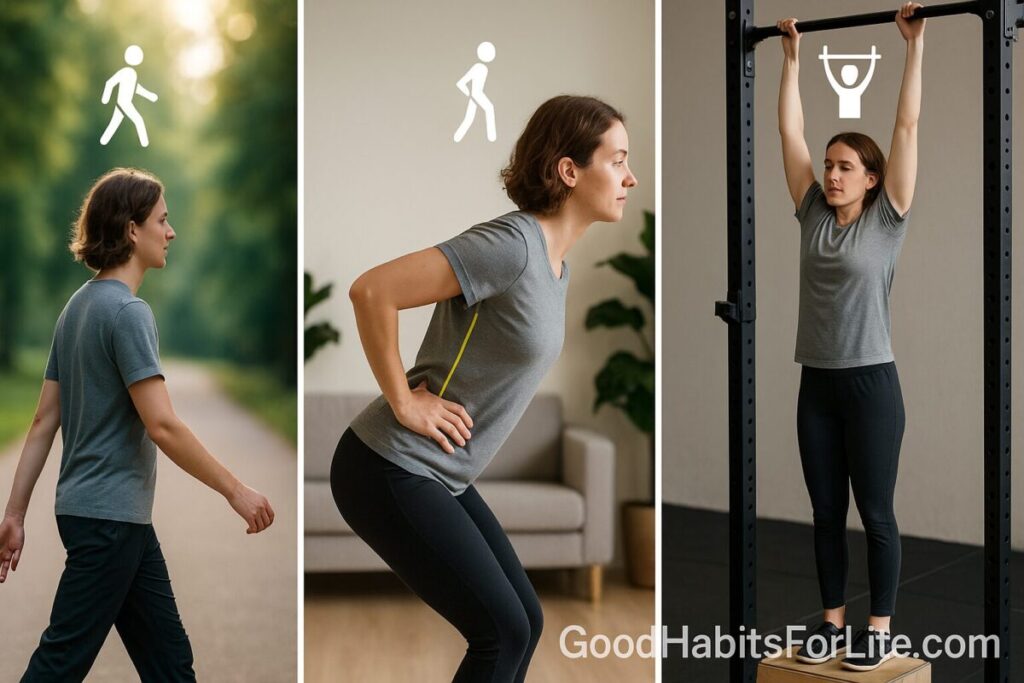
Back Pain Fix: Walk, Hinge, Decompress
Back Pain Fix: Walk, Hinge, Decompress
Table of Contents
🧭 What this guide covers & why it works
Low back pain is the leading cause of disability worldwide, affecting hundreds of millions of people. Most episodes improve with time and active self-management. Global and national guidelines consistently recommend staying active, building gradual activity (e.g., walking), and learning movement control rather than resting or rushing to imaging or procedures. World Health Organization+1NICE
Why these three moves?
-
Walk: Aerobic activity reduces pain sensitivity and stiffness, improves blood flow, and supports mood and sleep. Exercise (of many types) modestly improves chronic low back pain outcomes vs. doing nothing. Cochrane
-
Hinge: Learning to bend at the hips with a neutral spine spreads load to the powerful glutes/hamstrings and improves movement control—core elements of many physical therapy guidelines. JOSPT
-
Decompress: Brief supported “hangs” or traction-like positions can feel relieving for some. Evidence shows routine traction isn’t effective as a stand-alone treatment; think of decompression as an optional comfort technique, not a cure. Cochrane
✅ Quick Start: Do this today
-
10-minute walk (out-and-back). Comfortable pace; swing arms. If pain eases, extend to 15–20 minutes (~1–2 km / 0.6–1.2 mi).
-
Learn the hip hinge (3 sets × 5 reps): Stand tall, feet hip-width, hands on hips. Push hips back like touching a wall, keep ribs down, spine neutral, shins vertical; stand back up by driving through heels.
-
Gentle decompression (optional): Hold a doorframe or use a sturdy bar at chest height. Bend knees slightly, let hips drop back to create a light traction feeling for 10–20 seconds, 3–5 times. Stop if pain worsens or shoulders protest. (Skip if you have recent trauma, severe pain down both legs, or red flags below.) Cochrane
-
Heat or ice 10–15 minutes for comfort.
-
Log it: Pain (0–10), minutes walked, sets/reps.
-
Red flags—seek urgent care now if: numbness in the saddle area; new bladder/bowel problems; severe/progressive leg weakness; fever, weight loss, recent major trauma, cancer history. AAFPPubMed
🧠 Why these strategies work (evidence snapshot)
-
Exercise helps: Moderate-certainty evidence shows exercise is probably effective for chronic low back pain vs. usual care or placebo. Cochrane
-
Walking holds up: Meta-analysis of RCTs found walking performs about as well as structured exercise for pain/function in chronic low back pain—making it a low-cost, accessible option. PubMed
-
Movement control matters: PT guidelines endorse trunk muscle activation and movement control strategies as part of care. The “hinge” is a practical way to load hips and maintain spine neutrality during daily life. JOSPT
-
Be choosy with traction: Mechanical traction shows little to no important benefit for most people with low back pain; use decompression only as a short comfort strategy if it feels good. Cochrane
-
Weekly activity target: Aim for 150–300 minutes of moderate-intensity activity per week (walking counts), plus 2 days of muscle-strengthening. PMC
🛠️ Technique Deep-Dive: Walk, Hinge, Decompress
🚶 Walk (simple, scalable)
-
Dose: Start with 10–20 minutes daily (roughly 1–2 km / 0.6–1.2 mi). Add 5 minutes every 2–3 days as tolerated.
-
Intensity: “Slightly breathless, still conversational.”
-
Surface & stride: Choose flat, forgiving surfaces; keep cadence smooth; short, quick steps can feel easier than long strides.
-
Variations: Treadmill with slight incline; indoor laps on bad-weather days; split into 2 × 10-minute “movement snacks.”
🔩 Hinge (load hips, spare the back)
-
Setup: Feet hip-width, tripod feet; ribs stacked over pelvis; chin tucked long.
-
Move: Press hips back like closing a car door; torso inclines while spine stays long; shins near-vertical; stop before rounding. Drive hips forward to stand tall.
-
Drills:
-
Wall-tap hinge (learn distance).
-
Dowel 3-point contact (back of head–mid-back–tailbone stay in contact).
-
Hip-hinge to pick up a light object (progress height to mid-shin).
-
-
Why: Trains posterior chain and movement control, reduces provocative end-range lumbar flexion in daily tasks. JOSPT
🪂 Decompress (comfort, not cure)
-
Options:
-
Supported hang at a doorway/bar with feet partly on the floor.
-
Counter lean: Hands on countertop, step back, drop hips.
-
-
Dose: 10–20 seconds × 3–5, easy breathing.
-
Caution: Skip or seek guidance if you have acute radicular pain, recent trauma, shoulder issues, osteoporosis concern, or red flags. Remember: formal traction isn’t routinely recommended. Cochrane
🧰 Add simple core control (60–120 seconds total)
-
Abdominal brace + breath: 3 × 20-second holds while breathing quietly.
-
Marches or heel slides: 2 × 8 per side, slow and controlled.
-
Carry (light bag/weights): 2 × 20–40 m, tall posture.
📅 7-Day Starter + 30-60-90 Plan
7-Day Starter
-
Day 1–2: Walk 10–15 min. Hinge practice 3 × 5. Optional decompression 3 × 10–15 s.
-
Day 3–4: Walk 15–20 min. Add core control (2 drills).
-
Day 5–6: Walk 20 min. Hinge with object (light).
-
Day 7: Walk 20–25 min or 2 × 12 min. Reflect: pain 0–10, best/worst moves, next week’s target.
30-60-90 Roadmap
-
Days 1–30: Build to 30 min walking most days; hinge with light loads in daily tasks (groceries, laundry).
-
Days 31–60: Add one brisk/interval walk (5 × 1-min faster, 1-min easy). Introduce loaded hinges (kettlebell deadlift from blocks).
-
Days 61–90: Reach 150–300 min/week of moderate activity; add 2 strength days (hinge, squat to chair, row, carry). Track progress weekly. PMC
👥 Audience variations
-
Desk-bound professionals: 2–3 “movement snacks” (5–8 min walks + 1 hinge drill) during the workday.
-
Parents/caregivers: Practice hinge with childcare tasks (crib, car seat). Keep toys at hip height to avoid repetitive deep rounding.
-
Students/teens: Alternate 25-min study blocks with 5-min walks; backpack carried high and close; hinge when lifting bags.
-
Seniors: Prioritize supported hinges (wall or dowel), shorter but frequent walks; add balance drills (heel-to-toe). Align with weekly PA targets. PMC
⚠️ Mistakes & myths to avoid
-
“Bed rest will heal it.” Prolonged rest tends to worsen stiffness and slows recovery; keep moving within comfort. NICE
-
“I need an MRI right away.” Without red flags or trauma, early imaging doesn’t improve outcomes and can lead to unnecessary procedures. Consider imaging after a trial of conservative care or if red flags appear. PubMedAAFP
-
“Traction fixes backs.” Routine traction shows little to no benefit for most; use decompression only as an optional comfort measure. Cochrane
-
“Never bend your back.” Backs are robust; the goal is gradual exposure and better control (the hinge helps). JOSPT
💬 Real-life scripts (copy-paste)
-
Ask your GP/PT: “I’d like an active plan for my back pain—walking, movement control/hip hinge work, and pacing. What progress markers should I track?”
-
At work: “I’m adding two 5-minute walking breaks and a standing task block after lunch to keep my back moving.”
-
With family: “If you see me picking up laundry, remind me to ‘hinge—hips back, chest tall.’”
🧰 Tools & resources
-
Step counter / phone health app: Track minutes and steps.
-
Timer: Prompts for movement snacks.
-
Light kettlebell/backpack: For hinge drills.
-
Walking shoes: Cushioned, stable.
-
Heat/ice pack: Short bouts for comfort.
📌 Key takeaways
-
Start today: 10–20-minute walk + 3 × 5 hip hinges.
-
Build to 150–300 min/week of moderate activity; add 2 strength days. PMC
-
Use decompression sparingly for comfort; it’s optional. Cochrane
-
Seek urgent care for red flags; otherwise, favor active care before imaging. PubMed
❓ FAQs
1) How long should I walk for back pain?
Begin with 10–20 minutes daily; progress toward 30 minutes most days as symptoms allow. Walking performs about as well as structured exercise in trials of chronic low back pain. PubMed
2) Is the hip hinge safe if my back hurts now?
Yes—when pain-scaled and controlled. Start shallow with wall taps/dowel contact; stop if pain sharpens. It’s a standard movement-control pattern endorsed in PT guidance. JOSPT
3) Does hanging from a bar heal discs?
No. Some people feel brief relief from supported hangs, but formal traction isn’t routinely effective. Use decompression as a short comfort drill only. Cochrane
4) When should I get an MRI or X-ray?
If you have red flags (e.g., saddle numbness, new bladder/bowel issues, fever, cancer history, major trauma) or if conservative care hasn’t helped after several weeks. Otherwise, early imaging rarely helps. PubMedAAFP
5) What weekly activity target should I aim for?
150–300 minutes of moderate activity (e.g., brisk walking) plus 2 days of muscle-strengthening. Spread across the week in any bout length. PMC
6) Can I lift weights?
Yes—start light, hinge well, progress gradually. Strength work complements walking and often improves confidence and function. JOSPT
7) What if walking increases leg pain or numbness?
Stop and seek a clinician’s advice, especially if symptoms include leg weakness, numbness, or bladder/bowel changes (possible nerve involvement). nhs.uk
📚 References
-
World Health Organization. Low back pain – Fact sheet (2023). World Health Organization
-
World Health Organization. WHO releases guidelines on chronic low back pain (2023). World Health Organization
-
NICE Guideline NG59. Low back pain and sciatica in over 16s (current online). NICE
-
Cochrane Review. Exercise for treatment of chronic low back pain (2021). Cochrane
-
Vanti C, et al. Walking vs exercise in chronic low back pain—systematic review/meta-analysis (2019). PubMed
-
George SZ, et al. JOSPT Clinical Practice Guidelines (2021) – Interventions for LBP. JOSPT
-
Qaseem A, et al. ACP Clinical Practice Guideline: Noninvasive Treatments for Low Back Pain (2017). ACP Journals
-
Cochrane Review. Traction for low-back pain (2013 update). Cochrane
-
WHO/FC Bull et al. 2020 Guidelines on Physical Activity for Adults. PMC
-
ACR Appropriateness Criteria. Low Back Pain—Imaging (2021 update). PubMed
Disclaimer: This guide is for general information and habit-building only; it is not a substitute for personalized medical advice—see a qualified clinician for diagnosis and treatment.