
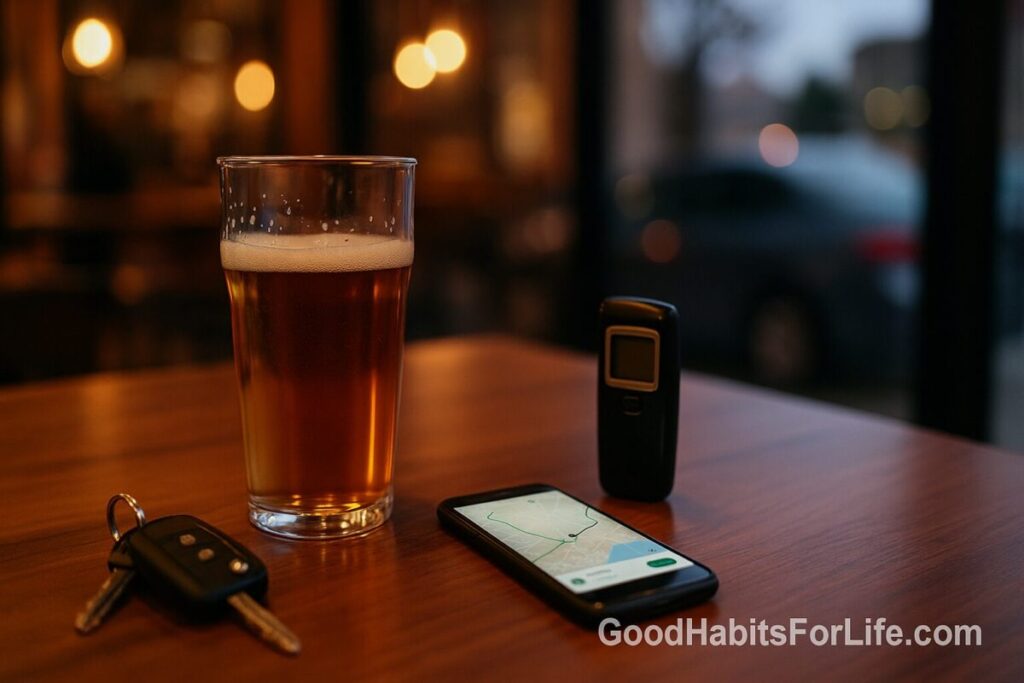
BAC Basics: Why Just One Still Needs a Plan
BAC Basics: Why Just One Still Needs a Plan
Table of Contents
🧭 What BAC Is—and Why It Matters
Blood Alcohol Concentration (BAC) is the amount of ethanol in your blood, expressed as grams per decilitre (g/dL) or percent (%). A BAC of 0.05% means 0.05 g of alcohol per 100 mL of blood.
Why it matters:
-
It correlates with impairment—slower reaction time, reduced coordination, and poorer judgment start at low levels.
-
Law enforcement uses BAC to define drink-driving offenses.
-
Risk rises non-linearly: crash risk jumps well before 0.08%.
What is a “standard drink”?
-
Definitions vary.
-
U.S.: ~14 g alcohol (e.g., 355 mL beer at 5%, 150 mL wine at 12%, 44 mL spirits at 40%).
-
UK “unit”: 8 g alcohol.
-
Many countries: 10 g.
Always check local definitions; labels and pours can differ.
-
Rule of thumb (imperfect): The body often metabolizes ~0.015% BAC per hour (varies widely). That means “sleeping it off” is slower than most people think.
⚖️ Legal Limits & Penalties (By Region Examples)
Limits vary by country/state and driver type. Common legal thresholds:
-
0.08%: General adult limit in the United States (lower for commercial drivers—often 0.04%—and zero/near-zero for under-21).
-
0.05%: Common in Australia (some classes lower), Scotland, and many EU countries.
-
0.08% (UK/England & Wales); 0.05% (Scotland).
-
0.03% (India) under the Motor Vehicles Act for private drivers.
Penalties can include fines, license suspension, points, mandatory education, interlock devices, community service, or jail. Refusal to test may carry separate penalties.
Always confirm your local laws before you drink; enforcement and penalties change over time and vary by jurisdiction.
🧠 Why “Just One” Can Still Impair You
Even one drink can affect:
-
Attention & tracking: Harder to monitor mirrors, speed, and lane position.
-
Reaction time: Milliseconds matter at 80 km/h (50 mph).
-
Risk perception & decision-making: Alcohol boosts confidence while dulling caution.
Why two people with the same drink differ:
-
Body mass & sex (on average, smaller bodies and people assigned female at birth reach higher BAC faster due to body water differences).
-
Food in stomach slows absorption.
-
Medications (e.g., sedatives, antihistamines) and sleep debt amplify impairment.
-
Time: Peak BAC can occur 30–90 minutes after finishing a drink.
Key insight: You can feel “fine” while objectively impaired—especially early in the evening before the first peak.
✅ Quick Start: Safer-Drinking Checklist
Use this before you sip:
-
Decide the ride: pre-book a taxi/ride-share, assign a sober driver, or use public transport.
-
Set a limit: e.g., max 1 drink in first hour, then water for 60–90 min.
-
Eat first: protein+fat slows absorption (e.g., eggs, yogurt, nuts, a sandwich).
-
Alternate: water or soda water between drinks (aim: ≥250 mL per drink).
-
Track units: know the ABV and serving size; count honestly.
-
Buddy rule: tell a friend your plan; share your live location if out late.
-
If in doubt, don’t drive—choose the safest option, even if it means leaving the vehicle overnight.
🗓️ 30-60-90 Day Safer-Choices Plan
Goal: Reduce driving-risk to near zero and build automatic pre-commit habits.
Days 1–30 (Foundations)
-
Pre-commit template in your notes app: “Tonight: cap = 1 drink; ride = Uber 22:30; check-in = text partner at 22:00.”
-
Unit literacy: Learn your local standard drink; memorize your usuals (beer/wine/spirits) in grams.
-
Trigger plan: If invited last-minute, default to no driving.
-
Audit weekends: Each Monday, log drinks/transport choices; rate decisions (0–5).
Days 31–60 (Automation)
-
Default calendar block for likely social nights: schedule the ride in advance.
-
If driving is unavoidable: choose 0-alcohol options; practice a firm “I’m driving tonight” script.
-
Upgrade your environment: keep non-alcoholic beers/spritzers at home; add a breathalyzer to glove box (for informational purposes only, not as legal clearance).
Days 61–90 (Mastery)
-
Stress test: weddings, work events, sports nights—rehearse scripts and backup plans.
-
Social norming: invite friends to alcohol-light venues or brunches.
-
Review outcomes: track any near-misses or lapses; refine pre-commit plan.
🛠️ Techniques & Frameworks That Work
-
Implementation intentions (“If-Then”): If the waiter offers a second, then I’ll ask for sparkling water.
-
Pre-commitment: Book the ride before the first drink; keep the screenshot handy.
-
Unit budgeting: Decide a weekly cap (e.g., ≤10 UK units / ≤7 U.S. standard drinks), then allocate to specific days.
-
Pacing rule: ≤1 drink/hour; alternate with water; stop ≥90 minutes before you might need to move a vehicle.
-
BRAC feedback (optional): Personal breathalyzers can give trend awareness but are not legal proof of fitness to drive; devices vary and readings lag blood levels.
-
Social scripting: Prepare one-liners so your brain isn’t improvising under peer pressure.
👥 Audience Variations
Students: Choose 0% ABV options when driving to off-campus events; set “buddy texts” and curfews.
Professionals: For client dinners, decide in the calendar invite: “Taxi both ways.” Keep a polished non-alcohol order (e.g., tonic with lime).
Parents/Caregivers: If you may need to drive at night for a child/elder, default to alcohol-free. Create a local taxi shortlist.
Seniors: Aging changes metabolism and medication interactions—talk to your clinician about safe limits and interactions.
Teens/Under-legal-age: Follow local laws. Zero tolerance for driving after drinking; seek adult transport plans.
⚠️ Mistakes & Myths to Avoid
-
“Coffee will sober me up.” It won’t. You may feel alert but remain impaired.
-
“I’m fine to drive after one.” Not necessarily; many factors can push impairment at low BAC.
-
Relying on “gut feel.” Perception is a poor proxy for BAC or driving fitness.
-
Ignoring pour size/ABV. A 250 mL glass of 14% wine ≈ 2+ standard drinks in some systems.
-
Assuming breathalyzers equal legal clearance. Personal devices are for guidance, not guarantees.
💬 Real-Life Examples & Scripts
At a bar (you’re driving):
“I’m the driver tonight—could I get a zero-alcohol lager and a lime?”
At a work dinner (second round offered):
“I’m good with water now—early start tomorrow.”
Hosting at home:
“We’ve got an Uber code in the group chat—use it if you’re drinking.”
Friend insists you’re fine:
“I don’t drive after drinking. Let’s book a cab—it’s on me.”
Partner check-in text:
“Leaving at 10:30. One drink earlier, switching to soda. Taxi booked.”
🧰 Tools, Apps & Resources
-
Ride-share apps (Uber, Lyft, Ola, Bolt): Pre-book rides; share trip status. Pros: reliable. Cons: surge pricing.
-
Unit/BAC trackers (e.g., Drinkaware, Rethink Drinking, NIAAA calculators): Learn your personal patterns. Pros: awareness. Cons: estimates only.
-
Personal breathalyzers (fuel-cell types): Trend awareness if calibrated. Pros: feedback loop. Cons: cost, not legally definitive.
-
Phone safety features: Emergency contacts, location sharing, focus modes to reduce impulsive choices.
📌 Key Takeaways
-
Plan first, drink second. Decide transport and limits before sipping.
-
One drink can still impair. Individual factors matter more than myths.
-
Know your local laws. Thresholds and penalties vary widely.
-
Use tools and scripts. Pre-commitment beats willpower late at night.
-
When uncertain, don’t drive. Choose the safest available option.
❓ FAQs
1) How many drinks put me over the limit?
It depends on body mass, sex, food, time, and drink strength. Some people approach legal limits after one large pour. Never assume a fixed number is “safe.”
2) Do cold showers or coffee reduce BAC?
No. Only time lowers BAC meaningfully. Showers/coffee can make you feel alert but don’t reduce impairment.
3) Is a personal breathalyzer enough to decide if I can drive?
Treat it as informational only. Readings lag blood levels and devices vary. If you’ve been drinking, choose not to drive.
4) What about “sleeping in the car” to avoid driving?
In many places, being in control of a vehicle while impaired (even parked) can still be an offense. Know your local laws and arrange safe transport instead.
5) Are 0% beers/wines truly alcohol-free?
“0.0%” products are alcohol-free; “0.5%” may contain trace alcohol. For driving risk, either is a safer social choice than alcoholic versions.
6) Does eating a big meal make it safe to drive?
Food slows absorption, but impairment can still occur. Don’t rely on food to offset drinking.
7) What’s the safest gap between last drink and driving?
Err on the conservative side: many people aim for no drinking at all if they might drive within several hours. If you’ve had alcohol, take alternate transport.
8) Are there special rules for new or commercial drivers?
Often yes—lower limits (e.g., 0.00–0.02% or 0.04% for commercial). Check your license class rules.
9) Can medications interact with alcohol and driving?
Yes. Sedatives, some painkillers, antihistamines, and sleep aids can multiply impairment. Read labels and consult a clinician.
10) What’s a reasonable weekly limit for general health?
Guidelines differ by country; several recommend lower is better. Focus on non-drinking days, smaller pours, and alcohol-free alternatives.
📚 References
-
World Health Organization. Alcohol Fact Sheet. https://www.who.int/news-room/fact-sheets/detail/alcohol
-
U.S. Centers for Disease Control and Prevention (CDC). Impaired Driving: Get the Facts. https://www.cdc.gov/transportationsafety/impaired_driving/
-
National Highway Traffic Safety Administration (NHTSA). Drunk Driving (BAC effects & laws). https://www.nhtsa.gov/risky-driving/drunk-driving
-
National Institute on Alcohol Abuse and Alcoholism (NIAAA). What Is a Standard Drink? https://www.niaaa.nih.gov/alcohols-effects-health/overview-alcohol-consumption/what-standard-drink
-
GOV.UK. The drink-drive limit (England, Wales; Scotland differs). https://www.gov.uk/drink-drive-limit
-
Transport Scotland. Drink driving limits. https://www.transport.gov.scot/roads/driving-abroad-and-drink-driving/drink-driving-limits/
-
Australian Government—Department of Infrastructure & Transport (state links). Drink driving and BAC. https://www.infrastructure.gov.au/
-
Ministry of Road Transport & Highways, Government of India. Section 185—Driving by a drunken person or by a person under the influence of drugs. https://morth.nic.in/
-
NHS. Alcohol units (how to calculate). https://www.nhs.uk/live-well/alcohol-advice/calculating-alcohol-units/
-
NIAAA. Rethinking Drinking calculators and strategies. https://www.rethinkingdrinking.niaaa.nih.gov/
Disclaimer
This article provides general information on alcohol, safety, and legal topics and is not medical or legal advice—always follow local laws and consult qualified professionals for your situation.