
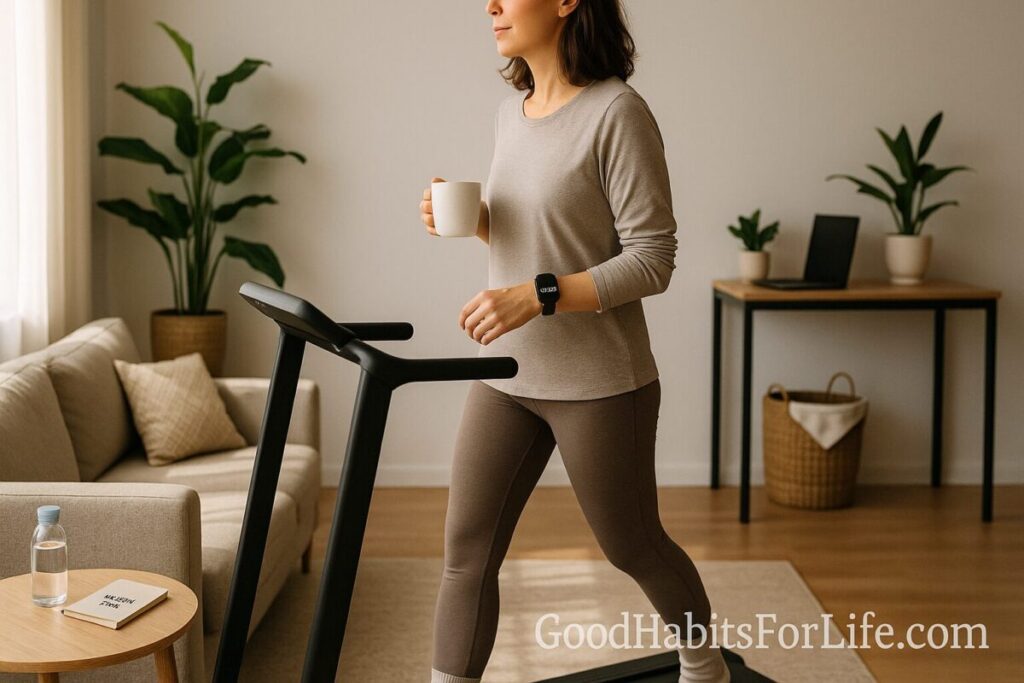
Autoimmune Awareness: Fatigue & Flares: Zone 2 + NEAT (2025)
Autoimmune Fatigue & Flares: Zone 2 + NEAT (2025)
Table of Contents
🧭 What this guide covers & why
Autoimmune conditions (e.g., RA, SLE, Hashimoto’s, IBD) can drive systemic inflammation and mitochondrial stress. The result is autoimmune fatigue—a profound low-energy state that doesn’t resolve with one night of sleep. Movement helps, but the type and dose matter.
This guide gives you a low-inflammation movement formula:
-
Zone 2 aerobic work (easy cardio that keeps you comfortably conversational) to support mitochondrial function, metabolic flexibility, and mood—without triggering post-exertional crashes.
-
NEAT (Non-Exercise Activity Thermogenesis): all the “between-workout” movement (standing, strolling, household puttering) that reduces stiffness and lowers the inflammation load of sitting.
You’ll get a Quick Start, a pacing plan for flares, and a 30-60-90 day roadmap designed for gentle, consistent progress—no hero workouts required.
✅ Quick Start: Do this today
-
Pick one 8-minute Zone 2 bout. Options: flat walk, slow cycle, gentle elliptical.
-
Talk test: You can speak in full sentences without gasping.
-
-
Add three NEAT snacks (3–5 minutes each): stand to take calls, light chores, hallway laps, calf raises while kettle boils.
-
Log a 1–5 energy score morning & evening (1=depleted, 5=great).
-
Set a flare rule: If pain, fever, new swelling, or breathlessness → stop and call your clinician.
-
Sleep + hydration basics: 7–9 hours target; ~2–3 L water/day (adjust for clinician guidance).
🛠️ Zone 2 basics for autoimmune fatigue
What is Zone 2?
A low-intensity aerobic zone that improves fat oxidation and mitochondrial efficiency while staying easy on joints and the nervous system.
How to find your Zone 2
-
Heart-rate estimate: 60–70% of HRmax.
-
HRmax ≈
220 − age. Example: age 40 → HRmax ≈ 180 bpm; Zone 2 ≈ 108–126 bpm.
-
-
Talk test: You can talk in full sentences; singing feels a bit hard.
-
RPE (effort scale 1–10): Aim for 2–4/10.
How much & how often
-
Starter dose: 8–12 minutes, 3–4 days/week.
-
Build toward: 20–40 minutes/session, 3–5 days/week, as symptoms allow.
-
Split sessions are fine (e.g., 2 × 10 minutes).
Good options
-
Flat outdoor/indoor walking, slow cycling, recumbent bike, pool walking, gentle rowing, low-impact dance, or treadmill at 0–2% incline.
When to scale back
-
After poor sleep, at infection onset, in heat/humidity spikes, or with rising joint/organ symptoms—halve the planned time and retest how you feel later.
Quick reference table
| Finder | What to look for | Typical target |
|---|---|---|
| Talk test | Full-sentence talk, not breathless | “Comfortably chatty” |
| HR (est.) | 60–70% HRmax | 108–126 bpm (age 40 example) |
| RPE | Light–easy | 2–4/10 |
| Time | Short, repeatable | 8–12 min → 20–40 min |
🚶 NEAT: The underrated fatigue fighter
NEAT = all movement outside structured exercise: standing, strolling, chores, fidgeting. It stacks energy without the “exercise tax.”
Targets
-
Hourly motion minimum: 2–3 minutes every 30–60 minutes.
-
Daily steps: Start at your 3-day average + 500 steps; build by +500/week toward 6,000–8,000 if tolerated (some thrive lower/higher—follow symptoms).
-
Micro-moves: Chair yoga, ankle circles, wall slides, gentle shoulder CARs, hip openers.
Movement snacks menu (pick 3–8/day)
-
Dish-washing calf raises, hallway strolls, folding laundry standing, countertop push-offs, stair slow-ups (one flight), balcony breathing walk, mailbox lap.
🧯 Handling flares: Pacing, buffers & safety
-
Pace by the 3-S rule: Shorter, Slower, Simpler. Cut session time in half, slow it down, and choose the gentlest mode (e.g., stroll instead of bike).
-
Buffer days: After a higher-activity day, schedule an easy day (NEAT only, or very short Zone 2).
-
The 48-hour check: New/worse symptoms that last >48 hours → step down again.
-
Red flags: Fever, chest pain, dizziness, new neuro symptoms, marked swelling → stop and contact your healthcare team.
📅 30-60-90 Day Habit Plan
Goal: Build a reliable low-inflammation movement routine with fewer boom-and-bust cycles.
Days 1–30 (Stability)
-
Zone 2: 8–12 min × 3–4 days/week.
-
NEAT: 3–6 snacks/day (3–5 min each) + stand for calls.
-
Track: energy AM/PM (1–5), minutes, step counts.
-
Win condition: 12+ Zone 2 sessions completed without >2 crash days.
Days 31–60 (Consistency)
-
Zone 2: 12–20 min × 4–5 days/week (splits OK).
-
NEAT: +500 steps/day over baseline; 4–8 snacks/day.
-
Add mobility 5 min/day (gentle range-of-motion).
-
Win condition: Average energy ≥3/5, fewer flare spikes.
Days 61–90 (Capacity)
-
Zone 2: 20–40 min × 4–5 days/week or 2 × 15–20 min.
-
NEAT: Stabilize steps in your sweet spot (often 6–8k).
-
Optional light strength 1–2×/week (band rows, sit-to-stands, wall push-ups, 1–2 sets of 6–10 reps).
-
Win condition: Consistent weeks with no >48-hour post-exertional payback.
🧠 Techniques & frameworks
-
Talk-Test Autopilot: Forget numbers; if you can chat comfortably, you’re there.
-
PEP (Plan-Execute-Protect): Plan the minimum effective dose → Execute → Protect tomorrow with sleep, protein (20–30 g/meal), and hydration.
-
Titratable Time Blocks: Increase only 10–20%/week if last week felt OK.
-
Anchor Habit: Attach your NEAT snack to existing cues (kettle, email send, ad break).
-
Joint-smart swaps: Choose recumbent bike/pool on high-pain days; keep strides short.
👥 Audience variations
Students: Campus walks between classes; backpack weight evened; 10-minute library laps.
Professionals (desk): Calendar “stand & stroll” every 50 minutes; walking 1:1s.
Parents/caregivers: Pram/pushchair Zone 2; toy-tidy squats; family after-dinner stroll.
Seniors: Rail-assisted stair steps; chair-to-stand practice; community mall walks.
Post-viral/PEM-prone: Start at 3–5 min Zone 2-ish efforts; extend by +1–2 min only after zero payback for 48 hours.
⚠️ Mistakes & myths to avoid
-
Myth: “If it doesn’t hurt, push harder.” → In autoimmune disease, easy wins are the wins.
-
Mistake: Chasing step counts on flare days. → Keep the streak with tiny movement.
-
Myth: “Rest only.” → Complete inactivity worsens stiffness and energy regulation.
-
Mistake: Skipping sleep and protein → undermines recovery.
-
Myth: “Zone 2 is too easy to matter.” → It’s exactly why it’s sustainable.
💬 Real-life examples & scripts
-
Doctor message (copy/paste):
“I’m building a gentle Zone 2 + NEAT routine for fatigue. Any contraindications for 60–70% HRmax walks/bike 3–5×/week? Flags to watch for?” -
Work boundary:
“I’m stepping away for a 3-minute movement break so I can stay focused for our next block.” -
Family check-in:
“I’m in a low-energy window today. I’ll do two 5-minute strolls and then rest—can you handle the heavy lifting?”
🧰 Tools, apps & resources
-
Timers: Repeat-alarm apps or watch timers for hourly NEAT.
-
Trackers: Any step counter or phone pedometer. Avoid obsessing; look for trend lines.
-
HR monitors (optional): Chest strap or optical band if numbers motivate you.
-
Gentle programs: Chair yoga videos, arthritis-friendly mobility playlists, aquatic walking groups.
Pros/cons snapshot
-
Timer method: +Free, +simple / −easy to ignore without visible prompts.
-
HR monitor: +Precision / −Cost, −can distract from body cues.
-
Step counter: +Motivating trend / −Can push overdoing on flare days.
📌 Key takeaways
-
Doable beats heroic. Small, repeatable Zone 2 + NEAT moves the needle.
-
Pace during flares with the 3-S rule; protect tomorrow.
-
Track lightly (energy 1–5, minutes, steps) and adjust by feel.
-
Build capacity gradually with the 30-60-90 plan.
-
When in doubt, choose gentle movement over complete inactivity—unless red flags appear.
❓ FAQs
1) What if I get wiped out after even 5–10 minutes?
Start with 3 minutes and stop while you still feel okay. Add +1 minute only after 48 hours without payback.
2) Is strength training off-limits?
Not at all. Many benefit from light bands/bodyweight 1–2×/week after Zone 2 is stable. Keep reps slow, sets low, and monitor joints.
3) Can I count chores as exercise?
Chores = NEAT, which helps fatigue and stiffness. Keep them gentle and spread through the day.
4) How many steps are “enough”?
No magic number. Find your personal sweet spot where energy and symptoms are best—often 6–8k, but sometimes lower is wiser.
5) Should I train through a flare?
No. Reduce intensity and volume; focus on short movement snacks and mobility. Resume usual Zone 2 once symptoms settle.
6) Do I need a heart-rate monitor?
Optional. The talk test and RPE 2–4/10 are reliable for most people.
7) Does Zone 2 reduce inflammation?
Regular moderate activity is associated with lower systemic inflammatory markers over time. Consistency matters more than any single session.
8) What about pool walking?
Great joint-friendly Zone 2 option. Keep pace conversational; use shallow water for stability.
9) Can I do intervals?
Save higher-intensity work for after 90 days only if you’re stable and your clinician approves. Many with autoimmune fatigue do best staying mostly in Zone 2.
10) How do I know if I’m overdoing it?
Energy drops (two days in a row), sleep disruption, pain spikes, or “heavy legs” the next morning. Step down for 48 hours and reassess.
📚 References
-
EULAR recommendations for physical activity in inflammatory arthritis and OA (2018)
-
WHO Guidelines on Physical Activity and Sedentary Behaviour (2020)
-
Gleeson M, et al. The anti-inflammatory effects of exercise. Nat Rev Immunol. 2011. Link
-
Campbell JP, Turner JE. Debunking the myth of exercise-induced immune suppression. Front Immunol. 2018. Link
-
Levine JA. Non-exercise activity thermogenesis (NEAT). Proc Nutr Soc. 2002. Link
-
Fedewa MV, et al. The effect of chronic exercise training on C-reactive protein: meta-analysis. Sports Med. 2017. Link
-
O’Dwyer T, et al. Physical activity in systemic lupus erythematosus: systematic review & meta-analysis. Semin Arthritis Rheum. 2017–2019. Link
-
U.S. CDC. Physical Activity Basics & Intensity Guide. Link
-
Cramp F, Hewlett S, et al. Management of fatigue in rheumatoid arthritis: evidence & guidance. Ann Rheum Dis. (EULAR perspectives). Link
Disclaimer: This guide is educational and not a substitute for personal medical advice; always follow your clinician’s recommendations, especially during flares or if new symptoms appear.