
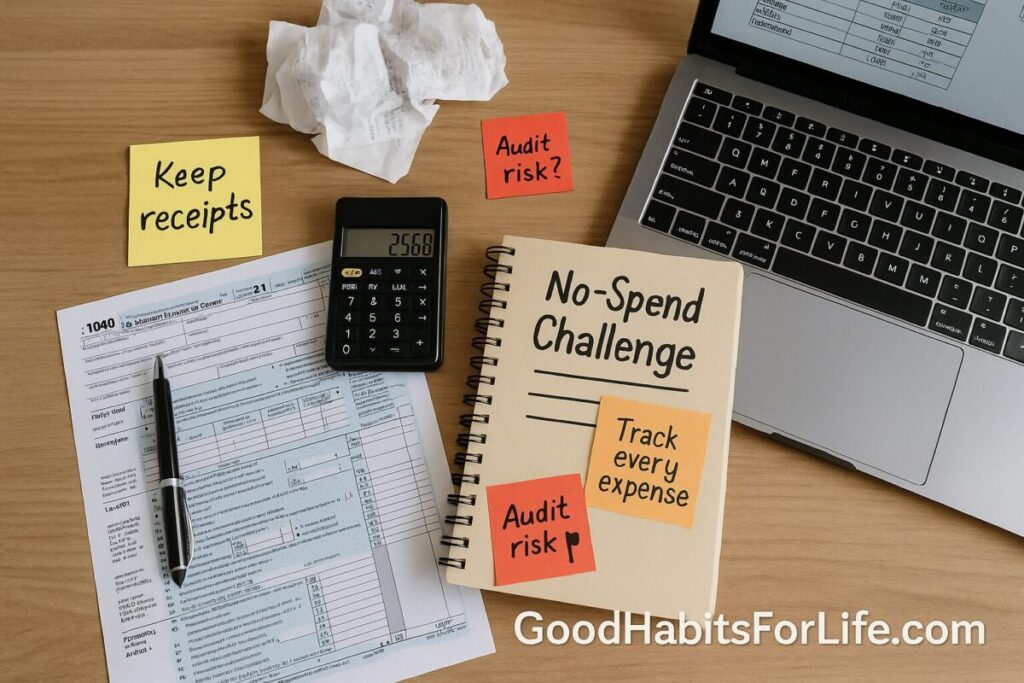
Audit Red Flags: Common Mistakes to Avoid: No-Spend Challenge (2025)
Audit Red Flags: No-Spend Challenge Mistakes (2025)
Table of Contents
🧭 What “Audit Red Flags” Are (and Why They Matter)
Tax authorities (e.g., the IRS in the U.S., HMRC in the UK, and the ATO in Australia) use automated screening plus human review to spot returns that may be inaccurate. Selection can be random, but patterns—like mismatched income reports or deductions that look disproportionate—raise the odds your return is examined. An audit doesn’t mean you did anything wrong; it just means you may be asked to substantiate your claims.
Good Habits angle: The same behaviors that make your No-Spend Challenge work (clear rules, tracking, documentation) also reduce audit risk. You’ll spend less and be ready to substantiate any claims at tax time.
⚙️ Quick Start: Fix the Top 7 Red Flags Today
-
Match all income. Reconcile every 1099/statement to your return (salary, freelance, interest, dividends, platforms, crypto where applicable).
-
Segregate business & personal. Separate bank/credit accounts; store receipts.
-
Home office correctly. Claim only if it meets “regular and exclusive use” and other jurisdiction-specific tests.
-
Charity done right. Donate to qualifying organizations; keep receipts/acknowledgments that meet substantiation rules.
-
Hobby vs business. Don’t claim losses from a hobby to offset other income. Document profit intent if you’re running a real business.
-
Vehicle & travel logs. Keep mileage logs, dates, purpose, and costs. No estimate-from-memory.
-
Keep records for 3–5+ years. Store digitally with searchable filenames; back up.
🗺️ 30-60-90 Day Compliance + No-Spend Plan
Goal: Cut discretionary spending and build savings, while making your return audit-ready.
Days 1–30 (Foundation)
-
No-Spend rules: Define allowed essentials (rent, utilities, groceries, meds, commuting) and banned categories (e.g., takeout, impulse shopping).
-
Automate savings: Move a small fixed amount after each paycheck to savings or debt (commitment device).
-
Set up records:
-
Open/confirm separate business account (if self-employed).
-
Create folders:
Income/,Expenses/,Donations/,Mileage/,HomeOffice/. -
Start daily receipt capture (photo + brief note).
-
-
Baseline logs: Start mileage tracker; note home-office square meters (and % of home area).
Days 31–60 (Tighten)
-
Audit self-check:
-
Compare income statements (payslips, 1099s, platform reports) to your ledger.
-
Review donation receipts for required details.
-
Verify home-office “exclusive use.”
-
-
Boost savings rule: Increase auto-transfer by a small step (e.g., ₹500/$10/£10 more).
-
Optimize categories: Re-allocate any No-Spend savings to emergency fund or debt.
Days 61–90 (Proof & Prep)
-
Quarterly folder review: Rename files consistently (
YYYY-MM-DD_vendor_amount_note). -
Vehicle & travel audit: Ensure logs show dates, purpose, distance, and totals.
-
Close gaps: If a deduction lacks proof, either find it or don’t claim it.
-
Plan sustainers: Keep auto-savings; allow a controlled “spend day” monthly to reduce rebound splurges.
🔍 The Red Flags, Explained (With Examples)
1) Missing or Mismatched Income (High Priority)
-
What happens: Tax agencies cross-match employer, bank, broker, and platform reports against your return.
-
Fix: Keep a year-end checklist; confirm every statement is included before filing.
-
Example: You forgot a small 1099-INT for ₹800/$10 in interest. The mismatch can generate a notice—and sometimes deeper review.
2) Disproportionate Deductions vs Income
-
What happens: Very large deductions relative to income (e.g., business losses year after year) can invite questions.
-
Fix: Claim only what you can substantiate; ensure expenses are ordinary, necessary, and exclusively business-related.
3) Home Office Misuse
-
Rule of thumb (U.S. example): “Regular and exclusive use” and principal place of business tests must be met; employees typically can’t claim this in the U.S. under TCJA (through 2025).
-
Fix: Measure the workspace; document photos/layout; keep expense allocation worksheets.
4) Hobby vs Business Losses
-
What happens: If you’re not truly operating with a profit motive, losses generally can’t offset other income.
-
Fix: Keep business plan, marketing, separate accounts, and profit-seeking evidence.
5) Vehicle & Travel Without Logs
-
What happens: Mileage and travel claims without contemporaneous logs are vulnerable.
-
Fix: Use an app or a simple spreadsheet; note date, destination, purpose, km/mi, and expenses.
6) Charitable Contributions Without Proper Proof
-
What happens: Donations must be to qualifying organizations, with specific receipt language for cash ≥ certain thresholds and all non-cash ≥ certain values.
-
Fix: Keep acknowledgments and valuation records; use the right forms for non-cash items.
7) Cash-Heavy Side Gigs / Tips
-
What happens: Under-reported cash income is a classic trigger.
-
Fix: Deposit cash, record daily totals, and report tips and platform income accurately.
8) Sloppy Record-Keeping
-
What happens: Vague, mixed, or missing records can result in disallowed deductions even if expenses were legitimate.
-
Fix: Follow jurisdiction guidance: keep business records for at least 5 years in AU; in the U.S. keep most records at least 3 years (longer in some cases); the UK requires detailed records for Self Assessment.
👥 Variations: Students, Parents, Professionals, Seniors, Teens
-
Students: Track scholarship/taxable grants; document gig income (tutoring, delivery apps). Keep donation receipts for campus fundraisers that qualify.
-
Parents: Child-related credits require accurate info; for donations of goods, capture photos and fair-market value notes.
-
Professionals/Freelancers: Separate accounts are non-negotiable. Use engagement letters/invoices; keep time logs where relevant.
-
Seniors: Keep clear paperwork for retirement income and charitable gifts (including Qualified Charitable Distributions in some jurisdictions).
-
Teens: First jobs bring first tax forms—save payslips and year-end statements; log any cash earnings.
⚠️ Myths & Mistakes to Avoid
-
“I’m small—no one will notice.” Automated matching flags small mismatches too.
-
“I can estimate mileage later.” Reconstructed logs are weak compared to real-time records.
-
“Any workspace counts as home office.” It must meet your country’s tests; in the U.S., employees generally can’t claim it until at least 2026.
-
“Charity receipts aren’t needed for small amounts.” Keep proof; rules vary by amount and type (cash vs non-cash).
-
“No-Spend means no records.” The challenge is a behavior tool, not a substitute for documentation.
🗣️ Scripts & Templates You Can Copy
-
Email to a charity for acknowledgment
Hello [Charity],
Please confirm my [date/amount] donation, stating whether I received any goods or services in return.
Thanks, [Your Name] -
Note on a receipt (why it’s business)
“Client coffee – project kickoff – 30 min – met with [Name] re: [Project].”
-
Mileage log line
2025-03-04 | 12.8 km (8.0 mi) | Office → Client A → Office | Project review
-
No-Spend rule set (paste into notes app)
Essentials OK: rent, utilities, transport, meds, basic groceries.
Paused: dining out, non-essential shopping, apps, subscriptions.
One weekly review: move leftover cash to savings.
🧰 Tools & Resources
-
Records & logs: Google Drive/OneDrive folders; simple spreadsheet or mileage app; a receipt-scanner app or built-in phone scanner.
-
Budget & saving: Bank auto-transfers; any basic budget sheet; reputable public guidance from consumer-protection agencies.
-
Tax guidance: Use your country’s official sites for definitions, thresholds, and forms (see References).
📌 Key Takeaways
-
Audit selection is partly automated; clean records and accurate matching reduce risk.
-
Biggest pitfalls: unreported income, outsized or poorly documented deductions, hobby losses, sloppy home-office/vehicle claims.
-
A No-Spend Challenge pairs well with compliance: automate saving, define rules, and document everything.
-
Keep records as long as your jurisdiction requires (often 3–5+ years).
-
When unsure, be conservative—or seek a qualified professional.
❓FAQs
1) Does a No-Spend Challenge affect my taxes?
Not directly. It’s a budgeting habit. Indirectly, it helps because you’re tracking spending closely—use that tracking to keep tax-ready records.
2) What’s the easiest way to avoid a mismatch notice?
Reconcile all third-party statements (employers, banks, brokers, platforms) with your return before filing.
3) Can I claim a home-office if I sometimes use the space for personal tasks?
Usually no. Many jurisdictions (e.g., U.S.) require regular and exclusive business use; check your country’s specific rules.
4) I sell crafts occasionally. Is it a business or a hobby?
If there’s no profit motive, it’s likely a hobby—losses generally can’t offset other income. Keep evidence of profit intent if it’s a real business.
5) How long should I keep records?
Guidance varies: AU commonly 5 years; U.S. often 3 years (longer for certain items); UK Self Assessment requires comprehensive record-keeping—see official links below.
6) Do I need special receipts for charitable donations?
Yes—keep acknowledgments that meet your country’s substantiation rules, especially for larger gifts or non-cash donations.
7) Are vehicle expenses safer with the standard mileage rate or actual expenses?
Either can be fine—what matters is substantiation. Keep detailed logs and choose the method you can support.
8) I have cash tips/side-gig cash—how do I handle it?
Deposit regularly, track daily totals, and report accurately.
9) Can frequent losses from my side business get me audited?
Consistent losses—especially without a clear profit motive—can draw scrutiny. Document your business plan and path to profitability.
10) What if I receive an audit letter?
Read it carefully, respond by the deadline, and provide the requested documentation. You can often handle simple correspondence audits by mail.
📚 References
-
IRS — Audits (overview & how you’re selected/conducted): https://www.irs.gov/businesses/small-businesses-self-employed/irs-audits IRS
-
IRS — The Examination Process (official brochure): https://www.irs.gov/pub/irs-access/p3498_accessible.pdf IRS
-
IRS — Publication 587/Topic 509 (Business Use of Home): https://www.irs.gov/publications/p587 and https://www.irs.gov/taxtopics/tc509 IRS+1
-
IRS — Hobby vs Business (newsroom guidance): https://www.irs.gov/newsroom/heres-how-to-tell-the-difference-between-a-hobby-and-a-business-for-tax-purposes IRS
-
IRS — Charitable Contributions (Pub 526): https://www.irs.gov/publications/p526 (and PDF) IRS+1
-
GOV.UK — Self-employed record-keeping: https://www.gov.uk/self-employed-records/what-records-to-keep GOV.UK
-
ATO — Record-keeping for small business: https://www.ato.gov.au/other-languages/information-in-other-languages/business/record-keeping-for-small-businesses Australian Taxation Office
-
OECD — Tax Administration 2024 (compliance & data matching): https://www.oecd.org/en/publications/2024/11/tax-administration-2024_5c4606e4.html OECD
-
CFPB — Building an emergency fund (automatic saving): https://www.consumerfinance.gov/an-essential-guide-to-building-an-emergency-fund/ Consumer Finance.gov
-
J-PAL — Commitment Savings (evidence on pre-commitment): https://www.povertyactionlab.org/sites/default/files/publication/Commitment-Savings-Bulletin-5.21.21.pdf J-PAL
Disclaimer
This guide is for general education only and is not tax, legal, or financial advice; consult a qualified professional for your situation.