
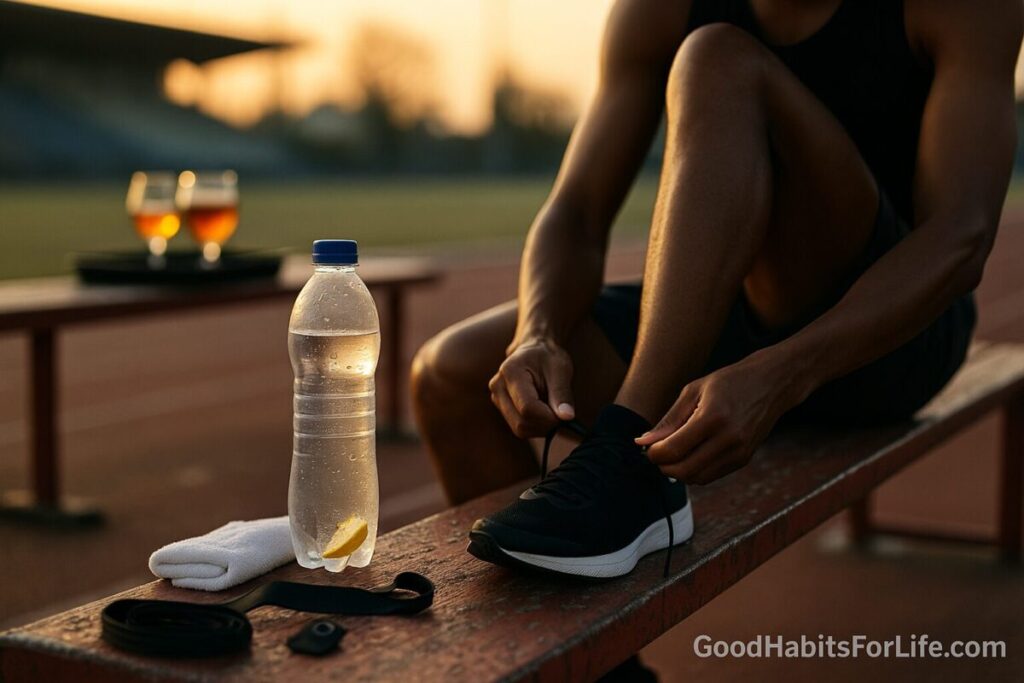
Athletes Who Skip Alcohol: Performance First
Athletes Who Skip Alcohol: Performance First
Table of Contents
🧭 What “alcohol-free for performance” means (and why it works)
Choosing not to drink (or taking long alcohol-free blocks in-season) is a pure performance strategy. It removes a recovery drag (slower muscle repair), a neural drag (slower reaction/coordination), and a sleep drag (less REM, more awakenings). Net effect: better training quality, more green days on the calendar, and fewer “dead” sessions after late nights. Evidence shows alcohol suppresses post-exercise muscle protein synthesis, interferes with hydration and thermoregulation, reduces sleep quality, and impairs psychomotor skills—all directly relevant to sport performance. PLOSNIAAAHarvard HealthCDC
Performance wins you’ll feel:
-
Tighter sessions (steady pacing, cleaner lifts)
-
Fewer soft-tissue niggles and illness dips
-
Morning readiness feels “springy” more often
-
Sharper decision-making in the last 10% of events
✅ Quick Start: Do this today
-
Pick your window: Commit to 30 alcohol-free days starting today (or after your next race if you’re mid-taper).
-
Swap the cue: Replace “post-game drink” with a simple Recovery 4-R ritual: Refuel (1.0–1.2 g/kg carbs + 20–40 g protein), Rehydrate (500–750 mL water + electrolytes), Repair (sleep routine), Relax (non-alcohol social).
-
Stock frictionless options: Alcohol-free beer, soda water + lime, ginger ale, or kombucha at home and in your kit bag.
-
Tell one person: Message a teammate: “I’m trialing alcohol-free for performance for 30 days—hold me to it?”
-
Track readiness: Note RPE, sleep hours, and morning “pop” (subjective). If you use wearables, log HRV/resting HR.
-
Pre-commit scripts: “I’m on a 30-day performance block—grab me a 0.0?” (See Scripts below.)
🧠 Physiology & Evidence: the short science tour
Muscle repair & adaptation. After training, your body ramps up myofibrillar protein synthesis to repair and grow muscle. Alcohol intake reduces this post-exercise response—even when you take protein—making it harder to adapt to training. PLOS
Glycogen refueling. Carbohydrate re-stocking is critical for next-day quality. Alcohol can reduce glycogen storage, mainly by displacing carbs and impairing nutrition choices (indirect effect), which shows up as flat sessions the day after. Physiological Journals
Hydration & cramps. Alcohol suppresses vasopressin, increasing urine output and dehydrating you; hangover symptoms (thirst, fatigue, headache) are classic signs—hardly ideal going into a session or match. NIAAA
Sleep & cognition. Alcohol fragments sleep and suppresses REM, a stage linked to learning, mood, and motor memory—key for skill retention and decision-making under fatigue. Harvard Health
Reaction time & coordination. Even at low BAC (below legal driving limits), alcohol impairs visual tracking, coordination, divided attention, and reaction time—the exact abilities that separate fine from sloppy. CDC
Big-picture health. Global and regional health agencies now emphasize there’s no “safe” level of alcohol for health risk; from a performance lens, that makes extended abstinence the easy hedge. World Health Organization+1
🛠️ 30-60-90 Alcohol-Free Performance Plan
0–30 days: The Clean Slate
-
Aim: Feel the “hidden tax” vanish—better mornings, steadier sessions.
-
Rules: No alcohol; anchor a sleep window (e.g., 23:00–07:00); Recovery 4-R after hard days.
-
Benchmarks:
-
Training: Hit plan ≥90% of scheduled sessions (intensity targets within ±3%).
-
Readiness: More “green” days on wearable OR better self-ratings (≥4/5) ≥5 days/week.
-
Sleep: Average ≥7–9 hours; fewer awakenings (subjective).
-
31–60 days: Performance Build
-
Aim: Turn gains into habit memory.
-
Rules: Keep zero-alcohol; add two quality extras/week (mobility block, technique drills, easy aerobic).
-
Benchmarks:
-
Key session PRs (e.g., interval split smoothness, repeat sprint maintenance, technical consistency).
-
Subjective focus in the final 20% of workouts.
-
61–90 days: Race-Ready or Peak Block
-
Aim: Lock the standard.
-
Rules: Still alcohol-free; rehearse social scripts for end-of-season events; pre-book AF options.
-
Benchmarks: Best-of-cycle performance markers; coach feedback on concentration, decision-making.
After 90 days, either continue alcohol-free or set clear off-season guardrails (e.g., ≤2 standard drinks on ≤1 night/week, never within 48–72 h of key sessions).
🧩 Techniques & Frameworks to make it stick
-
IF-THEN planning: “If we hit a pub post-match, then I order 0.0 beer + salty snacks.”
-
Habit stacking: Place AF options with recovery shake in your kit—cue proximity wins.
-
Identity cue: “I’m an athlete who chooses performance first.”
-
Environment design: Default your fridge to AF beverages; move alcohol out of sight or out of home.
-
Team contract (optional): During crucial blocks, agree no alcohol 72 hours before/after key sessions.
-
Sleep shield: Keep a consistent pre-sleep routine; alcohol-free plus blue-light dimming raises sleep quality.
🧭 Variations by sport & life stage
Endurance (running, cycling, tri): Hydration and glycogen rule. Avoid alcohol 48 h pre-long run/ride; protect REM on back-to-back days.
Strength/power (sprints, lifts, jumps): Muscle-protein synthesis is the adaptation engine; alcohol-free especially near heavy or eccentric blocks. PLOS
Team field/court sports: Decision density + reaction time make even “just a couple” costly during congested fixtures. CDC
Students: Dorm culture is a trap—use AF social swaps and buddy systems; NCAA resources are designed for you. NCAA
Masters (40+): Sleep resilience declines with age; alcohol’s sleep hit hurts more—protect REM and morning HRV. Harvard Health
⚠️ Mistakes & Myths to avoid
-
“I’ll just drink after the game—no harm.” Post-exercise is when recovery machinery is most active; alcohol blunts it. PLOS
-
“Beer rehydrates.” Alcohol is a diuretic; use water + electrolytes or low-alcohol/0.0 alternatives. NIAAA
-
“Red wine helps the heart.” Population evidence trends away from health benefits; performance still loses. World Health Organization
-
“One night doesn’t matter.” Sleep fragmentation and next-day coordination drops can flip a tight session. Harvard HealthCDC
💬 Real-Life Examples & Scripts
-
Post-race team dinner: “I’m on a block—0.0 for me. Can we add a pitcher of soda water for the table?”
-
House party: “Designated driver tonight—I’ll bring AF options.”
-
Curious teammate: “I noticed better sleep and sharper footwork alcohol-free. Trying it through this training phase.”
-
Coach conversation: “If we set a 72-hour no-alcohol window around A-sessions, we’ll protect adaptation and sleep.”
🧰 Tools & Resources
-
Tracking: TrainingPeaks, Garmin Connect, Strava notes—log alcohol-free days alongside RPE/HRV.
-
Quit-less apps: I Am Sober, Reframe, Sunnyside, or a simple habit tracker (free).
-
Education: NCAA Sport Science Institute substance-use fact sheets (student-athletes & staff). NCAA
-
Sleep: Harvard Health sleep hygiene primer (actionable basics). Harvard Health
-
Nutrition: Carbs + protein timing guides from sports dietitians’ associations.
🔑 Key Takeaways
-
Zero alcohol during build/peak blocks removes three drags at once: repair, sleep, coordination. PLOSHarvard HealthCDC
-
Hydration and glycogen recovery are cleaner without alcohol; next-day sessions feel noticeably better. NIAAAPhysiological Journals
-
A 30-60-90 plan, plus simple scripts and AF swaps, makes alcohol-free living easy and social.
❓ FAQs
1) Will one drink ruin my gains?
One drink is unlikely to erase progress, but alcohol’s dose-dependent effects on sleep, hydration, and psychomotor function start below legal BAC limits—so around key sessions, the safest performance call is zero. CDC
2) How long after training should I avoid alcohol?
If performance is the priority, avoid alcohol for the rest of the day after hard sessions and for 48–72 hours around A-sessions/competitions to protect repair and sleep.
3) Does non-alcoholic beer help recovery?
0.0% options can be hydrating and social; check carbs and sodium. They avoid alcohol’s diuretic and sleep effects.
4) Is there any health-protective level of alcohol?
Major agencies increasingly state no amount is “safe” for health; for athletes, the performance trade-off tips the balance toward abstinence—especially in-season. World Health Organization+1
5) What about glycogen if I eat well?
Good carbs still help, but several studies indicate alcohol can reduce glycogen storage (via displaced carbs/indirect effects). Don’t let drinks displace your refueling. Physiological Journals
6) Is it different for endurance vs strength?
Endurance athletes notice hydration/sleep hits; strength/power athletes risk blunted MPS after heavy or eccentric work. Both lose. PLOS
7) I’m a student-athlete—any tailored guidance?
Yes—NCAA resources address alcohol norms, team culture, and safer choices. Share them with your squad. NCAA
8) If I quit alcohol, will sleep improve right away?
Many athletes report better continuity within days; REM rebounds as your system stabilizes. Keep a consistent sleep routine. Harvard Health
📚 References
-
Parr EB et al. Alcohol ingestion impairs maximal post-exercise rates of myofibrillar protein synthesis. PLOS ONE (2014). https://journals.plos.org/plosone/article?id=10.1371/journal.pone.0088384 PLOS
-
Burke LM et al. Effect of alcohol intake on muscle glycogen storage after exercise. J Appl Physiol (2003). https://journals.physiology.org/doi/10.1152/japplphysiol.00115.2003 Physiological Journals
-
CDC. Impaired Driving—About BAC & impairment starts at lower levels. https://www.cdc.gov/impaired-driving/about/index.html CDC
-
NIAAA (NIH). Hangovers—vasopressin suppression & dehydration. https://www.niaaa.nih.gov/publications/brochures-and-fact-sheets/hangovers NIAAA
-
Harvard Health. Sleep hygiene: Avoid alcohol; reduces REM. https://www.health.harvard.edu/staying-healthy/sleep-hygiene-simple-practices-for-better-rest Harvard Health
-
WHO. Alcohol—Fact sheet (2024). https://www.who.int/news-room/fact-sheets/detail/alcohol World Health Organization
-
WHO/Europe. No level of alcohol consumption is safe for our health (2023). https://www.who.int/europe/news/item/04-01-2023-no-level-of-alcohol-consumption-is-safe-for-our-health World Health Organization
-
ACSM. Alcohol Consumption and Exercise Performance (2022). https://acsm.org/alcohol-and-exercise-performance/ ACSM
-
NCAA Sport Science Institute. Preventing Alcohol and Other Drug Use in Student-Athletes (fact sheet). https://ncaaorg.s3.amazonaws.com/ssi/substance/SSI_SubstanceUseFactSheet.pdf NCAA
-
Vella LD, Cameron-Smith D. Alcohol, Athletic Performance and Recovery (review). Sports Med (2010). https://pmc.ncbi.nlm.nih.gov/articles/PMC3257708/ PMC
Disclaimer: This article is educational and not a substitute for personalized medical advice; consult a qualified professional for your specific situation.